Tag: efficiency

  • Enough / Efficiency

    In the 1930s, John Maynard Keynes predicted that advances in technology would increase productivity to a level that we would only need to work 15 hours a week. I wonder what he’d have to say about 996. It’s also ironic that despite  the amount of time that technology has helped us save  – Google Search, Facebook for easily connecting with an extended social network, Amazon Prime delivery and a host of other companies that deliver not just products but services as well – we still have a time deficit! I am generalising, if you have proven Keynes right, congratulations. But for the rest of us, what happened?

    A couple of reasons are obvious. One – the ease that technology brought into our lives has also made us spend more time on it, thereby negating the saving. Two – this time spend has also exposed us to more stimuli that makes us want more. The second reason, by extension, has gotten us hitched on to a never-ending ride – efficiency for its own sake(more…)

  • Re: Org

    Timehop, which takes me on a nostalgia trip everyday, reminded me recently that it has been a year since I wrote The Change Imperative. The opening slide features a quote – “If you don’t like change, you’re going to like irrelevance even less“- attributed to Gen. Eric Shinseki. In the times we work in, I believe this cannot be overstated, not just for individuals but for organisations as well. Even as business dynamics force changes on the external manifestation of an organisation – the brand – any organisation that faces a client/consumer will also be forced to adapt its internal structure and practices to suit changing needs.

    For a long while now, I have been ambivalent about processes. I have worked in an era, and in organisations, where processes had a way of getting things done. But in parallel, I have also felt that many a time, processes have a way of forgetting what they were made for. The output overshadows the outcome. Over the last few months, my surmisal has been that, to use a Taleb classification, processes can make an organisation robust, but not anti-fragile. This very informative post by Aaron Dignan of Undercurrent – The Last Re-Org You’ll Ever Do -highlights many ways that organisations have tried to change standard structures and practices, and even suggests a six step path to reorganisation. (more…)

  • Platform Principles

    Though not by design thus far, I have actually been expanding on the 4P (planning to add one more) framework I wrote about in Agile @ Scale. The attempt is to help me navigate the concept of brand in a rapidly changing landscape. The Change Imperative tried to showcase some of the possibilities of these dynamic shifts, and Revisiting Brand Purpose dwelt upon purpose in the framework. This post is on platforms. Though media platforms have been around for a while and have been utilised by brands, and the internet, mobile and different OS can also be treated as platforms, I’m choosing to focus on the brand/ organisation as a platform.

    Thus far, the organisation as a platform has been built to leverage scale for competitive advantage. But technology and open platforms are easily on their way to make scale matter much less. As this post  succinctly states, connections weigh more than efficiency now. So how can the organisation move towards connections?

    My thought process on this was probably started in Social’s Second Chance. Social tools and platforms have brought the brand into full contact with the user and have caused paradigm shifts in not just marketing but across the organisation. This deck makes an insightful point that traditional marketing structures are dialectic in nature while social platforms are dialogic. That explains why brands are using social mostly as media and trying to frack it, despite there being better ways to approach it, even in the context of marketing. Experience > exposure is a lesson yet to be learnt.

    Among other reasons, one of the big factors that are contributing to a resistance in truly embracing social in entirety is a fear – loss of control. This is a great read on designing for the loss of control and my biggest takeout from it is where it quotes from ‘The Power of Pull‘ – “shaping strategies” on the individual, institutional, and societal level.

    I think there’s tremendous scope in rethinking the brand/organisation as a platform. In the bid for competitive advantage through scale and efficiency @ scale, it is possible that the organisation/brand has chosen to see value very myopically – as a transaction. What if the organisation transformed itself around connections – connecting employees to a sense of purpose, partners to the kind of work they’d want to associate with and its own narratives with that of the consumer’s? Of course there’d be transactions involved too, but how about engaging each in a way that understands and works with the unique value in every interaction within the context of a shared purpose?

    (Arguable) I think efficiency lays more stress on methods, but engagement has the potential to focus on principles. Profitability at any cost vs value creation as a means to profitability. The choice might actually make the difference between survival and irrelevance.
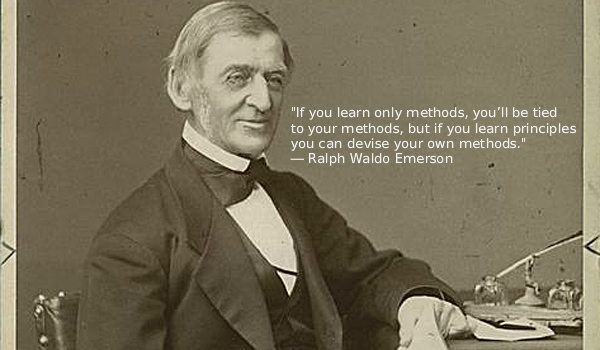
    Emerson

  • Brand agencies redux

    One of the ways to measure brand communication is to view it through the prisms of effectiveness and efficiency. I sometimes get the feeling that with time, mass media became more of an efficiency game. Then social technologies came along and forced the marketer to acknowledge (the forgotten) effectiveness criterion. That would explain the resistance to adoption, since communication strategy would have to change to accommodate it.

    A brand manager would ideally like a balance of both though. Meanwhile, somewhere on planet Quora, I voted up our friend Gautam Ghosh’s answer on ‘influence’. Apparently, an old HBR article (2005) had defined influence as a factor of two aspects – visibility and credibility. Considering that a brand is also aiming for influence, I found the connection between visibility/credibility and efficiency/effectiveness very interesting.

    I think the ROI debates are also a manifestation of seeking efficiency, though very few distinguish between cost and investment (I). The good news is that once tools are developed to address this, (I hope) brand custodians will focus on effectiveness too. I was very happy to read Jason Falls’ post about tools that are beginning to address scale too. (Expion and other social media tools to manage franchisee operations) While these tools would most likely scale themselves to accommodate new platforms and technologies that arise later, the bad news is that effectiveness is still something that can be judged only by someone who understands the brand as well as the platform in question.

    A quick detour. I recently started playing ‘Restaurant City’ just to get a feel of social games, and found Coke doing a pretty decent branding exercise there, that integrated well with the game mechanics and experience. The entire social gaming arena is already exploding. Farmville is passe, and Cityville is king. And that’s just one platform. How does a brand manager keep himself in the loop on all this, and experience enough to have reasonably good perspectives? So the idea of filtering experiences in multiple platforms to get perspectives on effectiveness is something I think only an agency can scale. And the more I think of this, the more I feel that this is the opportunity area for agencies – both communication (PR, Advertising) and media buying. I will state the obvious by saying that this is not likely to happen in their current avatars though. Your thoughts?

    until next time, agents of change
