Tag: Digg

  • Ad Hawks

    I made a mental note not to write back to back to back posts about tools, but I have allowed myself this exemption because though the post is about Digg and Twitter, its equally about advertising/revenue models.

    Last week, Digg announced Digg Ads, their new advertising platform, to be released as a pilot in a few months. Sponsored ads, marked so, will appear as part of the stream, and the twist is that the more the ad is dugg, the lesser the advertiser will have to pay. The idea, of course, is that the more relevant/interesting/entertaining the ads are to the audience, the more it can be seen as content, and the lesser the advertiser pays. I am not a Digg user, though I do have an account, but it does remind me of the thumbs up/down concept on Facebook. I have to wonder if Facebook will now release contextual ads in the stream, and use the same mechanism. And then perhaps move to the ‘everyone gets paid’ mechanism that I had mentioned in an earlier post on recommendations.

    Meanwhile, on to twitter, the two business models that i read about a few days back were Sponsored Tweets from Izea, (via RWW), to be launched in a month or so; and Super Chirp (via Tech Crunch) that’s already live. Versions of these concepts already exist in the market – Magpie and Twitpub respectively. As per the Adweek article, “Sponsored Tweets .. will offer Twitter users the option of sending their followers messages about brands and products. Twitterers will get paid based either on the number of clicks they receive or on a flat fee per Tweet.” Izea plans to capitalise on the “built in viral appeal” of Twitter and the sponsored tweets will carry a #spon hashtag. #spon is bound to spawn spam and let’s just say I expect to see #spon trending ๐Ÿ˜‰ Super Chirp is a totally differentย  concept. As per the site, the mechanism is fairly simple – Super Chirp allows you to “chirp” via direct message to people who pay to “subscribe” to you. If you are a publisher, you can make use of your existing Twitter account, you set the monthly price for your content, users subscribe to your content on the Super Chirp website, pay via Paypal, and then get the messages via DM. Super Chirp keeps 30% and you keep the rest. Its obviously a concept worth checking out for celebrities, and those who can give timely, essential info like say, stock tips. Judging by the way people pay for the Rs.30/month VAS items on mobile, I’m sure this can be put to good use. And while the micropayment concept for news has been dissed, I wonder if some news service provider would experiment with this. And why just news providers,ย  if i were live tweeting from events – ranging from WWDC to the Mumbai blasts, this could at least pay for coffee ๐Ÿ™‚

    Sponsored Tweets is ‘push’, but the publisher uses his pull among the crowd. Interesting that an advertiser might get negative vibes because of the publisher’s greed. Digg Ads is ‘push’ but rewarding the advertiser if he makes a favourable impression on the crowd.ย  Super Chirp is ‘pull’ and it’ll be interesting to see how the publishers fare. Of the three, Sponsored Tweets is closest to the advertising we see in traditional media today.ย  Digg Ads lend some democracy and forces advertisers to be interesting and non intrusive. A step ahead of the Google Ad Sense model, I’d venture. Super Chirp is more publisher driven, it is like starting from scratch, building an audience based on absolute value delivered – I like the content, I pay for it. Though i hope they have some system for preventing RTs (which would render the subscription model useless) I like the path, like Umair Haque says in this awesome post, “Today, viral economies pass links and messages from person to person. What will they pass tomorrow โ€” cars, jobs, houses?”

    In all of this, even Sponsored Tweets because I trust the system to correct ‘evil’, what made me take notice and be a bit happy was that we were moving away from an inventory based advertising set up of fixed time/ad space – pushing advertising, towards creating more value for everyone concerned by involving the end consumer in the process. In many views, I see them as different versions of content marketing. Whether we are seeing a new advertising model, is something time will answer. No, not the magazine silly!! ๐Ÿ˜‰

    until next time, add sense ๐Ÿ™‚

  • More delicious stuff on the horizon?

    Social Median has been a pending site in my things-to-do list for such a long time that guilt no longer describes the feeling enough ๐Ÿ™

    I’ve liked the concept of the site a lot, and while I’ve been following developments there, and have added the bookmarklet to the browser, and though I’ve started several groups (example) I’ve just not managed to become a regular user. The SM bookmarklet has been idle. But more importantly, while the site sends me updates every single day, I rarely manage more than a cursory look at the shared items.

    Why am I so bothered about my non usage? To put it as simply as possibly – it brings together the link sharing capabilities of Delicious, the voting of Digg, topic based groups in which you can add sources and stories get pulled automatically, commenting on shared stories, ranking keywords and topics, and most importantly uses collaborative filtering through people with similar interests to serve you content you should read. A compelling proposition and I don’t have a logical explanation for my non usage.

    So, what’s the context? A few days back, I got a mail stating that Social Median has implemented Facebook Connect, and I feel that’s really big news. It essentially means that you can sign up for Social Median with your Facebook account and share the stuff with your Facebook contacts!! While I do admit that the newsfeed is a complete mess after the redesign, I’m also looking at the enormous data of user preferences that Facebook will now gain, and how Facebook can leverage itself as a news sharing source much more now. In future, this could reveal tons of data on news consumption patterns and interests. Facebook Connect’s importance is something I’ve been stressing on for quite sometime now, and this strengthens that thought. I wonder what this does to Digg’s Facebook Connect plans though.

    Another ‘link’ based service – Google Reader (okay, feed based), one which I use a lot,ย  has also done a small tweaking and added a commenting feature, though its utility The debate on that is still on. There is a feeling that it will become the place of conversation and take comments away from the source (blog/site). Also, as The Inquisitr mentions rightly, the implementation is quite clunky, and if a full feed is published it takes away most of the reasons for the reader to visit the site. I hope that at least a plugin similar to the Friendfeed one (where the conversation is synicated back to the original source) will be developed soon, but since there’s been no API release, they’d have to do it themselves. Doubtful.

    Friendfeed has been around for sometime now, and though its a perfect place to have threaded conversations based on links shared from practically anywhere on the social web, it is still deemed to be a geek service. I wonder if a tags feature to categorise all imported data makes sense. Speaking of Friendfeed, I also read about a new service launched recently called Streamy. According to TechCrunch, “Streamy is a personalized news service and social network that combines elements of Google Reader with FriendFeed.” Streamy does boast of an extremely good interface and suggests interesting stories to you, which you can then share with friends on supporting networks from Streamy itself. And its implementing Facebook Connect. So, a package with potential. (RWW has a comprehensive post on the service)

    Now the social bookmarking service I use regularly is Delicious, though its via the browser add on, and its been ages since I visited the site. But while they were one of the pioneers of social bookmarking, they really haven’t developed further. They could easily build conversations around the links shared by different people, make it easier to create communities around topics of interest – all the stuff that Social Median is doing, and definitely make it easier to share the links on say, Twitter – the reverse traffic of Twitticious, like what Krumlr is doing. I think enabling BOSS to pull stuff (history and top tags) from Delicious is a good step in the right direction. I have just started using a Firefox plugin called tweecious. What it does is go through your tweets, find those with links and post them to your delicious account. Pretty neat, though it would help if it gave me more control over what data needs to be transferred to delicious. (eg: I tweet a lot of posts from my blog,ย  and perhaps some topical news from news sites, I wouldn’t want that on delicious, so a feature to ignore links from a particular domain?)

    Reports indicate that Twine, another service which i have not used much, (despite L Bhat sending me an invite and taking pains to explain it ๐Ÿ™ ) could soon challenge Delicious, in terms of unique visitors, and with the kind of work it seems to be doing in the semantic web space, would easily become a more useful tool. I also got a mail a few days back announcing a Twine bookmarklet, with which you add content to Twine as well as tweet it to Twitter!!

    until next time, linking in

    PS. While on links, check out the following too

    BackTweets, a very useful resource to see who’s tweeted links to a site

    OneRiot, a new Twitter search engine which shows the links shared on a particular keyword (instead of tweets)

    Twazzup – another Twitter search engine which shows the regular search results as well as trends , popular tweets and links, with more visual appeal

    Fleck, a social bookmarking service, which has a bookmarklet for FF and IE, it also allows you to import bookmarks from browsers and delicious, and gives you the option to share links on twitter

    ambiently, which calls itself the web’s first discovery engine.ย  – it’s a search mechanism with a bookmarklet, which you can add to your browser. Now, when you’re on a particular page, and you click the bookmarklet, it opens up an ambient page that lists web links related to the page you’re currently in.

    PPS. The post feels a bit incomplete without Digg. Since I’m not a regular user of the service, I have not attempted to draw comparisons. However I do know that the latest on that front is the Diggbar. You can catch the action here.

  • Virtual Fourth Estate

    A few articles that have to do with newspapers caught my attention in the last couple of weeks. One was the fact that Instablogs, is doing something I desperately wished it would do – opening the network for external blogs. I personally consider Instablogs a good benchmark for what online news sources should be,ย  going forward. If you haven’t checked out Instablogs yet, now would be about time!!

    The second was an article on whether we need editors anymore. That question would be quite controversial in any case, but it helps when The Guardian asks this. It is quite a compelling read, and makes some telling points, on how editors should evolve in the digital era. I think that it also points to a mindset change in the newsroom and the presentation of news, because the way news is consumed is also changing. “Reporting becomes a process more than a product” and thats a fundamental shift in the way newspapers approach the business. Here’s a great read on the subject. It is sad to see how newspapers, with some of the best resources, are not able to channel it to better use on the internet. This is a perfect example for what I’m trying to say. Now, once you’ve thought about all this, check out Instablogs’ tour. It might explain why I find the site awesome.

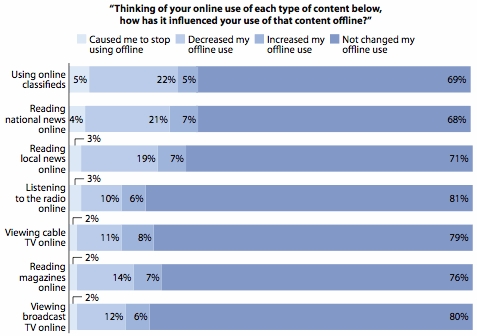
    Why is it important for newspapers to address the digital mindset issue? This data, (via here) though pertaining to the US shows how blogs and the online medium in general is making inroads into what was till now, the newspapers’ domain.

    While, with a 4.5% penetration, newspapers aren’t exactly on a ‘near-death spiral’ in India, I believe it still might be just a matter of ‘when’ rather than ‘if’. Speaking of which, the last article I wanted to discuss was one on WATBlog about Indiatimes’ launch of Hotklix, a Digg like service. Like I commented there, it would’ve been a great way for TOI, ET and all the publications of the Times Group to showcase the loads of content that they possess. How about seeding articles on a daily basis? Where is the integration of the TOI, ET websites with Hotklix, where I can bookmark an article immediately after I read it?

    On an aside, there are traditional news networks doing some pretty cool things on the web. CNN, for example, is allowing users to embed videos in blogs social media etc. No, that’s not a newspaper, I know, but it does come under ‘traditional media’. But even CNN received some flak a couple of weeks back. CNN is present on Twitter, and I happened to see this article, where a few users got pissed off with them for spoiling their Olympic fun. But that doesn’t stop the mashups. Take a look at Dialogg, their collaborative effort with Digg.

    Given that newsprint costs are rising, all over the world, and people are increasingly raising an uproar over cutting down of trees, I think its about time that newspapers took a long hard look at how the digital medium is transforming the content landscape. After all, we even have sanskrit newspapers going online. By digital, I don’t mean just the web, it could be the mobile too. 9.22 million subscribers have been added this month. I would like to compare it with the circulation additions for newspapers. Meanwhile, just read about an effort – MeraMobi, by the Dainik Bhaskar group in association with Pitroda Group LLC.

    Traditional media, especially newspapers, world over, have painstakingly created an equity and trust factor that’s extremely relevant in a transparency and trust led digital era, it would be sad to see it wasted. After all, with increasing global warming fears, newspapers might soon occupy the space that furs occupy now, so it might make sense to hunt for some virtual fourth estate.

    until next time, read….online? ๐Ÿ˜‰

  • Linkin Parks

    I’ve been a fan of del.icio.us for a long time, and was extremely happy with the plug-in they’d made for FF3.ย  Although this offers a perspective of people who don’t bookmark, I’ve found the idea of a taggable, online database that can be shared, extremely valuable, which is why the question of what Del.icio.us 2.0 would offer was an intriguing one. But I was quite disappointed with the url change, to delicious.com . There was something cool about the earlier url, but they have their reasons, as has been well documented by another fan here.

    So what did they say the improvements were? You can hear it right from the horse’s mouth here. To summarise, they have promised speed, a faster and more social search and a new design. Hmm, good, but I think they could have done better, because to me, this is a maintenance job, albeit a good one. As a die-hard fan, I wanted something radical, like Facebook (another favourite) taking the pedal off social networking and putting it on conversation sparking off comparisons to Twitter and Friendfeed. Yes, it has its detractors, and they’d say not many conversations seem to be happening there, but hey, only a small % of my fb friends are on twitter, its early days, and I, for one, am getting responses to my status messages, video uploads etc.

    But meanwhile, more than an FB progression path, this user generated discontent has been sparked off by a couple of entities I happened to come across, each of which could have been the lateral step that Delicious could’ve taken. I’ll start with Social Median. Its an online community where you can share links. So?ย  Well, if you use twitter, you’d realise the number of link sharing that happens there. Well, you can submit news to SM through Twitter. So, in this age of ‘noise’ you get like minded users to do “collaborative filtering to help people with similar interests identify/discover what to read/view.” And it’s not just people you can follow, its topics too. It is packed with features, perhaps thanks to an extremely user feedback based alpha mode. You can vote on the ranking of the keywords, sources that are used to seed the networks and can rank topics based on how important they are to you. In essence, it allows you to customise how frequently you want to read about ‘x’ topic and from ‘y’ media source. You can share the news you add, find through mail, and even twitter. You can also add a bookmarklet to your toolbar and add news to SN as you browse. A short term problem I see is the noise level, since many people would want to be community makers first. But the system will filter it in due course. They’re also planning to use the Google Social Graph API in some pretty advanced ways. While it seems closer to Digg, or Mixx, as a user, to me its fundamentally a collection of links, and shared interests,ย  and that’s Delicious’ premise. Meanwhile, there’s another one with the same idea, though not as feature packed.

    The other site I came across is httpfuse (via pluggd.in). The idea here is to allow the community to build a set of ‘fuses’ (bookmarks/links) around a topic of interest. Their differentiation wrt Digg, Delicious etc is clearly explained here. While I agree with the explanation on Digg, I am not quite convinced on the Delicious part. Maybe I need to explore more. But one thing I’ll grant, and I’ll use an example for this. If I search for ‘India’ in Delicious, I’ll get links bookmarked by other people with all the tags they have used. But when I do the same in httpfuse, it shows me the subtopics under India. And that’s definitely better.ย  I’d like a browser plug-in though, or did I miss it? Again, a focus that Delicious could’ve tried out.

    The last entity, is Browzmi, a browser within a browser. It not only allows real time collaborative browsing and bookmarking, with comments, but also has a chat functionality built in. You can also clip photos from a site you’re visiting, and share only that. All your actions are stored and can be viewed like any lifestreaming service. Unlike say, Yoono, its not an extension, and is actually quite a cute social browser which can be just another tab in your FF/IE browser. This is way lateral, but no harm in imagining. ๐Ÿ™‚

    That said, you are still my first bookmarking love, Delicious. But the competition is getting hotter, andย  you seem very absorbed in a linear way, so please buck up.ย  I really wouldn’t want to see you in this list. You could at least have added image bookmarking, you know.

    Meanwhile,a couple of other things you should check out, Feedly, an FF extension, which brings Google Reader closer to home, er homepage ๐Ÿ˜‰ and this one – iglue, which reminded me of Snap (only reminded, its not the same) and left me very impressed, with its potential.

    until next time, spread some link love