[scribd id=51588962 key=key-14uhqdxytbz79xbq5jae mode=list]
Tag: del.icio.us
-
Brand equity in real time
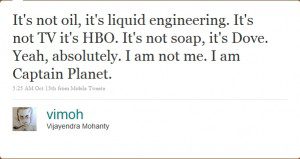
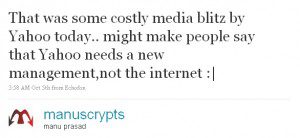
Media Post reports that Yahoo’s latest campaign caused its perception among U.S. adults to fall steeply – apparently, YouGov’s BrandIndex, which tracks daily consumer perception of brands, found that Yahoo’s buzz score had tumbled from 35.4 on Sept. 22 to 25.5 as of Monday. Acknowledging India’s growing significance, the $100 million (global) “It’s Y!ou” campaign was rolled out in India too – y!ou couldn’t have missed the “disruptive” frontpage takeover of multiple mainstream dailies or the TVCs. My views on it were expressed in <140 characters

Before you take me for some kind of Yahoo hater, I’m not. (Actually, I’m quite a fan of the Carol Bartz style of no-nonsense management – typified by the last few lines here) In fact my irritation with them stems from their relative disinterest towards a few tools that were original pathbreakers and that they’ve had for a long time – most importantly ‘delicious’, but I’ve written about that earlier, and some work on that service has happened since. So, anyway, Yahoo, this is not about you, you were simply a prolongued prologue, and a good example.
A couple of weeks back, when writing about Wave, I’d wondered “is brand equity an excuse/surrogate for thin value, and exist only in theory, or until the last good product?” This entire activity above somehow reminded me of that. Brand equity, and the lord knows there’s no shortage of definitions. (ignore the newspaper brand references) So why did I think brand equity is now a surrogate/excuse for thin value?
Every brand that enjoys good equity now must have provided ‘thick value’ at some point of time, to its audience. At some point though, did the ‘brand’ take over, and the focus become more on perception management, rather than as an aid to retaining/attracting customers. Is that the reason why brands in many industries cannot find a way past the disruption they’ve been facing – because they’ve been focused on creating brand equity basis communication and superficial value additions, and sticking way too close to the specifics, like competition, and not bothering about the generic fulfilment of a need?(classic example, newspapers and news delivery) Somewhere did brand and marketing communication start dominating the proceedings, at the cost of the basics – a product solving a need/a distribution that increases convenience/the factor that built the equity in the first place? And then did they shortchange consumers by putting a premium on the brand’s equity without delivering value? While trying to build the emotional connect and create a value perception beyond the commoditisation, did the means become the end?
Take Yahoo for example. By an unfortunate coincidence, last week, GMail replaced Yahoo Mail as the most popular email service in India. I can imagine why. Like many others, I have multiple Gmail ids, and a Yahoo id too. While I open Yahoo because of a couple of e-groups, GMail is my primary communication centre. It has never been static, features and tools have been added to a point where I wonder how I worked without them. (try operating in basic HTML for a while) I checked Yahoo out again, with as fresh a perspective as i could, and didn’t find anything that could make me consider a shift. I still use Delicious a lot, and it still has a lot of equity (in my mind) going for it. Yahoo’s brand campaigns have nothing to do with it.
Maybe the concept of brand equity had some merit when the audience didn’t talk to each other, but as WOM keeps getting bigger, push brand communication is bound to become more meaningless. As consumption patterns change, needs change, distribution systems change, as real-time becomes the norm, and exit barriers and costs for consumers come down, relying on a static and uni dimensional concept of brand equity is bound to be harmful. Also, with fragmenting media, fragmenting audiences, and an increasing importance for ‘my experience’, brand equity will be different things to different people at different times, and even the hazy setof objective measurements in vogue today, would be rendered ineffective. (Yes, it might have been the same before, but in an earlier era, consumers did not talk to each other, and it was easy to push the brand’s equity on to consumers). (Generalising, but) Take a look at the communication and taglines adopted by brands, their superficiality, the efforts that go into forcing the tagline’s emotion/value into the actual value provided, and thereby build/increase brand equity and you’ll see what I mean.

Perhaps, product equity will be the only measure that matters, and brand equity will be earned and burned real time, as consumers share feedback and rely on their trusted sources for updates, and historic performances will decrease in significance. (when the Fail Whale comes out on Twitter, evangelists become bloodhounds, or whatever..you know what I mean) And so perhaps, from a brand perspective, its about time that meaningless communication took a back seat, and we went back to the basics of brand equity, that may mean redefining the roles and responsibilities of everyone associated with ‘brand’ as a function. Because if you’re good, they’ll talk about you, and if you’re bad, they’ll talk more about you 🙂
But you know what, I had more fun when i thought about a parallel. Thought leaders. Replace ‘brand equity’ with ‘thought leaders’ (or personal brand equity) and tell me what you think. 🙂
UPDATE: Yahoo hires a new agency, tells Ogilvy “It’s not Y!ou”.. Damn, that was fast!!
UPDATE 2 Meanwhile, a homepage redesign gives them 9% more page views and 20% more time spent.
until next time, equitable solutions..
Bonus Reads:
Almost unrelated, but an excellent read – Jerry Yang’s Advice in Interesting Times (via @mukund)
-
More delicious stuff on the horizon?
Social Median has been a pending site in my things-to-do list for such a long time that guilt no longer describes the feeling enough 🙁
I’ve liked the concept of the site a lot, and while I’ve been following developments there, and have added the bookmarklet to the browser, and though I’ve started several groups (example) I’ve just not managed to become a regular user. The SM bookmarklet has been idle. But more importantly, while the site sends me updates every single day, I rarely manage more than a cursory look at the shared items.
Why am I so bothered about my non usage? To put it as simply as possibly – it brings together the link sharing capabilities of Delicious, the voting of Digg, topic based groups in which you can add sources and stories get pulled automatically, commenting on shared stories, ranking keywords and topics, and most importantly uses collaborative filtering through people with similar interests to serve you content you should read. A compelling proposition and I don’t have a logical explanation for my non usage.
So, what’s the context? A few days back, I got a mail stating that Social Median has implemented Facebook Connect, and I feel that’s really big news. It essentially means that you can sign up for Social Median with your Facebook account and share the stuff with your Facebook contacts!! While I do admit that the newsfeed is a complete mess after the redesign, I’m also looking at the enormous data of user preferences that Facebook will now gain, and how Facebook can leverage itself as a news sharing source much more now. In future, this could reveal tons of data on news consumption patterns and interests. Facebook Connect’s importance is something I’ve been stressing on for quite sometime now, and this strengthens that thought. I wonder what this does to Digg’s Facebook Connect plans though.
Another ‘link’ based service – Google Reader (okay, feed based), one which I use a lot, has also done a small tweaking and added a commenting feature, though its utility The debate on that is still on. There is a feeling that it will become the place of conversation and take comments away from the source (blog/site). Also, as The Inquisitr mentions rightly, the implementation is quite clunky, and if a full feed is published it takes away most of the reasons for the reader to visit the site. I hope that at least a plugin similar to the Friendfeed one (where the conversation is synicated back to the original source) will be developed soon, but since there’s been no API release, they’d have to do it themselves. Doubtful.
Friendfeed has been around for sometime now, and though its a perfect place to have threaded conversations based on links shared from practically anywhere on the social web, it is still deemed to be a geek service. I wonder if a tags feature to categorise all imported data makes sense. Speaking of Friendfeed, I also read about a new service launched recently called Streamy. According to TechCrunch, “Streamy is a personalized news service and social network that combines elements of Google Reader with FriendFeed.” Streamy does boast of an extremely good interface and suggests interesting stories to you, which you can then share with friends on supporting networks from Streamy itself. And its implementing Facebook Connect. So, a package with potential. (RWW has a comprehensive post on the service)
Now the social bookmarking service I use regularly is Delicious, though its via the browser add on, and its been ages since I visited the site. But while they were one of the pioneers of social bookmarking, they really haven’t developed further. They could easily build conversations around the links shared by different people, make it easier to create communities around topics of interest – all the stuff that Social Median is doing, and definitely make it easier to share the links on say, Twitter – the reverse traffic of Twitticious, like what Krumlr is doing. I think enabling BOSS to pull stuff (history and top tags) from Delicious is a good step in the right direction. I have just started using a Firefox plugin called tweecious. What it does is go through your tweets, find those with links and post them to your delicious account. Pretty neat, though it would help if it gave me more control over what data needs to be transferred to delicious. (eg: I tweet a lot of posts from my blog, and perhaps some topical news from news sites, I wouldn’t want that on delicious, so a feature to ignore links from a particular domain?)
Reports indicate that Twine, another service which i have not used much, (despite L Bhat sending me an invite and taking pains to explain it 🙁 ) could soon challenge Delicious, in terms of unique visitors, and with the kind of work it seems to be doing in the semantic web space, would easily become a more useful tool. I also got a mail a few days back announcing a Twine bookmarklet, with which you add content to Twine as well as tweet it to Twitter!!
until next time, linking in
PS. While on links, check out the following too
BackTweets, a very useful resource to see who’s tweeted links to a site
OneRiot, a new Twitter search engine which shows the links shared on a particular keyword (instead of tweets)
Twazzup – another Twitter search engine which shows the regular search results as well as trends , popular tweets and links, with more visual appeal
Fleck, a social bookmarking service, which has a bookmarklet for FF and IE, it also allows you to import bookmarks from browsers and delicious, and gives you the option to share links on twitter
ambiently, which calls itself the web’s first discovery engine. – it’s a search mechanism with a bookmarklet, which you can add to your browser. Now, when you’re on a particular page, and you click the bookmarklet, it opens up an ambient page that lists web links related to the page you’re currently in.
PPS. The post feels a bit incomplete without Digg. Since I’m not a regular user of the service, I have not attempted to draw comparisons. However I do know that the latest on that front is the Diggbar. You can catch the action here.
-
Don’t shoot the messenger….yet
A few weeks back, I’d written about Yahoo India’s TVC for Search. I was not impressed, because I felt that the ‘need for speed’ in search could easily be portrayed without making fun of a speech impediment. A few days back, I happened to see another TVC, this one for Yahoo Messenger.
To its credit, it does manage to create some suspense with the one eyed character, and you wonder where all this is leading to, especially since there are things that suggest a certain line of thought. The ending, however falls flat when it turns out that there is nothing more than a ‘It pays to know people better’ positioning communication. It plugs the revamped Messenger, with picture, music and video sharing, and friends’ activity updates.
I also read a couple of days back that Yahoo profiles was being evolved into a social network. You can read about more of their plans here. If Yahoo is serious about social networking, then I wonder if Yahoo will link some of its very popular properties, which together could create a formidable entity. A social network that utilises photo sharing flickr communities, the delicious link sharing communities, Messenger, Yahoo Launch for music sharing communities, and upcoming for geographical connect. The potential is enormous since all these are extremely popular in their own right, but yes, a star studded team need not be the best. What do you think?
-
Everybody, Friendfeed, right now!!
In a way, Friendfeed’s latest offering has revolutionised my usage of social media services. My experiments with FF had been limited since Twitter used to give me a fair amount of good conversations on various subjects of interest – from Bollywood to advertising campaigns to social media to social issues. I didn’t see any value that Friendfeed could’ve added, inspite of it being an aggregator of several services i use including blogs, Google Reader, delicious, Linked In, twitter, Google Talk status messages and recently last.fm among others.
With every new service, I’ve needed a catalyst to use the service more. With delicious, it was the toolbar plugin, with Facebook, it was the critical mass of friends to get me in there, and then apps like Scrabulous. With Twitter, it was the browser plugin. I’ve been lax on most services which make me open a separate web page. And that was the case with Friendfeed, Kwippy and Social Median. These three, because they are excellent services which i should ideally have used more. A quick plug for the last two before we move on.
Kwippy, a very neat Indian startup, about whom I’d written about a few months back, has moved on from a ‘twitter like service’ to a great place to have focused discussions. It has an awesome crowd too. But I do wish they’d work on a few things I had mentioned in the earlier post. Critical since information overload is bound to cause a consolidation soon. Social Median, with whom i was very impressed, and had written about sometime back, is a great filtering service that connects you to people and topics, by sharing links that interests you, and then have conversations around them. You can also create customised news networks on topics you’re interested in and then add sources. It is well connected with other networks and even has a toolbar plugin that allows easy sharing of links. In a sense, it works better than FF on many fronts.
And so, back to the catalyst. Last week, FF added a new feature – real time updates. What it does is that it helps me get instant reactions to the things I have shared via various other services. It can be anything from a comment to a blog post to a photo to a tweet to a Google Reader shared item. One small snag i see in the real time interface is the lack of bundling that the standard view of FF provides. It could mean I miss out comments and end up replying to them much later. I also have issues with my Google Reader shared items since they aren’t reflecting on ‘real time’. And lastly, why can’t I include my Facebook statuses??!!
A look at how all this affects my usage of other services. Twitter Search has real time updates for specific queries, and as Louis Gray points out about FF, “the team hasn’t yet connected its capability to search or keyword filtering, which, if ever delivered, could be a body blow to Twitter search.” (via The Inquisitr). Now, when i see a friend’s tweet on FF and decide to comment on it on FF, i am given an option to also send an @reply to twitter. How about pulling all the @manuscrypts tweets live for me on FF and giving me the same option?
My usage of Google Reader as a sharing device was limited. I have noticed that with real time FF, that has increased. I am sure that will also influence the posts I do here. Meanwhile, I can use FF to share links, with a comment. I can also choose the room I want to share it in. What does this mean to Delicious and Social Median, especially if FF can bring the easy search (and tags) features of delicious and the functionality and interface of rooms is jazzed up to the levels of Social Median?
With conversations happening everywhere, the need for aggregators will only increase, and whatever be your take on noise (there’s a great note here) a service like Friendfeed can only help. It’d be interesting to see the other services’ reactions to real time.
until next time, when there’s information overload, a friend in need…..