
Tag: Delhi

  • The Last Mughal: The Fall of a Dynasty, Delhi, 1857

    William Dalrymple

    Once, during a trip to Delhi, seeing the way history seemed to come ‘alive’ in the old city at various corners, I asked my friend whether anyone had tracked what had happened to the descendants of the Mughals, and how they saw their legacy . In this book, William Dalrymple does shed some light on it, though a sad one. More than the last Mughal emperor, the book belongs to the First War of Indian Independence to which he was unwittingly bound. Bahadur Shah 2 or Bahadur Shah Zafar as we were taught in history classes, born in 1775, whose pen name meant ‘Victory’, and was depicted as the face of the revolution that almost threw out the British. A hapless man who was pulled by a desire to ensure that he did justice to his legacy, when all he wanted to do was write his poetry and live in the company of like-minded souls. A spiritual man who was even considered a sufi saint, and still is, at his grave in Rangoon.

    It is now history, but at some point it was the life lived by people like us. 1857 seems like tangible history, an era that can still be felt by its influence, even if minimal. Using records from all kinds of people – common men and chroniclers across Indian and British nationalities, the author creates a vivid portrait of Delhi, before, during, and after the uprising. Characters such as Ghalib sometimes add philosophical layers to this narration, and help us understand the cultural high point that was regained in Zafar’s court. It also shows Zafar as a normal human being of his era – with his own superstitions and insecurities, a subject of court intrigue courtesy his wife Zinat Mahal, his son Mirza Mughaal, Hakim Ahsanullah Khan, General Bakht Khan and others, despite being hailed as Padshah, the Lord of the World.

    The book also makes a point to showcase the relationship between religious communities before the event, and as the author reinforces many a time, Zafar deserves quite some credit in understanding the fabric that held his city together and maintaining the harmony there. He also points out that the real reason for the uprising was not political, but religious. What started as a fight between Hindu sepoys and the British ended as a fight between a rebel force that was made mostly of Muslim jehadis and British mercenaries made of Sikh, Muslim Punjabi, and Pathans. And it was a war that could have gone wither way.

    Late in the book, there is also a mention of a royal survivor – Zafar Sultan, Zafar’s brother’s son, who refused government pension, and made his living with a brick cart. Once, many years later, in his old age, he was abused and beaten up by a businessman. After quietly taking the first few blows, he hit the businessman hard enough to break his nose. He told the court that sixty years earlier, the man’s forefathers would have been his slaves and that he had not forgotten his lineage. Dressed in dirty suits, made to get up and salaam the British (when he used to consider it an insult for anyone to sit in his presence), and verbally abused regularly, Zafar himself was the recipient of several injustices at the hands of the British, who did not even give any consideration for his old age after they ‘captured’ him.

    What remains with me, and this is something I went back to, almost every time I picked up the book to continue, is the photo of Zafar, lying with his face to the camera – the face of a broken old man who through his life saw the dominion of his ancestors taken away from him until all he had was his city and an empty title, who had just been made to undergo a trial and many humiliations before it, eyes expressing melancholy, and resigned to his destiny.
  • NH8

    This review was first published in Bangalore Mirror, and you are permitted to read further only if you promise not to LOL, because this happens to be a veg restaurant! Gasp! Those of my meat eating friends whose ribs aren’t being tickled and who can empathise, don’t worry, I compensated by refusing to meet vegetarians and following a meat-only diet during the rest of the weekend. 😉

    NH8 is on 80ft Road Indiranagar and this map should tell you how to get there. The Bata showroom above which it is located is a good landmark. While on maps, for the geographically challenged, the map on the restaurant’s signboard outside informs you that the National Highway 8 connects the country’s capital New Delhi with its financial capital Mumbai, and on its way passes the State capitals Gandhinagar and Jaipur. Ok, geography lesson over, now you can take your eyes off the road and focus on the gastronomic journey.

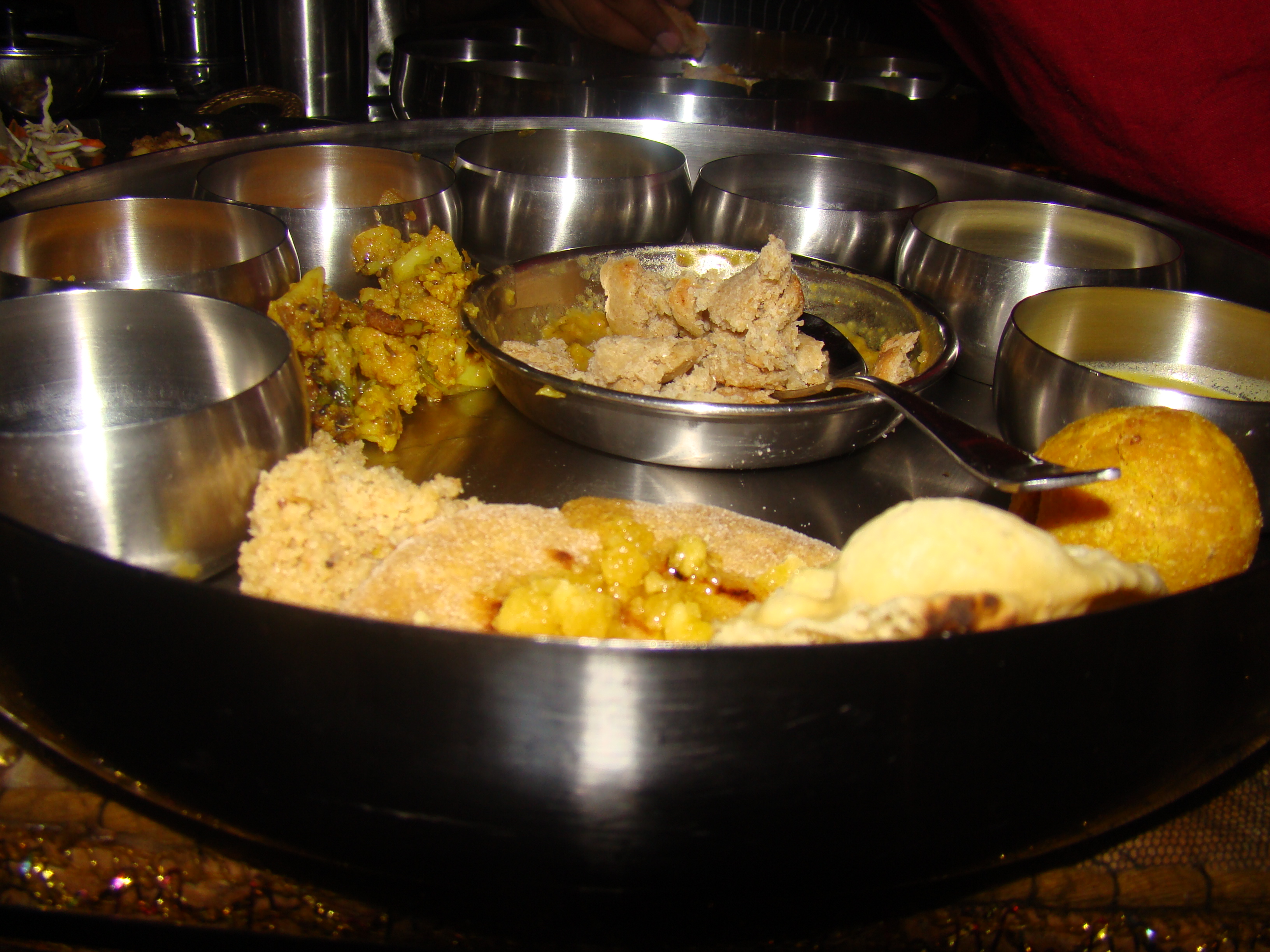
    The idea is to present the cuisine of the different cities traversed by the NH8 highway. The menu is still in the introductory stage, and they plan to add more options soon. For now, what is available is a thali with unlimited refills. From the tiny waiting area outside to the entire decor inside, a good attempt has been made to do justice to the geographical theme of the restaurant. Perhaps the only thing that sticks out is the gigantic TV screen, but then, that seems to be a hygiene item in restaurants now. The seating is of two kinds – low floor and regular, and the cushions are bright and comfortable. The staff also follow the theme with their colourful pagdis.

    The welcoming ‘Padharo Sa’ section with Chaanch and Jaljeera is followed by the savouries (Farsaan) that included the dhokla, Batata vada and Masala Bati among others. The main course (Aarogo Saa, Jeemo Saa, Rice) consists of gravies – dal, gatta, kadi and to go with it Naan, Roti and rice. There’s also a Moong Dal Khichdi and a variety of chutneys. The road ends with desserts in the form of burfi and Lapsi. There are more items on the thali on weekends as compared to weekdays. You can see the menu at Zomato.

    We started with the Paneer Kalimirch Tikka, and the Haryaali Aloo, both of which turned out to be excellent. Despite its companions being fancier, the Batata Vada was also appreciated. But the Khaman Dhokla was spongy enough but very dry. The line bewteen starter and main course is blurred since the items land on your plate at rapid speeds.

    The Dal-Bati was mildly spicy and good enough for multiple helpings. The Gujarati Kadi was sour, sweet and spicy and was much in demand. But clearly, the winner was the Jaipuri Gatta with its rich, thick and spicy gravy. The Gobi Masala turned out to be too spicy and lacking any other flavour. The Marwari Kadi was also too bland, and lacked the sour, tangy flavours associated with it. The Aloo Tamatar Rasawaala didn’t leave any good impressions either. Meanwhile, the Marwari Chaanch keeps you good company throughout the meal. Among the desserts, the Coconut Burfi was the pick of the lot. The Marwadi Lapsi, made of broken wheat, was found to be lapsing, quite a disappointment.

    The high speed delivery mechanism of one dish after another could overwhelm you, but if you let that pass, the service would rate as one of the best you’d have encountered. With smiling faces, they insist on serving you more and more and when you’re finished, pleasantly ask if everything was to your satisfaction. The finishing touch is in the form of the handwash, which moves away from the regular fingerbowl to a person pouring the water for you to wash your hands.

    The thali is priced at Rs.199 on weekdays and Rs.249 on weekends. (Fri-Sun) If you happen to be a vegetarian, this place is obviously worth a visit. Even if you’re not, drop in for a unique experience delivered in a most hospitable manner. The way to a man’s heart is a highway, and that’s not the ghee talking.

    NH8, 710, 3rd Floor, Above Bata Showroom, 80ft Road, Indiranagar, Bangalore – 560008. Ph: 42076575

  • Laa Jawaab

    A recent addition to Indiranagar’s North Indian dine out options, this restaurant is on CMH Road – the non metro side. 🙂 When coming from the Koramangala direction – on 100 ft Road, take a right turn at the CMH Road- 100 ft Road junction, you’ll find the restaurant on the right, opposite ICICI bank, just before Fabindia. Valet parking is available for 4 wheelers and there’s a 2 wheeler parking right across the road.

    The restaurant is on the first floor, describes itself as ‘swaad ka khazana’, and has two sections, one has a regular restaurant seating, and the other is more of a lounge section. (though they don’t seem to have a liquor license yet) We’d reserved in advance, but found it wasn’t required, especially if you land up before 8. There are a couple of nice 2-seat options, which give you a view of CMH Road. The ambience is otherwise pretty ordinary, with piped instrumental hindi music. The menu is shaped like a pankha (fan) and offers standard Delhi/North Indian cuisine.

    There were only the regular shorba options, but quite a few starter options (veg and non veg – including 2-3 sea food options), so we ordered a starter – Gilawati Kabab, which was described as “a unique mouth watering lamb kabab with the distinct flavours of Lucknow”. I liked the way it was served – on a tiny paratha, but the taste was skewed towards one flavor – nutmeg, says D. That took away from what would otherwise have been quite a good dish.

    For the main course, we ordered a Paneer Lababdar – “cottage cheese simmered in an onion and tomato gravy”, and a Murgh Methi Malai – “chunks of chicken with fenugreek and cream”, and to go along with that, an onion kulcha, a khaas amritsari kulcha and later, a plain naan. There was an interesting fish dish, (in addition to a couple of regular gravy options) with spinach and mint, but we decided to play safe. The paneer dish was quite ordinary, though spicy, and seemed quite lumpy to me, maybe because I was expecting a uniformly thick gravy. The chicken dish has a creamy white gravy, and an excellent one at that. This one I recommend. The portions are quite large and easily sufficient for two people. Both the kulchas were well done, the Amritsari kulcha is slightly spicy and has a stuffing (potato/onion). The dessert options were the regular suspects, except one – Paan Ice Cream, which I would’ve tried if I wasn’t so stuffed.All of the above cost us just over Rs.850, so its a bit on the expensive side.

    In essence, nothing extraordinary, but if you’re around Indiranagar, and are in the mood for North Indian food, you could check it out.

    Laa Jawaab, #516, 1st Floor, opp ICICI bank, CMH Road, Indiranagar. Ph: 42173232/42183232. [i can’t understand people who communicate their website url just to show a parked domain

  • And that leaves only

    Kolkata. Which is phenomenal by my standards, as though of you who’ve read the previous post might have realised. As for the others, all it takes is one sentence to bring you upto speed- i hate travelling.
    But this year has seen me visiting 3 of the (erstwhile only) 4 metros in the country.
    Mumbai – February – last visited 2006 April, and that was only because i had to get inducted, professionally, that is. Judging by my tenure, fat lot of good it did. I was a frequent Mumbai visitor in the 80’sthough – before the bhai stuff became popular. No, there’s no connection. Shivaji Park was the usual venue, with a bit of Peddar Road and Malabar Hill thrown in. And then i stopped going to school, and that ended the summer vacations.Sigh
    Chennai – August – last visited 1999 or was it 95? Damn, i’m really getting old. 95 is easier to remember because of the 12th Std results and the giant B&W poster of Aishwarya Rai to celebrate it. Yup, its 99 coz i boarded the Corromandel Exp from there for my first Kolkata trip.
    Delhi – September and October – last visited 1993. And a much forgettable trip.
    I dont think I’ll do Kolkata, at least that leaves my tarnished record some chances of redemption 😉
    until next time, traveller’s outlook