
Tag: curation

  • Can media become social enough?

    A few days back, it was reported that Facebook now had a million active advertisers, and that LinkedIn has 3 million company pages. I’ll let that sink in, in case you hadn’t heard. Despite all the social-ness, I realised it’s impossible not to call it media. The wiki definition for media is “tools used to store and deliver information or data” That, for me, is a smartphone now! I also wondered how many media behemoths could boast of a million active advertisers. And that’s when it really struck me how much the traditional media we were used to have been sidelined – yes, they still get advertising revenue, but from a sheer reach perspective. Google, Facebook, YouTube and many more platforms get anywhere between a few million to a few hundred million visitors every day.  To put it all in perspective, TOI – the world’s largest English daily has a readership of over 7 million.

    Media and advertising have had a very intertwined life, unless of course the publication/channel has been on solely a subscription based model. I think the magic of Facebook (and Google, before it) and those that followed is that they have democratised advertising by not just making it something any small business could spend on according to their means, but also giving them the ability to advertise according to contexts – intent, interest, social etc.  Though Google, Facebook etc are still intermediaries, they never flashed their powers, though the latter has begun to, recently. As brands move away from a one-size-fits-all mode of advertising, these platforms give them more options of form and function, and changing the face of advertising. (Google’s exploits are known, here’s a pertinent read on Facebook)

    In such a scenario, what really does a traditional media channel have to offer to its consumers and clients? I’m not saying that they’re all going bankrupt next Sunday, but it’s clear which way the wind is blowing. One way, of course, is to use their brand value, and replicate (and grow) their audience on devices and platforms which better serve advertising interests. They can hone their value offerings by offering various contexts and their combinations – local, social, interests, and so on, and build business models for each. The early movers are already making big deals. But that is the red ocean that everyone is fighting for. How really can a player differentiate?
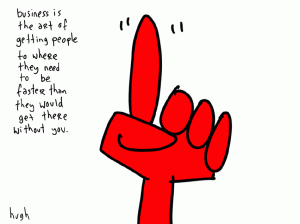
    Biz_Is_The_ArtI had a vague thought. Media’s original strength was its relationship with users and the trust involved. In the social media era, how can that be leveraged? Flipboard has already allowed users to become curators and create their own magazines. Is that the future, along with shared revenue on advertising? What if users can also curate the advertising their ‘subscribers’ can see? After all advertising is also news/information and has a certain value depending on the source. Traditionally, media  has been the middle man between advertisers and users, but what happens when everyone is media? Can media start aggregating influencers in every domain, including niches, provide them the material for curation, negotiate on their behalf to relevant advertisers, and share the revenue? Perhaps the next  disruption will be the platform that can handle the complexities involved. What do you think?

    until next time, mediator

  • Create and curate

    Yay! Instagram launched web profiles, and mine, as you can see, is dominated by food! Which meant that I was completely blown by what Zomato did with the Instagram API at Zomato.xxx. If you haven’t seen it yet, now would be a good time. Try to have a full meal before you take a look. One of the bugs in this version is that it makes people hungry. I don’t see them fixing that bug soon! 😉

    It’s not really an original thought, since I’ve seen at least one fashion brand use hashtags on  Instagram and Twitter to generate photos, but that doesn’t really take away anything, since the execution is extremely good.

    I wrote about the reemergence of branded content last week. One way is to create your own content, the scalability of which is debatable, unless that is one of the organisation’s core competency and priority. The other way is curation. Like I have mentioned on the blog before, curation is a great way for brands to engage with content producers and at the same time, provide  great content to those who consume it. It’s not really creation vs curation, but more of their respective share in the strategy.

    On the execution front, crowdsourcing works best if you make it as easy as possible for the for the content producer. In Zomato’s case, adding a #zomato to the food snaps I load on Instagram is hardly a task. The simpler the task is, and the more it is an add-on behaviour than a new one, the lesser the need for incentive. The cooler it is, the more people would want to be a part of it. It distributes itself.

    In a traditional media dominated era, more money was spent on distribution than creation. Now content is marketing and with owned platforms, and earned and ‘sponsored’ media on social platforms, the costs of distribution have fallen. There’s a lot being written about content strategy for brands from a creation perspective, but the costs of distribution fall even further in curation because content creators would want to show off their work. The hope is that brands will spend at least a part of the money they’re saving, into creating platforms, processes, tools etc that make it easy for the user to create and share ‘branded’ content.

    until next time, co-curation is for later 🙂

  • Social+

    Consumption and curation. At some point I can still remember, I consumed newspapers, magazines and all other mass publishers (across platforms) and expected them to curate for me. Curation for a large mass, when linked to their kind of production process and business model, got tits first whiff of trouble when the internet only models came into the picture. In the early days of content abundance, an algorithm came into our lives and changed the way we found content on the net. A bit later, I was introduced to a different kind of curation courtesy the service then known as del.icio.us.  #youremember I would put Google Reader in the same category too.

    Then came Facebook and Twitter, and RSS died several times if we go by the blog posts. Facebook for me has been and is a social graph. The only way my interest graph has crept in (in terms of content discovery and consumption) is in the form of pop culture. Can that change? I wouldn’t write it off. Twitter started out as an interest graph, but when it scaled, it began flirting with social graphs. For me, it’s now both, and I find that difficult to work with. It’s probably a bit of my laziness too – curating who I follow, making corresponding lists etc erm, not done. Anyway, my discovery and sharing on that network is minimal now. So, in that respect, the curation I expect on these platforms is minimal too.

    Purely by activity, it would seem that I am more active on my interest graph networks now. I wonder if I am alone in not being sure of mixing my interest and social graphs -Delicious, Foursquare, GoodReads., and until recently, (generically) Reader. The curation is by a set of people I trust in that domain, and any ‘social’ that happens remains ‘by the way’.

    Google didn’t even see the social boat IMO, and when they did, it was too far out. Wave, Buzz: crash, silenced. But while writing the WT5 column late last week, I found that Google+ has been creeping in everywhere – search results, news, Reader (I haven’t forgiven you, Google) and building in features like Mutual Circle Chat and search options.  I was thinking about this when I received one of my best sources of curation these days – the weekly Only Dead Fish newsletter (email, how ironic 🙂 ), and that’s where I saw this excellent post titled ‘From destination social to distributed social : why Google+ is the Trojan horse of the social web

    That’s exactly what Google seems to be doing. Unlike Facebook, which built THE social network and then tried to link consumption on other sites in an ‘oh, okay, fine’ way, Google is playing a balance act, and to its strengths. By giving me the tools to build a social network on Google+, and simultaneously being present at my points of consumption, Google is making me play curator to both social and interest graphs. If all goes well, I think Google will not only collect data, but also build several social networks based on interest graphs. Google’s cash cow still doesn’t have much to do with all this, but once the networks are built, Google will have better contexts for AdSense, based on a really smart social algorithm.

    I have always believed that Android is the next Google. Still do, but now I think that Google+ is a contender too. Or maybe the social OS will be built by them together.

    until next time, evil graphs 🙂

    Bonus: A Google Ventures backed app on iPhone named Stamped – very relevant in this context.

  • Brands and Curation

    Content and the need for brands to get into the space of creating it has been a subject discussed here several times. So, when I read about MTV's tumblr voyage, (via) I thought it would serve as a good handle to revisit the subject.

    I thought the choice was platform was in itself a great step. Tumblr, for now, seems completely clued in on how networks, sharing and community work and as MTV notes, is focused on web culture, which can be seen in the way they have designed the service. It also explains why there's nothing new about everyone from media companies to fashion brands hopping on to it.

    Brands as storytellers is also nothing new though new and interesting stories are hard to come by. That's where a crowd can help. Mostly, when brands say they've tried crowdsourcing, it means asking for a caption or a photo or a video that has something to do with their current campaign. There are exceptions like IdeaStorm, Dewmocracy, My Starbuc

    ks Idea etc but that's a small list in the large set of attempts.

    What I liked about MTV's approach was that it is not asking for anything specific. It is establishing a culture of conversation around its domain and with its trademark edgy approach (F*ck yeah!) – internally and externally, making it comfortable for a community to develop. Once that happens generating interesting stories (content) will slowly stop being a constraint. Brands can then chose to play curator, aiding discovery, surfacing interesting ideas, starting a line of thought, and streamlining conversations. And when it feels there's sufficient excitement, scale these up to a larger audience via other distribution channels. Right now, the reverse is how it works – a “come one, come all and quickly contribute to our newly launched endeavour” shout out on traditional media, instead of an organic approach.

    On a different track, this doesn't mean that if the crowd generates everything the agencies will be defunct. On the contrary, and in addition to the implementation, the agencies are probably best suited to play the role of meta curators, moving beyond one way advertising platforms and processes, and using their understanding of the brand to explore new platforms and communication protocols being developed, so that they can advise the brand on every frontier that comes up.

    until next time, tumble along

    Update: Just read that Tumblr hosts more blogs than WordPress now. (via)

    zp8497586rq