Tag: culture

  • The evolution of work and the workplace

    I spent Rajinikanth’s birthday  at Jaipur, all thanks to one of my favourite bloggers – Kavi, who, in his official avatar, invited me to his organisation’s annual HR conference. The theme of the conference was Evolve Connect Enhance, and I can honestly say that many of my perspectives were enhanced during discussions about the real  implications and challenges for organisations, brought about by radical changes in the business environment.

    For now, I’ll let the talk do the talking!  (transcript below the ppt) Do comment with your thoughts!


    Final Talk Points by manuscrypts


    until next time, work it out

  • A culture of innovation

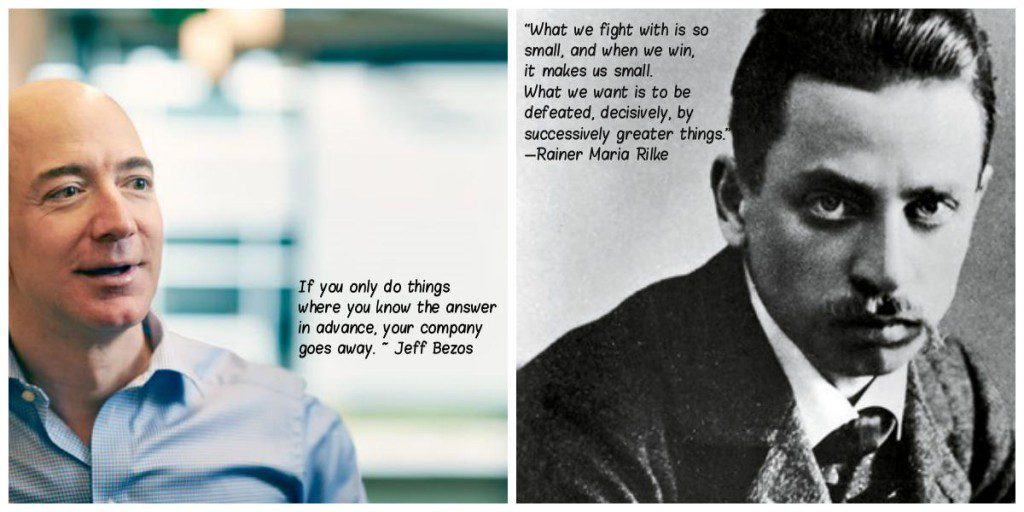
    More than four years ago, I’d written a post juxtaposing product and consumer life cycles wondering how products could evolve, yet be relevant to users at various stages of their usage maturity. Personalisation as a theme has advanced much since then, and web based services are definitely closer to cracking this. I also got a perspective from Jeff Bezos in this post All businesses need to be young forever. If your customer base ages with you, you’re Woolworth’s” though I’d take it with a pinch of context.

    But when disruption is the norm and technologies like 3D Printing and themes like the Collaborative Economy (and others) are poised to have an impact on an increasing number of business models, how does a brand pace its innovation? Branding Strategy Insider asked a relevant question on this premise – Can brands innovate too soon? The post quotes Michael Schrage in providing a good perspective “Your own rate of change is determined less by the quality or price/performance of your offerings than the measurable readiness of your customers and clients … Their inertia matters more than your momentum.

    This post I came across cites a research by Forrester which points out that most innovations remain incremental in impact, rather than being radical innovation..Companies often ‘innovate’ things customers don’t even want. The post suggests a simple cyclical framework of Learn (strategy) – Make (technology) – Test. (design) A more nuanced view (and framework) of innovation can be found at Digital Tonto. Bezos once again has a take on it “We innovate by starting with the customer and working backwards. That becomes the touchstone for how we invent.

    Social technologies provide multiple ways for an organisation to simulate scenarios and structure their innovation pathways in ways that will optimise customer benefits and business objectives. In fact, I believe that the responsive organisation (via) will soon become a strategic imperative. As quoted in that post “If the rate of change on the outside exceeds the rate of change on the inside, the end is near.” I also think that the biggest challenge in this entire movement is a mindset-culture lag. In a sense, all the so-termed disruptions happen because incumbents were not agile enough to adapt to a rapidly changing environment. There is some wonderful learning from the founder of Sonar in this post titled “Postmortem of a Venture-backed Startup” One of may favourites is “Think of culture as a cofounder that is present when you are not.” The thing is, it can work both ways! A cultural mindset to experiment, fail, pick yourself up and work harder, and win is probably what will define the winning institutions of the future.

    collage1

    until next time, “It is not the strongest of the species that survives, nor the most intelligent, but the one most responsive to change.” ~ Charles Darwin

  • Work from….

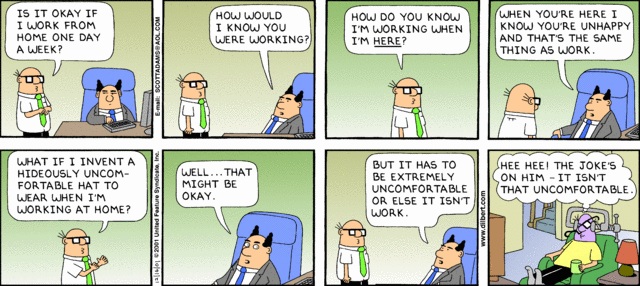
    (image courtesy: Dilbert)

    Sometime back, Marissa Mayer [disclosure: I’m a giggles fan 😉 ] created quite a flutter with her decision to get Yahoos to stop their work-from-home arrangements. This seems a performance linked decision and across the web, you will find various perspectives on it. This mix of perspectives continue on the employee side as well. Working-from-home brings its own set of pros and cons, and one can debate it from both sides.

    As with most everything, there can hardly be a single solution that fits all, and there are various subjective elements on the employee and employer sides that need to be considered. This is especially so in the social era, when corporations will be compelled to align business objectives with a purpose that consumers and employees can identify with, and work cohesively towards.  (more…)

  • Empowerment

    In ‘Is Kindness a Strategy?’, Jeffrey F. Rayport shares the story of an American Airlines employee who ingeniously helped a passenger catch a flight though he was late, by using the express lane for ‘invalid’ guests. He mentions that many colleagues of the employee might not be happy with her way of dealing with the passenger. He also writes about Ritz-Carlton’s use of “service recovery” – a company’s ability to respond quickly, decisively, and effectively to a service problem of its own making — is a powerful way to increase loyalty among existing customers. He rightly draws the distinction between the two approaches – they vary on who’s at fault, the customer or the company, and asks what any business might stand to gain if it oriented its associates to look out aggressively for opportunities to perform true acts of kindness for their customers.

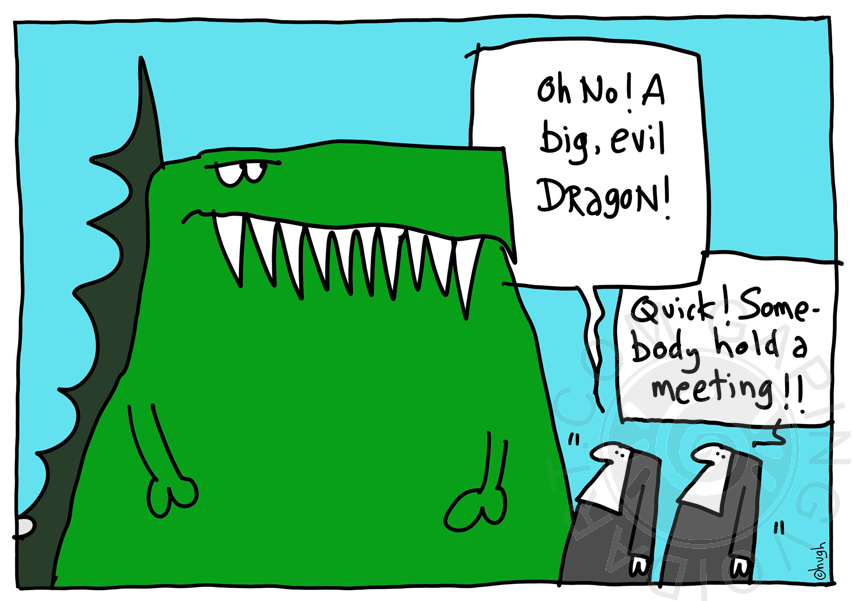
    In my mailbox, a few minutes earlier, I had seen this, in which Hugh MacLeod takes a (what I considered a) legit shot at meetings. As always, the toon says it all. When confronted with a business problem, (generally) the organisation’s first impulse is to meet, discuss, analyse and arrive at a consensus… probably 24 hours later. Yes, even when it involves a real-time platform.

    As I was writing last week’s post on culture, I was asking myself on the ingredients that make up a great organisational culture. Based on the above, I’d say Empowerment. When you have hired a professional to do a job that he has skills in, he/she should be empowered to apply his judgment to situations and not have to go through red tape or meetings involving people with minimal perspective on the matter. The first tenet of Zappos’ famous core values is “Deliver WOW through service”. In the same breath, Tony Hsieh also talks about “investing in a corporate culture that allows employees freedom and space” and follows it up with “If you get the culture right, then most of the other stuff, like great customer service or building a brand will just happen naturally.” On a related note, their unique hiring policy ensures that their sales staff don’t need scripts, they are trusted enough. It also ensures that an excellent culture is built by finding a fit between what makes the individual and the organisation tick. Empowering the employee so that he grows and so does the organisation.

    until next time, power trips

  • Culture.org

    For quite a while, I have believed that culture is the most underestimated and underutilised tool among the organisation’s means of gaining strategic advantage. A few like the much venerated Zappos have used this lapse to maximum effect and by assembling a group of passionate and aligned individuals generated profits and publicity, all while retaining a culture that continues to thrive. Remember “Anyone can do what we do, but nobody can be who we are.”?

    Last week, Maneesh wrote an excellent post titled ‘The Importance of Culture‘ that started off a discussion on twitter involving him, Harish and me. Having experienced a few instances when the influx of money into an organisation (not necessarily a startup) changed the internal landscape completely, I wondered whether scale (that many a time follows money) and culture are usually mutually exclusive. It’s not always so, but it takes not just a very skilled management team, but also an empowered employee bunch down the line to make it happen. It takes communication, rewarding the right behaviour and a lot of clarity to ensure that the culture is not lost. To quote from the post, “Culture is attitude, it is not behaviour. Everyone knows this, but we all get it messed up.

    When he linked professionalism and culture, I smiled because I remembered an incident from a couple of years back. That (very interesting) discussion, which prompted this post, was on whether passion or professionalism could better help the organisation scale. For various reasons, at that time, the two were mutually exclusive in the organisation. I argued for professionalism, because to me, it represented consistency and reliability. We both refused to accept the easy compromise of ‘both are necessary’. Towards the end, the management guru equated a professional to a mercenary. To me, the difference, was in alignment. In that sense, I agree with Maneesh that professionalism is practically non-negotiable. To quote from the post again, “You become a professional when you care. Your culture defines what you care about.

    A couple of days after this discussion, this tweet appeared on my TL

    Posts across years, across industries, across lines of work, but if you read them, you’ll sense the similarity.

    To me, culture is not a fancy set of perks and trappings that money can buy. It’s a sense of belonging, a feeling of being connected to a set of objectives and activities that give the individual a sense of purpose. A sense of enjoying the ride even when it’s a tough one, because you know there are many who will be your parachute in case you fall off a cliff that you didn’t anticipate. When that feeling is lost, the light in the cubicle is switched off. More often than not, permanently.

    until next time, culture counter