Tag: culture

  • Empathy & Monoculture

    Thanks to Shefaly, I saw this excellent video on Aeon about “outrospection.” As opposed to discovering who we are and what we do in this world by looking inwards (introspection), “outrospection” is about discovering it through cognitive empathy – consciously looking to understand the perspectives of others, and going beyond the labels we might have made for them. The idea is that outrospection is the ask of the times we live in, and not introspection.

    I quite disagree with that either-or view, and think both have their place in this era. They both work in tandem. For example, to let go of my prejudices, I’d have to understand why they exist in the first place and then proceed to change my perspective. Here outrospection follows introspection. Once I let go of my biases and listen more objectively, my worldview and my view of myself starts shifting again. In this case, introspection follows outrospection. As Lao Tzu says,

    3f3f3c8752b634128418895a84c26f6b (more…)

  • Processes, People & Culture

    It has been more than three years since I wrote about my Indigo fandom. Since then, they have been my preferred airline, mostly thanks to their on-time promise. A few weeks ago, Karthik wrote an excellent post “Why I love an errant Meru and hate the awesome Indigo!” that offered some unique perspectives based on a few of his recent experiences with the airline. He ends the post with When did the ‘plastic’ nature of Indigo’s customer-facing organization set in? May be around the same time their hostesses were asked to use wigs? It restored a sense of objectivity to my fandom.

    Our way of doing things” is how one definition of culture goes and I remembered Gautam’s recent insightful post on the components that make up ‘culture’ in an organisation. If you look at these factors, you’d wonder whether a cultural change was at the root of Indigo’s new avatar. It made me think of something I wrote earlier – Culture Architecture – the thrust of which  was culture being a strategic business advantage. But how can that be made sustainable? I’ve been a big fan of processes. Indeed, one of my favourite posters is

    626854484bf91ac616669379d9a394fd

    (via)

    (more…)

  • Culture Architecture

    Despite several posts on ‘culture‘, of the four Ps I’d mentioned in the Agile @ Scale post, ‘People’ is a topic that has gotten the least attention here in the recent past. As the change imperative forces organisations to be more responsive to rapidly changing external dynamics, the structures, processes and methods it had adopted for its internal stakeholders will most likely have to change as well. Jobs in earlier era were well defined constructs, but this era requires employees to work far beyond their job description in order to thrive. (“Why We Need to Change the Software in our Organisations“) It is probably not a coincidence that the four organisations that are defining the larger contours of business and technology are also the most favoured employers.

    The task is not easy. On one hand, there is a workforce that is increasingly getting overwhelmed by communication technologies that are dictating an always-on culture. (“Why you hate work.”) On the other hand, there is a new generation entering the workforce that has expectations of a culture tuned to their lifestyle and ways of functioning. They rapidly disengage if they feel this is no happening. In both cases, the end result is a loss in productivity. This is only one part of the story. There are several factors that define culture, and in an organisation, there are several factors that resist change as well.  How does an organisation adapt to these dynamics? A few thoughts, some strategic, some tactical. (more…)

  • Agile @ Scale

    Prelude

    I think I used ‘dis-aggregated social network‘ on this blog for the first time in 2009, referring to Google’s basket of services that were connected relatively flimsily then. IMO, Google has always been that way, even including Google+. (read) I remembered it when I tweeted this about Facebook – around the time news of their Fan Audience Network started trickling in.

    It got me thinking (again) on ‘scale’, a recurring theme here. In a less complicated world, where the trends in the business landscape were significantly more linear, (growth, competition, consumption, economy) scale was a powerful weapon to wield. But it’s a different world now. Artificial Intelligence, 3D Printing, Internet of Things, Wearables  and a hundred other things might completely disrupt the status quo and the need an incumbent brand satisfies. These are the known ones, and then there are the conceptually invisible (at this point) ones. Surviving (let alone thriving) in this shifting scenario requires agility, and it is difficult (though not impossible) to see scale and agility together. I looked to Google and Facebook for an approach towards this because not only are they surviving, they seem to be thriving. Yes, we’ll get to Amazon in a while.

    What does it take to be agile at scale? I can think of four ingredients, the last three repurposed from the title of this post by JP Rangaswami.

    Purpose

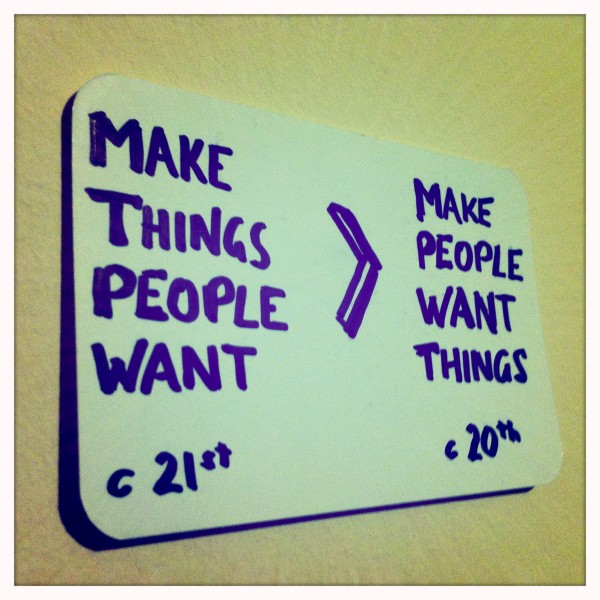
    I remember talking about re-defining of scale at the Dachis Social Business Summit. The thrust of the presentation was that brands could engage consumers at scale only if they use currencies that create value for the user in the context of a shared purpose. I have elaborated it in this post at Medianama. Recently, I saw that Hugh MacLeod has brought it out beautifully here. Simply put

    Make-Things-People-Want-600x600

    (via)

    Possibilities

    The purpose need not have one constant rendition. As the landscape changes, a business will need to adapt it to suit changing circumstances. For that, a business needs to understand the possibilities. I saw a very good line in this post about being a maker – the more you work in the future, the less competition you will have. How much into the future a business needs to be working is subjective and depends on its dynamics, but if it doesn’t disrupt itself, someone else will gladly do it for them. (“The Jeff Bezos School of Long-Term Thinking” is a good read in this context)

    Platforms

    While purpose and possibilities are all good at high altitudes, a business also needs strong operational  platforms to back it up. As organisations scale, I have seen two things that affect agility. One, the processes that are introduced to create efficiency @ scale more often than not, become the goal instead of a means, slowing things down and taking away from actual goals. Two, as processes and manpower increase, silos are created. The good news is that it is easy to see technology platforms bringing more efficiency into processes as well as an iterative way of thinking in the near future. It is already happening in marketing. This, and many other factors are also dictating a consumer experience driven approach and are forcing organisations to break silos. As the entire brand/organisation becomes a platform (read) that regularly revisits its context and purpose in the life of a consumer, ‘everything becomes a node on the network

    People

    HuffPo had a post sometime back, citing Zappos, calling 2014 the year of workplace reinvention. It is interesting to note that parent company Amazon has apparently aped Zappos’ ‘pay to quit’ policy, even as more and more stories about working there being a ‘soul crushing experience‘ are coming out. Meanwhile, the two points it mentioned for this to happen are purpose and trust. These I’d say are the bedrock of culture. It’s intuitive that a workforce mindful of the organisation’s purpose and their role in it would keep an eye out for the business’ possibilities, be ready to work beyond silos towards a great consumer experience, and bring in others who would help the business scale. This, along with purpose, has to be the glue that holds it all together, enabling the organisation to move fast without cracking.

    While different sectors are at disparate distances from a radical shift necessitated by technological developments, it is, I think, inevitable. In this fantastic post titled ‘Knowledge is faster than mortar‘, which looks at scale through a different lens, the author makes the point that ‘the old mechanisms don’t fit the new social structure.Old mechanisms were built to scale stability, new ones will have to be built to scale despite instability. Anti-fragile, so to speak. Indeed, we will see many manifestations as existing structures try to adapt – internal mechanisms like Amazon’s 2 pizza rule, consumer facing disaggregation like Facebook that have a corresponding internal wiring, or brands tweaking their 4Ps even further for different contexts. But whatever paths businesses choose, this will hold true

    responsive-to-change

    until next time, the fast and the curious

  • Social’s second chance

    For context, I believe the first chance was brand/marketing. That potential has pretty much been converted into a banal, mostly campaign oriented, traditional media (with better targeting thanks to various contexts) approach, though thankfully, we have do some rebel strongholds. I can clearly see this within the Big Shift construct – the third wave is about how organisations/institutions respond to knowledge and the flow of information, and what I see now is the typical marketing organisation conveniently converting social into a media framework that it seemingly understands and has worked with for a long while. The big boys – Facebook, Twitter, YouTube – have all created advertising products that cater to this thinking. Viva la broadcast!

    But I’d like to think that all is not lost. Social changed to social media when it approached brand in the same way its media predecessors did. I see this as a phase which will last until social media saturates itself and becomes just another standard media platform. That leads me to think – if each domain (HR, Product) treats social in the same piecemeal way, it is bound to fail across them all.  When this does happen, at least some organisations will realise that a larger structural change is afoot and the institutional response needs to be more strategic. “The Next Social Imperative” made me realise that social has been attempting to work on top of business processes, but it needs to work the other way to even begin this journey. (also, strongly reminded of Tac Anderson’s post in this context back in 2010!) The driver will be market dynamics but the good news for organisations is that many in the existing workforce have the potential to become navigators of this change.

    How does the workforce systemically play a part? Stowe Boyd’s insightful “The Future of Work : 4 trends for 2014” has at least two trends (consumerisation of work and me-isation of productivity and performance) that clearly point to this shift and its harbingers. Consumer technologies (and more so, the philosophy behind them) and a different kind of workflow can actually make an organisation more consumer centric than the silo approach currently followed. Steven Sinofsky’s long but superb post on the theory and manifestation of this paradigm shift is a must read on this subject. A very interesting manifestation of this shift I saw recently is Zappos’ move towards holacracy – a comprehensive ‘operating system’ for organisational governance that focuses on purpose and accountability without a top-down, hierarchical management structure.

    This could be the first step towards ‘social business’, and I’m thinking of social business as a platform. (a fantastic read on platforms) The organisation and its purpose would actually work as a platform to channelise and augment the connection between employees and consumers. This purpose would also convert a job into work than an employee is connected to, and on the other side, it would help the consumer get closer to a brand he believes in. This is also when epics happen. Social (and other) technologies would play enablers for a more fundamental change in the structure and nature of work, and allow organisations to harness data, connections and transactions towards a shared purpose. More a transition than a disruption. Different organisations, I think, would evolve differently – some would not evolve at all. This is more hope than anything else, but I do believe that social technology has it in itself to be transformational, and not just transactional.

    until next time, back to a socialist, communist workforce 😉

    quote-Peter-Drucker-so-much-of-what-we-call-management-108215