Tag: CSR

  • Cause and Effect

    My fandom relationship with the Pepsi Refresh Project has resulted in a few interesting conversations on this blog, this CSR one being the pick. As Surekha's comment says, this is the longest disagreement we've had. ๐Ÿ™‚ย  That being said, I do agree with Surekha's point of sustainability, but my conundrum remains on another front. Aligning social responsibility with existing strategy/processes will make it sustainable and give it context, but would it create a perception that is not fair to its (assumed) good intent?
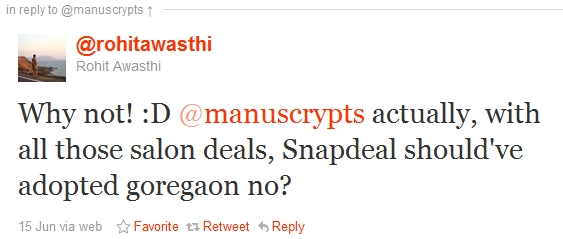
    I was reminded of this last week when the news of Snapdeal's adoption of a village hit Twitter. Snapdeal was trending for 2 days of twitter on account of it. None of the comments on my timeline were flattering. I am guilty of contributing a couple myself, one of which was gamely retweeted by Rohith Awasthi, Head – User & Communities at Snapdeal.com. (as I have said on Twitter on an earlier occasion, the intelligence and maturity he displays when dealing with 'crowds' is something I respect)

    Snapdeal has also written about their intent behind this exercise on their blog, and it is heartening indeed to see that it also happens to be the village that one of their employees belong to, and that the entire idea started there. I also have to wonder why that never made it to the PR machinery. Meanwhile, as their blog says, their commitment is something that time will show. Ef

    ficacy is another thing about which time will have an opinion.

    I thought about this from the perspective of the earlier post – sustainability, alignment with strategy etc. Even if this were a marketing gimmick, I'm fine because the village gains. As Snapdeal says, maybe other companies will follow suit too. Now, if good intent is the only thing at work here, how is it measured with regards to their strategic objectives? As I've repeatedly said, it's the deal that drives my relationship with the brand, anything else is of little consequence, including this effort.

    On the other hand, what if Snapdeal had tied up their CSR with their deals? It could have happened in many ways – a bottom up approach, polling people on what they should do as CSR and taking the story further, or perhaps a commitment based on the number/value of deals sold, or promising a certain part of the revenue towards a CSR initiative (both of which can use a wiki like meter to show transparency), or a matching grant scheme for a cause (you pay Rs.x, we put in an equal amount). All arguably aligned to strategy, helps build community, and can be counted as CSR. But as a user, I wonder if I would then have said they are doing it to increase their deal counter. Note that even for a seemingly unrelated deed like adopting the village, some of the reactions were pretty nasty.

    So, dead if you do, killed if you don't, and that's my conundrum. Am I missing something here? If not, perhaps the only way is to organically grow a community that supports you, communicate clearly with them and show them through actions over time – not just in terms of CSR, but overall strategy as well,ย  that inย  the commitment to a larger cause, you mean business. In a future era, when social business hopefully becomes more mainstream, and people see brands whose purpose ties in with the larger context of their lives, this won't be as difficult as it seems now.

    until next time, cause tick or Groupgaon? ๐Ÿ˜‰

    zp8497586rq
  • Effective Cause

    The Pepsi Refresh project is something I keep bumping into, inside this blog, as well as conversations outside. I admit to a bias towards it, because I somehow sense a sincerity in its approach. Some time back, Surekha shared with me a document on which we debated a bit. From what I’ve been reading, Pepsi hasn’t given (at least clearly) this project a CSR label, so the debate over whether CSR money has been spent well or not is a little pointless. Besides it was more on crowdsourcing CSR .

    But thankfully, the national animal ensured that we continued the debate. Aircel’s ‘Save the Tiger’ has also not been given a label, but it does give a good handle to convey my thoughts on CSR, especially since there are at least a couple of good posts on it already, by L.Bhat and Karthik. Harish’s ‘Branding with a cause‘ is a more general, but very relevant read in this context. Aircel’s high decibel campaign ensured that most of everyone knew there were only 1411 tigers left. If awareness was the objective, as stated, it’s been done, especially since the slacktivist generation has retweeted and facebook-fanned it so much that even the tigers must know now. They haven’t been asked whether they want to be saved in a planet full of us, but that’s a different debate. So is the debate whether Aircel should complete the loop, after all why can’t we? (and maybe there’s another phase anyway) But I digress, and generalise. Sorry.

    Clipboard02

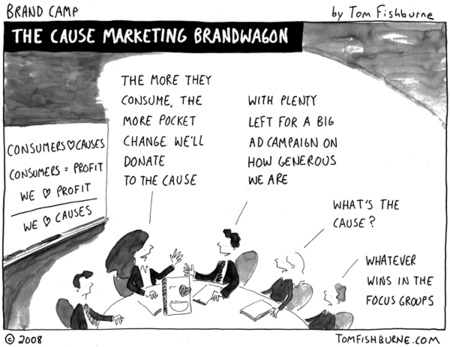
    (Image Courtesy: Tom Fishburne)

    The questions I have are these. Should CSR be related to the business domain or not? Aircel’s was not, but as Surekha rightly pointed out, they chose a topic that would connect with their target audience. My problem with that, though it helps stand out from the clutter in a commodity category, is the lack of context. With Pepsi, though one could say the project has nothing to do with sugared water, there was always a ‘youth’ context, which was established long ago. Now, if it were connected with the business, and it is possible with say, the pepsi project (surekha gave me at least 2 excellent ideas) I would turn around and say, vested interests, and doubt the sincerity of their efforts. ‘The big corporate giving us eyewash’ view. It would also bring in ROI measures etc, which I find hard to associate with CSR. Roshni put it succinctly when she said ‘sort of like proclaiming, hey, we did charity’.

    In trying to find a solution, I remembered a post by Umair Haque on ‘Great to good, which, perhaps unwittingly, made me think of a similarity between social media and CSR. As mentioned in my last post, the piecemeal approach to social media is something I dislike. Its as though it exists stand alone inside a box, I think I have a similar problem with CSR as a label. So, (simplistically put), what if the label were to be taken of and every process was carried out with an inbuilt csr approach – from creating environmentally friendly, sustainable products/projects and choice of partners/vendors to eco friendly packaging and everything in between? Oh yes, practical business considerations. I forgot. ๐Ÿ™‚

    until next time, with great responsibility comes great power?

    Relevant Read: Cause Effect

    PS: JK cement deserves appreciation for its support of an unrelated, but worthy cause – bikinis ๐Ÿ˜‰

    PPS: While on tigers, this one, by my good friend Blues, is a killer read ๐Ÿ˜€

  • Electronic Social Responsibility

    Late last year, I remember reading this article that talked about a study by Havas Media, which “looks at the impact of climate change on business from the point of view of consumer”. From the study,

    With respect to India, the survey claims that 86% of Indians would rather buy from companies that are trying to reduce their contribution to global warming. Further, 50% of Indian respondents would be more likely to buy environmentally-friendly goods in the next 12 months, if they were at the same price and standard as their usual brands. 43% would be willing to pay a little extra for those goods.

    Somebody has been listening, or more likely, had been listening for quite a while, for earlier this month, I read about Nokia India’s efforts though its ‘Take Back’ campaign, which aims to educate consumers about the recycling and re-use of old handsets and accessories. In addition to this contribution, Nokia will also plant a tree for every handset dropped at the recycling bins. I was extremely impressed by Nokia’s official notes on their efforts. As a market leader, Nokia has done a great job.

    Meanwhile, another key player has also been doing its bit for a better planet. I remember writing about Motorola last year – the Motopower project, that has 55 solar powered kiosks in Uganda offering free mobile charging to consumers. Motorola also has its share of recycling efforts, and I found its latest effort – the W233 Renew, very refreshing. This handset is the world’s first mobile phone made with plastics comprised of recycled water bottles., and is also the world’s first Carbonfree cell phone on the market.ย  The site also says that through an alliance with Carbonfund.org, Motorola offsets the energy used to manufacture, distribute and operate of the phone. (through investments in renewable energy sources and reforestation, courtesy Wild Blue Skies) The unfortunate bit, hopefully for now, is that this is not an India phenomenon now. Judging by the Havas Media report, Motorola is missing out on a huge opportunity in India.

    It is indeed good to see genuine efforts from major global players to make the world a better place, sustainable effortsย  because they also make buiness sense, and are not spur-of-the-moment CSR initiatives.There can never be enough efforts, and in an increasingly connected world, which thrives on transparency, there’s nothing like a genuine effort to build on brand equity.

    until next time, (as a Springfield tee says) Respect Green Rules