Tag: crowdsourcing

  • 99tests

    A crowdsourced software testing model that offers on-demand services to software developers and enables testers to build a repu

    tation and be part of a community, that is 99tests. In conversation with founder Praveen Singh.

    [scribd id=58358455 key=key-1hzrrg6tkr0rgr8gsnh7 mode=list]

    zp8497586rq
  • Brands and Curation

    Content and the need for brands to get into the space of creating it has been a subject discussed here several times. So, when I read about MTV's tumblr voyage, (via) I thought it would serve as a good handle to revisit the subject.

    I thought the choice was platform was in itself a great step. Tumblr, for now, seems completely clued in on how networks, sharing and community work and as MTV notes, is focused on web culture, which can be seen in the way they have designed the service. It also explains why there's nothing new about everyone from media companies to fashion brands hopping on to it.

    Brands as storytellers is also nothing new though new and interesting stories are hard to come by. That's where a crowd can help. Mostly, when brands say they've tried crowdsourcing, it means asking for a caption or a photo or a video that has something to do with their current campaign. There are exceptions like IdeaStorm, Dewmocracy, My Starbuc

    ks Idea etc but that's a small list in the large set of attempts.

    What I liked about MTV's approach was that it is not asking for anything specific. It is establishing a culture of conversation around its domain and with its trademark edgy approach (F*ck yeah!) – internally and externally, making it comfortable for a community to develop. Once that happens generating interesting stories (content) will slowly stop being a constraint. Brands can then chose to play curator, aiding discovery, surfacing interesting ideas, starting a line of thought, and streamlining conversations. And when it feels there's sufficient excitement, scale these up to a larger audience via other distribution channels. Right now, the reverse is how it works – a “come one, come all and quickly contribute to our newly launched endeavour” shout out on traditional media, instead of an organic approach.

    On a different track, this doesn't mean that if the crowd generates everything the agencies will be defunct. On the contrary, and in addition to the implementation, the agencies are probably best suited to play the role of meta curators, moving beyond one way advertising platforms and processes, and using their understanding of the brand to explore new platforms and communication protocols being developed, so that they can advise the brand on every frontier that comes up.

    until next time, tumble along

    Update: Just read that Tumblr hosts more blogs than WordPress now. (via)

    zp8497586rq
  • All hands on deck

    Since tis still the season of predictions and ‘looking forward to in 2011’, and because I brought up the subject of brand agencies reshaping themselves for the future, I thought I’d share with you three of my favourite decks of insights from the many that I managed to scan in the last few weeks.

    We’ll begin with JWT’s ‘100 Things to Watch in 2011’. (via Surekha on Reader) While there are many things in this that you might already think is a trend, what I liked about it is its thinking outside of any specific prisms – brands, technology etc, but still managing to capture the  essence of trends in human behaviour, culture, consumption, the shifts happening therein, and thus, a good reckoner for marketers.

    The second one I’d like to share is Edelman’s ‘Digital Trends to Watch in 2011’. Though there are a few commonalities with the JWT deck, this seems more focused. While this is definitely quite a sensible thing to do from a client perspective, I missed the “completely out of the blue, but damn, why didn’t I think of it?” moments that I usually associate with its creators. But that’s just a testament to my high regards for Armano and Rubel, more than anything else. What I liked most about this was the trend + best practice combining, that layering gives excellent perspective.

    The last one I’d like to share is Rohit Bhargava’s ’15 Marketing & Social Trends to watch in 2011′ (via Gauravonomics). There might be some overlap with the other two, but again, the idea of examples with each trend makes it a must-read, in addition to the overall quality of insights.

    While its easy to see that there are commonalities in these, I also noticed an interesting thread of thought that  resonated most with me.

    ‘There’s an app for everything everywhere’ is perhaps the underlying theme in #3 (Apps Beyond Mobile), #7 (Ubiquitous Social Computing, more specifically its best practice) and #9 (Appification of the web) in the JWT, Edelman and Rohit presentations. We then move on to ‘production of consumable content and experiences across platforms’  that connects #93 (Transmedia Producers – faint connection), #4 (Transmedia storytelling) in the JWT and Edelman presentations respectively. And at last, we move on to how it can scale which is brought out through #3 (Developer engagement) in Edelman’s presentation and #7 (Crowdsourced innovation) and #11 (Employees as heroes) in Rohit Bhargava’s presentation.

    While I may not endorse a brand strategy only basis tools, the ‘appification’ across platforms actually throws open the door for marketers to not just satisfy their ‘short head’ consumers in better ways, but explore the ways to reach the ‘long tail’. It allows them to blend or distribute their ‘story’ across platforms and if done well, raise the interest level of their consumers. And an agency or brand manager cannot do it alone. While the idea of crowdsourcing is looked down upon by many, there are enough examples to show that if targeted well and executed with clarity, it can deliver results. More importantly, here, the ‘crowd’ is not consumers, but developers who can re-create the brand’s experience on multiple platforms, and employees who can create a human story that will resonate with others.

    If these possibilities for 2011 don’t excite you, I’ll try again next week, but I really don’t have any more of these awesome presentations to back me up.

    until next time, slide rules!

  • Jump with a crowd

    ‘Jumping the shark’ is a phrase that has been jumping on to my face regularly, but something that got lost in the rigours of speed reading and processing. Thanks to Tom Fishburne’s excellent post on the subject in the context of brands, products and organisations, I got to think about it a little more. The quick definition would be (from the post), “the moment of downturn for a previously successful enterprise.” The problem with it? “The risk of jumping the shark isn’t getting eaten by the shark. It’s leaving your loyalists behind.”

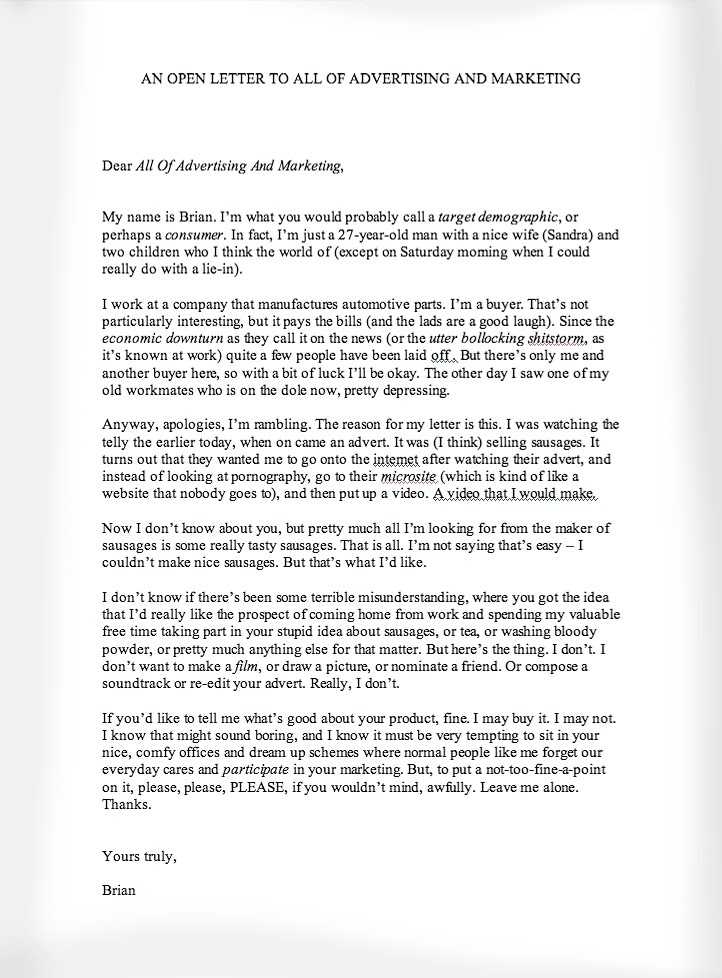
    I thought about it a bit, not in the context of brands or businesses, but more in terms of brand communication as a field, advertising specifically, and brands’ usage of the social web. Consumption patterns, media platforms available etc had pretty much created templates for creative agencies over a period of time. But the arrival of the web, social platforms and the democratization of media have managed to disrupt the ways of the one-way communication age. This post is a good one to read in that context, and talks about the change digital has made to campaigns, and the ‘role of the consumer’. But desperation, hype and the eagerness to get on board makes everyone concerned ‘jump the shark’. And unfortunately, the way I’ve seen many agencies and clients execute it (purely as a consumer), I’m quite inclined to agree with the author of this hilarious letter. (via PSFK)

    Clipboard01

    (click to enlarge)

    The job of the brand manager/creative agency is obviously a more difficult one now, and is made even more so thanks to the approach – of tool strategy. Like this (old but) excellent post states, ‘the technology that underpins social media is changing fast’, but its ephemerality ‘is a feature, not a bug’. It made me wonder whether brand communication/advertising, as a process (the way we see it now) had ‘jumped the shark’, mostly because the thinking process still sees  social platforms in the same light as traditional media and has not changed to be in tune with the former’s dynamics. In other words mistaking social media marketing for social media.

    Maybe they have to dig deeper, figure out the value that people are willing to pay for, and then find their ‘purpose idea + social object‘, and consistently. But that would mean a sea change in the way brands and creative agencies operate. Is adaption possible, or is complete disruption inevitable?

    I juxtaposed this thought with something that Seth Godin wrote recently, about the ‘red zone‘ – the joyless part of the learning curve. His graph also has a green dot, which represents ‘someone on the other side.. rooting us on, or telling us stories of how great it is on the other side’. Perhaps if brands can find from the existing consumer crowd a few who believe enough to play the ‘green dots’, they can adopt a more holistic approach to social platforms and carry the loyalists without it seeming like ‘jumping the shark’?

    until next time, safe jumping.

  • The next content aggregator

    There was a good ‘debate’ at the McKinsey debate zone on whether people will pay for content, in the context of newspapers. An old debate by now, and one whose conclusion is being seen around, with very few exceptions (the reasons for the relative success of the Big 3 of fee-for-content services—the FT, the Economist, and the WSJ are also dealt with), but made interesting because of its succinctness. Clay Shirky writes about the ‘high price of charging for content’, and starts with a very interesting line – “People will pay for content if it is necessary, irreplaceable, and unshareable.”

    [Before we go further, I have to share this amazing read (or listen) with you – Clay Shirky, at the Shorenstein Center on the Press, Politics and Public Policy. (also read the first 3 links to the commentaries on the web, the fourth is a twitter feed)]

    I’ll attempt a summary because the context is needed for the post. He talks about the temporary arrangement that had allowed accountable journalism to create an advertising based business model, and how in the internet era, specialist information sources have disrupted that model and allowed advertisers many more, and better options. He talks about how the newspapers’ way of bundling content, where readers and advertisers subsidised the content they didn’t want, doesn’t work now, and the aggregation has now moved from the ‘server-side’ to the ‘client-side’. He sees “the newspapers’ ability to produce accountability journalism shrinking”, and is convinced that “those changes are secular, monotonic, and irreversible, rather than being merely cyclic and waiting for the next go around.”  He also points out a major and adverse side effect of this disruption – the absence of newspapers as a bulwark against civic corruption. (While there are other media and their ‘sting ops’, I’d still say that the role of newspapers in this regard is still important). This is something I remember debating a few months back over at Iq’s blog, when he wrote on this issue.

    He believes that newspapers are irreplaceable in accountability journalism, and sees three kinds of experiments happening in the new media landscape – market based (commercial, the traditional advertising model of publishers), public (funded by income other than revenue – like non-profit models) and social (crowdsourced models). The internet makes the first difficult to sustain, the second easier, and the third, easiest.

    In a recent post, Umair Haque writes about the open ‘mediaconomy’, which offers tons of soda, but good wine too, and that’s the reason why most old media companies are in trouble now – ‘they’ve been for long producing generic soda, instead of distinctive kinds of wine.’ And in an economy where supply of soda far exceeds demand, how long will people continue to pay for it? As Umair points out, its not just about media, but any industry that’s doing the same.

    Now, a few days back, when I was searching for some information for a holiday, I went to my list of regular suspects – a  few Indian hotel/destination review portals and a few travel portals. I did find information, but was given a choice of hotels that I wasnt too happy with. I had opened another tab for the traveler advice on WikiTravel, and happened to come across options in the ‘Stay’ section which I hadn’t seen anywhere else. In fact it gave me more options than I’d have liked and I was forced to choose from two equally good places, whose websites had all the information I wanted.

    WikiTravel is free, created and curated by users, who take the time out to update and add information. They will obviously incur costs when doing this, and spend some time. They obviously are supported by a revenue model (personal) that allows this, a revenue model that most likely is part of the old economy (commercial, unlike public or social) And that’s what makes me worried about the transition period, the part when the old economy is too weak to support the new, and the new doesn’t have a way to support itself.

    The other point is that the content is out there, but the soda and wine are all mixed, and I’m yet to figure a model where I’m sure I’m not missing something. Yes, there is Reader, Twitter and perhaps a couple of other places, but these do have a tendency to evolve into an echo chamber every now and then. Serendipity does lose out a lot when I put systems and processes in place. Newspapers were aggregators in their time. I can customise tools to give me the news on only those categories I’m interested in. (Rarely) Sometimes people add the serendipity. In many cases, when I’m searching for specific information, the tools (search) and the humans (crowdsourcing) have failed me. I have ended up ‘discovering’ new resources – sites/tools/people and then sharing it. Its not as organised a way as I’d like, but I guess we’re still evolving.

    There is quite some work happening though. Google Reader recently added some ‘Magic’ which helps users discover interesting content faster. The new ‘Explore’ section has a generic popular items as well as recommended sources suggested basis the reader trends and web history (if opted in). Feeds can also now be sorted by ‘magic’, again basis the history of ‘like’ and ‘share’.  Twitter lists will add a new dimension to discovering users and content, and with the deals with Bing and Google, search is going to be more real time, and more importantly, involve a human filter – using the lists layer to deliver better, more relevant search results. The impact on SEO should be fun. TweetMixx is a site I came upon recently, and looks interesting in this context.

    Where will it land up? Is it possible to create an aggregator whose context is subjective preferences, but that will still bring in serendipity? (people who liked this also liked?) What kind of content aggregator will evolve that can either sustain itself without revenue, or convince me to pay for it? Or perhaps that single-entity era is over. It does make me wonder if at some point in time, everyone will be Hiro Protagonist like characters, paid for each piece of information they add into the overall system. 🙂

    until next time, infobesity

    Bonus Read: A very good read on ‘Why the great Indian media companies will fail on the internet

    Update: Set up Parse.ly Lets see what it delivers. 🙂