
Tag: Content

  • The brand your brand could be like

    The world seems to have loved the Old Spice guy horsing around. Even though the campaign had been around for a while, (via Surekha) the last couple of weeks took it to a completely different level, with the Old Spice guy (actor Isaiah Mustafa) sending unique video responses to people who had blogged/tweeted/written to him  – not just celebrities like Kevin Rose, Alyssa Milano, Mrs and Mr Demi More, Ellen DeGeneres etc but regular people too. He even made a marriage proposal on behalf of one @Jsbeals. You can see all his work at the channel here. Mashable has some statistics, which are quite amazing, and yet unsurprising – 180+ videos, 22500 comments, and more than 6 million views, when I last saw it. But more than the stats, it is the amount of interest that it has generated. The Google CFO mentioned it during an earnings call, and closer home, my eminent blogger friends – Bhat and Karthik have been gushing about it, understandably so. The Old Spice Guy even managed to charm 4chan, (this one is the 3rd most viewed in the series) and that I don’t think has a precedent! Meanwhile, after some really hard work (the making of), he has now wrapped up with one final video, thanking the internet.

    There are many lessons from what is quite obviously a case study – an idea, its amazing execution, the co ordination between creative, social media and tech to get near real time responses done, the confidence/bravery/trust of P&G to allow this team the liberty to make the responses with minimal supervision and as Karthik wrote, the importance of creating some really kick a$$ content. And thus the point of the post – an example of brands being media.

    When one way distribution platforms dominated, things were relatively simple – print ads, billboards, radio spots, TVCs, and even internet banners. But then came the tools of self publishing, the acknowledged game changer, with several possibilities.

    It meant that brands, not unlike us common people, could create their own channels using multiple tools and services available. Some brands used it just as they would use the channels of an earlier era, and pushed until no one was interested.

    When they were done with understanding that questioning the veracity of the content appearing online wouldn’t get them anywhere, some brands figured that the only difference that had been made was that a new breed of influencers and opinion makers/breakers/changers had been created. So, they formed alliances, sometimes transparent and sometimes not so. The thick line is now represented by multiple shades of grey. But that just seems to be the way the world in general works now, the Cisco-CNBC case, for example.

    And then there were brands that went deeper and figured out that creating things that would spawn positive content would be a better idea, even if it meant that they had to rework everything. It could mean that they came out with a great product/service which created or mobilised legions of fanboys/girls. They could involve their consumers by asking for ideas. Or they could take on a cause honestly and contributed to the larger society. Not every brand has a CEO who sets a gold standard (here’s an excellent example of Anand Mahindra’s Twitter magic), but it definitely can create an environment that will make ambassadors of employees. It could create such great content or offer so much reward that  others generated excellent content for them (users created an Old Spice voicemail message) , or at least link to them. And if these aren’t possible, a brand could at least ensure that you offered a little value to consumers on the platforms they preferred. And these are by no means the master set.

    When brands and their fan boys and girls become media in themselves, it raises many challenges too. What happens when a brand goofs up on a product and makes its vocal supporters seem like losers?  (you got that signal, I hope) How much of ownership can the brand take for the fans and how will their action or inaction affect those common consumers who are watching it all? What happens when there’s random malice that uses your brand name? (the recent Coke Facebook scam) Even for the star of the moment – Old Spice, what do they do, when a celebrity retorts in the same vein, and asks them to donate to a cause, that’s creating erm, waves all over the world. I, for one, am waiting for a response.

    But despite all that, I believe that the opportunities make the challenges worthwhile. The work is definitely different – doing an eyewash research, releasing an ad, and adopting vague measurement techniques like reach won’t really cut it. With technology that discovers newer and newer contexts for consumers to express themselves, and their intent, brands have to learn to react, if not be proactive, in real time. So, since the web has successfully bottomed the costs of distribution, it is perhaps time that brands started investing the savings into creating good content, finding their way on platforms and with the people using the platforms.

    until next time, content. is. marketing. too.

    PS. next post, in a fortnight 🙂
  • Even distribution

    The per second and per character billing wars happening in the Indian mobile space now, made me consider whether its beyond a price thing – a need for consumers to slice and splice until they get exactly what they need. I see a parallel in the flow of content too, something I discussed earlier.

    Which explains why I tweeted that I was still watching with great interest, the results of Murdoch’s arachnophobia, though it will take months. (despite having some fun with irobot.txt, and Walled Street Journal 😉 ) Now that’s a subject on which everyone’s had an opinion, so I’ll refrain. (though I’ll share the interesting Bing Theory) The other part of his announcement, where he wants to be paid for content, will obviously depend on the quality of content he can give, and whether it can be found elsewhere for free.

    Meanwhile, as a believer of the link economy, I should’ve logically said that News Corpse was the future, but I refrained. The reason was that for me, the complete mechanics of content distribution is still in an evolution stage. I wrote about brand content distribution last week, and I’m exploring similar thoughts on information in general, especially when i see studies on sharing trends like these (via Social Media Explorer), which I still think is a good indicator despite the inherent skews in sample/methodology it might have. The specific part that interested me being the low shares of Google channels and Twitter, and the larger understanding (reminder) that the web is much bigger than the social media savvy crowd. While Google News has become a great aggregator, there might be other distribution mechanisms that can be developed, keeping a paid model in mind.

    Media has long served as a distribution platform for brand communication, so its obvious that any effect on media would also force brands to think differently from what they’ve done so far. It means seeking and understanding various smaller ecosystems that are bound to develop, where media itself would be different from what we see now. In essence, brands would have to slice and splice their content to reach various audiences. Again, one can’t completely rule out the possibilities for Murdoch with niche specific audiences.

    Meanwhile, I had a good debate recently with Surekha on social media’s usage by brands- product/brand centric vs communication centric approaches. This great post (via Surekha) sums it up quite well. My contention was that ‘buzz’ (for lack of a better term) could be generated without a communication centric agenda, if brands/products were serious about social media and approached it from a business design perspective. Communication centric approaches would tend to see networks as broadcast platforms and the focus would be on ideas and execution, which may quite often be platform centric, with less thought on how sustainable it is in the long run,  especially if all parts of the organisation are not aligned to a different way of working that’s required. Also, in addition to the spurious ROI methods which are evolving, my issue with communication – centric approach is best described by Godin in Hammer Time (every function (PR/Advertising all bring their own hammers to nail social media) and Rex in “If Advertising is your middle name, your surveys will always suggest the solution is….

    (Update: Thanks Dina, for sharing this)

    It led me to wonder if brands’ usage of  FB, Twitter etc as broadcast platforms, also contributes to the way these platforms are evolving – from the concept of digital sub-prime crisis that Umair Haque has written about recently to the kind of hiring that brands do. (In this context, the Ad Contrarian’s 3 Distinctions post is also worth reading) Taking it further, is that why (simplistically put) instead of collaboration and easy interoperability, there is the scenario that Tom Reilly very interestingly describes in ‘The War for the Web‘ – war between natural monopolies  (search, social networking, classifieds etc) for adjacent areas.

    I’m hoping that like with all things web 2.0, the community will turn both the fights in a direction that is beneficial to itself, and we won’t be left replacing one system with another that develops with the same principles.

    until next time, choosing sides 🙂

  • The evolution of Content Marketing

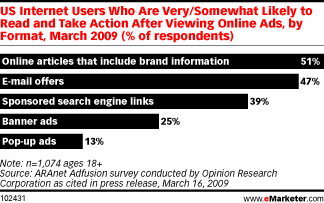
    A few weeks back, the eMarketer released some statistics about the kind of web advertisements that elicit reactions from readers.

    emarketer

    Clearly, the crowd likes to see ‘advertisements’ within content – I think advertorials would be a subset of that. This trend is all the more prominent in the younger audience, when the demographic profiles of the respondents are considered. (check out the statistics here)

    The graph shows that advertising in content is also ahead of sponsored search links, perhaps because the human writer would obviously have a larger sense of context than the ad serving Google. More importantly, there is a trust factor involved when the ‘advertising’ comes from a ‘known’ blogger/writer. There have always been debates about bloggers ‘selling out’ and plugging products/services, but sponsored posts are a reality, and so long as the disclaimers and the disclosures are in place, I am quite okay with that. I’m quite sure that if the concerned blogger gets greedy, the crowd will straighten him out in time.

    Content marketing is definitely different from traditional marketing/PR and raises interesting scenarios for all three parties involved – advertisers, publishers and consumers. Before you go further, I’d suggest reading up Chris Brogan’s (slightly old but) informative post about content marketing.

    The advertisers could range from large brands – products or services, to those serving niche sections. Trendwatching had written recently about sellsumers

    SELLSUMERS: Whether it’s selling their insights to corporations, hawking their creative output to fellow consumers, or renting out unused assets, consumers will increasingly become SELLSUMERS, too. Made possible by the online revolution’s great democratization of demand and supply, and further fueled by a global recession that leaves consumers strapped for cash, the SELLSUMERS phenomenon is yet another manifestation of the mega-trend that is ‘consumer participation’.

    Advertisers would have to figure out if they want to establish and maintain their own content marketing platform, or rely on on a network of entities like sellsumers – that could be individuals or a content marketing service that aggregates independent websites/bloggers, or encourage their regular consumers (/prosumers) to speak about a brand they use, or just support activities/communities and hope for good word of mouth. Perhaps it could be a combination of any or all of the above, with a different objective (a brand goal or a sales goal),  and different measurement criteria for each. In any case, this could prove a great way for brands to explore their long tails of products/services and communication too. It would also mean that brands would have to work harder to ensure that they reach the desired audience in the desired way, in an increasingly fragmented media landscape.

    Publishers, as mentioned above, could be the brands themselves or sellsumers  – individuals or a network. Perhaps newspapers could explore this as a revenue stream, since they’ve always been content aggregators with specialist columnists. The existing social networks are trying to evolve a revenue model out of this. Celebrities could build up an audience across social networks and create an endorsement 2.0 version. For any of the above, the key would be to establish and maintain a set of users, with whom they have an equity- a social capital, to whom they can provide a value, even when they’re doing content marketing. In essence, while the old publishers used their reach for any advertiser who could pay the required price, the new publishers would have to be focused and would have to live with the involvement of consumers in who they sell the reach to, and how.

    The end consumers will seek out networks they can trust, ones which can provides non intrusive ways of connecting them to the product/service they might have an interest in. They would play an active role in creating and maintaining relevant publishers and networks, by ensuring that they are trustworthy sources of information.

    Going forward, it is possible that all the entities we see on the web now, including us, will play all these roles at various times. Unlike the clearly demarcated advertiser-publisher-consumer system we have now, the new systems would be more fluid, with flexible options for all parties. The standards and norms of content marketing need to evolve. Perhaps the disruption we are seeing now, with the decline of traditional media and rise of social web is a prelude to this flexible system.

    until next time, role play

  • Change we need?

    Considering the nature of the post, its a bit of paradoxical way to start. But it is the place the thought started – Dina’s post on The Paradox of the Wisdom of Crowds. It made me look at the way this blog has evolved. But before that, about the matter under discussion – in the attempts to make sure that we’re ‘tuned in’ to the blogosphere, we’ve begun to recycle posts and thoughts so much that there is very less of independent thinking. See, I told you it was a paradox.

    When i started this blog, the intention was only to have a place where i could air my ‘brand’ thoughts, in an Indian context. Because there was very little blog content around that (at least that i knew of) the thoughts were fairly independent. But somewhere down the line, the social media bug bit me, and I started writing about that too.

    That also meant that I had to follow the thought leaders in the social media/internet scene. So the Google Reader was stuffed with ‘Those Who Shall Not be Named’, and the list kept growing till (now) it’s a race against time to finish reading the stuff. As i commented on Dina’s post, I really don’t have the time to be original, and am (unfortunately) willing to chew on the nth generation cud, and pass it on to whoever is next.

    But, my way of adding value has been very simple. I aggregate from diverse sources and try to push the ideas along a line of thought. That’s very little originality. Even if i have to pat myself on the back, it can only be for stepping back and trying to see a pattern. Actually, a short while before Dina’s post, my thoughts had been going in this direction. But before we get to that, i feel there are two kinds of pressure that i can easily discern when writing about social media, web etc. One is ‘breaking’ news, the other is ‘knowing’ news. I am not in the former so I don’t feel that pressure. But I am not immune to the other. So there are links that show that I ‘know’ the news. This is because I’d hate some guy commenting (not that i get many) ‘Oh, XYZ had this article you should read. In it, he……..’  Childish, but true!! I’ve also been thinking whether sub consciously, it was a behaviour similar to some brands i rant about – a way of keeping the conversation in one’s own territory. But the result of these games is that I end up creating content for the people who write about similar things .. a very cyclical way of content generation.

    Nothing wrong with a self sustaining system, but its not great for an emerging scenario like social media, where new thoughts are the order of the day. Otherwise, if everyone links to everyone else, and everyone read everyone else, er, someday we’ll all figure out we’ve been moving in circles.

    But something changed, and that’s what made me think on a change in direction – my increased usage of Friendfeed, where I am able to share my Google Reader ‘knowing news’. 🙂 Of course, that’s a lil race too. Because I realise after i shared, that I am duplicating what someone has already shared. So, a few corrective measures that I’ve planned – a churning of the feeds I have subscribed in Google Reader, reading FF before sharing the Reader stuff, and through these I hope I can effect some changes in the contents of this blog, and add more value here.

    The only thing that worries me, though, is that I have no clue what the readers of the blog want. So,  before I adjust the content according to my learning curve, I’d like to hear from you. Also, i have a rating mechanism for your perusal. Right beneath the title on the post page. Please use that liberally. And then, i shall hope that the wisdom of the crowds will guide me.

    until next time, sorry Obama

  • User Generated Contentment

    People!! While I thank all those of you who gave me their feedback (and it helped), I did not get much feedback on the content.  The other person to thank is the one who first used the smart phrase used in the title. So, assuming all’s well, am planning a couple of tiny changes to the entire flow.

    I’m shifting the Manuscrypts Monday post to Tuesday, since 2 posts on one day is a bit too much, even by my ‘prolific’ standards. Which means that there will be posts on all days except Saturday.

    Monday – Brants

    Tuesday – Manuscrypts

    Wednesday – Brants

    Thursday – Manuscrypts

    Friday – Brants

    Sunday – Restorants

    No, I don’t expect you to mug it up nor am I doing this because of a misplaced sense of self importance 😀

    Its only because the blogs used to have different audiences, and now all the content is in one place. Like a reader said, because I attempt so much of wordplay in all the posts, it might be difficult for readers to figure out which category the post belongs to. So, I’m hoping the above serves as a kind of indicator.

    The second change is to do with the Brants content. I have noticed a disconcerting habit of rambling, so I’m going to attempt a more brevity-led approach from Friday.

    until next time,koi shaq ya sawaal? 😀

    And this is for Technorati

    <a href=”http://technorati.com/claim/jwtdg93aav” rel=”me”>Technorati Profile</a>