Tag: Content

  • My ‘content history’, with Pepper Content

    Thanks to Natasha Puri and Pepper Content, for a dash of nostalgia and excitement for what the future holds.

    Also thanks to YouStory for covering it.

    P.S. There is some issue with the text on the page, so watching the video might be a better idea.

  • The future of Fintech marketing

    First published in ET Brand Equity

    Fintech is one of those small words that contains worlds. Just like marketing. While the former could be payments, lending, insurance, wealth management, neobanks etc, the latter includes brand management, digital acquisition, marketing automation, social media and so on. A combination of the two makes for a complex mix. It also means that crystal gazing has its limits and there really is no common answer. Having said that, let’s try our hand at “how it started, how it’s going to go…”

    Audience & Access: India’s digital economy now boasts over 700 million connected users. As per RBI data, the number of digital transactions are expected to make a 12x jump from 125 million a day in 2020 to 1.5 billion by 2025! Fintech has made leaps over the last 10 years – starting with personal finance products such as banking accounts and deposits, moving on to mobile payments and e-wallets, and finally leading to a full bouquet of financial services including trading, insurance and wealth management. But the pandemic has been a force multiplier for digitisation in many sectors, including personal finance. This audience avalanche means that marketers have to revisit their segmentation and personas, and deal with different cohorts of digital audiences at different levels of maturity. What are the new user segments, what financial products and services would they like to access, and what are the new use cases that will emerge?

    Brands & Behaviours: With new segments emerging, education and awareness will need to go hand in hand with acquisition strategies, and nuanced, personalised communication for different segments. While financial products on digital platforms may not be completely new to many consumers, brands will still need to earn the customer’s trust. This is especially true in the context of an unfamiliar investment product or service, and might require a revisit of customers’ needs, barriers and opportunities.

    This is crucial because we’re now living through a kind of liminality, a period marked by the uncertainty between an old normal, and what emerges next. Even more than before, marketers will need to have an empathetic mindset. Channeling this into communication will be necessary to build trust. Beyond actual trials, different consumer segments would have different surrogates for trust. And old wines and new bottles have challenges. Take celebrity endorsements, or its (relatively) poorer cousin – influencer marketing. Or “cause marketing”. All of them are susceptible to social media vigilantism and cancel culture, even as manufactured word of mouth thrives.

    The pandemic has forced us to relook our lives, and maybe even did a Marie Kondo on our lifestyle choices. “Experience shapes memory; memory shapes our view of the future.” What is the impact on the spending, saving and investing habits of your existing customers? What behaviours will we continue, what will we drop? Whom will we trust on money matters, and why?

    Cords & Cookies: We’re in the era of the second screen. After all, some people still use the television when they want a large screen experience. But seriously, though cord cutting may not be mass yet, such has been the rise of OTT and digital consumption in general that the erstwhile second screen is practically the first. This has a huge impact on the media mix, especially because of the range of customisation that’s possible on digital media. Of course, you might still be an IPL sponsor if you’re a mass brand, but it’s definitely possible to build brands with digital as the primary medium. Not that it’s without challenges. Some level of precision targeting will continue to be an option at the top of the funnel, but privacy concerns are making a cookie-less world imminent. Even as adtech is scrambling to find a replacement for cookies, (I believe that) first party data and a non-cookie cutter approach is something brands should focus on. Codeless designing, chatbots, and the ever increasing tools of marketing automation allow the digital marketer to create custom journeys using demographic, behavioural, and other parameters. Content marketing using multiple formats is still a great way to build domain authority and trust. Podcasts have seen quite a lift during the pandemic. In short, we have moved further from mainstream to many streams.

    Data & Delivery: The common theme in all the above points is fragmentation – of markets, messaging and media. And this is essentially what the future looks like. The challenge for the marketer is to ensure narrative cohesion. This requires us to get comfortable with collecting and analysing data, and being able to deliver this understanding via communication and channels. The other kind of delivery we’ll be responsible for is ROI. This will require us to find new ways to measure both effectiveness and efficiency across campaigns, channels and market segments.

    In closing: The “new normal” is unlikely to be the normal we knew. Especially for marketing, because even after the pandemic goes away, the uncertainty will linger in consumer minds. Despite the abundance of choice that customers have, there is an opportunity for brands. As Scott Galloway has astutely pointed out, “Choice is a tax on your time and attention. Consumers don’t want more choice, they want confidence in the choices presented.” In the race for wallet share, trust continues to be the best currency. Building a trusted brand in a fragmented world takes time and a growth mindset. It’s good to remember that there are no perfect solutions, only conscious trade-offs.

  • What makes a full stack marketer?

    On Twitter, GG asked a question that I felt compelled to answer because I have used this on LinkedIn for a while.

    I did borrow the phrase from tech, but sounding cool didn’t quite cover it. 🙂

    To begin with, why do I use it? First, the people I want to connect with on LinkedIn are from the consumer tech, digital marketing and brand domains. This usage would be familiar to them, and would help frame my experience and expertise. The experience straddles the offline and digital space, and has media, FMCG, e-commerce and fintech brands. The second part is to do with the skill sets that I think qualifies one for that description. This is my attempt to elaborate on the latter. The “frontend” and “backend” of marketing. It covers demand generation, lead generation, and conversion but I have refrained from classifying it because it is context-dependent.

    Disclaimer: These are my perspectives of things I have worked on. I do this with the understanding that “as our island of knowledge grows, so does the shore of our ignorance” (more…)

  • Of destinations and feeds

    In An Ambient Future, I had written about how Google was potentially poised for something really interesting because technically, it had things in place to harness mobile, social and sensor data and overlay it with machine learning and AI. An early version of how this data could be surfaced contextually and be shown in an interface would be Google Now, as Christian Hernandez had pointed out. And that was why I was quite surprised and dismayed when I read that most of the team that had been working on Google Now had left!

    The larger context though is about content discovery and two possible approaches to it – destination (platform?) and feed. I remember reading Neil Perkin’s post on the subject last year (it’s a fascinating rabbit hole of related reads, you’ve been warned!) and it has had me thinking ever since, especially in recent times, with apps increasingly replacing the traditional website as a destination. So far, the feed largely served as a distribution method to destination, but I believe it is no longer that simple on the web, let alone mobile.  (more…)

  • Brand, Journalism, Marketing

    A few months ago, in The Future Of Owned Media and Can media become social enough?, I’d written about a marketplace model that would connect journalists and ‘buyers’. More recently, I saw an article about Contently raising a round of funding to work on its stated objective – connect freelance journalists and writers with nontraditional publishers, such as brands, agencies, nonprofits, and new media companies. These organizations use Contently’s technology to commission projects, such as sponsored articles, infographics, and blog posts.

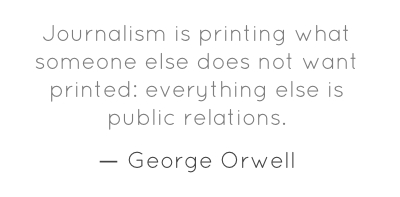
    Like I’ve tweeted before, journalism is definitely in need of a business model. Media (with advertising) is arguably not the best bet now, because of various reasons. Digital has allowed brands to create their own media platforms (blogs, websites) and social has enabled them to (at least) broadcast it themselves, without a dependency on traditional media. Frank Strong, in a post titled ‘Why Content Marketing is the new Branding‘, rightly states that content is currency. It not only builds perception, but enables us to transact with consumers, keep a conversation going, and at some point, achieve a certain business outcome.

    However, except for campaigns, marketing collateral etc, brands have never really required/produced ‘content’ on a regular basis, and thus they are not wired for it. But content marketing obviously requires sustainable quality content, and that’s where brand journalism can play a part. I’d come across the term ‘brand journalism’ first on this post in early 2013 – ‘The Role of Brand Journalism in Content Marketing‘ – where it is defined as “research, storytelling and reporting for a non-media company, in that company’s line of business, with the goal of thought leadership.” (Erica Swallow) There’s a media vs non-media debate in the post, but my little tiff with the definition is that ‘thought leadership’ is rather limiting. There might be other business objectives/outcomes. Unless we’re talking of a leadership among the consumer’s thoughts. (share of mind)

    Meanwhile, in addition to a structured way like Contently, I can see brands already doing other forms of brand journalism. (used loosely) I’d classify blogger outreach, guest Twitterers, all under this, because the brand is using a content creator’s contextual reputation to enhance its own standing. The latest example I saw was quite fantastic – teen retailer Wet Seal ‘handing over’ its Snapchat account to MissMeghanMakeup (aged 16) who has quite a social following on various platforms. (via) To note that this is not Miss Meghan’s only client!

    I can paint a rather utopian win-win-win picture with this – brands with a purpose that has a social-societal perspective, journalists, who have created trust and a reputation of their own, who can identify with the brand’s purpose and who can write honestly (with disclosure) and consumers, who get to know more about the brands they align with through superb narratives created by these journalists. (among other storytellers) But I’d be surprised if it pans out this way anytime soon.

    It will have its challenges, but most of it is when we try to fit this method into the ‘containers of the past’. Its potential to succeed is because it offers much for all stakeholders. Journalists will have the option to be authentic in their writing, and give full disclosure because they’re not tied to the (traditional) media aspect. (newspapers/channels with their own business interests) Brands can be transparent about who has been commissioned to produce their content, and can use paid, owned media to promote it. Consumers get an interesting mix of narrators. It is a shift because the players (Brand, PR, journalists, media platforms) and/or their roles (production, distribution) will transform, but I do think brand journalism (a type of content) + marketing stands a chance.
    Clipboard01

    until next time, to better brand stories