Tag: consumption

  • An Internet of Things narrative

    Towards the end of last year, I’d written a post on the ‘social product‘. Its premise was that given social’s conversion to media, the opportunity for fulfilling social’s initial promise would fall on ‘product’ – using data, network effects, and relationships to connect consumers along a shared purpose. In the last few weeks, I have seen rapid acceleration happening on this front. I can see at least two narratives working in tandem, and I’m sure that at some point they will begin to augment each other really well. In this excellent post on technologies that are shaping the future of design, sensors occupy the top slot, and they are at the basis of both the narratives – one on humans, and one on things. The official classification, roughly, translates into Wearables and Internet Of Things respectively for the scope of discussions here.

    This post is about the second. So, what is the Internet of things? The wiki definition is simple, but effective –  “The Internet of Things (IoT) refers to uniquely identifiable objects and their virtual representations in an Internet-like structure.” The best primer I have come across would be this infographic, which has everything from a quick technology explanation, applications and challenges to market size, statistics, and interesting use cases. For a really solid perspective, look no further than this deck titled ‘The Internet of Everything‘.

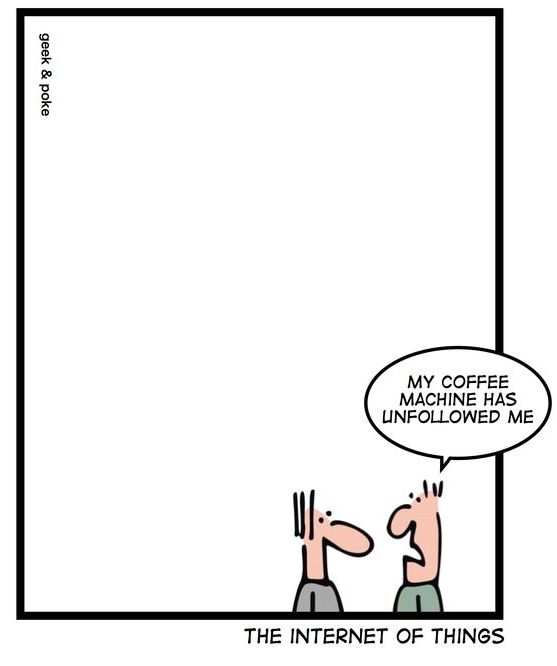
    How does it affect us? For now, it is about convenience. If you’re familiar with Android launchers, imagine an IoT version – it’s almost there, using iBeacon! There’s more – Piper, which works as an IFTTT for your home, the smart fridge that can order groceries from the online store, the smart TV that can learn preferences and help us discover content, the washing machine that can help order detergent, the egg tray that will let you know about the number of eggs it holds and their ‘state’, the automated coffee machine, Philips’ connected retail lighting system, Pixie Scientific’s Smart Diapers, the GE a/c that learns your preferences, the smart bulb that doubles up as a bluetooth speaker, (!) and so on. Some of the products are really useful and solve a need, while some others are more fads and probably not adding the value that reflects the potential of IoT. But that’s just the learning curve in progress, as the market starts separating needs and wants.

    All of this also means that consumption patterns will begin to change, as more purchases become automated, and more importantly data-driven. In my post on the driving forces of 2014, I had brought up technology as the biggest disruption that marketing has seen. This is most definitely one of the manifestations.
    Clipboard02

    What can brands do? For starters, get interested. Think about the tangible benefits that can be offered to consumers. What are the kind of data patterns that devices (or products) can surface to help the consumer make better consumption decisions? What kind of contexts can be relevant? Instead of force feeding advertising on traditional channels and fracking social platforms, can communication to consumers be made seamless using data, contexts and easy processes? While ‘device’ brands might have an initial advantage, ‘product’ brands need not be left behind at all. As the washing machine post (linked earlier) suggests, a Unilever or P&G might subsidise a machine, because it’s pre-sold with 500 washes worth of their detergent. It could even be real time, with SDK, API systems telling a partner brand to push a contextually relevant communication to a consumer. As things start storing and communicating data, privacy will be a major factor that decides whom consumers will share what with. Unlike media, trust cannot be ‘fracked’, it needs to be earned over a time frame.

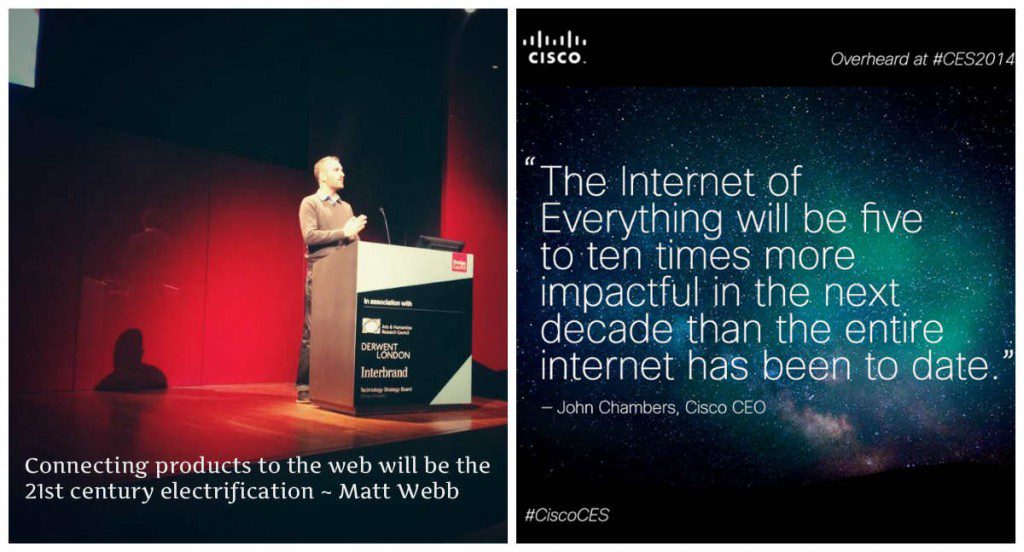
    Where does it go from here? A common language/protocol/registry is a good start, as is a white label platform – both are trying to connect an assortment of devices and gadgets. While there is value in data at an individual level (more on that in the next narrative) one of the critical factors in the success of this phenomenon is the devices talking to each other – humans acting as middle men to pass on data may not be a smart way ahead!  Digital Tonto has an excellent nuanced perspective that differentiates IoT from the web of things. (WoT sounds cooler!) The difference is in connection and interoperability.
    collage

    Equally important is this phenomenon’s ability to solve human needs. (Internet of Caring Things)

    Collaborative consumption is fast becoming a consumer reality. As always, brands (generalising) are bound to be a few years behind, but the hope is that the web of things will force them to start collaborative creation and distribution and more importantly, focus on consumer needs.

    until next time, #WoTever

    P.S. In a corruption of Scott Adams’  idea, I think #WoT is paving the way for robot domination. 😉

    P.P.S. If the subject interests you, check out my Internet of Things Pinterest board.

  • The narratives that we drive

    It probably started with the ‘narrative’ post, but a few things I read later made me wonder about our choices of narratives and where this could be leading to. Some narratives happen to us depending on our circumstances – time, geography etc, and some we choose of our own volition, or so it seems. Continuing from the earlier post, I think it’d be safe to say that with a more connected world, our ability to choose narratives has been heightened. Abundance of creation, and consumption. I think this was the related fantastic little piece of content that triggered this entire line of thought. It has some thoughts on material consumption, and though delivered differently, it has some profound insights as well.

    Partly thanks to that abundance, the noise around us has also increased, and has found better ways of being amplified. To quote Clay Shirky,

    It is our misfortune, as a historical generation, to live through the largest expansion in expressive capability in human history, a misfortune because abundance breaks more things than scarcity.

    In fact, one could argue that compulsive consumption (material, and otherwise) is one of the reasons for our ‘emptying out‘. (do read) As I was writing this, I had a sense of deja vu, and some searching pointed me to this, written 3 years back, in which I tried to figure out whether there was a middle path between a self that was driven by others’ perceptions and one that was driven by a moral compass dictated by few external stimuli. In that post, I had quoted from Paul Graham’s ‘addiction’ post,“we will increasingly be defined by what we say no to” I think that still holds true.

    In this era of abundance, what narratives should we choose to be part of? How can one be objective, is one even right by being objective? An excellent post whose advice I hope to implement more is this. I really couldn’t disagree with any of the 30 things mentioned, it just seemed intuitively right. But I think this would serve as an excellent first lesson..

    (via)

    until next time, an open and shut existence

  • A different kind of more

    (image via)

    Sometime back, I read this excellent post titled “Your Lifestyle Has Already Been Designed“. A colleague shared it with me because he felt I’d like it. And right he was, because it echoed my own thoughts on how our consumption these days have little to do with our needs. The author in fact, goes a step further to say that the typical 40 hour work week (actually it’s way more) manufactured by big business has reduced our free time to such an extent that whatever we do get is spent less in meaningful, healthy activities and more in drowning ourselves in wanton consumption. While that may or may not be true, I think we have a choice, but one that involves winning a battle within. When we lose the battle, we begin indulging ourselves covering it up with the ‘deserve it/earned it’ argument, and the culture of random consumption lives to fight another day. The author sums it up rather well with “We buy stuff to cheer ourselves up, to keep up with the Joneses, to fulfill our childhood vision of what our adulthood would be like, to broadcast our status to the world, and for a lot of other psychological reasons that have very little to do with how useful the product really is.”

    In a larger sense, we tend to live a life that’s not really ours. I cannot help but remember the words of a near-immortal “Your time is limited, so don’t waste it living someone else’s life. Don’t be trapped by dogma – which is living with the results of other people’s thinking. Don’t let the noise of other’s opinions drown out your own inner voice. And most important, have the courage to follow your heart and intuition. They somehow already know what you truly want to become. Everything else is secondary.

    In essence, what we consider as motivation from our own self is actually not. I found an amazing/bizarre manifestation of this in the truly unique story of Mike Merrill, who divided himself into 100000 shares and ‘sold’ himself. Known as the IPO man, his investors would earn a profit out of activities he did outside of his job. In fact, his intent behind the entire activity was to raise funds for things he wanted to do, and felt he would make a profit from. What followed is a fascinating story that has resulted in the investors even getting to have a say in Mike’s personal relationships and sleep patterns!

    I couldn’t help but think of how similar it was to an ordinary person’s life. It is an extreme case, but when we’re driven by wants and motivations that have little relation to needs, the only difference is that Mike is conscious of his lack of control, while we are smug in our belief that we’re in control. I most definitely am not saying we should be living like ascetics, but the balance does lie in consciously separating needs and wants. That, I believe, is the way to a fuller life. A different kind of more from a different set of mores. I wonder if it’s a coincidence that the term ‘Utopia’ was coined by a person named Sir Thomas More. 🙂

    until next time, more or less over

    P.S. The good news is that increasingly these days, I see people making conscious choices across the board – lifestyle, media, time, relationships. The more the merrier 🙂

  • Social+

    Consumption and curation. At some point I can still remember, I consumed newspapers, magazines and all other mass publishers (across platforms) and expected them to curate for me. Curation for a large mass, when linked to their kind of production process and business model, got tits first whiff of trouble when the internet only models came into the picture. In the early days of content abundance, an algorithm came into our lives and changed the way we found content on the net. A bit later, I was introduced to a different kind of curation courtesy the service then known as del.icio.us.  #youremember I would put Google Reader in the same category too.

    Then came Facebook and Twitter, and RSS died several times if we go by the blog posts. Facebook for me has been and is a social graph. The only way my interest graph has crept in (in terms of content discovery and consumption) is in the form of pop culture. Can that change? I wouldn’t write it off. Twitter started out as an interest graph, but when it scaled, it began flirting with social graphs. For me, it’s now both, and I find that difficult to work with. It’s probably a bit of my laziness too – curating who I follow, making corresponding lists etc erm, not done. Anyway, my discovery and sharing on that network is minimal now. So, in that respect, the curation I expect on these platforms is minimal too.

    Purely by activity, it would seem that I am more active on my interest graph networks now. I wonder if I am alone in not being sure of mixing my interest and social graphs -Delicious, Foursquare, GoodReads., and until recently, (generically) Reader. The curation is by a set of people I trust in that domain, and any ‘social’ that happens remains ‘by the way’.

    Google didn’t even see the social boat IMO, and when they did, it was too far out. Wave, Buzz: crash, silenced. But while writing the WT5 column late last week, I found that Google+ has been creeping in everywhere – search results, news, Reader (I haven’t forgiven you, Google) and building in features like Mutual Circle Chat and search options.  I was thinking about this when I received one of my best sources of curation these days – the weekly Only Dead Fish newsletter (email, how ironic 🙂 ), and that’s where I saw this excellent post titled ‘From destination social to distributed social : why Google+ is the Trojan horse of the social web

    That’s exactly what Google seems to be doing. Unlike Facebook, which built THE social network and then tried to link consumption on other sites in an ‘oh, okay, fine’ way, Google is playing a balance act, and to its strengths. By giving me the tools to build a social network on Google+, and simultaneously being present at my points of consumption, Google is making me play curator to both social and interest graphs. If all goes well, I think Google will not only collect data, but also build several social networks based on interest graphs. Google’s cash cow still doesn’t have much to do with all this, but once the networks are built, Google will have better contexts for AdSense, based on a really smart social algorithm.

    I have always believed that Android is the next Google. Still do, but now I think that Google+ is a contender too. Or maybe the social OS will be built by them together.

    until next time, evil graphs 🙂

    Bonus: A Google Ventures backed app on iPhone named Stamped – very relevant in this context.

  • All hands on deck

    Since tis still the season of predictions and ‘looking forward to in 2011’, and because I brought up the subject of brand agencies reshaping themselves for the future, I thought I’d share with you three of my favourite decks of insights from the many that I managed to scan in the last few weeks.

    We’ll begin with JWT’s ‘100 Things to Watch in 2011’. (via Surekha on Reader) While there are many things in this that you might already think is a trend, what I liked about it is its thinking outside of any specific prisms – brands, technology etc, but still managing to capture the  essence of trends in human behaviour, culture, consumption, the shifts happening therein, and thus, a good reckoner for marketers.

    The second one I’d like to share is Edelman’s ‘Digital Trends to Watch in 2011’. Though there are a few commonalities with the JWT deck, this seems more focused. While this is definitely quite a sensible thing to do from a client perspective, I missed the “completely out of the blue, but damn, why didn’t I think of it?” moments that I usually associate with its creators. But that’s just a testament to my high regards for Armano and Rubel, more than anything else. What I liked most about this was the trend + best practice combining, that layering gives excellent perspective.

    The last one I’d like to share is Rohit Bhargava’s ’15 Marketing & Social Trends to watch in 2011′ (via Gauravonomics). There might be some overlap with the other two, but again, the idea of examples with each trend makes it a must-read, in addition to the overall quality of insights.

    While its easy to see that there are commonalities in these, I also noticed an interesting thread of thought that  resonated most with me.

    ‘There’s an app for everything everywhere’ is perhaps the underlying theme in #3 (Apps Beyond Mobile), #7 (Ubiquitous Social Computing, more specifically its best practice) and #9 (Appification of the web) in the JWT, Edelman and Rohit presentations. We then move on to ‘production of consumable content and experiences across platforms’  that connects #93 (Transmedia Producers – faint connection), #4 (Transmedia storytelling) in the JWT and Edelman presentations respectively. And at last, we move on to how it can scale which is brought out through #3 (Developer engagement) in Edelman’s presentation and #7 (Crowdsourced innovation) and #11 (Employees as heroes) in Rohit Bhargava’s presentation.

    While I may not endorse a brand strategy only basis tools, the ‘appification’ across platforms actually throws open the door for marketers to not just satisfy their ‘short head’ consumers in better ways, but explore the ways to reach the ‘long tail’. It allows them to blend or distribute their ‘story’ across platforms and if done well, raise the interest level of their consumers. And an agency or brand manager cannot do it alone. While the idea of crowdsourcing is looked down upon by many, there are enough examples to show that if targeted well and executed with clarity, it can deliver results. More importantly, here, the ‘crowd’ is not consumers, but developers who can re-create the brand’s experience on multiple platforms, and employees who can create a human story that will resonate with others.

    If these possibilities for 2011 don’t excite you, I’ll try again next week, but I really don’t have any more of these awesome presentations to back me up.

    until next time, slide rules!