
Tag: compassion

  • In considerate mode

    Delivery guys riding on the wrong side of the road, kids behind you kicking your seat on a flight, speaking on the phone loudly in a public space – these are a few of my favourite peeves. I am sure you have yours too. That’s why this post on LinkedIn caught my attention – “things pissing me off” in situations where people aren’t following rules is something I could relate to.

    Barring a few exceptions where I am absolutely not able to tolerate what I believe is ‘inconsiderate behaviour’, I don’t engage. But engage or not, these instances also reveal my snap judgements. e.g. what an inconsiderate idiot, speaking loudly during a movie. I judge myself the most, but also try to intellectually understand my motivations.

    That’s why I found this particular episode of The Knowledge Project – in which Shane Parrish speaks to Todd Herman – fascinating. Around the 49th min mark, Shane asks Todd if he has a hard time relating to average people, people who just didn’t want to be the best at what they do. I could relate to it in my professional context – another pet peeve. Todd admits how despite having matured, he still has to watch out as his ego still tries to stack them as ‘average’. Todd explains that he does this because he over-indexes what he personally finds important. e.g. a career-driven person might judge someone who prioritises being a parent.

    I battle my own bugbears – punctuality, work ethic, grammar and spelling errors etc. That image below is my team taking revenge on my birthday cake. Cheapos! 😂
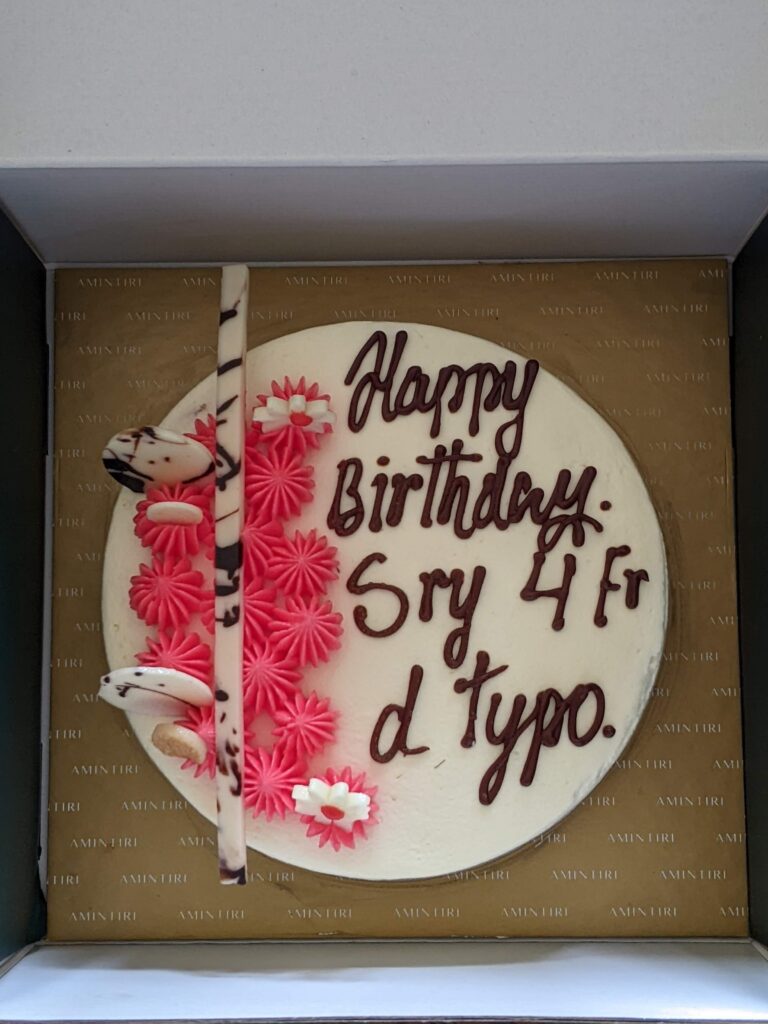
    The point is that others are not average/ inconsiderate people, they are at best average/inconsiderate in the thing I am over-indexing for! There are many contexts and reasons why they don’t behave in a way I think they should . As I commented on LinkedIn, I have realised that being able to afford consideration (or applying oneself) is a privilege.

    But that was level 1. When I dug deeper, I saw my real problem. When that ‘idiot’ is not following my worldview (‘ideology’) – whether it is ‘considerate behaviour’ or being conscious of spelling mistakes – it raises (in my own mind) doubts on the objective correctness of my ‘ideology’. Will Storr has a  brilliant insight – “for humans, ideology is territory”. We fight for ideas like animals fight for land.

    At this point, we have evolved to an extent where we hold hundreds of “shoulds” and “shouldn’ts” in our heads. And we expect the world to comply – from nationalism to having pets/kids to the usage of the Oxford comma and so on. Any deviation from our ‘ideology’ is treated as a judgement against us. No wonder every interaction has the potential for conflict. We are defenders of our own little faiths that make up our identity. What we could practice, when we have the privilege, is to step back and think about the little judgements we make, in work and life scenarios, and then react with empathy, because it is not a personal attack.

    There have been many posts on this blog about morality, and recently, I found two quotes that connect it to judgement and empathy.

    “The drug of morality poisons empathy” ~ Will Storr (again)
    “Compassion is the basis of morality.” ~ Arthur Schopenhauer

    I found these to be an educative lesson on how I look at my subjective morality, and how I behave with others in real life.

  • Dealing with the revolution

    At the end of last week’s post “Understanding the revolution“, one of the points I wanted to emphasise was our individual role in dealing with it. I had mentioned two factors that I believe have led us to this point – rising inequality, and intersubjective realities. An attempt to fix also needs to begin here.

    When demonetisation first hit us, I tweeted this


    (more…)

  • Acts on Purpose

    A day last week began very badly. My cab driver, despite instructions to stick to his own half of the road, didn’t do so, and bumped into a two wheeler. To be precise, our car hit the ankle of the lady who was riding pillion. It obviously hurt her, she was sobbing. The driver was absolutely unapologetic and when I got down to check on her and apologise, he asked me to get back in! The traffic was piling up and the clock was ticking for a meeting I had at 11. I got in, and have felt miserable since then.

    It also has to do with the fact that a decade back, we (or D, rather) were at the receiving end of exactly this. That night, it was the kindness of a family in Koramangala that helped us get some semblance of control over the situation. Their connection with the event was just that it happened in front of their house. The driver of the car which hit us (his family was with him) gave us the slip on the way to the hospital. Meanwhile, with D’s leg in a cast, it was a harrowing month for both of us. All of this was playing in my head, and I felt feel very guilty for not cancelling the ride and doing what I could to help. (more…)

  • Loneliness and the AI evolution

    In a post that I found extremely poignant and true, the Guardian calls it out as The Age of Loneliness. It lists out the structural shifts causing this social collapse. “The war of every man against every man – competition and individualism, in other words – is the religion of our timeWhat counts is to win. The rest is collateral damage.” Seems we are but slaves of a ‘hedonic treadmill’, in denial.

    In earlier posts (The Art of Live In, Emotion as a Service) I’d written on how (IMO) even the micro-unit of society – the family- is ripe for disruption. At both societal and familial levels, I think the related fallout is an increasing lack of compassion and empathy, something that I notice a lot on Twitter, for example. Irony that the more connected we are, the more disconnected we are from each others’ emotions, and what impact our actions/inactions have. But guess who is coming to the rescue? Quite possibly, robots, that care! (12) (more…)

  • For Charlie to tango

    The interesting question is, just because something thinks differently from you, does that mean it’s not thinking? We allow that humans have such divergences from one another. You like strawberries. I hate ice-skating. You cry at sad films. I’m allergic to pollen. What does it mean to have different tastes – different preferences – other than to say that our brains work differently? That we think differently from one another?
    ~ The Imitation Game (via)

    I watched the movie last weekend, and this was one of the scenes that stayed with me. By sheer coincidence, the book I was reading then was The Age of Spiritual Machines, which dwells on the progress of artificial intelligence, and therefore, its impact on humanity. Humanity will be forced to reckon with AI sooner than later, (an earlier post) but long before that, we will need to learn to deal with ourselves. Have we really learned to live with our divergences? Take this as an example :

    (more…)