Tag: communication

  • Internet and People States

    The Economist has an excellent read titled ‘The Future of the Internet‘, where it details the possibility of a Balkanisation of the internet, by forces such as Network Operators, countries, and closed platforms. Quite an irony, as they point out, since the internet was supposed to be a great unifier.

    I realised that so far we had been dealing with entities that had a geographical constraint – all forms of media, languages, culture etc. When brands entered alien markets, they adapted to suit the needs of the local population – sometimes in terms of communication, sometimes in terms of the product/service itself.  So I guess, it would be futile to expect that we would solve a challenge of this magnitude soon, considering that the internet has been around for only a relatively short amount of time. (cool infographic)

    But what struck me was that though the factors mentioned above are indeed distinct and relevant ones, what about users? Thanks to the long tail of content, people are able to get content tailor-made to their requirement, more often that not. They are also able to create content and share it with specific people. When I see e-groups, closed blogs, newsletters, and increasing privacy options on existing networks, I wonder how much of Balkanisation already exists thanks to users, who control a lot of the where, what and to whom content is shared. I connect with different people on different networks and share different relationships with them basis different contexts and interests, and except for minor overlaps b/w Facebook – Twitter and Twitter – Foursquare, they are all almost separate worlds. And its not just the where and the what, its also the when – I have Orkut friends discovering Facebook, Facebook and LinkedIn friends/connections discovering Twitter, Twitter followers discovering Foursquare, GReader friends discovering Quora, when my usage and behaviour on these networks would be completely different from theirs thanks to relatively early adoption.

    The other question is how would brands be affected by a Balkanised internet. Would all their users exist in the same place and time? How does it affect communication? Product, or service, how many brands can be like Apple, who are the nearest to being a ‘state’ in themselves? How many can actually build and sustain that? How much of it depends on the nature of the product and how much of it on the people connections (or social gestures)? Would integration and consistency of communication matter then?

    But then I realise that despite the user Balkanisation, we have our means of communication and transportation open. When push comes to shove, perhaps it will be too unprofitable for any entity to remain Balkanised, irrespective of their own vested interests? We live in hope. 🙂

    until next time, 800th post at the other blog 🙂

  • Multi purpose content

    This post over at GigaOm, titled “Apple doesn’t target markets, it targets people” sparked a tiny debate between Mahendra and me, on the effects of ‘antennagate’ on Apple fanboys, though the article itself had little to do with this line of thought. I wondered, like I’d written here earlier (last two paras), whether the continuous dissing in the media and the product flaw itself would create skepticism among the fanboys and affect future purchases, Mahendra didn’t think so.

    The subject of influence has cropped up here earlier, but the focus was on new media platforms and people. The above conversation made me think about the challenges that brands face on content that’s created on multiple media platforms.

    Even as traditional media platforms are being unfavourably compared to new media thanks to their constraints, the abundance of content – the media tsunami, on the latter does make one wonder how much of consumption by the intended crowd really happens. Meanwhile, despite the constraints,  technically, the reach of the traditional media platforms is still significant. A brand’s consumers exist on/consume these media.

    That really poses interesting questions on the notions of brand imagery, consistency etc, which have been holy cows of a previous era. Take this video, for example. Its a massive hit on Facebook and YouTube

    httpv://www.youtube.com/watch?v=cTl3U6aSd2w

    “Where’s the Gillette logo?!”, if this were a traditional TV spot, and what’s the message here? A close shave? 😉 But at 5 million + views, surely this must count for something. But what? This fuzzy nature of social media content and the media on which its propagated is exactly what raises difficult  but important questions on brands’ participation in social media.

    The answers are obviously not simple ones, and would have to be adapted to each brand’s needs. But as these lessons from Old Spice would suggest,  an important requirement is to understand objectives and define roles for each platform. The challenge then would be to create a content strategy that not only uses the inherent strengths of the different media, but also understands the motivations, consumption habits and preferences of the different kinds of people who use them. Instead of blind adaption across various platforms, exploring content options and finer segmentation is perhaps the order of the day.

    Perhaps Apple’s success is because of what the original post says “It focuses on users. And Apple lets them decide how and where they’ll use its products.” I wonder how many brands use that kind of understanding in their communication and brand strategy.

    until next time, iWash 😉

  • Of Social Media Baubles

    I read Umair Haque’s post – The Social Media Bubble, through the prism of  ‘interesting’ vs ‘popular‘, the subject of my last post. In the post, Haque’s biggest gripe with social media, the way it is now, is the low quality of ties between the people who are connected. Thin relationships, he calls them and he has five supporting arguments – the disproportionate rise in the average number of ‘friends’ vs trust, the creation of more intermediaries rather than removal of old ones, hate (and I keep ranting about this on the other blog – trigger happiness), exclusion (again, something from the other blog – the clique friendly web), and lack of intrinsic value (and therefore the need to monetise, perhaps by ‘extractive, ethically questionable ways’). He also sees three major casualties because of this – inefficient attention allocation, investment in low quality content, and the weakening of the Internet as a force for good.

    Now, the archives of posts here and on the other blog would show that I am sometimes frustrated and disappointed with a lot of activities on the social web, its usage, and therefore the direction in which it is going. But then again, I still have faith in the social web, and believe what we’re going through is the phase of transition, a time between fundamental shifts in the way we interact, and I’d be naive to expect it to be smooth. Also, unlike the earlier forms of media and communication, the web (and mobile) seem to have a much smaller gestation time between disruptions. I now tend to believe that this IS the way its going to be for quite a long time, because we’ve only started exploring avenues and possibilities. So, extrapolating current usage patterns to the future in a disruptive scenario looks flawed to me. But yes, like any other ardent faithful, I too am looking for signs.. and thoughts.

    So while I did agree a lot with what was written in the post, and considered it a very good read, I was even more happy to read two replies to that post – “Rethinking Thin: Social Relationships in Social Media“, by Adrian Chan, and “Umair Haque is another new spatialist” by Stowe Boyd.

    Adrian Chan does a great job in deconstructing Haque’s post. He first argues that the logic and analytic of social network analysis cannot be based on the attributes and qualities of human relationships and social organization. He maintains that in the former, the tie (and its not the same as a relationship) is more significant than the node. (person) The (sometimes) asynchronous and unequal communication facilitated by the medium is also a point well made. The semantics of “social”, when explored through the meanings of ties, interactions, communication and relationships is something I found very enlightening. On the whole, I agree that these tools are modes and means of producing communication, and offer us means to form ties, interact, possibly communicate and then over a period of time, even establish a relationship. But the ties can be just that, and remain to be re-used in other contexts and at other times too, by people I may not have a relationship with, until then. Its a post you really must read, and I must confess that I’m still (re) reading it to truly grasp all the arguments.

    Stowe Boyd argues that Haque is ‘undervaluing the utility of weak ties’ and then brings in three of his own thoughts – ‘social has not gone far enough’, whatever is there has been ‘commoditized by the corporate types’, and a worry about the governance of the social web. The common thread that I sensed (with the paragraph above) was how the dynamics of broadcast media have been brought into play in blogging and microblogging. (attributes of one system forced on another). The other wrong attribution, with respect to Haque’s post, is perhaps looking at it through just an economic framework. The New Urbanism and New Spatialism notes are really fascinating, and that’s an understatement.

    Very honestly, and it most probably is because of my levels of understanding, the two ‘rebuttals’ and the thoughts therein, are quantum leaps that are required, which will take time. In the short-medium term, I think it will be an evolution (as opposed to a revolution). We might end up with better social media structures and frameworks of understanding or we could become a set of gated communities within a world wild web with controlled experiences suited to our likes and dislikes. The latter is not something I’d like since we’ll just be trading one set of walls and gatekeepers for another. In either case, I hope the medium term will see better tools for managing our ties and relationships, and will help us streamline our creation, and consumption. A good note on that curation by Robert Scoble.

    Meanwhile, I’m also thinking of the implication for brands. The no-brainer is an approach that goes beyond tools and looks at basic changes required within and without. The other part is setting the expectations right on metrics and ROI, when using the social web?

    until next time, echosystems, I hope not..

  • Wide Labels

    I ended last week’s post with the view that removal of labels and building in the intent and components of these labels into an organisation’s processes might result in structure better than one obtained by a piecemeal approach. I’m still thinking about Surekha’s last comment – on corporate governance, and wondering whether it does indeed encompass (enough) the social facet. Social, both in terms of implication on the larger society, as well as the social used in the context of say, social media.

    While I’m not expert enough to look at the first part comprehensively and offer the soundest of opinions, I think the latter is everyone’s playground 🙂 On that front, I don’t think corporate governance quite makes the cut. And that led me to keep searching for various models being discussed. I also brought into this search the perspective I’d shared earlier on a Dunbar’s number for brands/organisations, retaining the ‘soul of the brand’ (courtesy Chris Brogan) and scalability issues.

    And that’s how I came across the ‘Platform Organisation’ concept. The presentation below approaches the need for this from a communication perspective

    The larger organisational imperative can be read here. This worked for me because I thought it matched business and social needs.  The community would ensure the soul of the brand is intact and would also allow a ‘scaling up’ of the brand’s Dunbar number. But I did wonder whether this would work for large organisations that  have a legacy of systems and processes. Deciphering that would perhaps be the next logical step.

    As I’ve always maintained, the business structures we have built have a huge impact on how we live and consume as a society, and the lives we lead as individuals,(an old and favourite read discovered via Dina) and hence the extended interest on this topic stream. 🙂

    until next time, life’s work 🙂

    PS: While on the subject, a related good read via @vijaysankaran “The Definitive Guide to Scaling Social Enterprise

  • Brand equity in real time

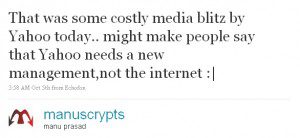
    Media Post reports that Yahoo’s latest campaign caused its perception among U.S. adults to fall steeply – apparently, YouGov’s BrandIndex, which tracks daily consumer perception of brands, found that Yahoo’s buzz score had tumbled from 35.4 on Sept. 22 to 25.5 as of Monday. Acknowledging India’s growing significance, the $100 million (global) “It’s Y!ou” campaign was rolled out in India too – y!ou couldn’t have missed the “disruptive” frontpage takeover of multiple mainstream dailies or the TVCs. My views on it were expressed in <140 characters

    Clipboard02

    Before you take me for some kind of Yahoo hater, I’m not. (Actually, I’m quite a fan of the Carol Bartz style of no-nonsense management – typified by the last few lines here) In fact my irritation with them stems from their relative disinterest towards a few tools that were original pathbreakers and that they’ve had for a long time – most importantly ‘delicious’, but I’ve written about that earlier, and some work on that service has happened since. So, anyway, Yahoo, this is not about you, you were simply a prolongued prologue, and a good example.

    A couple of weeks back, when writing about Wave, I’d wondered  “is brand equity an excuse/surrogate for thin value, and exist only in theory, or until the last good product?” This entire activity above somehow reminded me of that. Brand equity, and the lord knows there’s no shortage of definitions. (ignore the newspaper brand references)  So why did I think brand equity is now a surrogate/excuse for thin value?

    Every brand that enjoys good equity now must have provided ‘thick value’ at some point of time, to its audience. At some point though, did the ‘brand’ take over, and the focus become more on perception management, rather than as an aid to retaining/attracting customers. Is that the reason why brands in many industries cannot find a way past the disruption they’ve been facing – because they’ve been focused on creating brand equity basis communication and superficial value additions, and sticking way too close to the specifics, like competition, and not bothering about the generic fulfilment of a need?(classic example, newspapers and news delivery) Somewhere did brand and marketing communication start dominating the proceedings, at the cost of the basics – a product solving a need/a distribution that increases convenience/the factor that built the equity in the first place? And then did they shortchange consumers by putting a premium on the brand’s equity without delivering value? While trying to build the emotional connect and create a value perception beyond the commoditisation, did the means become the end?

    Take Yahoo for example. By an unfortunate coincidence, last week, GMail replaced Yahoo Mail as the most popular email service in India. I can imagine why. Like many others, I have multiple Gmail ids, and a Yahoo id too. While I open Yahoo because of a couple of e-groups, GMail is my primary communication centre. It has never been static, features and tools have been added to a point where I wonder how I worked without them. (try operating in basic HTML for a while) I checked Yahoo out again, with as fresh a perspective as i could, and didn’t find anything that could make me consider a shift. I still use Delicious a lot, and it still has a lot of equity (in my mind) going for it. Yahoo’s brand campaigns have nothing to do with it.

    Maybe the concept of brand equity had some merit when the audience didn’t talk to each other, but as WOM keeps getting bigger,  push brand communication is bound to become more meaningless. As consumption patterns change, needs change, distribution systems change, as real-time becomes the norm,  and exit barriers and costs for consumers come down, relying on a static and uni dimensional concept of brand equity is bound to be harmful. Also, with fragmenting media, fragmenting audiences, and an increasing importance for ‘my experience’, brand equity will be different things to different people at different times, and even the hazy setof objective measurements in vogue today, would be rendered ineffective. (Yes, it might have been the same before, but in an earlier era, consumers did not talk to each other, and it was easy to push the brand’s equity on to consumers). (Generalising, but) Take a look at the communication and taglines adopted by brands, their superficiality, the efforts that go into forcing the tagline’s emotion/value into the actual value provided, and thereby build/increase brand equity and you’ll see what I mean.

    Clipboard02

    Perhaps, product equity will be the only measure that matters, and brand equity will be earned and burned real time, as consumers share feedback and rely on their trusted sources for updates, and historic performances will decrease in significance. (when the Fail Whale comes out on Twitter, evangelists become bloodhounds, or whatever..you know what I mean) And so perhaps, from a brand perspective, its about time that meaningless communication took a back seat, and we went back to the basics of brand equity, that may mean redefining the roles and responsibilities of everyone associated with ‘brand’ as a function. Because if you’re good, they’ll talk about you, and if you’re bad, they’ll talk more about you 🙂

    But you know what, I had more fun when i thought about a parallel. Thought leaders. Replace ‘brand equity’ with ‘thought leaders’ (or personal brand equity) and tell me what you think. 🙂

    UPDATE: Yahoo hires a new agency, tells Ogilvy “It’s not Y!ou”.. Damn, that was fast!!

    UPDATE 2 Meanwhile, a homepage redesign gives them 9% more page views and 20% more time spent.

    until next time, equitable solutions..

    Bonus Reads:

    Braggarts take over the web

    Almost unrelated, but an excellent read – Jerry Yang’s Advice in Interesting Times (via @mukund)