Tag: coke

  • More than fizz and froth

    While the recession hits the economies worldwide, the cola giants have been trying their bubbly best to get the fizz back into the lives of their target audience, through hope and optimism campaigns.

    Pepsi began proceedings with its new logo, accompanied by a tagline “Every generation refreshes the world”. You can catch an entire set of creatives in this New Year video. On an aside, the (yet to be proved conclusively) brief for this campaign has caused much amusement. You really have to take a look – it is bizarre and includes everything from gravitational pull and thr relativity of space-time to Mona Lisa and the Bible!! (via psfk) Meanwhile, Coke rolled out its ‘Open Happiness’ campaign a few weeks later, complete with a massive campaign and 2 new Super Bowl spots, prompting the question “Who smiled first“. The answer turned out to be Obama, but Pepsi claimed that finally Coke was following them. Coke pointed out that it had started using smiley logos six months back.

    Critics have been skeptical about Coke moving away from the ‘Coke side of life’. Pepsi, they say, having always been a youthful brand has been able to bring out a more buoyant and less laboured campaign. In India, they’ve decided to be totally Youngistan, with SRK no longer a brand ambassador, leaving us stuck with Ranbir Kapoor’s adventures. Some respite recently from Dhoni and gang, with the baap connection.

    Meanwhile, these campaigns also made me wonder whether typical mass media communication and feel good campaigns are indeed the way to connect during such troubled times,  more so when I read this article by Tom Martin in AdAge. It talks about “the simple human need to connect to others.”

    And that brings me to a brilliant campaign I’ve seen (virtually) – froth brand this time, instead of fizz- Starbucks’ “I’m In” campaign, (in association with ‘Hands On Network’) “ an initiative to make it easy to participate in the President-elect’s call for national service.” The campaign allows a person to pledge five hours or more of community service toward a local volunteer opportunity of choice. It rewards the person with a free coffee. The goal is to raise pledges in excess of one million hours of service from all over the country. You can catch the results here. This is what is correctly described as ‘marketing with meaning‘ – which includes several facets – social, personal, storytelling, disruptive, responsible, each of which gives individuals different sets of incentives to be part of the campaign. Starbucks timed the campaign brilliantly – Obama’s inauguration week, and got itself an Oprah Effect. It has all the ingredients required to make a consumer want to be associated with the campaign, and has used the social web very well.

    Now I’m not sure of Coke/Pepsi in the US have tangible renditions of the happiness theme on ground, but I know several campaigns in India which have paid lip service to excellent themes/ideas and have ended up looking superficial. In the times and circumstances we live in, there are excellent opportunities for brands to genuinely do good to society within the sphere of their category, and thereby increase their equity in the consumer’s mind.  (Jaago re is a great example) I wonder how many brands will see this.

    until next time, a lot can happen over coffee 🙂

    PS. While on fizzy stuff, did you hear about the RSS launching cow’s urine as a soft drink? Called gau-jal, its undergoing laboratory tests and would be launched “very soon, maybe by the end of this year”. Sumant suggests Mo (rarji) Desai in low riding jeans, basketball jersey and bling, as brand ambassador, and I suggested the tagline Pee yo! Wonder if Coke and Pepsi are pissed 😉

  • Brands & Associations..

    When we met sometime back, Nikhil asked whether I’d noticed the smudging of the Coke logo in a scene from Slumdog Millionaire. I hadn’t, and we weren’t sure if there was something to it. A few days back, I saw this article in Campaign India, which spoke about Mercedes and Coke rejecting an association with the movie, and demanding that their ‘association’ with the movie be smudged/deleted – Mercedes, because a gangster is driving it (passenger – Mahesh Manjrekar, during the cricket game-police chase scene) and Coke, because it is offered in the slum (as a ‘carrot’, before they are taken to the beggar camp). The article ends with

    While the average brand manager would have been delighted with the seeming ‘free’ publicity, executives at both Benz and Coke took a deep breath to consider the dangers to the brands. There would certainly have been some short-term gain, but was that gain worth it in the context of possible long-term damage?

    Possible long term damage?! I wonder if Mercedes-Benz has this set of parameters, which a potential customer has to fit, before he is given the keys. Maybe they do, I haven’t tried buying it, but then what about resale? What about proxy owners? On to Coke, do they restrict their distribution channel to areas which their specific target audience resides in? Does a pet bottle self destruct when it recognises economic/living conditions that it would not fit in? Does Coke actually mean that when i am thirsty, I’d not have a Coke because Jamal, a slumdog, had it in a movie??!! So, what exactly are we trying here? I am going to focus on Coke, because with their price tag, Mercedes-Benz can afford to be elitist, but Coke??!! Besides, at #22 in the Virtue’s most social brands of 2008, this is hardly the kind of mindset I’d expect from Coke.

    I understand that a brand has a certain target audience (in terms of demographics-SEC) it keeps in mind while designing communication. Good, it gives focus. But aren’t we going a bit ahead of ourselves when we think that consumers really have the time to check out all possible associations of the brand, especially these one off occurrences? (unlike say, the Indica – taxi phenomenon)

    At a time, when people can shoot what they want and load it on YouTube/Flickr and get a few thousand hits before the brand manager can say ‘Cut’, what sense does such policing make? Really, how much can you control where your brand is seen and what is being done with it? (Remember Diet Coke + Mentos)

    Almost 20 lakh views. That’s viral. Smudge that!!

    IMHO, this is exactly the kind of restrictive thinking that brands cannot afford in such times. Coke could’ve easily converted this into a ‘From Slumdog to Millionaire – Coke (Always/The Coke side of life/Open happiness)’ stance. But what do I know, I’m just a normal consumer 😐

    This very interesting adliterate article talks about empathy, and how brands try to understand consumers but never try to see the world through their eyes. By starting out with this perspective,

    We would then perhaps have a collection of real and individual stories about people who are from the group we are seeking to influence. These would be real accounts of real people’s lives.And to get those stories we would need a new approach to engaging with people directly and without fear.

    Instead, as he correctly states, we try to lump our audience into easily manageable categories, so that communication then becomes automatically an easier job. The old media scenario and the systems of distribution therein, had a way of making this perhaps the only way. But with the proliferation of niche TV channels, the web and social media, brands can now break the big lump into almost individual pieces which gives each potential consumer a unique relationship with the brand.

    Based on their context, a single brand means different things to different people, and fit into their lives differently. The sooner brands recognise this, the more meaningful their communication can become, to the consumer.

    until next time, open up 🙂

  • Locally cold, globally cool

    Like I commented here,  my reaction to Coke’s latest TVC is one of its own iconic tag lines – Thanda Matlab Coca Cola. The ad, which tries to showcase that Coke, in the festive season of Diwali brings family, friends and even strangers together, left me absolutely cold. While the earlier Hrithik commercial was far from impressive, its tag line – Jashn Mana Le, I thought, would’ve been a great fit here, wonder why they didn’t continue the thought.

    Coke has, in the past, done some great contextual stuff. I recently came across an old ad of theirs that used the premise of Grand Theft Auto, and did a neat twist to the character, who does good deeds instead of bad ones, and says that ‘Give a little Love and it all comes back to you in the Coke side of life!’ That seemed to be taking forward the theme of an older ad – “What goes around comes around”. I wonder why the ‘Coke side of life’ has not been utilised here. Actually, even this old Xmas ad of theirs was well worth aping.

    Meanwhile, Coke’s on to a lot of good things otherwise. I recently read about its efforts to go green. This  TVC, which aims to spread awareness of the fact that Coke is made without any artificial flavours. is a part of this effort. They recently launched a range of sustainable tees, made from its recycled PET bottles, and in the recently concluded Olympics, distributed it to athletes. They also partnered with the Olympics organising committee to make sure that all PET plastic bottles collected from all official venues were fully recycled into valuable reuses. Read about more efforts here.

    Coke has also launched The Design Machine, which ensures that its image in markets, across all brands,  around the world reflects the core strategy as far as POS materials go, but allows enough flexibility for localisation. This should allow them to get the perfect mix of glocalisation. You can read the details here.

    And its not just the real world, but they seem to be doing some interesting stuff virtually too. Coketag is a widget that allows users to package and share links across the web. This can be a “blog, work, interests, team, band or whatever you like or care about”. Once the links are shared, you can also track its popularity. The widget can also be shared on Facebook. A good widget to facilitate connecting and sharing, another aspect of ‘the coke side of life’ (via Startup Meme)

    All the above activities are in line with Coke’s position as a market leader. With the advances Coke is making in glocalisation, we can hopefully see the good work happening in other markets being adapted contextually in India. Or we could make better ads here 😐

    until next time, the green side of life..


  • Social Icing

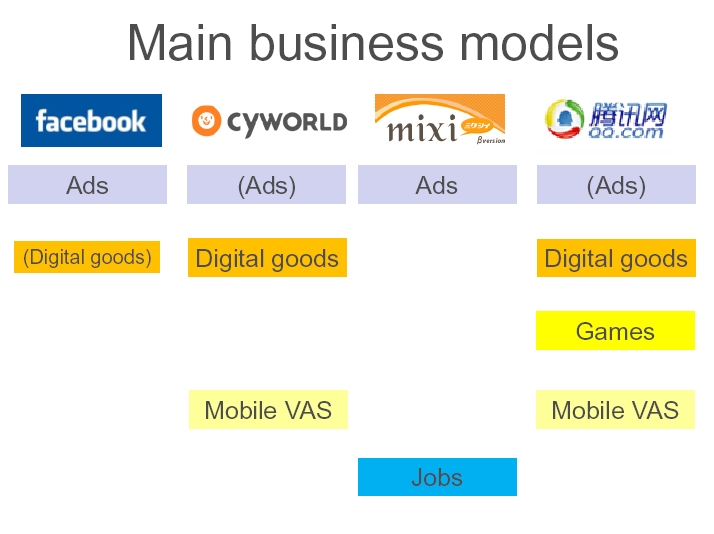
    Continuing from what i wrote earlier, the social networks we’re familiar with (assuming you don’t use our friendly neighbourhood sites – cyworld, qq, mixi) have a revenue mix of ads and virtual goods. However, as the chart below will show you, this is not the only way to monetise a social network, as the chart below will show you.

    clipboard01.jpg

    Courtesy – http://www.plus8star.com/ 

    Now, should that make our familiar networks hmm, disoriented? :D. Not exactly, because the population is there, even if its lesser than the other sites. The word of caution, is that the audience reaction to monetisation can never really be predicted.

    Social media is indeed popular, though it is felt that it lacks metrics which are so important for monetisation.That however, has not stopped brands from using the networks in a variety of ways. From making groups to building applications and so on, brands have cashed in on the network’s popularity to hook the customer on one more platform. This, for example is a post on social media marketing strategies.

    The common newspaper ad sales motto is that they lease their relationship with their customers to paying third parties. While the digital scene has diverged from traditional media in a lot of ways, I’m not quite sure why this can’t be made true for social media. I agree that a lot of applications are also a value addition to the site since they keep the visitors glued, but that can’t be the case always.

    For instance, look at this application on Facebook by Coca Cola. I doubt if Facebook is making any money from Coke. But the basic questions are ‘Whose platform is Coke using?’ and ‘Whose audience is Coke using?’. And so, why can’t this be a way for Facebook to make money? By all means, allow developers to make applications, but if brands are involved, no harm in asking them to pay. Use part of the revenues to keep users happy by providing better features. That’d be the icing.

    until next time, socialism 2.0

  • Coke and Bull

    At the risk of being questioned about what i had for breakfast or about my recent smoking habits, i have decided to post this absurdity.

    Saw the new Coke ad yesterday featuring HR (no, not the unfriendly department kind or the topi kind, but the Roshan kind). According to agencyfaqs, research stated that a lot of youngsters, after their regular nightlife go to street food joints, thats true for most cities, and since coke goes with most food, that right there, was the thought behind the ad. Fair enough. The line now is ‘Jashn mana le’ as opposed to ‘Piyo Sir, Uthake’ (er, something like that).

    20565_2.jpg 20565_4.jpg 20565_6.jpg 20565_7.jpg

    Meanwhile thats not the absurdity i was talking about. Since HR and Ash are both citizens of Cokistan, how much fun would it be to do an MTV style spoof on the song ‘Jashn -e-bahaar’ from Joe Tha Akbar (copy error, ignore), with a video to match, and use it as a brand ad for Coke?

    For those who have concluded that I’ve lost it, wonder what you’d have thought if i shared the other idea that also involved Celina Jaitley, the brand ambassador for Jashn, an ethnic Indian wear brand.

    until next time, I’ve not been on coke!!