
Tag: CNN

  • A plus cases on Twitter

    Last week, @aplusk beat @CNNbrk in the race for one million followers. In plain English, Ashton Kutcher, an actor, challenged CNN on Larry King Live – who would get to a million followers first – to prove a point that an individual could have a reach equal to a large network on Twitter. Twitter joined in the fun, because unlike the norm, users couldn’t unfollow either of the parties, of course smart tweeps found a way out anyway.  Point taken, AsKu, though the irony was that until a  week back, the CNN account was not run by them, though for sometime they’ve been managing the account through the person who created it.

    For more than two years, the CNNBrk account (for breaking news) had been created, maintained and run by a 25-year-old British Web developer who just wanted a way to beam short news alerts to his cellphone.

    And that’s the beauty of this user driven service. Something that I fear might change with the ‘mainstream’ spotlight and the rush of real celebrities. Its only a matter of time before a new celebrity thinks of a new stunt. But it is to be noted that  Kutcher is donating 10000 mosquito nets worth $100000 to a charity. In fact, one week before that, I’d read about Hugh Jackman’s donating AUS $100,000 to charity via Twitter, the charity to be selected via Twitter pitches.

    Now, I’ve always maintained that users should figure their own comfort levels and use the service accordingly. But I also feel that a sudden influx of people with no intent other than rooting for a celebrity might be the kind of inorganic growth that will work against the service and its more regular users. This could range from a disruption of the service due to the load to a change in the ‘culture’ of the service.

    Kutcher’s point was about getting a reach higher than a media giant. I’ve always had a problem with numbers – followers, updates etc as a means of measurement on Twitter. I find it a paradox for a place which became popular because of a qualitative measure – conversations. CNN will deliver breaking news regularly, and (as someone suggested on Twitter) Kutcher followers will just have to wait for those occasional Demi photos. Reach has been an index to sell traditional media space, is that the benchmark Twitter wants to take forward?

    There was a very interesting post on Tech Crunch on whether Twitter should remove its follower count. Like I tweeted, I’d agree. Once upon a time, it was a medium to share an instant – something you thought/read/saw/felt to make others smile/think/share their own expressions. With growth came the ‘how a tweet might cost you a job’ and ‘5 ways to increase sales with Twitter’ theses, and the instant was lost. Perhaps you will ignore that as a subjective grumble. But think of the times you see the ‘need 5 more followers to get 500. please RT’ and what you feel then. What happens when that’s the norm and the service changes to accommodate and encourage that culture because that’s what helps them make money. [Note: I’d love for Twitter to make money, but I’m sure they’ll find better ways]

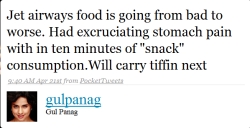
    While on celebrities and Twitter, closer home Gul Panag has been quite active on Twitter the last few days. The Twitterverse has had its share of imposters and has been trying to ensure there’s no ‘identity crisis’ this time, so much that poor GulP might have one soon. This tweet of hers caught my attention. (Oh, okay the dimples too!!)
    gulp1

    Spicy Jet news. Poor them. It reminded me of a post I’d written sometime back on ‘Social Ambassadors‘ – what would happen when the transparency of social media met celebrity bloggers? In this case, micro bloggers. In fact, micro blogging is even more ‘dangerous’ since the interaction is real time, and not like a PR draft that can be posted on ths site, and replies given in a few hours or even days. This becomes all the more important if celebrities use social media as a personal broadcast medium to their fans. Of course, brands can use the media to their benefit too – for example, create conversations between celebrities (a Twitter conversation between Aamir and Gul basis their Tata Sky TVC would be fun), use celebrities to communicate beyond the obvious advertisement etc.

    The challenge is for celebrities too. Perhaps it will also make celebrities more responsible when making endorsement choices. (It would be fun to ask SRK/Aamir why they switched soft drink brands in between.) Also, can celebrities retain their ‘interestingness’ when they are in touch with the fans all the time, unlike a traditional system when news about them was less abundant?

    On an aside, when celebrities move to direct-to-crowd platforms, what happens to the go-between media for whom they were the news makers, and we were the news consumers? And what happens to the micro celebrities on Twitter? 🙂

    until next time, when twitter streams meet mainstream
  • Social Advertising

    A post on the WindChimes blog sparked off an interesting argument on whether banner advertising on Facebook is called Social Media Marketing. But before we step into that, a quick look at what Facebook has been upto recently.

    Facebook recently announced that users had uploaded 10 billion photos on the network. Considering that Facebook’s not a flickr or picasa, this gives an indication of the quantity and quality of users’ relationship with the social networking service. Facebook also recently announced its Fb fund recipients. Read about this effort to help seed innovation here. For those who want to check out Facebook as a desktop app, check out Visual Sage. (via Startup meme) Facebook Connect has also been in the news recently. It is scheduled to launch on Nov 30. You can check out CNN’s Facebook Connect implementation – for the post presidential debate discussions, here. There are also links to the implementations of CBS, Red Bull etc. And the last ‘collateral’ links to a wonderful take on Facebook friendship, and this on social networks, revenues, and brands’ expectations from them. Meanwhile, Facebook can draw solace from the fact that it was the social network of choice of 1/3 of the  US online retailers interviewed. (from a study by Internet Retailer and Vovici via WildBlueSkies)

    As far as advertising goes, the inclusion of Microsoft Live Search into the social network is quite a significant development. Goes without saying that along with the search results, a few ads would also be thrown in. 🙂 Looks like win-win, for both Microsoft and Facebook. (with their revenue/cost concerns).

    And now, whether Facebook Ads are social media. I’d say (technically)any advertising on a social network would automatically qualify for social media marketing, since advertising is a way of marketing. Now, with specific reference to Facebook, as part of its redesign earlier, Facebook had also categorised the different kinds of ads that can be purchased. Out of the 6 categories mentioned, #5 is akin to a first generation banner ad.  I’d written about some unique features of Facebook Ads earlier. Like I’d mentioned in that post, this normal banner ad has been given a cool social twist by allowing users to give it a thumbs up/down and give their reasons for doing this. Let me go a step down and ignore the rating. Connecting my profile and actions to the kind of ads served, it gives the ads at least some contextual connection, and hence appeal.  So, in practise too, I’d consider banner advertising on Facebook a part of social media marketing. On Magpie, over on Twitter, however, I’m still in two minds.

    until next time, social soul searching

  • Twitter Updates

    While the last post covered some ground in terms of social media, an entity which was conspicuous by its absence was Twitter, perhaps the social media tool that I use the most, these days. From sharing my anguish at Raikkonen ruining the Ferrari party in the penultimate lap of last weekend’s race, to checking out exciting sites/services that others have found, Twitter plays multiple roles in my communication.

    There have been several Twitter based services that have been launched since my last twitter post. We’ll start with Twittad. (via Mashable) If you have a not-so-bad twitter following, you can just sign up on the site, give your number of followers, and auction your twitter page to an interested advertiser. Check out the left side of this profile, he got $15 for a month’s display of that ad. Now, the background in Twitter is not clickable, so its just like say, a virtual non-interactive billboard. My bigger concern is that this is visible only to those who use the web interface. If you use say, Twitterfox, a browser plugin, or a desktop client, you may not even see this ad.

    That’s not the only advertising model available on Twitter. Another option I came across is Twitterise. This seems a more robust tool, and allows marketeers to use twitter as a platform. With a twitter account, you can schedule communication to go out to consumers, and more importantly track it in terms of response. Read more about it here. Its a nifty lil tool, and once users can get more detailing in terms of the clicks (who, when etc) generated, its a do-it-yourself kit for any brand manager to test out twitter. I’m going to give it a spin very soon, for my brand. 🙂  But the real story is Cherp, which is an entire agency that’s “dedicated to finding brilliant ways to leverage the Twitter platform and network”. I’m lost for words, even 140 characters!! On a sidenote, I read an interesting suggestion for Twitter to get some revenue.

    There are some interesting stuff for regular users too. For those who are also active on Digg, there’s a new tool Twiggit, which allows you to let your followers know everytime you Digg an article. Two great services, and one awesome mashup, i think!! The other tool I came across is Lazy Tweet, which works on crowd sourcing your answers. While I already use Twitter to get lots of answers, the next time I want a question answered, all I’ve to do is start the tweet with lazytweet (or a few other options), and I’ll get access to a bigger crowd than just my followers. Read more about it here. If you’re the video kind, Viddler has launched a new service called 15s, which lets you share your 15 secs or lesser video with your twitter friends (via Center Networks). There’s already a player in this market – 12seconds. And lastly, if you’re the textual kind, check out this post on literary experiments on twitter.

    I read a post on how a tweet does not make a brand. I agree, one does not, but the idea is of conversation, of engaging with consumers in real time. The objective is to involve the consumer in the idea of the brand and thus make the brand more than a soulless entity that caters to one specific need in their life. Many brands are making an attempt at this conversation, take a look at the stories here. And of all the efforts, I’d rate CNN as the best. In spite of the Olympics argument, it still experiments with the medium. I read a few days back that it was promoting Twitter heavily on air, now that’s what I call great integration. And it’s not just one anchor, the engagement on Twitter is being taken to different levels, including a Twitter show. Really awesome stuff. I hope we get to see more more activity, and from more organisations.

    until next time, go tweet

    PS. If you use twitter on your blog, and are okay with handling code, you could check out TweetRemote, which allows some level of customisation.

  • Virtual Fourth Estate

    A few articles that have to do with newspapers caught my attention in the last couple of weeks. One was the fact that Instablogs, is doing something I desperately wished it would do – opening the network for external blogs. I personally consider Instablogs a good benchmark for what online news sources should be,  going forward. If you haven’t checked out Instablogs yet, now would be about time!!

    The second was an article on whether we need editors anymore. That question would be quite controversial in any case, but it helps when The Guardian asks this. It is quite a compelling read, and makes some telling points, on how editors should evolve in the digital era. I think that it also points to a mindset change in the newsroom and the presentation of news, because the way news is consumed is also changing. “Reporting becomes a process more than a product” and thats a fundamental shift in the way newspapers approach the business. Here’s a great read on the subject. It is sad to see how newspapers, with some of the best resources, are not able to channel it to better use on the internet. This is a perfect example for what I’m trying to say. Now, once you’ve thought about all this, check out Instablogs’ tour. It might explain why I find the site awesome.

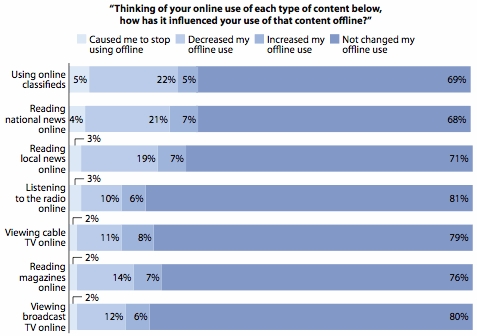
    Why is it important for newspapers to address the digital mindset issue? This data, (via here) though pertaining to the US shows how blogs and the online medium in general is making inroads into what was till now, the newspapers’ domain.

    While, with a 4.5% penetration, newspapers aren’t exactly on a ‘near-death spiral’ in India, I believe it still might be just a matter of ‘when’ rather than ‘if’. Speaking of which, the last article I wanted to discuss was one on WATBlog about Indiatimes’ launch of Hotklix, a Digg like service. Like I commented there, it would’ve been a great way for TOI, ET and all the publications of the Times Group to showcase the loads of content that they possess. How about seeding articles on a daily basis? Where is the integration of the TOI, ET websites with Hotklix, where I can bookmark an article immediately after I read it?

    On an aside, there are traditional news networks doing some pretty cool things on the web. CNN, for example, is allowing users to embed videos in blogs social media etc. No, that’s not a newspaper, I know, but it does come under ‘traditional media’. But even CNN received some flak a couple of weeks back. CNN is present on Twitter, and I happened to see this article, where a few users got pissed off with them for spoiling their Olympic fun. But that doesn’t stop the mashups. Take a look at Dialogg, their collaborative effort with Digg.

    Given that newsprint costs are rising, all over the world, and people are increasingly raising an uproar over cutting down of trees, I think its about time that newspapers took a long hard look at how the digital medium is transforming the content landscape. After all, we even have sanskrit newspapers going online. By digital, I don’t mean just the web, it could be the mobile too. 9.22 million subscribers have been added this month. I would like to compare it with the circulation additions for newspapers. Meanwhile, just read about an effort – MeraMobi, by the Dainik Bhaskar group in association with Pitroda Group LLC.

    Traditional media, especially newspapers, world over, have painstakingly created an equity and trust factor that’s extremely relevant in a transparency and trust led digital era, it would be sad to see it wasted. After all, with increasing global warming fears, newspapers might soon occupy the space that furs occupy now, so it might make sense to hunt for some virtual fourth estate.

    until next time, read….online? 😉

  • Traditional Media 2.0 ?

    Traditional media, and specifically the print media, don’t seem to be too worried about the web being competition. Possibly justified, since, unlike their counterparts in the US, their circulation numbers don’t seem to be dipping. Which is perhaps why, they don’t think much of web 2.0 or the potential it offers to them. For now, they’re satisfied with saying that they are on the web too.

    In fact, the TV sites like CNN IBN and even NDTV to a certain extent looked much more closer to what a media site should be, online. Even they have some way to go before they can take on, say a CNN. I recently saw India Today’s site, which shows some promise.

    But I’m wondering if the story of traditional media websites and pure web players is a little like the old hare and tortoise story, roles played respectively. Consider this, the JuxtConsult 2008 report says that checking news is the 4th most common activity that Indians indulge in, on the Internet. The same report shows Yahoo as the most preferred site for this purpose, with MoneyControl and CricInfo taking the top spots in Financial News and Cricket news respectively. At a circulation of 31.46 lakhs, why doesn’t TOI find a place there? If we take into account that the Internet in india is still at a nascent stage, don’t the already popular dailies have a good chance of replicating their success on the internet, especially if they start early and already have a good credibility factor in that space?

    And this is not restricted to English media. With every online player realising the importance of vernacular, even the regional language players cannot afford to stand and watch. Which perhaps Malayala Manorama has realised, because the last few days saw a flurry of activity in pushing their website as well as their matrimonial site. One could say that the latter is a late entrant, but in both cases, MM is heavily leveraging their strengths in traditional media. This is of course, in addition to the news channel and radio stations. Perfectly poised, I’d say.

    Meanwhile, on another and what I would consider a more dangerous front, there are entities like Instablogs, which in addition to a wonderful design, does a superb mix of news and user generated content, including the recently added user-generated-video-news, all of that based out of Simla. Sigh. Not to forget webdunia, which though does not boast of a cool interface like the former, is doing very well on the regional media front.

    With the rapid penetration of the mobile, the increasing access of the internet through mobile, and the vernacular factor, I’m wondering if the race in India will buck the regular trends shown globally, and suddenly swing in favor of the new media players, while the hare is caught napping.