
Tag: Charity

  • A plus cases on Twitter

    Last week, @aplusk beat @CNNbrk in the race for one million followers. In plain English, Ashton Kutcher, an actor, challenged CNN on Larry King Live – who would get to a million followers first – to prove a point that an individual could have a reach equal to a large network on Twitter. Twitter joined in the fun, because unlike the norm, users couldn’t unfollow either of the parties, of course smart tweeps found a way out anyway.  Point taken, AsKu, though the irony was that until a  week back, the CNN account was not run by them, though for sometime they’ve been managing the account through the person who created it.

    For more than two years, the CNNBrk account (for breaking news) had been created, maintained and run by a 25-year-old British Web developer who just wanted a way to beam short news alerts to his cellphone.

    And that’s the beauty of this user driven service. Something that I fear might change with the ‘mainstream’ spotlight and the rush of real celebrities. Its only a matter of time before a new celebrity thinks of a new stunt. But it is to be noted that  Kutcher is donating 10000 mosquito nets worth $100000 to a charity. In fact, one week before that, I’d read about Hugh Jackman’s donating AUS $100,000 to charity via Twitter, the charity to be selected via Twitter pitches.

    Now, I’ve always maintained that users should figure their own comfort levels and use the service accordingly. But I also feel that a sudden influx of people with no intent other than rooting for a celebrity might be the kind of inorganic growth that will work against the service and its more regular users. This could range from a disruption of the service due to the load to a change in the ‘culture’ of the service.

    Kutcher’s point was about getting a reach higher than a media giant. I’ve always had a problem with numbers – followers, updates etc as a means of measurement on Twitter. I find it a paradox for a place which became popular because of a qualitative measure – conversations. CNN will deliver breaking news regularly, and (as someone suggested on Twitter) Kutcher followers will just have to wait for those occasional Demi photos. Reach has been an index to sell traditional media space, is that the benchmark Twitter wants to take forward?

    There was a very interesting post on Tech Crunch on whether Twitter should remove its follower count. Like I tweeted, I’d agree. Once upon a time, it was a medium to share an instant – something you thought/read/saw/felt to make others smile/think/share their own expressions. With growth came the ‘how a tweet might cost you a job’ and ‘5 ways to increase sales with Twitter’ theses, and the instant was lost. Perhaps you will ignore that as a subjective grumble. But think of the times you see the ‘need 5 more followers to get 500. please RT’ and what you feel then. What happens when that’s the norm and the service changes to accommodate and encourage that culture because that’s what helps them make money. [Note: I’d love for Twitter to make money, but I’m sure they’ll find better ways]

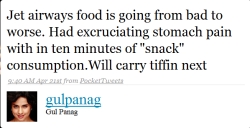
    While on celebrities and Twitter, closer home Gul Panag has been quite active on Twitter the last few days. The Twitterverse has had its share of imposters and has been trying to ensure there’s no ‘identity crisis’ this time, so much that poor GulP might have one soon. This tweet of hers caught my attention. (Oh, okay the dimples too!!)
    gulp1

    Spicy Jet news. Poor them. It reminded me of a post I’d written sometime back on ‘Social Ambassadors‘ – what would happen when the transparency of social media met celebrity bloggers? In this case, micro bloggers. In fact, micro blogging is even more ‘dangerous’ since the interaction is real time, and not like a PR draft that can be posted on ths site, and replies given in a few hours or even days. This becomes all the more important if celebrities use social media as a personal broadcast medium to their fans. Of course, brands can use the media to their benefit too – for example, create conversations between celebrities (a Twitter conversation between Aamir and Gul basis their Tata Sky TVC would be fun), use celebrities to communicate beyond the obvious advertisement etc.

    The challenge is for celebrities too. Perhaps it will also make celebrities more responsible when making endorsement choices. (It would be fun to ask SRK/Aamir why they switched soft drink brands in between.) Also, can celebrities retain their ‘interestingness’ when they are in touch with the fans all the time, unlike a traditional system when news about them was less abundant?

    On an aside, when celebrities move to direct-to-crowd platforms, what happens to the go-between media for whom they were the news makers, and we were the news consumers? And what happens to the micro celebrities on Twitter? 🙂

    until next time, when twitter streams meet mainstream

  • The egoism that lurks…

    Sometime back, our yoga instructor spoke to us about the importance of forgiving. While most of it I agreed with, there was one part where I thought i’d a different point of view. She said that forgiving was possible only if the ego had been eliminated (for all practical purposes). My point of view (which unfortunately i didnt have time to express) was that ego was inherent in forgiving, showing that the forgiver is in a higher plane than the one forgiven. But I am assuming that the teaching was fine, there must be a kind of forgiving I am not aware of…yet.

    The same kind of thoughts assailed me, when i read this post by mathatheist, where she wrote about charity. (you must subscribe to her daily musings, a wonderful read everyday) She wrote about the need for love (as opposed to pity) in charity. I am in agreement with the role of intent in everything that we do. Intent is what will drive everything else. To be fair to self, I have negligible thoughts of pity in any act of charity. The way i have driven it away is via a simple thought – I imagine someone I love, struck with a fate that the beneficiary has, and compassion replaces pity. I believe there’s a difference between the two. But the compassion is tinged with an enemy that is not so easy to dispose of – the ego. It shows its presence with a smirk and an unhealthy, unnecessary reminder to myself that I’m in a position to donate something (however insignificant it might be) for a cause. But I am assuming that the acts are fine, here must be a state of compassion without the ego, that I am not aware of…yet

    until next time, to land the ego….

    PS. any Ayn Rand fan here? Egosim is an important part of her Objectivism philosophy, which i am otherwise a fan of 😐

  • Cause and Effects

    Sometime back I’d written about the potential of the net, and especially the latest community version to do good to humanity. One of the startups that was presented at TC50 (had written about TC 50 in the last post) was CauseCast. Its aim is to bring ten non profit companies into the spotlight every month. How does it do this? By getting celebrities involved, and communicating about the companies through videos, events, and showcasing the activities it does. Every activity has its own celebrity who champions the cause. The causes are broadly divided into animals, arts, community, environment, health, human rights and youth. They also have contextual news for each category. For example, I saw a  news item on Army killings in Manipur under Human Rights. The best part is how it involves the user community. The user can make a portfolio of the causes he has donated for. Over a period of time the list would start reflecting the performance of the companies. The portfolio can also be publicised using a widget on the user’s blog, for example. 

    There are ways for brands to get involved in philanthropy too, in ways which make business sense. Philips has a wonderful program, referred to as ‘philanthropy by design’ which is aiming at social innovation, designing things that help bridge the gap between technology and people. In what’s a very long term vision, it tries to “provide people the means of generating the income necessary to pay for your products.” There’s an interesting Indian piece of this here, which explains how this designing is tied up with employment opportunites and micro financing. The ICICI effort is more than a month old, but is in context. ICICI tied up with an NGO named Dignity Foundation, and created a portal DignitySecondCareers.org, whose aim is to “provide the retirees a platform to explore opportunities that will enable them to continue to utilize their expertise and to encourage them to lead an active post-retirement life.” (via WATBlog).

    As the examples show, these initiatives may not be the cash cow projects in terms of revenue, but the effect it has on the social and human side of life, and the equity it can thereby create for the brand is immense. With some tweaking in the organisation’s mindset/perspective, it can gain tremendous long term benefits.

    Mashable has a good read on starting local support systems, and again, bridging the gap between the real world and social media.  Speaking of local causes, I happened to come across Rang De (via HeadStart), a non profit organisation that has set up a Peer to Peer (P2P) lending platform to connect the socially conscious with those who are financially disadvantaged. “Rang De’s mission is to make microcredit accessible to all by lowering interest rates by doing things differently.” I went through the site, and their model is win-win for both parties – the lender and the borrower. Yes, you would get better returns if you rode the sensex waves, but hey, if that’s the criterion, this endeavor is not for you. I think the concept, like Kiva, is amazing and begins to address India’s substantial need for micro credit very well.  The geographical spread is right now limited to Maharashtra and TN, but its quite scalable, I think (i already saw 3 towns about to be added).  I am going to try Rang De out very very soon, and shall update on my experience. Meanwhile, on an immediate basis, I’m playing the quiz, in this very cool effort – HelpBihar.in, by Quasar Media and Cadence to help those affected in Bihar. Go on, do your bit.

    A few days back, we (my wife and I) made what some might call a strange decision. We chose to go through Give India, rather than Helpage, both are non profit organisations operating in roughly the same space, though Helpage is more focused. The strangeness comes from the fact that Give india takes a percentage of the sum we give for covering its expenses, Helpage doesn’t mention that. The value it adds, and the reason we shifted loyalty was because it sends us a mail every month (or whenever you make a donation) giving us the details of exactly how and on whom the money was spent. While Helpage’s site is far better designed than Give India, the latter has a web 2.0 characteristic I value – transparency. I guess even when we save humanity, we have changed such that we need some accountability. 😐

    until next time, be human