
Tag: Change

  • ..the question remains

    It has been more than a couple of years since I wrote on the subject of planning – the acceptance of destiny vs free will in The Uncertainty Principles and the balance between change and stasis in its follow up. In my mind, the debate continues to rage, with flash points on a regular basis, thanks to various life scenarios and the things I read. I also realised that the recent narrative posts (1,2) are also a different way of framing this debate. Like I wrote in the posts, some narratives are already chosen for us, and some we choose, but these are all our attempts to fulfill our sense of belonging. In other words, our endeavour to find the reason for our existence – our purpose. Does one find it by working towards something or by dealing with life on a real time basis?

    A few days back, I read an article in HBR titled “It takes purpose to be a billionaire“, in which the author classifies ‘purpose’ into three buckets. Not that everyone’s idea of ‘purpose’ is to become a billionaire, but this is very clearly a planned path to achieve something that contributes to the sense of purpose. While the article does not mention it, the category I have always wondered about consists of people who have followed their passion – sports people, artists etc who have worked on a skill and honed it to near perfection. A very interesting perspective I read on that premise is the Scott Adams’ “Practice and Genes“, which takes a look at the theories on the subject and finally states that the critical element is luck. The most important skill involved in success is knowing how and when to switch to a game with better odds for you.

    Which brings me back to purpose and how we find it, and my introspection. “Who looks outside, dreams; who looks inside, awakes” ~ Carl Jung. (via) I thought about the ‘living in the moment’ perspective that finds a place in Buddhism texts and several other works of wisdom. At first, I thought it supported the destiny and real time approach, specially because it is difficult not to have baggage associated with the plans one makes. (literally and otherwise!) But then I realised that it was less to do with the planning aspect and more to do with how we deal with scenarios. Even if one works on a plan, how one deals with a setback to it is where the advice has value. In essence, that won’t help solve the debate.
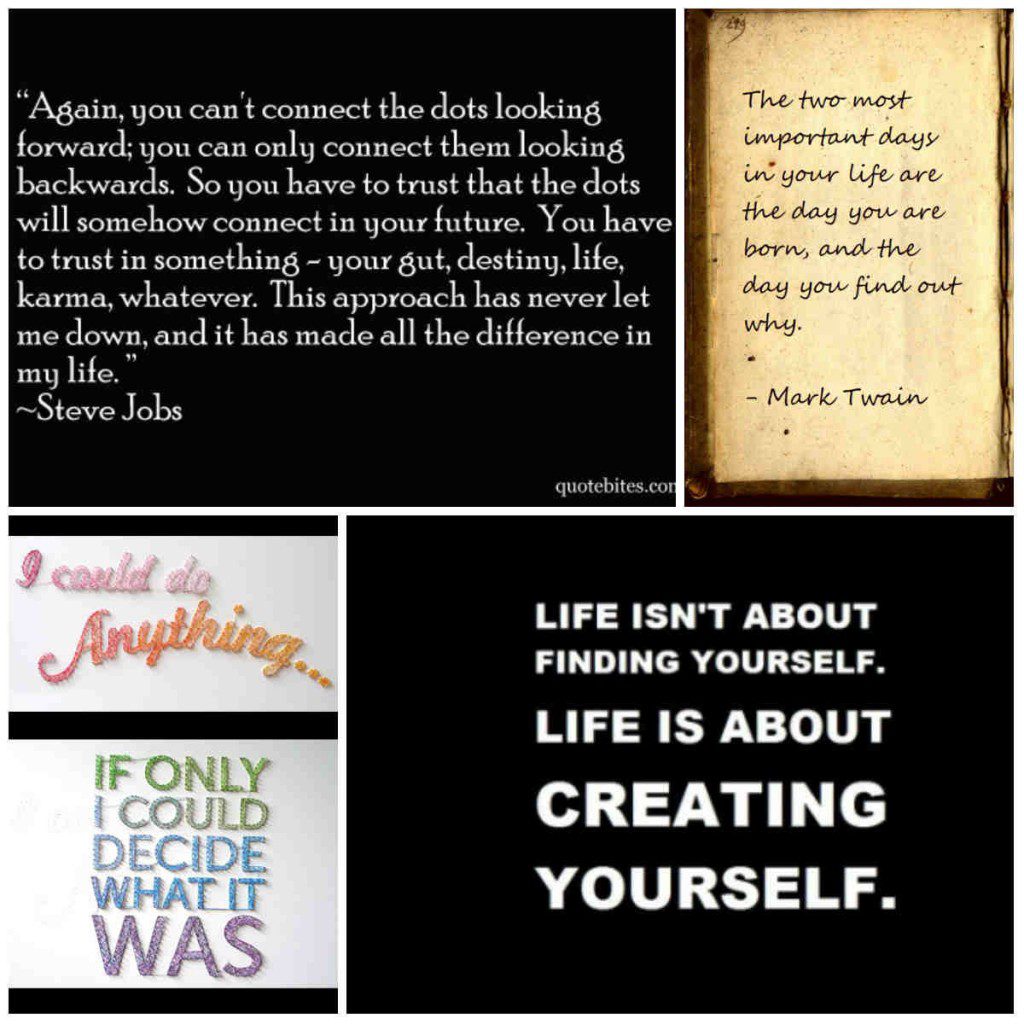
    collage

    There are profound statements that support both ways of looking at it. I continue to rack my brains to find the path that will fit me, or make it. I think there is an element of subjectivity involved. That does not make the job easier, in fact, it probably makes it tougher. After all, “He who knows others is wise. He who knows himself is enlightened.” Lao Tzu

    until next time, the clock ticks away in real time

  • A change of course

    There was an intriguing article on HBR last month, titled “Can Companies Both Do Well and Do Good?” It was based on a research that looked at the correlation  between the financial performance of firms and their social & environmental performance. At the corners of a grid made of both kinds of performances on X and Y axes respectively, are Idealists (great on socio-environmental, but low on financial performance) Trendsetters, Exploiters and Laggards, in the clockwise direction. As should be expected, there are companies all over the chart, and the correlation is near zero! There were outliers, of course, but not really a pattern.

    It made me think whether it was possible for the corporations we see around to do good and well. I am not talking of CSR or ad hoc sustainability projects that would temporarily bring them to a Trendsetter level, but a radical shift that would stand the test of time. We are seeing a paradigm change in the way business is done, but this era is only the beginning of that transformation. In general, the entities we see around are hard wired to maximise profit and not really to spare a thought on the social/environmental or I daresay human fallout of their activities. These are large corporations with individual personnel, processes, shareholders who are used to a certain perspective. These are systems with a single point agenda. Is it really possible to shift them without a huge investment of all kinds of resources – time, energy, money – with no guarantee that this would really benefit the firm in the long run?

    So does this mean that in the medium-long term, these corporations are destined to fail as our understanding of achieving a balance between profit and being ‘good’ matures, and only those which have started/start now with a DNA that is meant to achieve this balance will do well? Or is it that as the individual and societal mindset gradually change, and as social business evolves, corporations will also be able to use that time to slowly transform themselves? I do wonder. What do you think?

    until next time, become the change you want to see

  • A new era of work

    Sometime back, I had written about institutional realignment – on how the internet will slowly eliminate the middlemen across industries and disrupt every institution that we have built thus far – political, societal, economical, professional, cultural, health and so on. This would have massive impact on our sense of identity and how we live as a society.

    A couple of weeks back, I read this interesting post at Pando Daily titled “Are we becoming a world without big companies?” The post quoted AngelList founder Naval Ravikant “the world would be increasingly made up of very small startups interacting with each other through APIs. No big corporations.” The corporation, at this point in time, plays a lot of middlemen roles – from our sense of identity to global relations – and continuing from my earlier thought, I think the internet will disrupt this one too.

    Which then makes one think of the workforce currently employed in the corporations – that’s most of us. 🙂 From 3D printing which is poised to disrupt the already shaky manufacturing industry and the not-so-shaky distribution systems to singularity, which will have major implications on our health, education and employment, there are macro changes that will affect us. Even the best minds would not have a definite answer on what/ where the jobs of the future would be. As Ray Kurzweil has stated in this interesting interview, “People couldn’t answer that question in 1800 or 1900 either. ” (when asked about the scene in 2000)

    It then brings me to something I believe will be the key to survive and flourish in the coming age – the willingness and ability to live with uncertainty. In this excellent read in the WSJ titled “Learning to Love Volatility“, Nassim Nicholas Taleb argues that rather than trying to predict black swan events, we should be building institutions that are not fragile and can withstand and even benefit from disorder and unexpected events. Though an institution is the protagonist here, I think there are lessons for individuals too.

    In a way, humans could be considered open APIs that big corporations and governments used to meet their ends, it would be interesting to see a future that reverses this. 🙂

    until next time, be the change….

  • By Design

    “Your people will judge you on what you build, not what you destroy”, said the  US President. But sometimes, to create, one had to destroy – for instance, his blog’s old design. Now came the difficult part. He hoped that in the two most important sections, there’d still be something good enough to write – Home, About.

    until next time, whatcha think of the revamp? 🙂

  • Change 2.0

    The world, or at least most of it, has been applauding the success of Obama’s social media strategy, stating it as one of the big pillars of his victory, and rightfully so. A look at his homepage would tell you that he is very well connected to the social media scene – ‘Obama Everywhere’. ‘Organise Locally’ (my.barackobama.com) and “Welcome Hillary supporters. Get involved” are two things that impressed me much, the signs of a man who knows wants to carry people along. StartUp Meme has a post on the Facebook stats of Obama’s activities. Obama has 4 times as many supporters as McCain on Facebook.

    Meanwhile, in the case of blogs, 500 million blog posts for Obama vs 150 million for McCain. The ratio is almost 4:1 again. On MySpace, 844,927  friends for Obama compared to McCain’s 219,404. On Twitter, Obama 118,107, John McCain’s Twitter followers amount to 4942.(all data courtesy RWW, and Trendrr) On an aside, Trendrr seems to be a neat service, will use it more, and post.

    And for those who thought that this brilliant use of social media was a campaign stunt (as many brands tend to), Obama has launched Change.gov. (via Mashable), where he is attempting to have conversations, right from asking people to share their election stories and their vision for America, to outlining his own agenda. The two properties of the social web I find most appealing – transparency, and the wisdom of crowds.

    But social media, after all is a tool. Yes, a tool which can take the brand to great heights, but only if it has a strong product/brand at its foundation. And there lies the brilliance of brand Obama. Adage has a great article by Al Ries on the attributes that made Obama’s campaign a colossal hit – Simplicity (of the keyword – change), Consistency (create and maintain the positioning of ‘change’ agent, so that the word is associated with him more than others), Relevance (forcing the competitors to fight on your comfort ground). I was also very impressed with this article on afaqs by Vijay Sankaran, which gave 10 lessons that marketers could learn from Obama. Excellent lessons all, i especially liked the one about relinquishing control.

    The brand was so strong that several of my friends became fans of Obama on Facebook. On election day, I saw a photo of college kids in bangalore wearing Obama tees, and carrying Obama placards.

    As a person in India, the real benefits that Obama can get me are not much, but in addition to becoming America’s messiah, he might have also become social media’s messiah, and virtually, nothing could make me happier than a web 2.0 champion who happens to be the President of America. Yes, Obama, we can!!!!

    until next time, i hope change is a constant

    PS. For those reading this, make a start, join ‘Connected Indians‘. Hopefully we can change India too.