Tag: Change

  • Re: Skill

    In The Entrepreneur and the ProfessionalI brought up the challenges at work faced by my generation. The focus was on an approach to work and the changes that have been forced on it because of rapidly shifting business environments. In addition to the business’ external dynamics, another factor that has been changing the organisation is the entry of a different kind of workforce.

    How the Millennial Workforce is Changing Business” calls this a revolution, and writes further that they will prepare the organisation for the future by making them Digital, Clear, Fluid, Fast. PwC’s layered report on the same subject brings out this workforce’ motivations, acknowledges the generational tensions and suggests what the organisation would need to do to attract, develop and manage millennials.  (more…)

  • Change Strategies

    It was mid last year when I wrote The Change Imperative, which was as much a note on massively changing business dynamics as it was a note to self. I thought the new year was a perfect time to revisit and explore how brands and business can use change as an opportunity. The new year sees a glut of predictions, trends, insights etc, but the one I look forward to is the JWT Future 100. This year too, it impressed me with unique insights and potentially far reaching consequences. But in the change’ context, I found slides 33 and 52 most interesting. Both of these were related to brand strategy – 33 (Third Way Commerce) was about how millennials were looking for brands with clear values, and 52 (The Long Near Game) was on brands taking a dualist approach to balance short and long term goals.

    In my mind, they are related, as brands are making efforts to maintain/create business models that are buffered from current and future shocks and can remain relevant now and later. I found an intersection of the two thoughts in a couple of places. The first was in this post by David Card on new models of  disruption. The first model brought up in this is “Adjacency Platforms”, which is about platforms migrating into new markets or industries. Apple’s iOS moving to payment is the example given here. This thought is also echoed in slides 24-28 of this trends presentation – the phrase used was Startups going ‘Full Stack’. I particularly liked this framing of the thought – It’s not like a brand like Virgin diversifying to follow an audience, it’s diversifying to follow an expertise. Both fantastic approaches, I must say, because they’re based on consumers who believe in the brand’s values. [I believe that Uber is a brand with much potential in this respect – check this]

    (more…)

  • The Change Imperative

    Ever since I first wrote about institutional realignment, I have been more conscious of it and its implications on our lives. To a certain extent, even paranoid, because of the pace of change. Ray Kurzweil is hard at work to make himself immortal, and believes we should get really close by the 2030s. He has been right before on many things of this nature. Moore’s law, digitisation and everything related are also getting us really close to the singularity. I am reasonably convinced that I will see both in my lifetime. If you live to be 200 and have robots smarter than you around, what does that do to education, money, marriage, work and pretty much everything that constitutes life? On the flip side, natural resources are running out, and I can see the complications already. It’s not a good sight, or experience!

    I am finding it impossible to wrap my head around what all of  this would mean to our concept of life. In the meanwhile, I do know that everything is changing at breakneck speed, and in order to survive, we need to be cognizant of things that can impact our lives – as individuals, and as organisations.  I have deliberately avoided the word ‘disruption’ because it gives me a sense of suddenness and it is a furiously debated topic these days. Rather, to quote John Green (said in another context) I think we’re in the first state of “Slowly, and then all at once”.  This, is my take on ‘Change’.

    (Thanks Nikhil for helping on a couple of alphabets and Amit for Unsplash, the source of many images used)


  • The evolution of work and the workplace

    I spent Rajinikanth’s birthday  at Jaipur, all thanks to one of my favourite bloggers – Kavi, who, in his official avatar, invited me to his organisation’s annual HR conference. The theme of the conference was Evolve Connect Enhance, and I can honestly say that many of my perspectives were enhanced during discussions about the real  implications and challenges for organisations, brought about by radical changes in the business environment.

    For now, I’ll let the talk do the talking!  (transcript below the ppt) Do comment with your thoughts!


    Final Talk Points by manuscrypts


    until next time, work it out

  • A different kind of prosperity

    A couple of months back, there was a very heated debate (mild term) based on an article that was titled “Why Generation Y Yuppies Are Unhappy” and (also) dealt with something that has occupied my thoughts for a while now – the sense of entitlement. It had a very simplistic formula on happiness : Happiness = Reality – Expectations, and the author’s take was that a sense of entitlement/being special heightened expectations and when that collided with reality, Gen Y’s happiness suffered. Another key factor in this was they are also regularly ‘taunted’ by people who are doing better – simply because the latter share their successes much more.

    I must say that my observations on the sense of entitlement have led me to believe that it’s not totally an age thing. I do agree that societal and lifestyle changes have led to parents becoming more indulgent, but I think the larger culprit is mass publishing platforms –  the ability to broadcast one’s thoughts to large number of people. It is enhanced when the publisher realises he/she has an audience. It does seem higher in younger groups but that’s only because they have been exposed to these platforms much earlier in their life than an earlier generation and therefore do not have the alternate perspectives and experiences of the latter. But the entitlement discussion is for another day.

    An interesting point made in the article was that Gen Y wanted fulfilling careers. What does not come out though is what defines ‘fulfilling’. Is it the emotional satisfaction of working towards a shared purpose, or is it the perks that come with a high-flying career? I suspect that fulfilling at this point swings more towards the material success that the latter provides. Umair Haque has an interesting take called ‘Growthism‘, a devolved form of capitalism, whose dogma is to achieve growth at all costs and according to the author prevents us from developing a sophisticated conception of what prosperity is. It does seem fluffy but that’s probably because we have been conditioned by various institutions for a long while now.

    But I sense a change is on its way. For instance, thanks to this post, I came to know of The Prosperity Index, which goes beyond the GDP and economic success based models of measuring prosperity of nations. While this is indeed a positive step, I think true change will happen when constituents like the Gen Y mentioned earlier begin to look at currencies beyond money for a sense of fulfillment, and happiness. In this must-read article titled “Who Will Prosper in the New World“, the author mentions “People who don’t need money” – people who have the incomes of the lower middle class and the cultural habits of the wealthy or upper middle class.

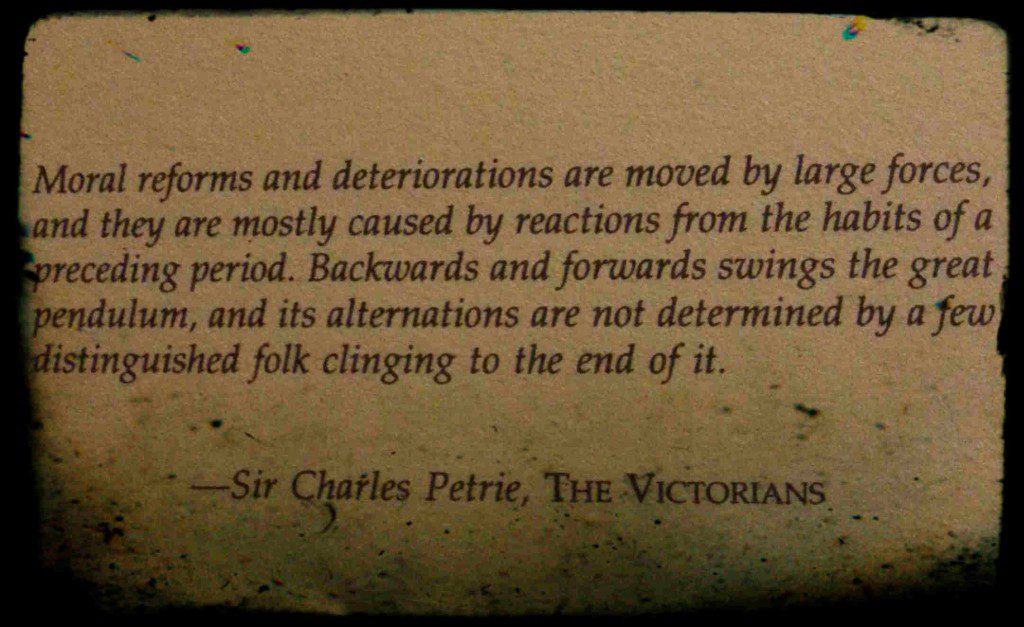
    I think we’re at the beginning of a new cycle – a generation will start ignoring the paradigms of success and fulfillment set by its predecessors and their institutions, and use the fabulous technologies that are evolving to craft its new narrative of happiness. I also think that my generation might be the casualty of two large concepts at war with each other, but maybe that’s what it takes for a civilisation to be entitled to its prosperity….
    moral

    until next time, changelings

    P.S. On a related note, do read ‘On Lifestyle Rigidity
