Tag: business

  • Brands, Activism & Morality

    A while back, someone had joked on Twitter that by 2025, babies will be born outraged. But in 2020, the joke, at least in Indian advertising, is that when the Tanishq brand manager begins to think of a campaign, #BoycottTanishq starts trending. When I was writing the article on brands and empathy for Business Insider, I realised it would need a lot of effort for brands to go beyond signalling.

    However, with inequities becoming even more of a pressing topic, and the expectation from brands to be active participants in society – activism to action, is there an inevitable movement that we will see? And hence, this post on brands through the prism of activism and morality, from the perspectives of a consumer and a brand marketer, and the safety of an armchair.

    We are living in an era of woke capitalism in which companies pretend to care about social justice to sell products to people who pretend to hate capitalism.

    Clay Routledge
    (more…)
  • The business of brand

    It used to be that a brand manager could run 3-4 campaigns a year, negotiate heavily in media buying for efficiency, and roughly correlate effectiveness to quarterly brand health data and sales performance. With VC funding-led rapid scaling, digitisation,  real-time data, and polarised social media, this version is being rendered obsolete. The changing business context also means that looking at a 30 sec ad purely through a consumer lens is only half the story. Two recent examples made me reflect on the dynamics between brand, social media, and business.  I do realise that my commenting on them is a bit like the Nobody – Me meme, and delayed at that, but that’s one of the perks of having a blog.

    Cred: We’ll begin with the Mad Men perspective, but after a short detour. Brand building for VC-funded startups has a template that actually works. Rational benefits with emotional storytelling. Flipkart and Myntra both went through a learning curve with “Granny and Mouse” and “Where fashion comes together” respectively, before they cracked it with “kids as adults” and “Real life mein aisa hota hai kya?“. It works because in addition to building the brand promise, it also has a tangible effect on business. And that’s why it’s often followed by many others across categories – Pepperfry, LivSpaceKhatabook, or even an extended approach like The Whole Truth. This is assuming that distribution, product, customer service etc are at least on par, and the execution is done well.  In that context, Cred’s recent ads, after readability issues in the first print ad, and the lengthy Jim Sarbh ad, were most definitely clutter-breaking. By not following that template.  (more…)

  • Algorithms, the institution of the future!

    Tom Goodwin’s precise summing up of the shifting business environment is now legend – Uber, the world’s largest taxi company, owns no vehicles. Facebook, the world’s most popular media owner, creates no content. Alibaba, the most valuable retailer, has no inventory. And Airbnb, the world’s largest accommodation provider, owns no real estate. Something interesting is happening. 

    Institutional realignment is now on an accelerated path. In this superb, nuanced post titled ‘Uber and AirBnB make the rules now – but to whose benefit?“, Vili Lehdonvirta brings up very interesting perspectives. (To paraphrase)

    – If buyers switch to a new market, sometimes sellers have no choice but to follow, irrespective of whether it brings them gains or losses (eg. if there is very little business outside of Uber to be had)

    – Even if everyone participates with interests intact, the collective effects on society may not always be positive (eg. AirBnB rooms causing nuisance to neighbours)

    – These conflicting interests are usually reconciled by political institutions, but they face the challenge of siding with incumbents or upstarts.

    And towards the end of the article, this very important thought – these new platforms appear to provide access to those who have been denied it by the institutions and processes thus far, but is it that simple? In this context, the new jobs being created are quite different from the typical ‘job’ description. That brings me to a key institution – the traditional workplace.

    (more…)

  • All ideas are equal, some more equal than others…

    (via Threadless)

    A conversation in office on an unrelated topic led me to ask this question on Twitter.

    ..and @atulkarmakar gave me his perspectives


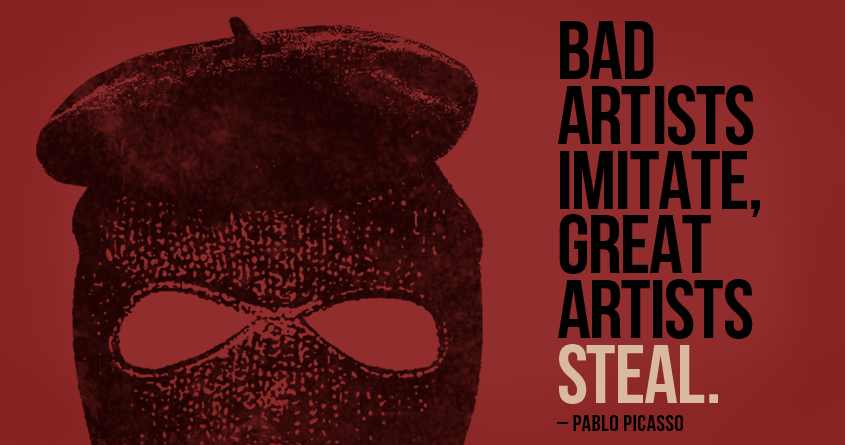
    Just like Atul mentioned, I had first considered whether it was because creative ideas were considered more personal  and a business idea/model an impersonal, corporate entity. But my starting point had been advertising, to which this does not really apply. Compare the reactions of Company A replicating Company B’s business model/idea versus them being ‘inspired’ by their advertising. In the case of advertising, both agencies might get paid and both clients might benefit. But in the case of a business, the second player could benefit from the mistakes (strategy/execution) of the pioneer and build a more successful business. That would be really unfair to the first guy whose business idea might have been a really creative solution to some need. And yet, it’s more likely that the aping of ads would spark a larger debate and the business cloning would be ignored. Am I missing something? Any perspectives you want to share?

    until next time, game of clones

  • Servility or Clarity?

    Trendwatching’s October brief – Servile Brands, reminded me of a favourite OTA which was generating some buzz recently for publicly firing its PR agency. (enough clues, but no names lest I should be accused of SEO bait 😀 ) ‘Servile’ is defined as “turning your brand into a lifestyle servant focused on catering to the needs, desires and whims of your customers, wherever and whenever they are.” It relates to brands having to evolve to factors such as (from the trend brief) on demand, time compression and consumers no longer revering brands.

    Meanwhile, I would think that being ‘servile’ is scalable and useful only to a certain extent, even if an organisation is supremely wired to be the jargon word that is on an upward swing in the hype cycle – social business. In fact, I’d argue that a business can be social only if it has a clear understanding of what it stands for in terms of what its business is and how it conducts it, who its consumers are and therefore what needs it wants to satisfy. (the order of the last 2 can be switched as well) I also instinctively think that brands which can communicate this clarity across its various interactions will pull the kind of consumers it wants to have.

    ‘Servile’ implies that brands place the consumer’s needs above its own. I’m really not sure of this. Social or not, brands are in business. I doubt if bending over backward on every service request that every consumer has is a viable strategy. The reason why I remembered the aforementioned OTA is because of their reaction to an incident I wrote about in ‘Mean Brands‘.

    The current version of social – pandering to every consumer – is arguably swinging to this extreme. Hopefully, brands will soon learn that there is a middle path and that is the most viable one. The brands who reach there faster will be able to weather the storms ahead better, because they would have a compass. The compass is their clarity of purpose. Scaling it across the organisation is the challenge, and the fun. 🙂

    until next time, all clear?