After the ‘social product‘ post, the brand guy in me wanted to reconcile this evolution of the product with the brand story. After all, ‘network effects’, ‘purpose’, ‘community’ etc are essential parts of the brand story as well. But I thought of stepping back a bit before moving forward.
The ‘tyranny of the big idea‘ is oft discussed here and the more I see platforms evolve, the more I feel the need (for brands) for nuanced strategy and propositions that are relevant in various contexts and take into account the radical change that is two-way communication. (as opposed to broadcast) I think this is an inevitability of consumption fragmentation as well as changes in attitudes/behaviour/expectations, and sustained nuanced propositions is one of the key ways to create ‘network effects’ across platforms.
In this context, I thought the ‘Moving Forward’ section in this insightful post titled “Killing Big Strategy” captured it perfectly. Also, through it, I came across something that helped link the product-brand stories – “Finding the right job for your product“, a fantastic alternate perspective on traditional market segmentation, and some excellent lessons in defining competition and positioning. Not to forget this gem from Drucker “The customer rarely buys what the company thinks it is selling him.”
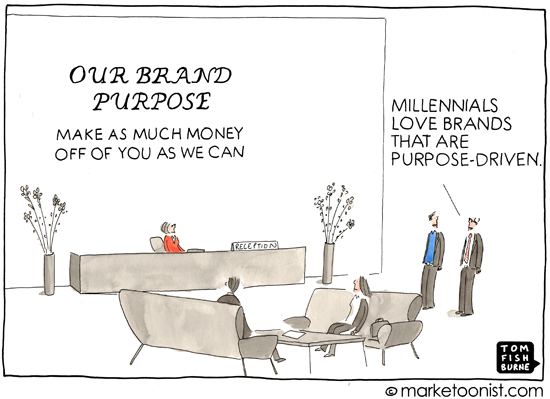
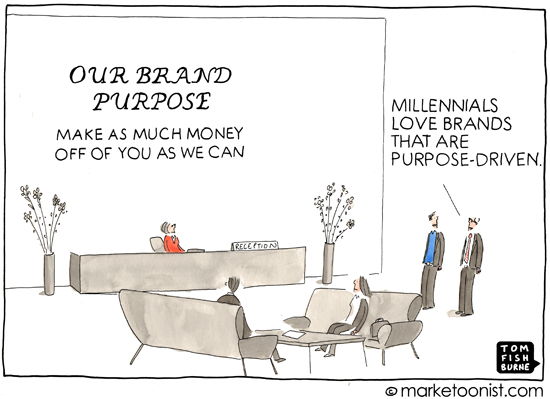
So where does this all begin? Though ‘purpose’ is increasingly being used as a buzzword and also espousing a corporate-centric view (unfortunately) I still get to see a lot of relevant literature that does more than lip service. At a broad level, this little framework of Purpose – Delivery – Resonance, for instance, is a good start. There are many needs that brands fulfill and many reasons why they are loved, and these could start as pointers for a brand to figure out its purpose. John Hagel’s “The Untapped Potential of Corporate Narratives” offers some excellent perspective on how user-centric narratives gets several ‘pull’ factors to work in tandem and offer numerous sustainable advantages. The examples include my usual favourite – Nike, and this is a subject I have touched upon earlier as well, (1,2) though not as eloquently. 🙂 If you think about it, this is also another way of ‘finding the right job for your product’.

(via)
On delivery. Russell Davies’ “Activities not audiences” draws the distinction between users and user needs and calls for focusing on the latter. Again, another rendition of a product doing its ‘job’. This post, titled “Brands: One System Of Touch“, explores the misalignment of brands which view customer experiences in isolation, by channel, whereas customers of course view and grade their experiences cumulatively. This is a good starting point to think about what needs to be changed internally to deliver a cohesive, relevant and useful experience to the consumer.
In the meanwhile, I came across quite a few examples of brands adopting the ‘product doing a job’ approach even though it might be an isolated exercise at this point – Hermes’ silk knot app, Volkswagen’s and Audi’s Augmented Reality apps to repair/know the features of their cars. While they might seem too self serving to qualify for the concept under discussion, they’re definitely a step in the direction. Uber’s response to a bus driver strike with free rides might be a more evolved example. Another one might be Ford’s platform to ‘hack’ its car hardware and software. Many more examples of ‘branded utility’ can be seen here. I think that in the looming collaborative economy, platforms like Google Helpouts will help brands become a real time utility in their domains. Interestingly there are also examples of brands (Citi, Kleenex) which are trying to create value beyond their core purpose/utility. Levi’s’ ‘School of Make our mark‘ is another example.
The last bit in the framework (though the framework also mentions differentiation, I see it as something that needs to be built into purpose and delivery) I referred to earlier is resonance. I think these above experiments will not only help brands learn what it takes to build sustained resonance in various consumer contexts but also how to amplify this to potential consumers who might share similar needs. This will require learning and application beyond the conventional mass reach tactics employed currently. The corollary is that measurement paradigms would also need to change. I could see this being aligned to all the points mentioned in this superb post – ‘The Future of Marketing‘ – messages to experiences, rational to passion, adaptive strategy, simulations, brands to platforms.
To bring it all back to the link between the social product and the brand, I now (again) see technology (including social) as an enabler in the product and marketing road maps – working in tandem to deliver the brand’s purpose and help it augment resonance.
until next time, utilising brands