Tag: Books

  • #Bibliofiles : 2019 favourites

    Preface: Every 2 months, we buy 7 books. 6 that I choose, and one for D. 3 fiction, 3 non-fiction. From experience, 6 is my balance between Tsundoku (piling up without reading) and abibliophobia (running out of books to read). In keeping with the pattern, the list below has 6 books that I enjoyed this year, from the 36 I read. For a lark, the text has been limited to 66 words each. 😉 (more…)

  • On books and realness

    Optimized-shelf copy

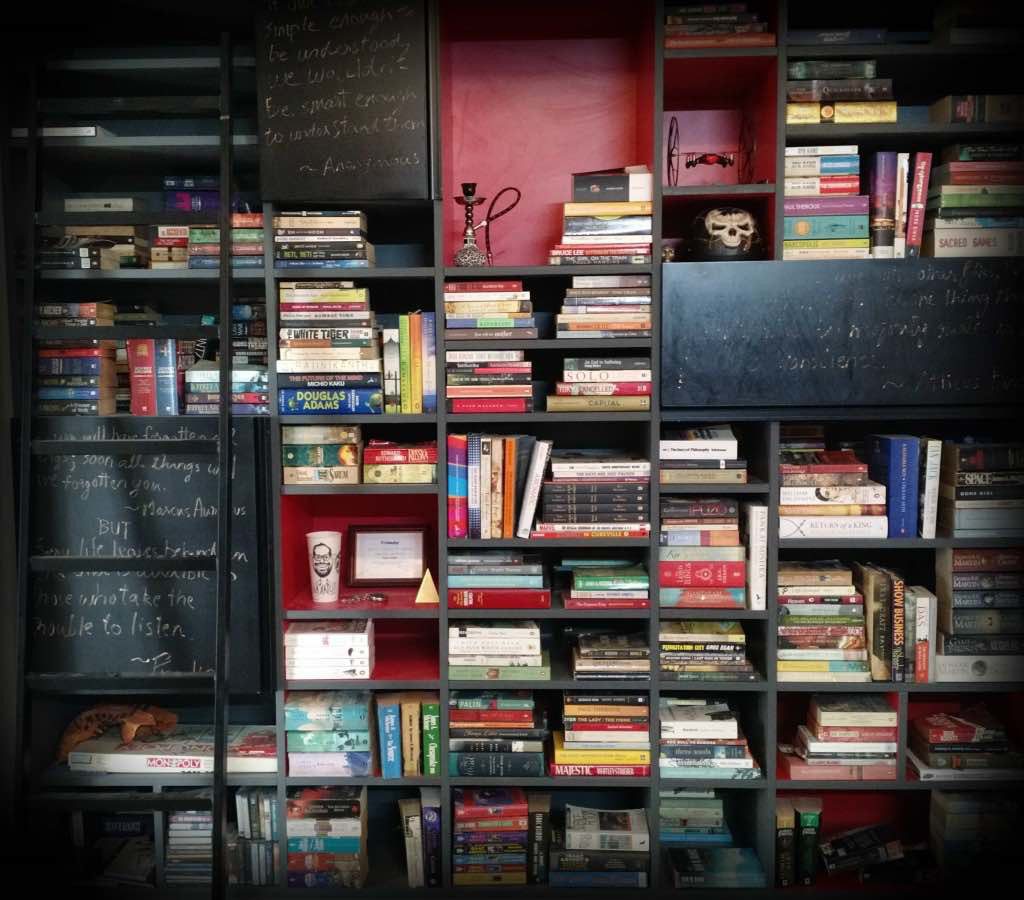
    The books on the bookshelf. Each with a story to tell – when I bought them, where, and why. Some of them are gifts. There is a tangible sense of our history (theirs and mine) and collective mortality when I run my hand across their spines, and flip through their pages. Sometimes they also contain the stories of unknown others. Many of my earliest memories are book -related – trips to Paico, Amar Chitra Katha purchased at railway stations, and so on. Some of the reasons why, despite not being the calibre of reader (and collector) JP Rangaswami is, I can still easily relate to why he is not buying a Kindle. Because I’ve had a love affair with books ever since I can remember as well.  (more…)

  • Habits and home

    It’s been happening on enough recent Cochin trips to be given the status of a habit – visiting The Grand hotel for lunch. The food is predictably good, though they take liberties with what can be called ‘meals’. But there’s more to it. The Grand has been around for as long as I can remember, and in the otherwise rapidly changing landscape of my hometown, it offers a solidity and anchorage that is rare and appealing. This time, we had this guy seated right behind us. 🙂

    Another habit, which is even older, is shopping from Malabar Chips – for friends, colleagues, and us. Some of the people working there have been around for decades, and I told D how I’d watched them change over the years. “..all the faces that made up my childhood“, as Rana Dasgupta phrases it in Solo. It made me think how we probably notice changes in others more than they themselves do. By the same token, we don’t notice ourselves change. (more…)

  • Future Tensed

    Thanks to Neal Stephenson’s The Confusion, (Vol 2 of The Baroque Cycle) I’ve had to do something that I haven’t done since I started reading – read two books in parallel. Every 200 pages of The Confusion, I take a break and read a volume of The Hunger Games. Neal Stephenson, to me, is genius, and I’ve been a fan since I first read Snowcrash. I could speed read The Confusion, but I really want to pay attention and understand the nuances, the humour, the larger thought and so on. I cannot do that for 800 odd pages, hence this shift.

    I only understood the ‘connection’ after I started reading The Hunger Games. The Baroque Cycle is set in late 17th-early 18th centuries, and uses an excellent mix of historical and fictional characters to cover a whole variety of themes. In some ways, it uses the past to understand the present. The Hunger Games, on the other hand, is set in a dystopian future, and shows a potential fate of humanity. It uses cues from the present to predict the future. The connection ends there, almost. Though at massively different levels, both require imagination, the former at a much more larger scale.

    That’s what led me to think about imagination in the present. We’re in the midst of probably the biggest upheavals in the history of humanity – new technologies emerging at a rapid pace, institutional realignment, socio-cultural changes, behaviour alteration and so on. All of this means, that collectively, we’re having to run really fast just to cope. Where does that leave time for imagination? In fact, such is the assault on senses that I wonder if anything really disruptive is being written in the science fiction genre these days (I hope to be proven wrong and pointed in the right direction) because except for things like teleportation and time travel, pretty much everything that was science fiction is getting played out now, and so busy are we – trying to keep abreast – that science fiction is merely extrapolating the present (read) or giving alternate versions.

    There is a term in psychology called Functional Fixedness, wiki-defined as “a cognitive bias that limits a person to using an object only in the way it is traditionally used.” With my limited knowledge, I wonder if that’s the dystopian future of the human imagination.

    until next time, the end of collective imagination

  • An idea called home – 2

    Anjum Hasan’s “Difficult Pleasures” is borderline surreal, the jacket told me. She would be in my top 3 favourite authors list, and I am completely awed by her writing (check the last para here) but I wonder if even that can explain the surreal thought I had as I read the first few pages. Can a book be called a home? What is a home after all? Isn’t it just an idea that is sometimes real and tangible and exists physically?

    And that was the surreal thought – every time I read this author’s books, it’s like going home, as though I could reach inside, get into the story and talk to the characters and they wouldn’t consider me out of place at all. I could belong. Yes, it’s surreal, and I haven’t been smoking, but I just couldn’t get the thought out of my head.

    until next time, home away from home