
Tag: blockchain

  • Slowly and then suddenly…

    …because we’d like to have the best physical abilities that any species has in terms of moving, seeing, hearing, strength etc. From the mind’s perspective, an organ that could upgrade itself to store more, to experience more, to work faster, to be more accurate. And it doesn’t stop there – reading others’ minds, telepathy…

    We will see the beginning of all this in our lifetime. The progress might be slow, so slow that perhaps later generations wouldn’t realise how we’d lived without most of the artificial things that they would be taking for granted. How would this affect the experiences of life that we go through now – joy, sorrow, pain, ecstasy, spirituality?  How long before what we call human would give way to a being that would probably exist forever, possibly without living? Will they even realise it when it happens?

    The man… the machine

    This is from my first post on what I called the augmented human, back in 2009. And I continue to ask myself what the man-made man will be like.

    (more…)
  • An efficient existence

    The Cyberiad by Stanislaw Lem is a book I recently read, and loved. It was written in Polish in 1965, and translated to English in 1974. Lem wasn’t an author I had heard of, despite having read many science fiction anthologies. An online post that extolled him at the cost of my favourites like Asimov was what led me to this book. (I would have linked it, but I’ve forgotten how I found it!) Lem has been translated into 41 languages and has sold 30 million copies. But he was rebuffed by quite a few American writers including Philip K. Dick, multiple times, because he was perceived as being annoying, and had commented that American writing was “ill thought out, poorly written…” Also, his belief was that the only true motive for writing was to contribute to literature.1

    It made me think of a post in one of the newsletters I often recommend to folks – Taylor Pearson‘s The Interesting Times. As I tweeted sometime back, his writing is centrifugal – pointing to books, posts and ideas, and centripetal – goes deep into an idea and provides food for thought (the latter is different from what Austin Kleon meant in the original framing 2). The specific post I am referring to – 4 minute songs, which was about certain rules that a creators need to follow if they want their work to be consumed and appreciated, was the latter, and made me reflect. I wondered whether, even at an individual level, we are increasingly optimising for others’ consumption over our own expression.

    (more…)
  • Front tier journeys

    Remember the early days of the pandemic, when we played alphabet soup with economic recovery? One has to be extremely optimistic to consider the much-touted “V” now, and there’s increasing consensus around “K”. There’s something subliminal about the former sounding like “we”, and the latter sounding like, well, K, signalling that we don’t care. And that’s why I began thinking of how those in the upper part of “K” are utilising their wealth. In addition to using it to create more wealth, that is.

    I think there are at least two expansion narratives at play. One is seeking new “real” frontiers. This is a centuries-old pattern – the Americas, Silicon Valley – until geography has been tamed. We’re now on to “colonising” Mars. The metaphor is clear. The other is digital frontiers, where our time and mind space is being increasingly spent. Both are about escaping the confines of reality as we know it now.

    (more…)
  • Choices & Automation

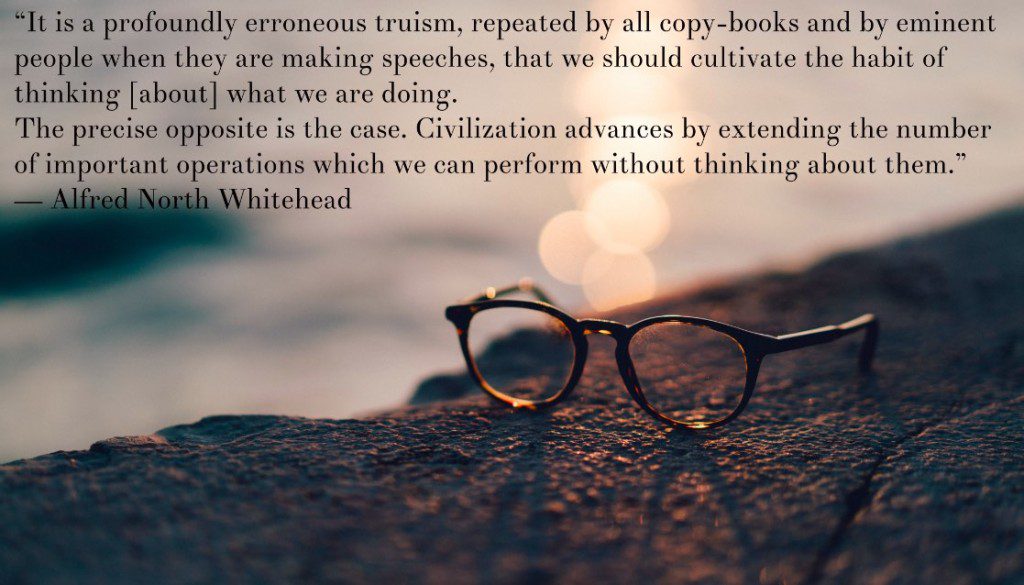
    Taylor Pearson wrote an excellent primer on blockchain a while ago. While explaining why blockchain matters, he quoted something by Alfred North Whitehead

    Untitled 1

    Photo by Joshua Newton on Unsplash

    (more…)

  • The abstraction of trust

    Usually, I use evolution. But that indicates a forward movement, and in this case, I am not so sure now! I had a thought on how the notion of trust in transactions has changed, and felt that I should document it, even if it’s in a super simplistic way!

    1. It began with a producer/consumer – consumer/producer relationship in the form of barter.

    2. A central currency suddenly opened up trade and now it could just be producer – consumer

    3. That also meant that a middleman could enter the system, hence a producer – seller – consumer (more…)