
Tag: big data

  • With great data…

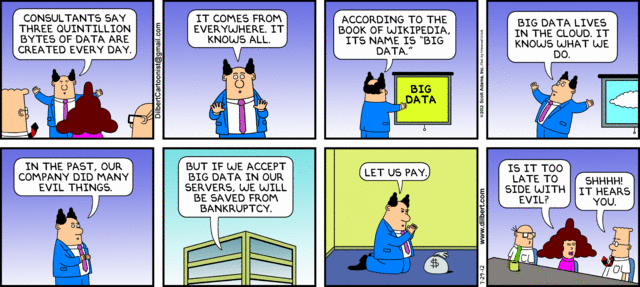
    LinkedIn’s article curation is improving very well in my case. What I particularly like is the dash of serendipity in the list. One of the articles I recently read was “Are we all being fooled by Big Data?” Though it is less to do with business per se and is skewed towards economic forecasting, it does make for a very interesting read.

    Gartner’s 2013 Strategic Technology Trends has Strategic Big Data as one. In fact, I’d also add ‘The Internet of Things’, ‘In Memory Computing’ and ‘Actionable Analytics’ (also in the list) as related items, as a source, enabler and application respectively. While Big Data has been talked about for a while now, and has seen applications as well, I am not sure how accessible it is to the majority of organisations and brands. In essence, is it ‘mainstream’ enough? (I see organisations struggling to link existing data) Are there frameworks being built that will aid analysis and action across various functional domains – ways to nimbly access and use contextually relevant ‘packets’ from troves?

    Probably 2013 is when we will see things moving. But there’s something about data that worries me. This has come from my own experience as well as from the things I have read/heard. And that’s where the organisation’s intent becomes important, because you can find data to validate most anything! This is all the more significant because with improving technology, the volumes of data will have the potential to help brands shift paradigms and disrupt the status quo. But it can also be used for strategic/tactical blunders. As the saying goes “If you torture data long enough, it will confess to almost anything

    All of this reminds me of social media. The hype, the evangelism, the tools and so on. And just like social, Big Data has in it the ability to amplify the inherent nature of the enterprise.

    until next time, think big
  • Differentiate or die?

    I’m close to finishing “A Clash of Kings” – Book 2 of George R.R. Martin’s “A Song of Ice and Fire”. Pages 879-913 has lists of houses and characters. The lists will continue to expand in the next book, I’m reasonably sure, and I will probably have to spend Rs.200+ and buy this app. Many fantasy superstars have existed before GoT – Potter, LOTR, but this is the first time I have been immersed in one. Generally speaking, works of fiction are unique, and yet, such is the abundance and the related scarcity of time that there are choices to be made. So why GoT? Mostly courtesy the huge buzz the TV series generated on my various timelines. Let me now shift the story to brands, where abundance and time scarcity takes an even worse toll.

    The title of this post comes from an article in FT. Without getting into the author’s bias/(vested) interest, I think he has a point when he says that the increasing focus on efficiency is stifling innovation and on the other side making consumers ‘number and dumber’.  On the business side, why bother with niche audiences when access to large sets of consumers through databases and mass media (now social media too) is much easier. On the consumer side, larger tribes are easier to find in the search for belonging. Of course these are generalisations, and I’ll be the first to admit that there are exceptions.

    In the case of mass brands solving mass needs/wants, functional benefits are increasingly becoming a commodity. In an earlier age of information scarcity and relatively unfragmented media, differentiation could be as simple as just being visible. The story is different now, though the recent turn of social towards media would indicate that only the channels have changed. But IMO, there is a high chance that this trend will prove to be shorter than the reign of mass media, and true differentiation will evolve from a user perspective after everything from product to design to communication to experience has become a commodity. Arguable. 🙂

    Increasingly, brands are using social media to target better, and that’s how platforms are selling their users too. I wonder if/how many brands at this stage are attempting to make their stories personal to the user. Different social platforms offer different contexts – in the way they are designed, in how users consume them, in terms of the need they satisfy, in terms of devices they are best suited for etc. Think of how Facebook, LinkedIn, 4sq, Twitter, Pinterest, Instagram, Path and the other services you use fit into your lives. Yet how many brands are trying to fit themselves into these contexts? Yes, we’re still in the early days of Big Data, but how much of investments are brands making in this as opposed to say, better FB targeting? What do you think – is it a scalable form of differentiation? Is it because of the pull towards familiar forms and templates of communication (read targeted mass advertising) that brands are loathe to walk this long path?

    until next time, differentiation by integration?

    Bonus Read: The Future of Storytelling

  • Until the customer is king..

    Instagram just released v3.0. One of the biggest changes in this version is the introduction of Photo Maps, which quite obviously, plots your photos on a map. The default is opt-in, not opt-out, though they’ve done their bit to give the user control over data.  I updated despite reading this Wired article on the privacy implications and the bug that briefly exposed private photos!

    I’d written my first post that referred to Big Data recently, and the day after that, I read this very interesting post that talked about various applications including an algorithm that can identify cities based on their unique architectural elements and other distinguising characteristics. But a few weeks earlier, WSJ had an interesting post that talked of how large corporations see big data as a means to get personal with customers using information gathered by placing tracking files in people’s browsers and smartphone apps without their knowledge—so they can be stalked wherever they go, with their “experiences” on commercial websites “personalized” for them. The post describes not just its real world analogies but practices as well, and predicts a future where the user will declare your own policies, preferences and terms of engagement—and do it in ways that can be automated both for you and the companies you engage. An entire ecosystem across apps and corporations built in a consumer centric fashion.

    But as the post itself admits, the move toward individual empowerment is a long, gradual revolution. Until then, we need to define our own limits of sharing, fully understanding that it is a give and take. Not just what and where, but whom too – since all it takes a RT or a ‘Share – Public’ for something shared in a close circle to go public. How much of privacy would I give up to open myself to opportunities, or get an experience that is tailored to my needs and convenience. On the other side, a modern corporation needs to understand the choice the consumer is making and use the information to not just provide genuine value, but also make it easier for both entities to adapt to the rapidly changing landscape.

    until next time, kingmakers

  • Data: Growing up

    The Facebook story might be facing rough weather, but that hasn’t stopped the social network from pushing out new and interesting things. It launched “Page Post Targeting Enhanced” – features that make it a media platform offering sharper slices to marketers (easily) by allowing filters based on gender, interests, relationship status etc. It has also rolled out Facebook Stories that highlights “people using Facebook in extraordinary ways”. Venture Beat has a very smart take on how this can be the future of news by intersecting two of the most interesting contexts – location and interest. As a media platform, one can imagine the advertising potential.

    Twitter already has local (city specific) trends, though, from experience, many people seem to think that they’re viewing national trends when Twitter is actually showing them local trends. Twitter already has Promoted Tweets and is enhancing features that allow better targeting.

    Media buying in the age of traditional media consisted of a plan being prepared (and negotiated) after evaluating the reach, cost and other parameters of various options across platforms – print, OOH, TV, Radio etc. The (reach) data has always been contested, and the (post) measurement is more of a myth than reality. New media platforms, on the other hand, are significantly better in terms of transparency and in addition, have better native and 3rd party tools for self publishing, distributing and measuring. The data is one click away from the marketer. After a certain tipping point of reach that these media achieve, traditional media would be forced to provide this level of accessibility, and then, IMO, the value provided by media agencies would be reduced significantly, as tools would make it easier for the marketer to plan real time and measure too, across platforms.

    In essence, data that the marketer needs, to make informed choices on the why/what/how/when of platforms, is easily becoming available.  The data that really needs to be converted into information is now flowing in the reverse direction – from the consumer and his actions across platforms to ______. And this data is not just for marketing, its use is across the board and affects product, customer care, operations, technology and so on. It is Big Data, the players are evolving, and the next stage in this ever changing game has begun.

    until next time, don’t worry, it’s already a buzzword. 😉