
Tag: belonging

  • A plan to be

    One of my first posts this year was Certain, simple frames, in which I had written about my lapse-of-reason episodes, and my methods of overcoming them. I had also mentioned in the post the insight I got about myself – the lapses of reason were triggered by my fear of it upsetting the plan. The Plan is financial freedom for D and me – we shouldn’t have to work for the sake of earning for current or future needs and wants.

    In this context,  I found a quote by Ramit Sethi that succinctly conveyed a perspective that I have touched upon in at least a couple of my posts – Prisons of Happiness (conscious choices of freedom and understanding the trade offs) and Please Find Detached (on delaying stimuli and minimising lifestyle creep) – a rather distinct definition of frugality.
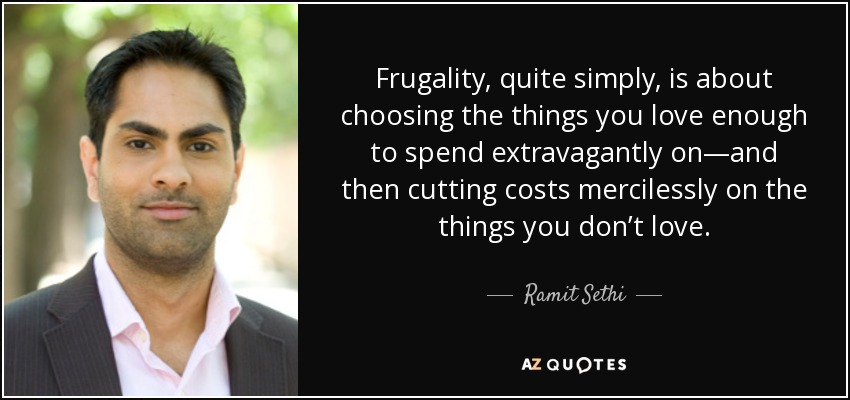
    quote-frugality-quite-simply-is-about-choosing-the-things-you-love-enough-to-spend-extravagantly-ramit-sethi-64-20-74

    I have been doing this for a while, but the catch, as I have experienced, is in “choosing the things you love enough”, and it exists because of the intent behind that ‘love’. The usage of the word “love” is important. In my view, it is used to distinguish the things that one really wants.

    But it is difficult to be objective about one really wants. Paradoxically, at different points, the intent could be a desire to belong, or a desire to stand out. A fundamental human need to connect and share that drives the first. A basic ego stokes the second. A desired destination here could be a kind of “reflective equilibrium”. Easier said than done!

    The ego first derives from societal benchmarks, the projected self, and then self image. Getting beyond the last one is extremely tough. And if one does get close, there is an immediate realisation that there are no markers, no play books, no goals. There is no unseeing this either. “And once you are awake, you shall remain awake eternally. ”All very difficult to get used to, especially when the mind continues to ask, “Is it going to be ok?”

    To quote Bill Bonner, “There’s the standard of living, which can be measured in dollars, and there’s the quality of your life, which can’t be measured at all.The Plan is built on financials, and is therefore aimed at tackling the first part. The second is indeed an intangible, and speaks probably of a contentment that comes from being comfortable with one’s decisions. That’s why the plan is also an attempt to iron out the terms of one’s interaction with the world, and just be. The hope then, is that belonging will take care of itself because one is actively pursuing the wants that really matter, without money having a real say in it. The desire to stand out? Well, it will be forced to sit out!

  • Home Outgrown

    On our way to the airport, for what would be one of our shortest trips to Kerala, I told D that I didn’t see myself making this journey a decade from now. At least not framed in the way we do it these days – a trip home. I was wrong – it happened way sooner than a decade.

    It wasn’t a comment made lightly – after all, to borrow a phrase, I was referring to a city which had all the places that made up a couple of decades of my life.

    What does one go home for? The obvious answer is easy – to spend time with people who matter in one’s life. To note – even that changes during one’s lifetime. But if I have to dig a bit deeper, Rana Dasgupta’s words make sense – when one becomes homesick, it is not a place that one seeks, but oneself, back in time. And when one does that, the props matter. The places, the faces, all reminders of different phases. When they no longer exist, the place is no longer a cure for homesickness. (more…)

  • Balance Wheel

    Somewhere between the need to belong and the constraints of conformity lies that Utopian state. I am beginning to realise that this is applicable across all modes of social interaction, whether they be real or virtual.

    It begins with people finding a common interest or ‘wavelength’ and sharing great vibes. School/college cliques, blogs and microblogs, workplaces, interest groups and so on.  Startups are fun places to work in the initial years because rules are made on the go, blogs and microblogs in their early days were sparsely populated and everyone was discovering their own voice and community norms.

    I have always wondered what breaks the utopian state – time or an increase in the group size. These days I am beginning to be convinced that it is the latter. As each new member is added to the initial set, the needle begins to slowly shift from the erstwhile average. The addition of new members also changes the dynamics of the group and slowly the earlier common sense of belonging changes even as a new one is created. Some adapt, others refuse to conform and break away.

    But what I have also realised recently is that there is a middle path – refusing to conform but refusing to go away either. It is a tightrope walk, and best done without baggage. And that’s the walk I am trying to learn, across my worlds.

    until next time, walking schtick

  • But what do I know?

    Unlike in my other blog, Seth Godin is rarely referenced here. But when I read this post (rant, he says) from him titled “Deliberately uninformed, relentlessly so“, I sensed some vague connection with something I’d written a while back.

    Unlike other posts of Godin, whose blog I religiously follow for its ‘food for thought’, I found a smugness to this post – perhaps the rant provides the liberty. But as always, he manages to make a point. However, for a second, I wondered about the irony of this post coming from someone who does not allow comments on his blog. And thus this post.

    It is to be noted that he did not switch off comments just like that, he has valid reasons. Even if one just looks at the scale (1858 people retweeted and 2373 ‘Like’s) and considers  only a certain % commenting, it would tend towards chaotic. But whatever the reasons, he has chosen not to use comments as a channel.

    Ok, lets move on to me now. 🙂 I don’t read business books, however I follow several blogs in my line of work and otherwise. I rely on my Twitter, Reader and (occasionally) Facebook connections to point me to interesting reads. I also use Wikipedia extensively, despite the accusation that crowdsourced content can only be so trustworthy. From all this consumption, I have ‘superficial’ information on a lot of subjects, which make good conversation. This is also because I have way too many interests, and I’m forever in awe of things I don’t easily understand. My interest sometimes wears off after I’m able to bring a subject to my horizons of understanding. Sometimes, a more knowledgeable person corrects me/points me to things he/she thinks might interest me further and whenever I need/want to know more about a subject, I try and use the web’s sources to the fullest.

    But here’s the thing. Once upon a time, I could remember websites in context and add to discussions (offline), but increasingly I rely on delicious, among other things. I’m forced to prioritise my memory thanks to the ton of information out there that I process daily. Ok, that, and age.  🙂 And this is not a problem that will end soon, and its something I keep bringing up here. (Read)

    Time is the new currency, and I increasingly feel that people now react mercilessly to an “I don’t know”. Is that an excuse for people to claim knowledge of things they know nothing about? Maybe not, but perhaps like many other things, it is one of the ways for them to feel accepted and have a sense of belonging. So yes, it might be easy to label it as being deliberately uninformed, but in judging people so, without context and more understanding, we might be falling into the same trap ourselves – about people this time, as opposed to subjects.

    until next time, judge mental capabilities?

  • Gulp fiction

    I’m quite a huge fan of Heroes and was quite sad to see Season 4 end, more so than normal season finales, because after quite a while, there was a villain that I could really empathise with.  Robert Knepper as Samuel Sullivan just rocked. Though the villainy is manifested in his selfish desire to become more powerful, there was something in his arguments that made me forget it at regular intervals. To give you some context, the entire series revolves around people with special abilities (think X-Men). This season, mostly through Knepper’s character- Samuel, emphasised a lot on how society treats such people. Samuel’s desperation to belong (and later make normal people respect his kind) is expressed very well in his conversation with another character with abilities, Claire.

    “Freedom is what you do with what’s been done to you”, says Claire, quoting Sartre.

    “I always thought freedom was just another word for nothing left to lose”, counters Samuel, without acknowledging “Me and Bobby McGee” 🙂

    The urge to belong and the pain of being different. Mo wrote a post recently on being chided for missing a reference in a conversation. A reference to Pulp Fiction.  At a broader level its also a small commentary about our consumption of popular culture, and second had experiences. Its a sentiment I share – that somehow the consumption of popular and even off beat culture and getting the respective references is the benchmark for judging a person. So, to get bombarded with “haven’t you seen/read/eaten.. don’t you know..” is now a common thing. Like I told her, thanks to everyone becoming media, C+ is actually a great grade, considering the noise.

    In some ways, I felt it also throws up our need for validation. The consumption and the opinions we have on that decide the kind of role we land in our immediate crowd, and now, the larger world. From “Govinda movies??!!” and “MLTR is why I go away from you” to “Eww, you’re still on Orkut?! .. Omigod, how can you play Farmville??”,  this judgment happens all the time  🙂

    At times, the validation is for others and their expectations, and at times for the self. In many ways, I think its like some gladiator fight where a person is just fighting himself, and the expectations he has set. The audience could be the self, or others. If its the latter, its all okay so long as the person conforms to a broadly accepted set of norms within the crowd.Even if one wants to get out of it, its difficult. Its difficult to sever the connection between a validation that is given to one without asking and the ties that one would want with other humans. 🙂

    In Heroes, Claire’s character’s ability is instant regeneration. Break a bone, receive a bullet wound, and she heals instantly. In the last scene of season 4, she throws herself from the top of a Ferris wheel, lands on the ground all broken up, and immediately heals, all in front of a waiting media crew. An open challenge to society to accept her the way she is. And another character says “Its a brave new world”. To me, it was a statement of hope, one that will get out of a TV show that’s part of popular culture, and enter the real world.

    But meanwhile, for now, until the pill happens, the moment one goes beyond what can be immediately understood, and what provides a point of reference, one has to be ready for “And I will strike upon thee… “:D

    until next time, reverence to reference 🙂