Tag: Behave

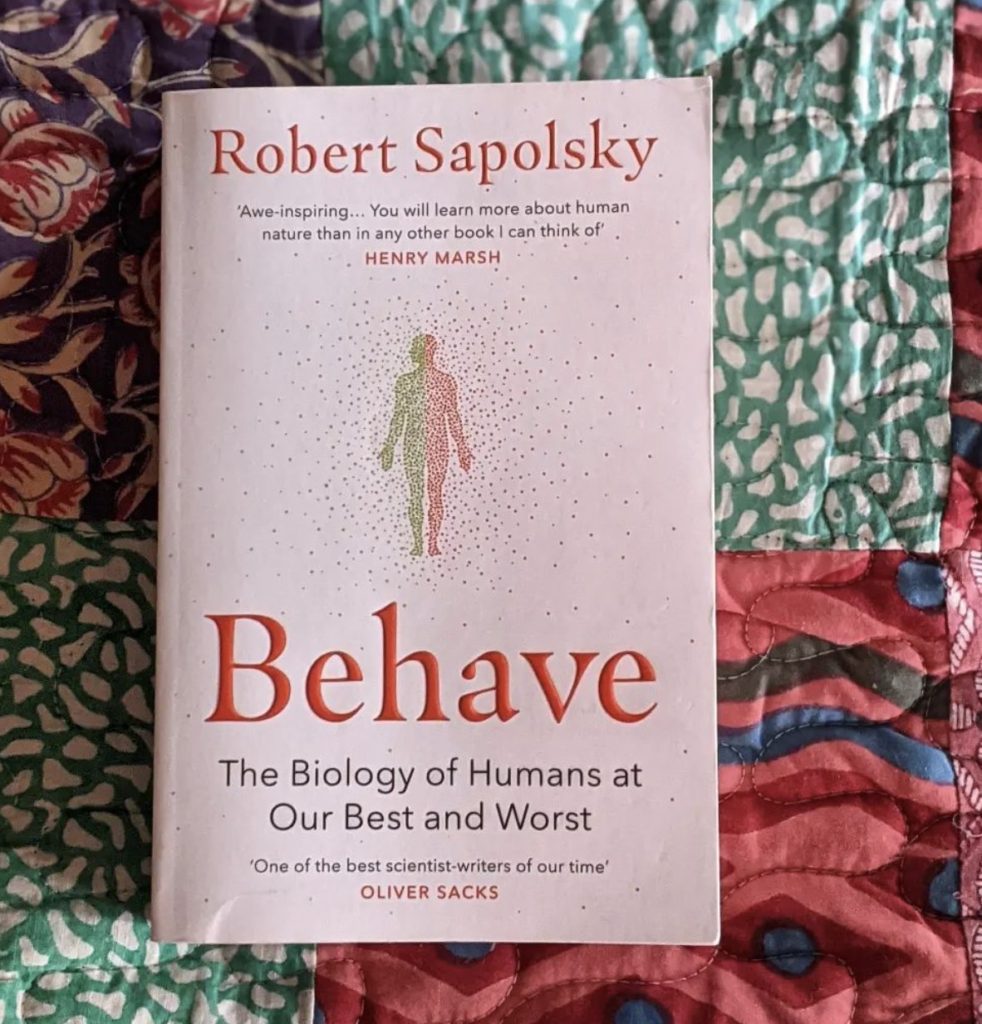
  • Behave : The Biology of Humans at Our Best and Worst

    Robert M. Sapolsky

    I remember Don Draper’s words from Mad Men – “When a man walks into a room, he brings his whole life with him. He has a million reasons for being anywhere, just ask him. If you listen, he’ll tell you how he got there.” Robert Sapolsky asks this to our behaviour, and tries to answer it using multiple disciplines of science. 

    At any given point in time, we are behaving in one way or another. What influences that? To understand that, he travels back in time. From the seconds before that behaviour, and the possible neurobiological explanation, to the genes we have inherited, to the early days of our non-human ancestors and the environment that shaped many of their behaviours. Hormones, environment, culture, and events from millennia ago, all offer but clues to understanding how we are today. 

    From a narrative point of view, you’re first thrown into the deep end of the pool. I found the first few chapters reasonably tough to get through, simply because between the names of neurotransmitters and hormones and their little quirks, I had to repeatedly go back and check if I had understood right (even if it’s a remote understanding!) It doesn’t help that there are footnotes on practically every page. I stopped reading them after a while. It also doesn’t help that each chapter is a rabbithole with multiple little sections.

    And finally, I know the author means well and is probably trying to keep the prose conversational, but repeated “see what I did there?” are also a bit painful. As an exception, I did find the part on genes interesting, especially how it doesn’t act in isolation and interacts with the environment. ‘Genes aren’t about inevitabilities; they’re about potentials and vulnerabilities.’

    Having said all that, once we have gotten out of the body, and moved into environment, culture, decision-making etc, the text is a lot more accessible and at least to me, supremely interesting. Behaviour and what goes into it indeed becomes fascinating as we start to see the behaviour of other species and how similar we are in some aspects. It is also awe-inspiring to behold the species we have become. And much of it purely by chance. Also mind-bending how biology affects our tendency to violence, our sense of justice and many other things whose behind-the scenes we don’t really look at. 
    I think I’ll need at least one more read to assimilate everything in the book.

    But it is indeed fascinating to know that ‘we are constantly being shaped by seemingly irrelevant stimuli, subliminal information, and internal forces we don’t know a thing about.’ ‘Our worst behaviours, once we condemn and punish are the products of our biology. The same applies to our best behaviours.’

    It’s not the easiest read, but if you persist, a lot of insights await you.
  • Reflections on my OS – Part 2

    Continued from here.

    A couple of weeks ago, I wrote about how the book “Behave”  gave me insights on the ‘why’ behind the mindsets I have in life. Since mindset isn’t something you can leave at home, there is some impact on the professional front too.

    Work

    As I had mentioned, my OS has a few known features (uncharitably, bugs) – the scarcity mindset, a low regard for familial bonds and (until recently) friendships, and a belief that in a crunch the only person one can depend on is self. This has led to some obvious implications and some not-so-obvious ones at work.

    (more…)
  • Reflections on my OS – Part 1

    Alternately: Internal Pattern Recognition: IPR? 😉

    If there’s one thing that Stoicism has taught me, it is that the good fight is not with the world, but yourself. Many of the books I read and observations I try to make on family are to get a better understanding of the ‘why’ behind my thinking. Among the many things that “Behave” gave me insights on was this, and an explanation for how siblings can be very different in terms of mindset and behaviour, despite inheriting not just ‘nature’ but sharing ‘nurture’ too.

    Another dogma was that brains are pretty much wired up early in childhood – after all, by age two, brains are already about 85% of adult volume, but the development trajectory is much slower than that. …the final brain region to fully mature (in terms of synapse number, myelination, and metabolism) is the frontal cortex, not going fully online until the mid twenties.

    …the brain is heavily influenced by genes. But from birth through young adulthood, the part of the human brain that most defines us (frontal cortex) is less a product of the genes with which you started life than of what life has thrown at you. Because it is the last to mature, by definition the frontal cortex is the brain region least constrained by genes and most sculpted by experience. This must be so, to be the supremely complex social species that we are. Ironically, it seems that the genetic program of human brain development has evolved to, as much as possible, free the frontal cortex from genes.” 

    (more…)
  • #Bibliofiles : 2021 favourites

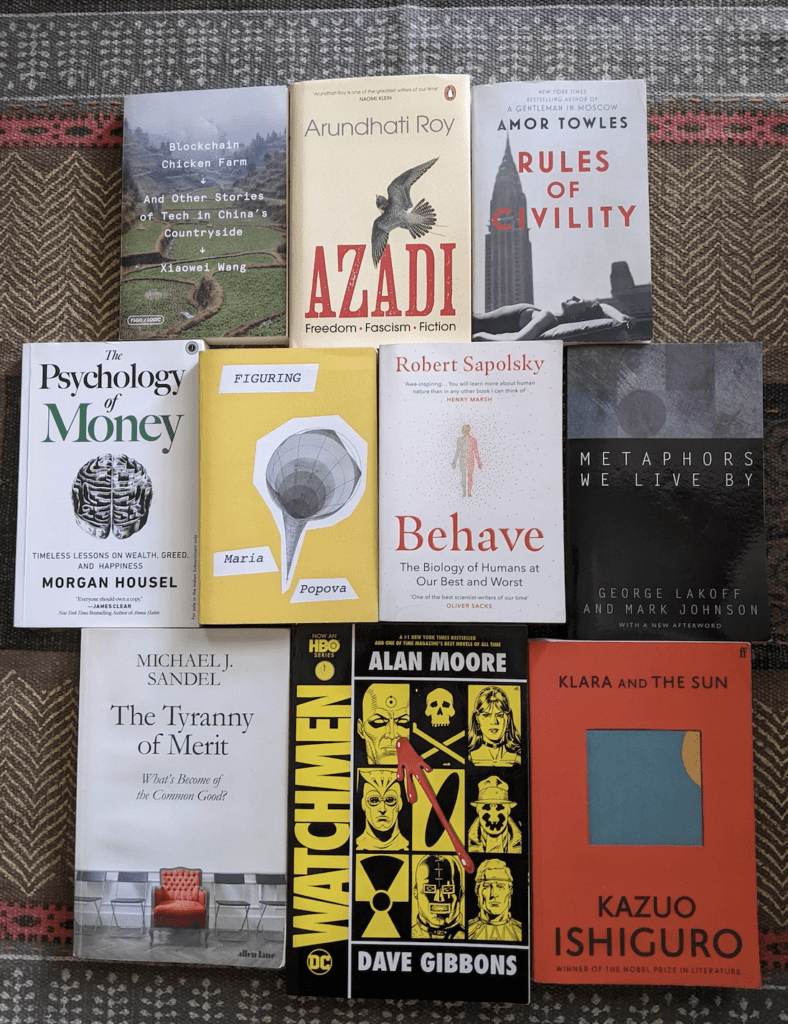
    Oh well, since Gates doesn’t have a monopoly these days, I thought I’ll continue this from last year and the year before. Actually, it’s for a couple of reasons. One, I think there are underlying themes in my reading every year, which will be interesting to examine years later. And two, if someone chances upon these, they will hopefully be able to discover new books and themes for themselves. The shortlisting was tougher this year, because the list was slightly bigger, and the quality of books was also great. My long list from the 50 books I read this year was closer to 20, and I’ll mention them in the relevant places.

    (more…)