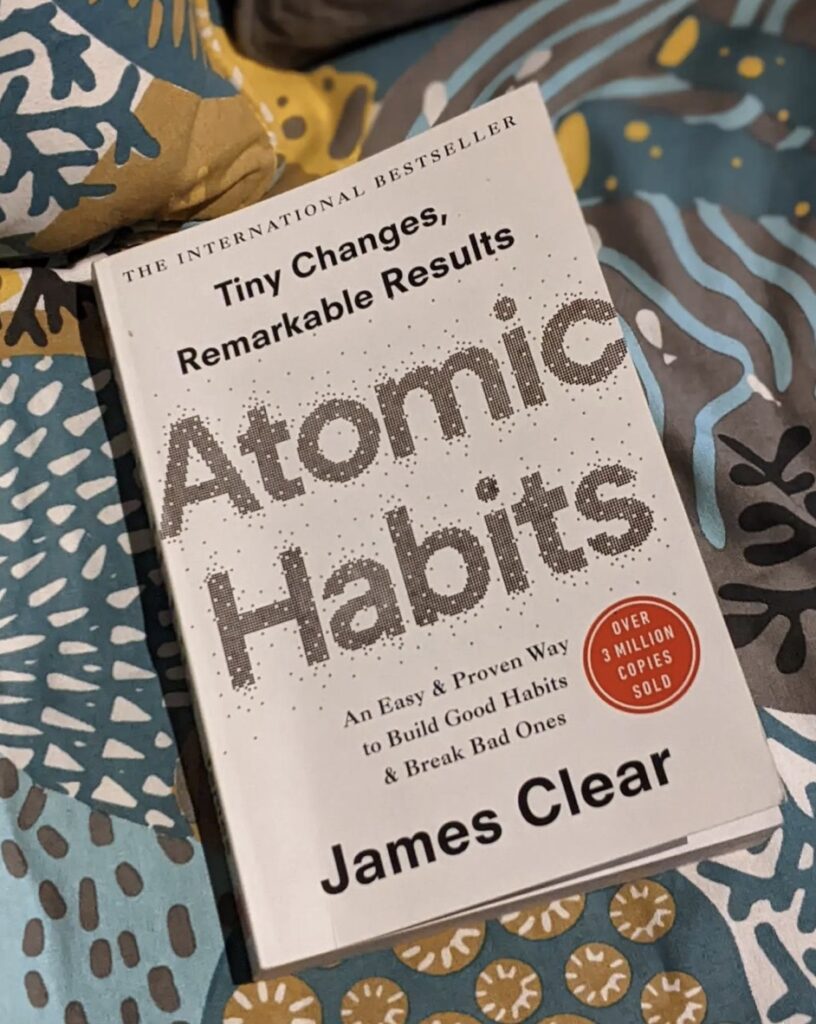
James Clear
Given that I read The Power of Habit a while back, and have been a subscriber to James Clear’s newsletter for a while, I should have read this a long time ago. But better late than never.
He begins by explaining how small changes can make a big difference over a period of time. Positively and negatively. ‘Habits are the compound interest of self-improvement.‘ Hence the word atomic – small, part of a larger system, and the building blocks of great results.
I think one of the best insights of the book is the three layers of behaviour change framework – outcomes, processes, identity. While most people focus on outcomes, systems (processes) are a better way. ‘ You do not rise to the level of your goals, You fall to the level of your systems.‘ But the best way is to focus on the ‘identity’ – the person you want to become. The first stop is to figure out one’s habits, which tend to be quite a few over a period of time. As per research, apparently 40-50% of our daily actions are habits. And many of them are not even consciously-created ones. A habit, as Clear brings up right at the beginning, is a routine or behaviour that is performed regularly – and in many cases, automatically. From an evolutionary perspective, ‘Habits are, simply, reliable solutions to recurring problems in our environment‘. And that means, nature has its own way of creating things that reduce our cognitive load.
He then proceeds to breaking down the process. The process of building a new habit (or getting rid of one) has four steps – cue, craving, response, and reward. Correspondingly, to create a good habit, make it obvious, make it attractive, make it easy, and make it satisfying (and their inversion to get rid of a habit). These make up the Four Laws of Behaviour Change. The remaining chapters are all about bringing this to life. From managing one’s environment to the role of friends and family, fixing procrastination, using commitment devices and motivation rituals, reducing friction, how to stick to good habits, and even automate them when possible. By the time you read the end of this part, you have a fantastic table that can be quite easily applied.
I liked the last 50-odd pages the most because of my own interest in the topics. The perspectives on the role of nature and nurture – ‘genes can predispose, but they don’t predetermine‘, and how to determine the game where your odds of success are higher. Habits are easier when they align to one’s natural abilities. ‘Boiling water will soften a potato but harden an egg. You can’t control whether you are a potato or an egg, but you can decide to play where it’s better to be hard or soft.’
He also brings up the downsides of even good habits, the importance of reviews and realignment, and how one can break the beliefs that are holding one back. Becoming the best version of yourself requires you to periodically edit your beliefs and worldview, and expand your identity.
Some of the frameworks have been inspired by others (and Clear makes sure he mentions those) but through framing, easily relatable examples, and ways to implement them in daily lives, he makes application very easy. This is a must-read book, especially if you’re in your 20s and 30s. From experience, compounding is probably the most underrated phenomenon. The earlier you start, the better. ‘The costs of your good habits are in the present. The costs of your bad habits are in the future.’