
Tag: Ashton Kutcher

  • Brands & Niche Networks

    For a while now, I have believed that one of the inevitable consequences of the sprawling social networks we see around today, would be niche networks. This is not something we don't see around already – in fact, most of the networks or users address it in their own ways – groups/pages on Facebook, LinkedIn, lists and cliques on Twitter.

    But I see niche networks as an evolutionary phase because currently, the popular networks seem to have been designed for mass, with features evolving when there was a demand – from the users or clients for more segregation. Users, because, sometimes even for the infovores, (apparently the term was the title of a book by Tyler Cowen – HT @uglybutbearable) the deluge of information without efficient filters meant that they were losing out on information they'd have liked to have, and businesses, because without more customisation options, social would just be another media/distribution platform. But social and mass seem to go intuitively together, so the usual way is to aggregate and then segregate.

    (Bonus: Great read on filtering by JP Rangaswami on his blog)

    However, there are many manifestations of niche networks that I can already see emerging. Ashton Kutcher, whom I'd consider a personality brand, has built his own custom Twitter app with the help of Ubermedia

    . A new service called MyCube, still in private beta, is offering users the ability to monetise their information. (via) Raptr, a social networking service for gamers is customising users' news streams extremely well using the information it has on its users. (via)

    The only commonality here is that all these seem to be moving away from a mass design to one that's meant for smaller/more specific user sets. Of course, the existing large networks can always figure a way for users themselves to be filters and recommend appropriate things to their own network, (eg. Facebook's new feature) but that's a rewiring.

    But I believe that the rise of the niche networks provides an excellent opportunity for brands to get into the thick of things and 'own' the domains they operate in. Nike+ has always been a favourite. I also think Toyota's approach to social networking, built with help from Salesforce is a good first step. The challenge, as always, will be to find ways of how a user need can be satisfied with a new offering that is synced enough with his familiar territory (existing networks) for his experience to be as frictionless as possible. If brands can do that well, they will have built something that's not utterly dependent on the vagaries of current and emerging media platforms.

    until next time, admoniche 🙂
    zp8497586rq
  • Weekly Top 5

    [scribd id=51588949 key=key-46fgvef6f50df3m562g mode=list]

  • Weekly Top 5

    [scribd id=51588941 key=key-19m03e2zvo6xcn09ckzo mode=list]

  • A plus cases on Twitter

    Last week, @aplusk beat @CNNbrk in the race for one million followers. In plain English, Ashton Kutcher, an actor, challenged CNN on Larry King Live – who would get to a million followers first – to prove a point that an individual could have a reach equal to a large network on Twitter. Twitter joined in the fun, because unlike the norm, users couldn’t unfollow either of the parties, of course smart tweeps found a way out anyway.  Point taken, AsKu, though the irony was that until a  week back, the CNN account was not run by them, though for sometime they’ve been managing the account through the person who created it.

    For more than two years, the CNNBrk account (for breaking news) had been created, maintained and run by a 25-year-old British Web developer who just wanted a way to beam short news alerts to his cellphone.

    And that’s the beauty of this user driven service. Something that I fear might change with the ‘mainstream’ spotlight and the rush of real celebrities. Its only a matter of time before a new celebrity thinks of a new stunt. But it is to be noted that  Kutcher is donating 10000 mosquito nets worth $100000 to a charity. In fact, one week before that, I’d read about Hugh Jackman’s donating AUS $100,000 to charity via Twitter, the charity to be selected via Twitter pitches.

    Now, I’ve always maintained that users should figure their own comfort levels and use the service accordingly. But I also feel that a sudden influx of people with no intent other than rooting for a celebrity might be the kind of inorganic growth that will work against the service and its more regular users. This could range from a disruption of the service due to the load to a change in the ‘culture’ of the service.

    Kutcher’s point was about getting a reach higher than a media giant. I’ve always had a problem with numbers – followers, updates etc as a means of measurement on Twitter. I find it a paradox for a place which became popular because of a qualitative measure – conversations. CNN will deliver breaking news regularly, and (as someone suggested on Twitter) Kutcher followers will just have to wait for those occasional Demi photos. Reach has been an index to sell traditional media space, is that the benchmark Twitter wants to take forward?

    There was a very interesting post on Tech Crunch on whether Twitter should remove its follower count. Like I tweeted, I’d agree. Once upon a time, it was a medium to share an instant – something you thought/read/saw/felt to make others smile/think/share their own expressions. With growth came the ‘how a tweet might cost you a job’ and ‘5 ways to increase sales with Twitter’ theses, and the instant was lost. Perhaps you will ignore that as a subjective grumble. But think of the times you see the ‘need 5 more followers to get 500. please RT’ and what you feel then. What happens when that’s the norm and the service changes to accommodate and encourage that culture because that’s what helps them make money. [Note: I’d love for Twitter to make money, but I’m sure they’ll find better ways]

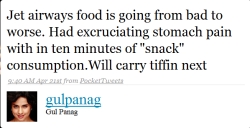
    While on celebrities and Twitter, closer home Gul Panag has been quite active on Twitter the last few days. The Twitterverse has had its share of imposters and has been trying to ensure there’s no ‘identity crisis’ this time, so much that poor GulP might have one soon. This tweet of hers caught my attention. (Oh, okay the dimples too!!)

    gulp1

    Spicy Jet news. Poor them. It reminded me of a post I’d written sometime back on ‘Social Ambassadors‘ – what would happen when the transparency of social media met celebrity bloggers? In this case, micro bloggers. In fact, micro blogging is even more ‘dangerous’ since the interaction is real time, and not like a PR draft that can be posted on ths site, and replies given in a few hours or even days. This becomes all the more important if celebrities use social media as a personal broadcast medium to their fans. Of course, brands can use the media to their benefit too – for example, create conversations between celebrities (a Twitter conversation between Aamir and Gul basis their Tata Sky TVC would be fun), use celebrities to communicate beyond the obvious advertisement etc.

    The challenge is for celebrities too. Perhaps it will also make celebrities more responsible when making endorsement choices. (It would be fun to ask SRK/Aamir why they switched soft drink brands in between.) Also, can celebrities retain their ‘interestingness’ when they are in touch with the fans all the time, unlike a traditional system when news about them was less abundant?

    On an aside, when celebrities move to direct-to-crowd platforms, what happens to the go-between media for whom they were the news makers, and we were the news consumers? And what happens to the micro celebrities on Twitter? 🙂

    until next time, when twitter streams meet mainstream