Tag: Ashok Banker

  • The Seeds of War

    Ashok Banker

    The second in Banker’s MBA (Mahabharata) series. The book quickly moves through the progeny of Bharata, pausing only for characters who have a direct bearing on the final epic war. Kacha – Devayani, Yayati and Puru are such, with the latter also offering lessons on dharma.

    The plot then moves on to the story of Shantanu and Ganga, and thus Devavrata, later to be known as Bhishma, after his terrible vow. The last few portions are focused on Shantanu’s second wife Satyavati and their offspring, and the continuation of the dynasty by Vyasa. (more…)

  • The Forest of Stories

    Ashok Banker

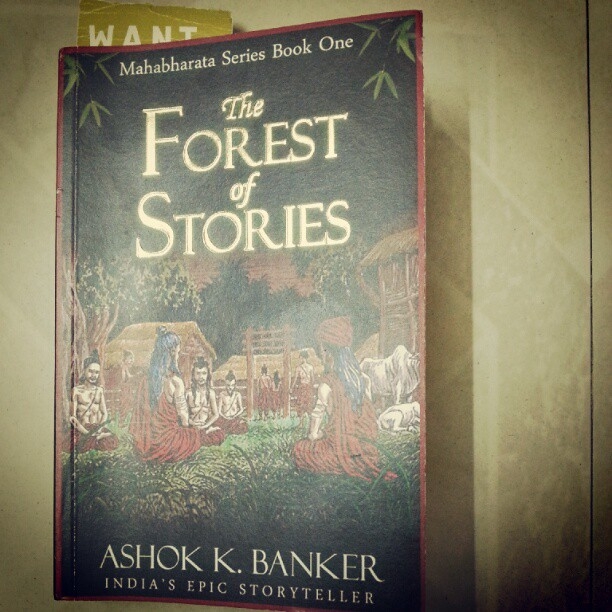
    Book 1 of Ashok Banker’s Mahabharata, MBA if you will. It is an exact rendition of the saga written by Krishna Dweipayana Vyasa. The narrative begins in Naimisha-sharanya, where Ugrasrava, son of Lomarsana and better known as Sauti, arrives to convey the news of Vyasa’s transcendence to the next life, and to narrate the grandest tale ever created.

    The tale begins long before the descendants of Kuru faced each other on the battlefield at Kurukshetra. Kurukshetra, famous long before as Samantapanchaka where Parasurama created five lakes of blood from the decimation of kshatriyas, and famous long after as the venue for the sarpa satra conducted by Janamajaya, descendant of the Pandavas.

    Sauti explains how Jaya, the original tale swelled from 8800 slokas to 24000, named Bharata and then over several narrations, to Mahabharata, made of one hundred thousand slokas. A narration that Sauti himself was the recipient of, from Vaisampayana, as well as Vyasa himself, at the satra.

    The narrative is anything but linear, like a tree with a multitude of branches, and does stick to Vyasa’s original work. It flits from story to story, occasionally coming back to what can be loosely described as central narrative, in this case, a sort of index built by questions being asked to Sauti during his narration. Thanks to this, from creation of the world and the origin of different species to the reason for the Mahabharata war and the stories of many antecedents of the Pandavas and Kauravas, there are stories and stories. This book ends with the introduction to Bharata – the emperor, son of Dushyanta and Shakuntala, after whom the country is named.

    As someone deeply interested in mythology, this is a very interesting read, despite the elaborate prose, but what you will get from it completely depends on your level of interest in the epic.

    Clipboard01

  • Visage.. envisage

    In the first book of the Ramayana series, Ashok Banker uses a line, a statement made by Rishi Adhranga to Lakshmana, as the brothers are about to enter Bhayanak van, where Tataka resides – “Over time, truth becomes fact, fact is rewritten as history, history fades to legend, and eventually, legend remains as myth.” In the myth 🙂 , these words are  spoken in the Treta Yuga (the Age of Reason), which follows Satya Yuga (the Age of Truth). The character also states that by the time its the Kali Yuga (the Age of Darkness, which is last and after the Dvapara Yuga), devas and asuras would be just race-memories and dismissed as fantasy by the rational and the scientific.

    In science fiction, there are many stories of the ravages of time. One, where, man comes across computers and other technological specimens, but does not know how to use them, since the lack of energy had made humans de-evolve. Another, where man discovers that the canals on Mars were made by a race of humans, ten thousands of years back, in an older ‘cycle’ of evolution and de-evolution. Interesting? 🙂

    So the other day, I was thinking about facts, truth, history and stories. It further led me to thinking about these blogs of mine, the lifestreams on Facebook and Twitter and on the blog. The digital snapshots of our lives, the way we are storing our life almost by the second, for many reasons. Our experiences, our thoughts, our desires, our emotions, our fears, our happiness and sorrow, and so many more things. To share, to look back….. to create an image of ourselves for whoever sees it?

    In Cochin, at home, there are these old albums with black & white and sepia photographs. The ones with which we, as children, had fun trying to identify Mom and Dad in their childhood photographs. There are other characters in them – grandparents, uncles, aunts and other relatives, friends of theirs. While many of them are easily identified by the earlier generation, some remain unknown, or rather, ones who aren’t remembered. Either ways, other than direct interactions, these photos are perhaps the only remains of people who lived a few decades back. Ever wonder who they really were, as persons, what were their thoughts, what did they think of their life, and others’, did they question their existence, or were they busy running a life, as we are? Did they think that someone, somewhere in the future would look at their photographs and peer into their lives beyond the confines of the frame? Would they have smiled a bit more if they knew, or would they try to look more serious? Maybe they wouldn’t have cared enough to strike a special look or pose?

    With the advent of the web, there are now more means than ever to store ‘life’. Sound, pictures, videos, enough material to make sure that a life is much more documented than the two dimensional photographs. Though my lifestreaming purpose is limited to my life, when I read posts about what happens to a person’s blog/Facebook account etc after his/her death, I can’t help but wonder about the future of digital lifestreams.

    With relationships getting redefined on a  regular basis, will there be anyone later who cares enough to go through another person’s life. After all, with the explosion of user generated content, an individual’s lifestream is just a statistic. (yes, even otherwise, it might just be that, but these are perhaps our efforts to move from being an irrelevant statistic  to a relevant individual). Yes, perhaps truth won’t become facts and so on, though the objectivity of truth itself can be questioned. But meanwhile, I am reminded of the science fiction tales. Maybe no one will be able to access all this content. Or it could be a deviant of this scenario. I have quite a lot of music cassettes. While I can still easily find devices to play it, a few years later, that might not be the case – either that, or the tapes would be in no state to be played. There are many tracks in these which I can’t find online. In the near future, they will be lost to the past. So in essence, technology might advance so much that those data items which have not been updated might be inaccessible anyway.

    A life. A lifetime of experiences, which defined not just what happened to a single person, but also to those around. Multiple lives. A web of existence. Humanity. Statistics and non-stories. All of which would be rendered inaccessible or meaningless in the future, but without which the future would not exist. An endless stream, which may have the larger picture of its origins, but has only hazy notions of the details. Makes me wonder. About the construct of our lives.

    until next time, streaming out loud…

  • Copy, right?

    A while ago, the literary world was in uproar over a certain Kavya. Of course, the same world had put her on a pedestal a few months before that, but it all ended up with the somewhat catty “How Kavya got Dissed…”… her crime was that she had copied lines, okay , paragraphs from other books. well, copied would be a harsh word, she was inspired, or in her own words (pun unintended),had internalised too much of what she read and liked…
    I have just finished the last book of Ashok Banker’s Ramayana series, and although i didnt like it in parts, i enjoyed reading it on the whole.. he has been successful (IMHO) in recreating the saga,and most importantly, made it sound real.. of course i always believe our myths were reality a long time back, but then i have been a sucker for mythology, and had even suffered arun govil and deepika gladly.. 🙂
    Now that we have dealt with the boring prologue, lets deal with my issue. The Ramayana series is not an original piece of work, not if you go by plot, or characters, which to me are important components of any literary work.. but hey, no one is raising any issues with it. is it because the ramayana and mahabharata have already been written by various authors throughout history? and is it because, there is no one to authoritatively speak on behalf of valmiki or veda vyasa and claim these works to be the most obvious examples of copyright infringement?
    Maybe, the difference is that, what Kavya did can be classified as plagiarism, and this cannot be because due credit has been given? But do you think Kavya could even have begun her book if she said that her work was an inspired version of works that had been written earlier? By that logic,aren’t we assuming that M/s Valmiki and Veda Vyasa wouldnt have had a problem with recent authors getting inspired by their works and writing their own versions? And maybe, just maybe, a long time later, in KBC 15, it could happen that someone could lose a lot of money by answering ‘Ashok Banker’ to ‘Who wrote the Ramayana?’

    until next time, who determines the right to copy?
    PS: Having said all that, Mr.Banker’s series is a must read, for those who know the Ramayana, as well as those don’t, for its a story well retold.
  • Legacy Issues

    Yes, i can understand the techie eyebrows shooting up, but its nothing to do with system related legacies..its more to do with the original usage of the word, long before they had thought of computers…Like i have said in a post not too long ago, in addition to the fact that we love reading, there is also possibly a subconscious reason for buying books.. it is perhaps a way of transmitting ourselves to those who come after us.. because the books we have read also tell a little something about the kind of persons we are, and also share the ideas that in a way shaped our thinking… i also write the date of purchase of the book so i can sit back a long time later and smile at the books i used to read…:)
    I have started collecting Ashok Banker’s Ramayana series, also because of the fact that it might be slightly more appreciated than the ramanand sagar vcds..:).. though i bought it quite a while back, i started reading it only recently.. the author has a disclaimer that there are lots of versions of the ramayana, and he has tried is best to be as true to the original version by valmiki as possible…but he has written it very clearly keeping the current generation in mind… there is definitely a difference in the style of storytelling..
    this is almost like a desi ‘Lord of the Rings’ interms of characterisation and narration.. for example, i am not too comfortable with a ‘Harishchandra Avenue’ in Ayodhya or Shatrughan being called ‘Shot’!! but its still a good book..and so while i may be leaving behind a legacy, i should keep in mind that books are also the perspective of the author and can be way different from what i would want it to be…
    until next time, dont believe everything you read 🙂