Tag: Anjum Hasan

  • Difficult Pleasures

    Anjum Hasan

    Anjum Hasan is definitely among my top 3 favourite authors, and this book only adds to it. But that also means that this is not a thoroughly objective review. 🙂

    The book has thirteen short stories that have a varied set of characters in different circumstances. As the jacket informs us, some of the stories are borderline surreal, but that doesn’t take away from the empathy that the author (has and) seems to be able to evoke in the reader. This is especially commendable because the characters vary in age, socio-economic class, mindset, location and many other factors. Yet, the single common takeaway from each of these (sometimes not-so-ordinary) slice of life situations is how the author is able to drag the reader in and empathise with the character/s even if not completely identify with. (more…)

  • An idea called home – 2

    Anjum Hasan’s “Difficult Pleasures” is borderline surreal, the jacket told me. She would be in my top 3 favourite authors list, and I am completely awed by her writing (check the last para here) but I wonder if even that can explain the surreal thought I had as I read the first few pages. Can a book be called a home? What is a home after all? Isn’t it just an idea that is sometimes real and tangible and exists physically?

    And that was the surreal thought – every time I read this author’s books, it’s like going home, as though I could reach inside, get into the story and talk to the characters and they wouldn’t consider me out of place at all. I could belong. Yes, it’s surreal, and I haven’t been smoking, but I just couldn’t get the thought out of my head.

    until next time, home away from home

  • Shillonging Day 4 – Peaks and Falls

    Contd from Day 1, Day 2, Day 3

    Ajmal managed to be late citing tire problems as an excuse. My legs were tired too, but D seemed to be even worse off, stooping like an old woman when she walked. I laughed, but my back hurt when I did that! Breakfast was standard – paratha and omelette. The night before, Ajmal had claimed complete ignorance of where Laitlum – one of our destinations for the day – was. Though Chintu also professed no knowledge, he was kind enough to find out and draw a map for us. Google Maps helped too.

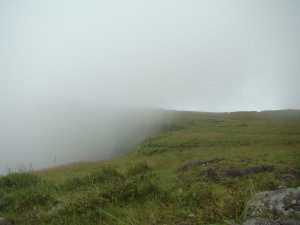
    We decided to go straight to Smit, and from thereon to Laitlum. Despite the map, it was difficult to find. It was really an ‘edge of the world’ place, and though there was heavy mist, it was quite an awesome view. Unfortunately the damn mist wouldn’t allow the canyon view to pose for photos! It takes just over an hour from Shillong, so it’s really worth a trip, for the silence and awe. 🙂 Ajmal, as usual, had no idea on where the 100 year old house in Smit was, so we had to skip that!


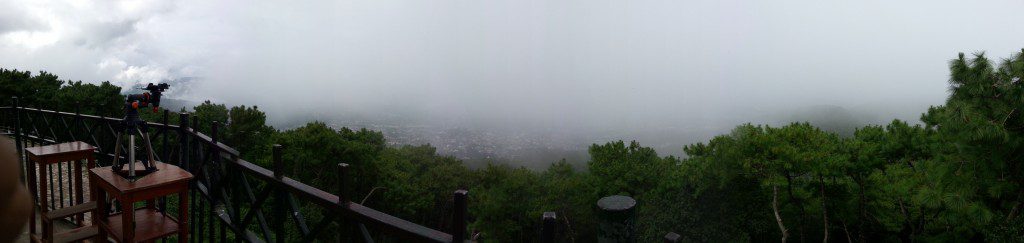
    The next stop was Shillong Peak, and it had begun raining heavily again! But it cleared for a few minutes just as we reached the peak, and so we were able to catch the splendid view, though there were clouds and mist. D also got to wear the traditional Khasi costume for Rs.50. While climbing the little watchtower, D suddenly realised that she had developed a fear of steps. 😀


    Elephant Falls was next. Appearances and sounds were deceiving, and when D realised the number of steps that it would take to reach the third level of falls, she immediately balked. The first level was easy, and I went till about the second level, but from my vantage point, didn’t see a lot of sense in going to the third. I also realised that the place seemed to be a favourite rendezvous for the young Shillong crowd, and didn’t want to disturb their, erm, best practices.

    We got back to Laitumkhra after spending close to an hour in Shillong traffic! This time we were adamant about finding Sesame, and finally did! It was in a little building called Shoppers Cove near the Municipal Parking Lot in Laitumkhra! We entered the dimly lit, tiny outlet and discovered that they really didn’t serve local dishes as various stories had informed us! So Pork Chilly Mushroom and a Chicken Chopsuey it was! We then went back to the hotel, totally tired.

    We were too lazy to even go out for dinner, so the plan of visiting Cloud 9 in Police Bazaar was dropped. Instead we ate waffle cone ice creams at the Baskin Robbins outlet nearby. 😀 A sweet last night in Shillong.

    Day 5: On the return trip, Ajmal was supposed to stop at Barahpani, but didn’t deem it worthy enough. Instead we got to see several man made waterfalls on the road, with truckers being the major contributors. Ajmal seemed to be focused on sending us heavenwards even before the flight, and had a curious habit of accelerating on hairpin curves and places where there were boards that stated speed limits of 20-30 kmph. Have to mention here, that we found a Kerala restaurant at 9th Mile! Seemed closed though. The Guwahati airport does have a couple of options for snacks. At Kolkata we sat at our regular CCD hangout just outside the main building and killed a few hours. Indigo proved to be as 6E as it always is in terms of sticking to time.

    The trip cost us around Rs.60000 inclusive of everything – tickets, hotels, meals, taxi. We went through Traveloearth, but really wouldn’t recommend them mostly courtesy Ajmal. Both White Orchid and Cherrapunjee Holiday Resort are functional and clean. The trip was worth it thanks to the day spent at Cherrapunjee,  a couple of really nice people we met – Chintu and Angela, and for visiting a place that a favourite author set her first book in – also her birthplace. I am a huge fan of Anjum Hasan‘s writing, but on Day 1, I became skeptical of her description of Shillong. However, by the end of the journey, I could completely relate to the place in “Lunatic in my head” though it is set in the 1990s. It would seem that Shillong has grown since then, but hasn’t really moved.

  • Lunatic in My Head

    Anjum Hasan

    Though this is the author’s debut, I happened to read it after I read the second work – Neti Neti, which can arguably be seen as a sequel of sorts to this book, not just because its protagonist happens to be Sophie Das, a character introduced in this book, but also because both the books seem to have a common theme of a search for belonging.

    ‘Lunatic In My Head’ has four principal characters. Firdaus Ansari, who teaches English literature to an apathetic class, pursues an elusive PhD, finds it diffuclt to connect to the authors she’s dealing with, fights staff room battles, suffers from near OCD and tries desperately to remain in love, as she lives with her grandfather, both of them conscious of a fragile balance that allows them to endure each other.

    Aman Moondy, Civil Services aspirant, obsessed with Pink Floyd with a bunch of friends, each fighting their own battles with parents, siblings, lovers and representing the life of youth stuck in a small town.

    Sophie Das, eight year old daughter of an English professor who refuses to be realistic and his wife who feels her husband has stopped caring for the family.

    And Shillong, for this book is also about the place, its people, its gossip, its idiosyncrasies, and its clearly visible lines of separation between the natives and dkhar (Khasi word for non tribal person)

    Each of them also live in their own fantasy world too- Sophie, who cooks up a story of being adopted, and Aman, who thinks Roger Waters makes songs based on the letters he sent him. The smallness of the town is perhaps emphasised by the degrees of connection between the characters, how their paths cross, and how intertwined their lives are.

    Divided into chapters such as ‘Wonder’, ‘Sadness’, ‘Love’, ‘Courage’, ‘Disgust’, ‘Fear’, ‘Anger’, ‘Joy’ and finally ‘Peace’, the book passes through what can be seen as a cycle, and uses the mundane occurrences in a small town to reflect mindset and the paradoxical static and dynamic nature of the place and the people there. What takes it to a higher level is the moodiness that seems to reflect rainy and misty Shillong itself.

  • Neti, Neti Not This, Not This

    Anjum Hasan

    Before anything else, the summary on the back of the book does not really do justice to what the book is about. That’s just a perspective. Though indeed, it is about Sophie, a girl from Shillong who came to Bangalore to work with a book publishing company and ended up in a US-based company that outsources the subtitling of DVDs and her increasing sense of being out-of-place in the growing metropolis, I thought it did dwell a lot on what the idea of home is to a person, and how time and situations change the idea and affect this relationship.

    The other facet of the book is how the author uses Sophie’s Shillong origin to portray just how different the North East is from the rest of the country. So this becomes a layer that goes beyond the stereotyped small to big town transition angst.

    The paradox, however is that Sophie is someone many people can identify with – someone who contemplates what this entire game of living is all about. And it is through these eyes that the author zips through the age old debates of culture/modernisation, young/old, east/west etc, the cliches of the modern Indian metro – malls, new age spiritual gurus, midnight parties in high rise apartments, work relationships, pubs, the influx of quick money, changing lifestyles and so on – the drama in the daily grind. The disenchantment with her new and old ‘homes’ is something I could completely relate to.

    Anjum Hasan is a prose artist. While I’ve not been to Shillong, the way she has captured Bangalore makes me feel that when I land up in Shillong, I’ll get a sense of deja vu. When you add to this some superb wit, and a penchant for subtlety, you get a book that’s quite easily worth a read.

    I read in a few reviews that Sophie’s character is from Hasan’s earlier work “Lunatic In My head”. Couple that with the fact that she has opted for quite an unconventional ending, and I begin to hope that there is another book in the making, in which Sophie gets out of her disillusionment. That’ll be a journey worth waiting for.