Tag: Anil Seth

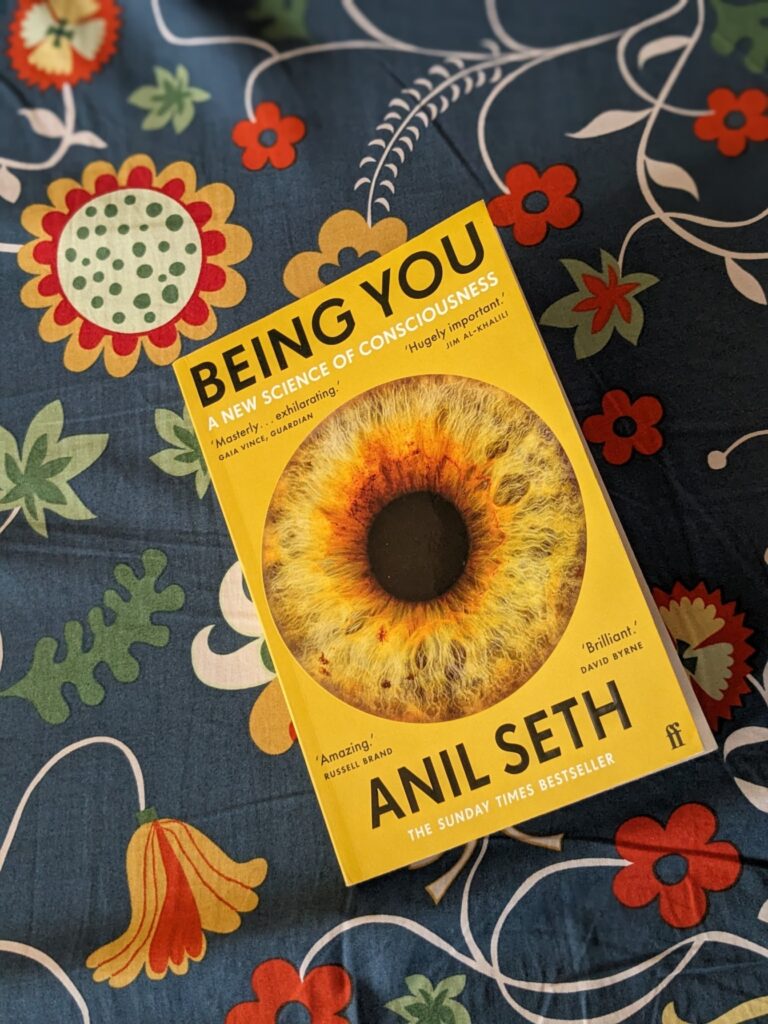
  • Being You: A New Science of Consciousness

    Anil Seth

    I have to confess, I will need to read this again. I also want to. For two reasons. First, the subject is something I feel is important – understanding consciousness through the lens of a scientific method. Second, grasping all of the material in Anil Seth’s fascinating exploration, I feel, is impossible with a single read. Having said that, the first read of Being You is indeed enlightening.

    Being ourselves is not something we are always conscious of.* Anil Seth sets out to explore how billions of neurons within the brain end up creating a conscious experience – a uniquely personal, first person experience. Being You is divided into four sections – defining the ‘problem’ and showing the approach to the scientific exploration of consciousness, looking at it through how it relates to ‘content’ and external phenomena, and then going inwards to the experiences of conscious selfhood, and finally applying the learning to non-human entities – animals and AI.

    In the first section, Seth brings up the ‘hard’ and ‘real’ problems of consciousness. The first (David Chalmers) is focused on how consciousness happens, how it is related to our biophysical machinery and how it is connected to the universe at large. On the other hand, the ‘real’ problem is how the ‘primary goals of consciousness science is to explain, predict and control the phenomenological properties of conscious experience.’ i.e. why is a particular experience the way it is, and what is its relation with what is happening with the brain and body. In other words, deeply understanding the connection between mind and matter. The latter approach would need measurement.

    This begins with understanding ‘conscious levels’ – complete absence (e.g. coma) to light sleep to waking states. Conscious content is what we are conscious of – sights, smells, emotions, moods, thoughts, beliefs – all sorts of perception. There is a very interesting part on how psychedelic states are at a conscious level well above waking state, and have the maximum algorithmic complexity (a measure of the diversity of signals). Another interesting proposal is how all conscious experiences are informative and integrated, (red ball vs red and ball separately) leading to the integrated information theory (IIT) of consciousness, an axiomatic approach that starts with theories and use them to support claims on what properties the mechanisms underlying the experiences will have.

    The next section is about conscious content and then the experience of a conscious self. Here’s where the idea of perception gets upturned. Perception is a ‘controlled hallucination’ (phrase by Chris Frith), an active construction as opposed to a passive registering of an external reality. The brain constantly makes predictions about the causes of its sensory signals through a Bayesian process in which the sensory signals (also) continuously rein in the brain’s various hypotheses. Perception is a continual process of prediction error minimisation (reducing the difference between what the brain expects and what the signal provides).

    Reality is an interpretation, and the entire process is not optimised for accuracy, it is designed for utility. ‘We perceive the world not as it is, but as it is useful to us.’ A mechanism of making it seem real so we respond to it. Not to know the world, but to survive it! There is the fascinating part on colour – an object is not objectively ‘red’, redness is just the way in which it reflects light, and how the brain perceives it. And this applies to all of our perceptions. Mind effing bending! A great distinction here (John Locke) is on why that train is not just a perception and you shouldn’t jump in front of it. Objects have primary qualities that exist independently of an observer (e.g. space it occupies, movement, solidity), and secondary qualities that depend on the observer (e.g. colour)

    The self, as shown in the next section, is also a perception, a controlled hallucination. To begin with, selfhood is divided into an embodied (being a body), perspectival (having a first-person perspective), volitional (having ‘free will’) and narrative (personal identity and deep emotions), social (how I perceive others perceiving me). The link between perception and the body and its physiological processes exist in all these forms. When we flip the learning from the previous section inwards, we understand that we do not perceive ourselves to know ourselves, we do it in order to control ourselves’. The entire panorama of experience and the mental life and thus its perceptions and cognitions stems from a deep-seated biological drive to stay alive.

    I found the part on why we think we are stable and unchanging over time, very interesting. Perceptual inference is about finding out things about the outside world. Interoceptive inference is about controlling things – physiological regulation. In the latter, the prediction error minimisation happens by acting to fulfil top-down predictions of the brain. The brain, for survival, desires predicted ranges of physiological viability and thus the need for strong, precise and self-fulfilling predictions. And if it comes to that, the brain will (and does) systematically misperceive.

    The end of the section also brings in the complex but fascinating FEP (free energy principle) and specifically how it applies to living systems and consciousness. In this context, it boils down to this – being alive means being in a condition of low entropy. Any living system, to resist entropy, must occupy states which it expects to be in. Free energy here approximates sensory entropy, and apparently, it amounts to the same thing as prediction error. Broadly, that connection with physics and the universe, and the brain’s regulation of the perception of the worlds outside and inside! Appealing, but they’re still ironing out many wrinkles.

    I found the last parts – free will, and consciousness in animals and AI to be areas which are still under much (more) debate, and therefore more descriptive than insightful. That is not to say that it does not merit a read! It is just that the 200+ pages before were so rich and intense that on a purely relative scale, this seemed less so.

    As I said, Being You is most definitely not an easy book, but it does such a fantastic job of providing that glimpse and promise that we might actually get answers to our most basic and profound questions that one automatically cheers for the understanding that each chapter provides. Also the kind of book that makes me wish I were smarter – to really grasp the entirety of it! It also made me think of how science and spirituality seem to converge – the latter’s approach to reducing wants and desires, and increasing mindfulness as a means to prediction error minimisation. πŸ™‚

    This was part of my Bibliofiles 2024 list, and in fact, my favourite read of the year.

    Notes and Quotes
    “The essence of selfhood is neither a rational mind nor an immaterial soul. It is a deeply embodied biological process..”
    “Wherever there is experience, there is phenomenology, wherever there is phenomenology there is consciousness.”
    Deductive (reaching conclusions by logic), inductive (extrapolating from a series of observations) and abductive reasoning (the best explanation from a series of observations)

    *now that I have read the book, I am analysing this sentence!
  • #Bibliofiles : 2024 favourites

    Bibliofiles 2024

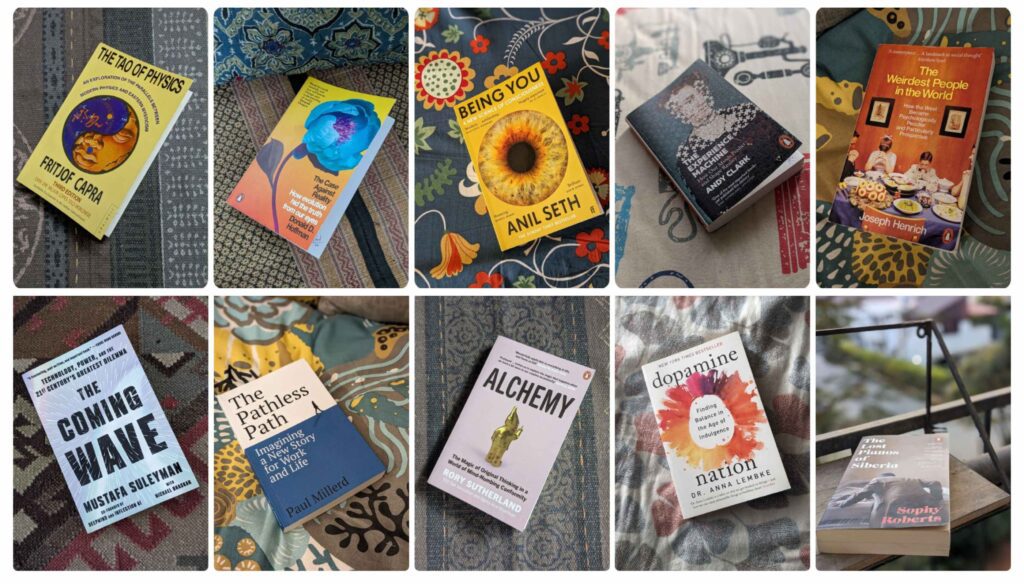
    In 2024, the mind seemed to be obsessed with the mind and the reality it perceives, and that’s a good thing because I was able to take a shot at some synthesis on why I am the way I am. When you see the books, you’ll know why/how. And so, as per tradition – from 2019202020212022 and 2023 – we have this year’s list of ten (plus a few extras πŸ™ˆ). From the 63 books I read in 2024…

    (more…)
  • An entropic guide to history

    In the last year, I have read four ( + one) books that I thought summed up the why-what-how of humanity’s evolution very well. Respectively, The Case Against Reality: How Evolution Hid the Truth from Our Eyes (Donald D. Hoffman), and Being You: A New Science of Consciousness (Anil Seth) (my favourite this year), The Master and His Emissary: The Divided Brain and the Making of the Western World (Ian McGilchrist) (first among my favourites last year), The WEIRDest People in the World: How the West Became Psychologically Peculiar and Particularly Prosperous (Joseph Henrich) (don’t worry, it is inclusive enough in this context), and finally the + one The Cosmic Game: Explorations of the Frontiers of Human Consciousness (Stanislav Grof) because while it is fringe science and despite the qualitative proof, I wasn’t convinced on the existence of divinity, I think our experiences in our non-ordinary states of consciousness has a connection with the ‘why’.

    The theme that unites them is entropy and ‘order’. Haha, school stuff, I know. So here’s a quick refresher. Simplistically, entropy is the measure of the degree of disorder in a system. The second law of thermodynamics states that in any isolated system, the total entropy tends to increase or remain constant over time. Our universe is an isolated system because, as far as we know, there is nothing else other than our universe; there is no external environment that our universe can exchange matter or energy with.

    Let’s begin with Hoffman. He points out how natural selection is the only process we know that ‘fights’ entropy. It pushes organisms to higher degrees of functional order to try and delay entropy if not offset it completely. Across a vast amount of time, it has tweaked living systems to not just be fit for survival, but also reduce disorder. But there is a trade-off. We don’t see reality as it is. He posits that “some form of reality may exist, but may be completely different from the reality our brains model and perceive.Maya, anyone? He compares this to icons on our screens that are a way of interacting with the system but don’t look/feel/behave like the system underneath. They are a user interface that spares you tiresome details on software, transistors, magnetic fields, logic gates etc. And everything we perceive around us through our sensory organs and mind is just like that – icons that help us navigate. Our perceptions don’t even have the right language to understand/describe reality. Think of it like the UI or formats we have evolved for navigating the world, and there are different ‘languages’ for different species.

    The non-ordinary experiences – courtesy psychedelics etc – that Grof writes about , I suspect, opens up our brain to a different language and thus a different interpretation of the world. A perception of reality in a different language.

    Anil Seth also touches upon how our brain is wired for survival and the functional order that natural selection is driving towards. Reality is an interpretation, and the entire process is not optimised for accuracy, it is designed for utility. ‘We perceive the world not as it is, but as it is useful to us.’ A mechanism of making it seem real so we respond to it. Additionally, perception is a ‘controlled hallucination’ (phrase by Chris Frith), an active construction as opposed to a passive registering of an external reality. The brain constantly makes predictions about the causes of its sensory signals through a Bayesian process in which the sensory signals (also) continuously rein in the brain’s various hypotheses. Perception is thus a continual process of prediction error minimisation (reducing the difference between what the brain expects and what the signal provides) because lesser error, more order, lesser entropy.

    McGilchrist ‘s work goes deeper into the functioning. The right is present and pays attention to the world outside, the left re-presents. The differences between them are less about what they do and more about how they approach something. A fascinating perspective on how the two halves of our brain have quite different worldviews – the β€œleft hemisphere is detail-oriented, prefers mechanisms to living things, and is inclined to self-interest, where the right hemisphere has greater breadth, flexibility, and generosity.” Relatively, mechanisms offer more control (order) and predictability than living things. Thanks to its ability to break things down into simple answers and better articulation, the left hemisphere has been able to grab control at an accelerated pace since the Industrial Revolution, and create a world where it prizes precisely these capabilities in individuals, institutions, and culture at large.

    And finally, Henrich, overlapping with McGilchrist, shows how cultural learning adaptively rewires our brains and biology to calibrate them for navigating our culturally constructed worlds. “Unlike other animals, we have evolved genetically to rely on learning from others to acquire an immense amount of behavioural information, including motivations, heuristics, and beliefs that are central to our survival and reproduction.” From kinship altruism and pair bonding to our own motor patterns to projectile technology and food processing to grammar and social norms. When you look around, the dominant narrative is the WEIRD (Western, Educated, Industrialised, Rich, Democratic) one. Broadly, individualism and personal motivation (self focus, guilt over shame, dispositional thinking – based on intent not context, low conformity, self regulation and control and patience, time thrift, value of labour, desire for control and choice), impersonal pro-sociality (impartial principles, trust, honesty and cooperation with strangers and impersonal institutions, emphasising mental states in moral judgment, not revengeful but willing to punish third parties for not sticking to principles, reduced in-group favouritism, free will, belief in moral truths like physics principles, linear time), and perceptual and cognitive abilities and biases (analytical over holistic thinking, attention to foreground and not surroundings, endowment effect, overconfidence on own abilities) are all features of this, and the correlation with higher functional order is evident.

    If I look around the metro crowd in India and across the world, the optimisation for WEIRD is rising. As I wrote in Kaumpromise, we can still see an alternate way in patches. It’s interesting how with the rise of AI, we are at once creating even more order in many ways but at the same time ceding control to blackboxes. That requires some thought, and another post!

    P.S. There is a nice time dimension to this as well, brought out in monochronic and polychronic cultures. Read more here.