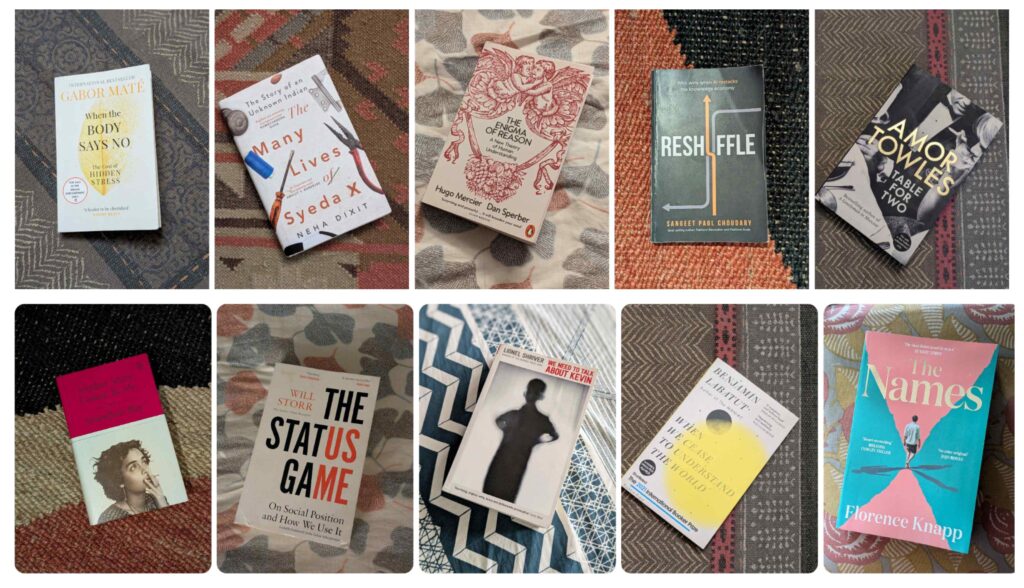
Compared to the last couple of years, I read fewer books in 2025, but I think the variety was higher. That probably explains the highest number of fiction books in a long time.
And so, once again, like 2019, 2020, 2021, 2022, 2023 , and 2024, presenting #Bibliofiles 2025’s list of ten (plus the long list). From the 58 books I read this year…
I paused to take one final stock of the room. When I looked out of the window, I could see the mezzanine balcony. I doubt he had stood there, looking at it as I did. From his vantage point on the bed, he’d have seen the far wall. Photos, an album of life. I sat for a while on the bed, looking at a suitcase that wrapped up the last remnants of a life.
But one day, years after the convergence has begun, you cannot only sense the inward trajectory of the walls, you can begin to see the terminal point in the offing even as the terrain that remains before you begins to shrink at an accelerating pace.
…the three infirmities amount to the same sentence: the narrowing of life at the far tip of the diamond. Step by step, the stomping grounds of these friends had shrunk from the world itself, to their country, to their county, to their home, and finally to a single room where, blinded, breathless, forgetful, they are destined to end their days. Though Abacus had no infirmities to speak of yet, his world too was shrinking. He too had watched as the outer limits of his life had narrowed from the world at large, to the island of Manhattan, to that book-lined office in which he awaited with a philosophical resignation the closing of the finger and thumb.
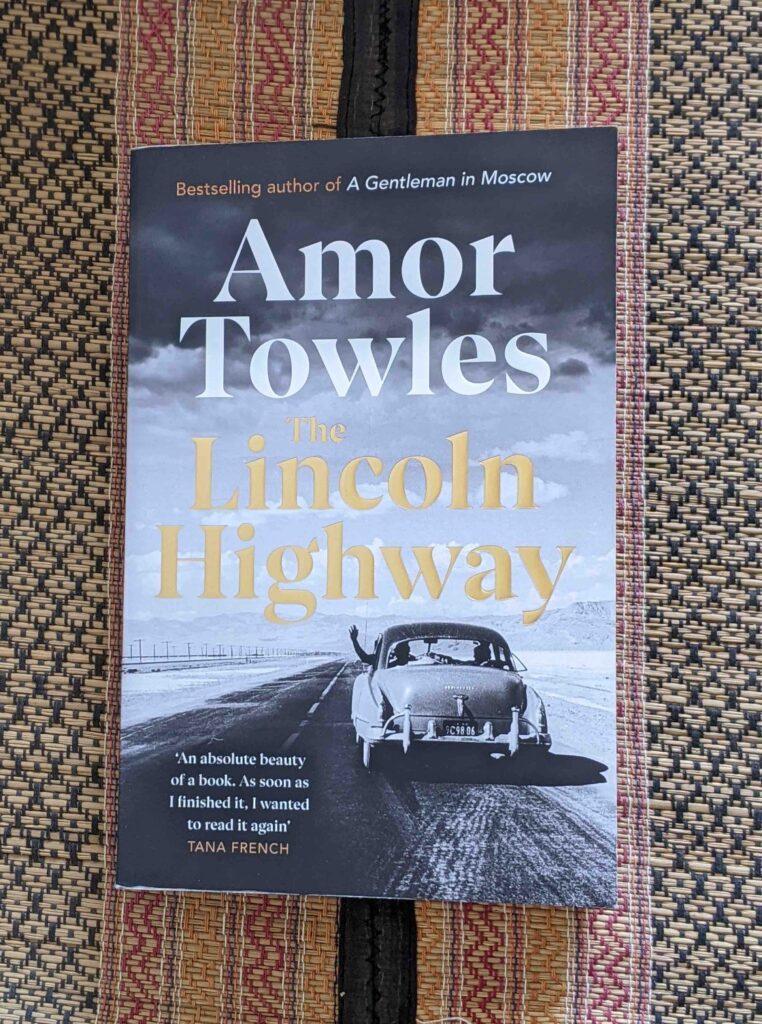
The Lincoln Highway, Amor Towles
In the second half of my life, I am now able to visualise this a lot more easily. There is something bittersweet about this. Like when I give away clothes. I am sometimes forced to pause for a minute because a particular tee would trigger memories of a different time. A different me. And by giving it away it is almost as though that part of me is now beyond retrieval.
Later, when I got home, I looked around. The contents of our life, now. I’m sure all of it is subject to change. Home is after all a construct of the past, present, and future.. Things that point us to the past and helps us remember it as we grow older. Things that point us to the future, and help us visualise it the way we are imagining it now. And things that point us today to our self image. The things we possess, and the things that possess us. What would happen when they all start shrinking? As we clutch what we can remember of the past, struggle to imagine what can change in the future, and watch our self image shrinking? I suspect that is how the physical space too starts shrinking. Or maybe it works both ways.
As I think about that suitcase now, and the remains of a lifetime, I wonder if he would have liked them to be in ‘the foreign object‘, a part of his happier days, which I had appropriated a decade later. I have no idea what will happen to the latter when I am gone. A cross-section of a life that no one needs to remember. And it makes me wonder as I look around again, all of these possessions which seemingly give our life meaning now, only have that meaning when we are around.
Somewhere in the last 100 pages, Duchess tells us that in vaudeville, it is all about the setup. He brings up Mandrake the Magnificent, who wasn’t a great magician, but what he lacked in the general act, he made up in the finale. The book is something like that. The countdown approach to chapters also helps set up a fantastic climax.
The Lincoln Highway is not Rules of Civility, it’s definitely not A Gentleman in Moscow. You’ll be better off without that set of expectations. The characters are younger and less sophisticated though still fascinating, and the narrative didn’t have the subtle nuances the earlier books had. It is probably closer to say, a Huckleberry Finn. Or as someone wrote, it’s an ode or love letter to the classic American road trip. I didn’t love it like I did the other two, but having said that, it is well structured and an absolutely enjoyable read. Something about the book(s) reminds me of Jeffrey Archer – the unambiguity of right and wrong, morally upright characters and a world that was less complex.
The story is of three boys in their late teens who know each other from a juvenile ‘camp’ – Emmett, Duchess and Wally. And Emmett’s precocious younger brother Billy, the fourth musketeer. Towles does a good job of creating multiple narrators – they add perspectives and help in making the characters (and their actions) relatable. The circumstances of the three are completely different, as are the reasons they landed up in the camp. Both of these factors exist on a continuum, with the three characters at different points. And in many ways, this have an impact on their character and the decisions they make. That’s essentially the book – good, evil, the choices we make, and their implications – now and later. In fact, with the destinations and detours, the road (The Lincoln Highway) from one end to the other (in this case, America) is probably a metaphor for life.
The book has connections to Towles’ earlier works. Amor Towles doesn’t seem to be done with Manhattan, and while it doesn’t have the presence it did in Rules of Civility, it is at least a side character. On p455, when Wally describes his uncle’s watch, I had a feeling of deja vu. Turns out the uncle is Wallace from Rules of Civility! The camp at Adirondacks is also revisited. And this might be just a coincidence, but June 1954 is when The Gentleman in Moscow ends. That’s also when this book begins. Maybe we have an Amor Towles Universe forming. I, for one, won’t mind that at all.
Asides: Once you’ve read about Leonello’s amazing business model and that special dish – Fettuccine Mio Amore (p 138), look up Amor Towles’ website for the recipe 🙂 My favourite part was in p505-6 when Abacus Abernathy gives a perspective on the two halves of life – divergence and convergence. First, the world opens out and then, as we age, it closes in. It was amazingly articulated and I could relate to it a lot.
Nearly five years ago, when I wrote about the closure of my second (and probably final, given the zero usage now) book of accounts, I had ended it with how the days of our lives have found a rhythm, a familiarity. They actually point to the habits that have become a part of my life. Earlier this year, when I wrote The building blocks of freedom, the ending was again a commentary on habits. As I quoted in it (from a splendid post Routine Maintenance), while habits are indeed a way to off-load cognitive overhead… at their most extreme, habits can slide into addictions and compulsions, patterns that resist our conscious efforts to break them… Ritual dissolved into routine.
Habits, as I wrote, are possibly a micro-version of intentionality. They are are physical, mental and even emotional. But when we don’t review them, it is almost as though they hijack our intentions and make them subservient! It’s almost like the new Batman’s point about scars – Our scars can destroy us, even after the physical wounds have healed. But if we survive them, they can transform us. They can give us the power to endure, and the strength to fight. As I have realised many times recently, it is extremely difficult to be objective about my habits. It is only when I am deeply mindful that I observe some of my habits, and sometimes laugh at their absurdity. But when I go back and understand where it came from, I also give a mental hug to my earlier self. 🙂
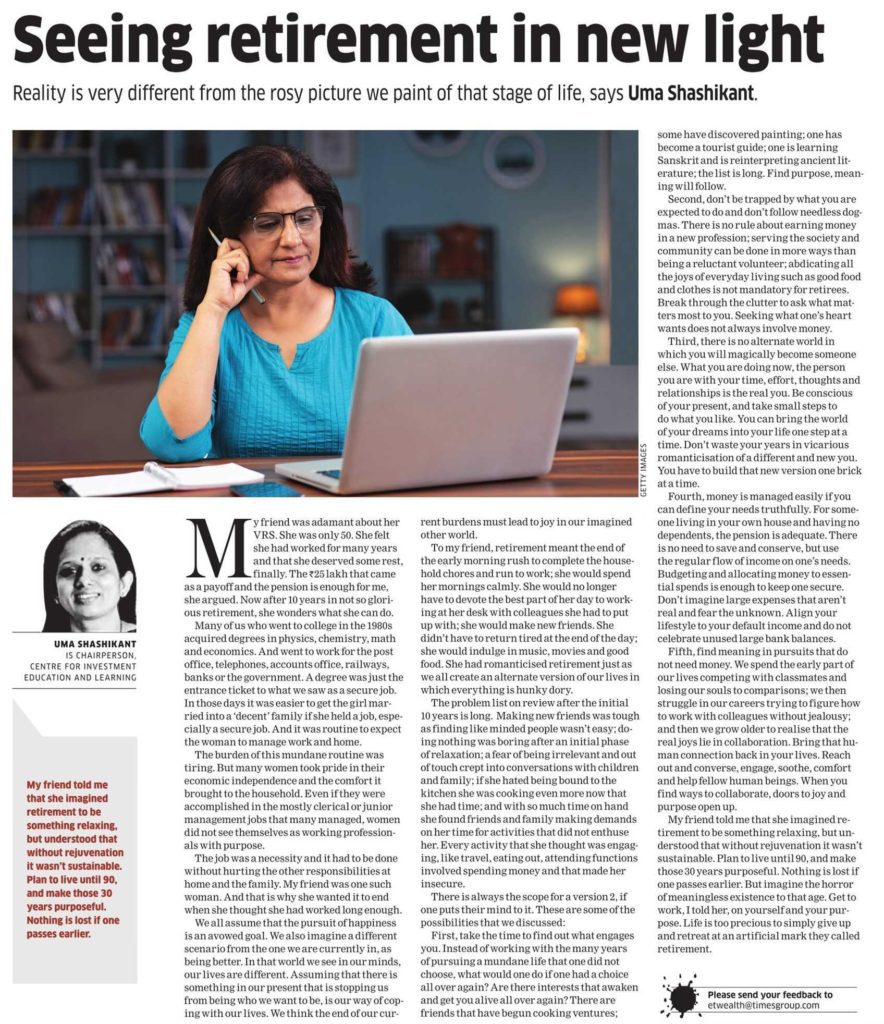
Very recently, it also made me review my deep-set approach to retirement. I had mentioned that in my previous post – the third point in Uma Shashikant’s excellent article (below).
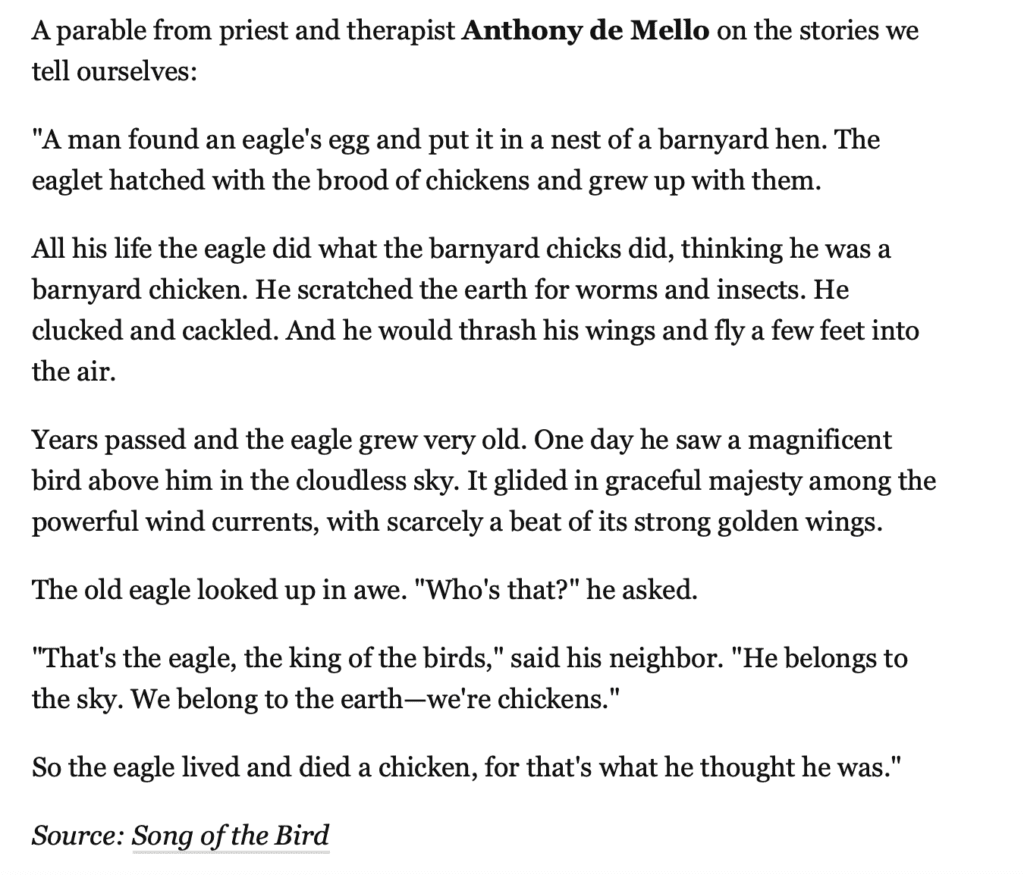
I always assumed that the day I stopped working for a living, I could switch into a ‘different me’. I now see how it’s quite impossible. I will have to start looking at the ‘difference’ right now, and build new habits and junk old ones that can help me move in the direction of the ‘new’ me. The idea is that it won’t seem new. Turns out this isn’t a problem that only I encountered. In a couple of books and articles that I read recently, I came across some very insightful perspectives.
Familiarity and habit impoverishes the way they look at things. They are mostly unable to break away from the past and see things in a fresh way. It doesn’t help that breaking away might mean losing everything that made them great/admired. Lack of interest and curiosity are aggravated by biological conditions, and this intellectual and emotional indifference may cause inertia.
Simone de Beauvoir, The Coming of Age
…Marcel wrote of the human tendency to become stuck in habits, received ideas, and a narrow-minded attachment to possessions and familiar scenes. Instead he urged his readers to develop a capacity for remaining “available” to situations as they arise. Similar ideas of disponibilité or availability had been explored by other writers, notably André Gide, but Marcel made it his essential existential imperative. He was aware of how rare and difficult it was. Most people fall into what he calls “crispation”: a tensed, encrusted shape in life — “as though each one of us secreted a kind of shell which gradually hardened and imprisoned him.”
“On the Ontological Mystery,” Gabriel Marcel, via At the Existentialist Café
And while being too lazy to type out the one above, I found someone had already written about ‘crispation’. And found this (below) there. It reminded me of the converging life Amor Towles wrote about.
“We all end up as packaged goods,” Westbrook Pegler remarked a little while before he died. The dreary road to the wrapping and bundling counter is probably inescapable: there is the hunt for the discovery of what works, then the erosion of curiosity about what else might work, then the disappearance of all curiosity about anything unfamiliar, and at last the prison of the safety of one’s own accepted manner. Yeats was a little way off the mark; the peril for the artisan no less than for the artist is not that his circus animals may desert him but that he will let slip past the time when he ought to turn them back to the forest.
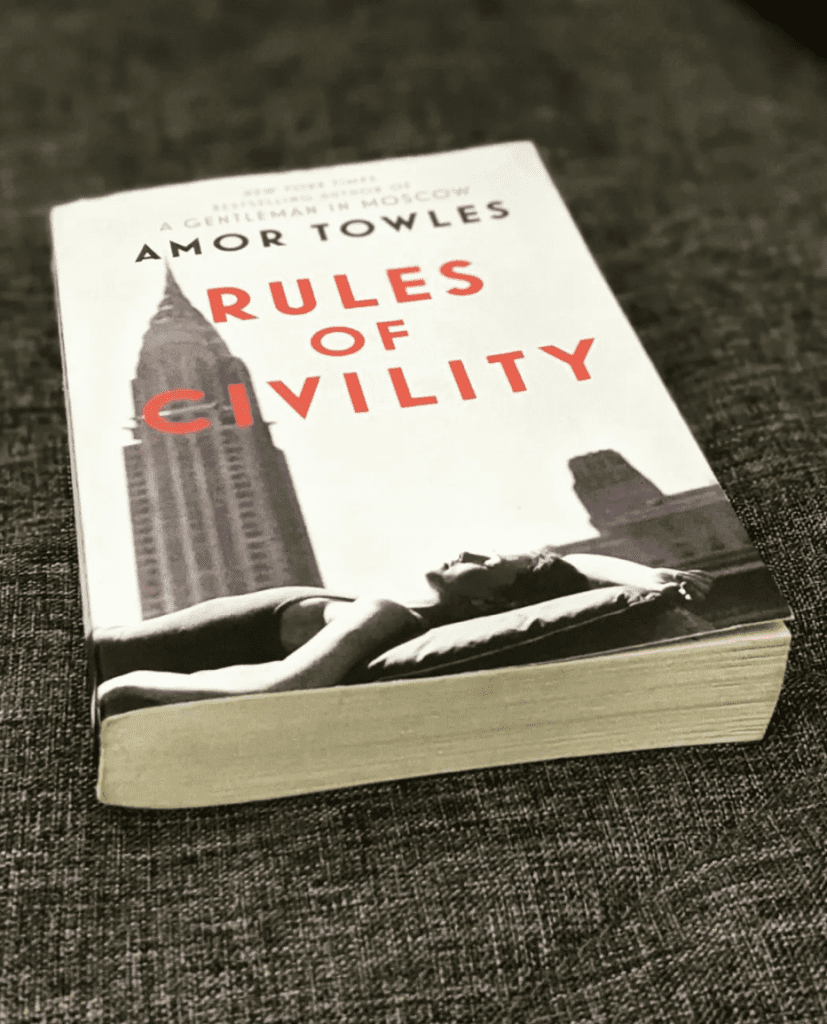
“For however inhospitable the wind, from this vantage point Manhattan was simply so improbable, so wonderful, so obviously full of promise — that you wanted to approach it for the rest of your life without ever quite arriving.” That last bit, that’s how I feel about some books. This is one those, just like “A Gentleman in Moscow”. I have to admit a bias because that book is among my all-time favourites.
In the preface, we meet Katey Kontent (originally a Russian immigrant Katya), who, in an exhibition in 1966, sees the photograph of an old acquaintance Tinker Grey. It catches him underweight, with a visibly dirty face, ill shaven, in a threadbare coat. As Katey’s memories come flooding back, she decides to leave, but catches another photo of Tinker at the exit – clean shaven, in a custom-made shirt and a cashmere coat. The second was from year before the first, prompting Katey’s husband Val to say “riches to rags”. “Not exactly” is Katey’s response, because in the first, Tinker’s eyes were bright and he had the slightest hint of a smile on his lips. And that sets the stage for a wonderful ride that starts on the last night on 1937, one Katey met Tinker for the first time.
The photographs remind Katey not just of Tinker, but a mix of people who would play important roles in her life – Wallace Wolcott, Dicky Vanderwhile, Anne Grandyn, and her best friend at that time – Evelyn Ross. And then there is New York, or specifically Manhattan whose different shades also appear, as Katey’s life changes. Amidst the parties, cocktails, flings and high-heels, there are extremely well-etched characters (some really powerful women among them), all different from each other, and all with moments of deep poignancy.
Anything more and I think I’d take way the joy of discovering the layers of the book, and the sharp revelations too. Enjoy the ride.