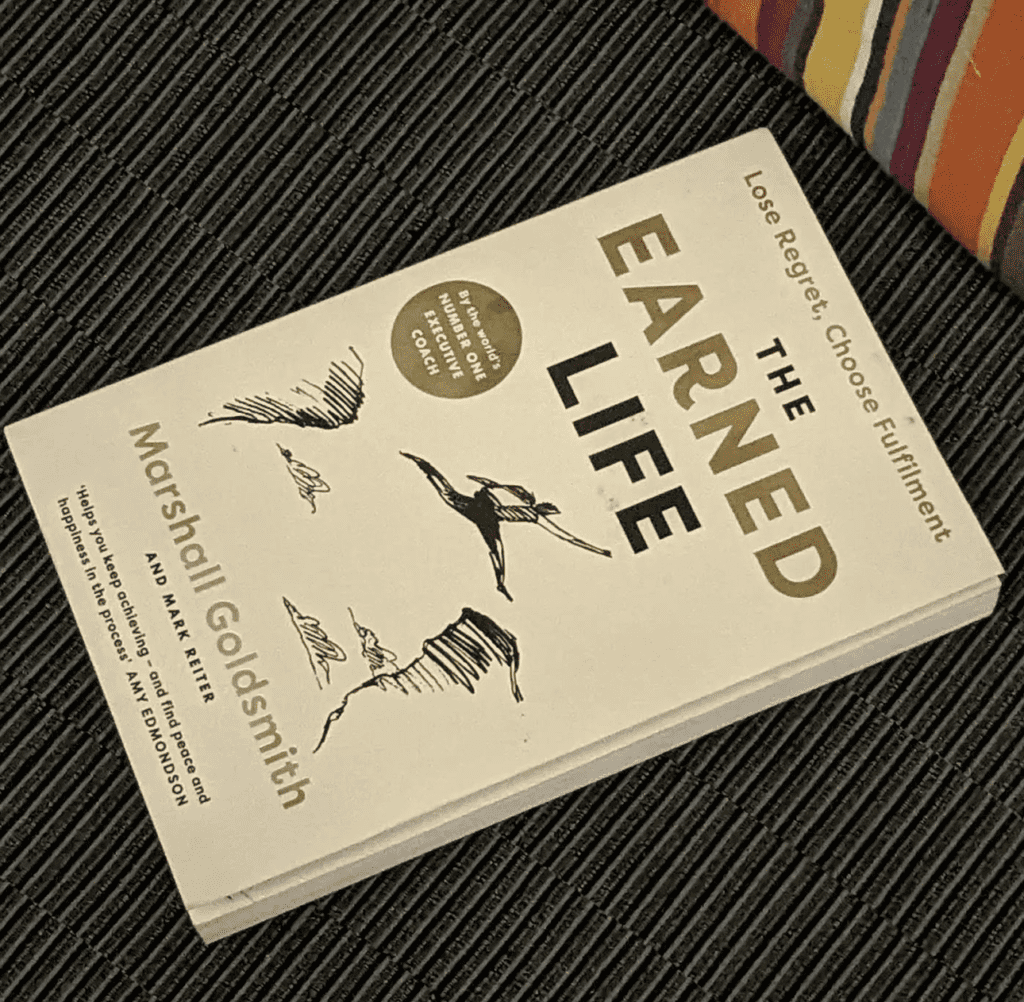
Marshall Goldsmith, Mark Reiter
I chanced upon the book courtesy a Farnam Street podcast. In the introduction, Marshall Goldsmith shares an anecdote about Red Hayes, who wrote the song “Satisfied Mind” getting his inspiration from his father-in-law, who when asked who was the richest main the world said, “it is the man with a satisfied mind.” And that, ultimately, is the point of this book – to use your time to live a fulfilling life with minimal regrets.
The book has two parts – Choosing your life, and Earning your life. Roughly, the theory and the practice. In the first part, Goldsmith begins with the perfect role model – the Buddha and his “every breath paradigm” – ‘every breath I take is a new me’, the ideas being impermanence and attachment. On a related note, I loved the book’s epigraph too – Presume not that I am the thing that I was (Shakespeare). In essence, fulfilment can neither be achieved by wallowing in memories nor by a living based on a “I’ll be happy when…” premise. Essentially, it has to be earned every moment.
The second chapter addresses ‘What’s stopping you from creating your own life?” and has some very good summation of the things that hold us back – inertia, programming (conditioning), obligation, lack of imagination, the dizzying pace of change, and being ‘narcotised’ by vicarious living (mimetic desire). In the next chapter he outlines the four qualities + two factors required for us to succeed – motivation, ability, understanding, confidence, support and marketplace.
The fifth chapter, about aspiration, was the one that I found to be most insightful. I usually use a can-want-need framework for my decision-making, but this one was a far more elegant framing – action-ambition-aspiration. I really liked the articulation of the nuance between ambition and aspiration. Ambition is what we want to achieve, aspiration is who we want to become. The path to a fulfilled life happens when all three are aligned. In my case, I face tug-of-wars between ambition and aspiration. This gives me a compass to align.
Another excellent framing I found was opportunity vs risk, as opposed to the more common reward vs risk framing. This is related to the three As. Action is relatively immediate, ambition has a defined time, and aspiration is infinite. By being very conscious of the alignment when gauging opportunity and risk, one can have a better understanding of the risks one is willing to take, and thus make better choices.
While all the chapters have exercises at the end, the second section has more weightage on practice. I must confess that I am not comfortable with measuring this movement to a better life, but I am beginning to see some use cases thanks to this book. I found a very good framing called the Credibility Matrix with axes of ‘making a positive difference’ and ‘proving yourself’ which helps determine whether proving yourself to someone is a worthwhile activity. This was useful to me because I believe in letting my work talk, but Goldsmith proves why sometimes I’d have to talk! This is related to the ‘confidence’ quality in Chapter 2, and thus merits more thought.
As a world-renowned executive coach, Goldsmith has the experience, expertise and the wisdom to frame and articulate the building blocks of living a fulfilling life. He does that extremely well in this book, and provided me perspectives that I hadn’t considered earlier.
Quote
In a few hundred years, when the history of our time will be written from a long-term perspective, it is likely that the most important event historians will see is not technology, not the internet, not e-commerce. It is an unprecedented change in the human condition. For the first time- literally-substantial and rapidly growing number of people have choices. For the first time, they will have to manage themselves. And society is totally unprepared for it. ~ Peter Drucker