
Tag: Amazon

  • Agile @ Scale

    Prelude

    I think I used ‘dis-aggregated social network‘ on this blog for the first time in 2009, referring to Google’s basket of services that were connected relatively flimsily then. IMO, Google has always been that way, even including Google+. (read) I remembered it when I tweeted this about Facebook – around the time news of their Fan Audience Network started trickling in.

    It got me thinking (again) on ‘scale’, a recurring theme here. In a less complicated world, where the trends in the business landscape were significantly more linear, (growth, competition, consumption, economy) scale was a powerful weapon to wield. But it’s a different world now. Artificial Intelligence, 3D Printing, Internet of Things, Wearables  and a hundred other things might completely disrupt the status quo and the need an incumbent brand satisfies. These are the known ones, and then there are the conceptually invisible (at this point) ones. Surviving (let alone thriving) in this shifting scenario requires agility, and it is difficult (though not impossible) to see scale and agility together. I looked to Google and Facebook for an approach towards this because not only are they surviving, they seem to be thriving. Yes, we’ll get to Amazon in a while.

    What does it take to be agile at scale? I can think of four ingredients, the last three repurposed from the title of this post by JP Rangaswami.

    Purpose

    I remember talking about re-defining of scale at the Dachis Social Business Summit. The thrust of the presentation was that brands could engage consumers at scale only if they use currencies that create value for the user in the context of a shared purpose. I have elaborated it in this post at Medianama. Recently, I saw that Hugh MacLeod has brought it out beautifully here. Simply put
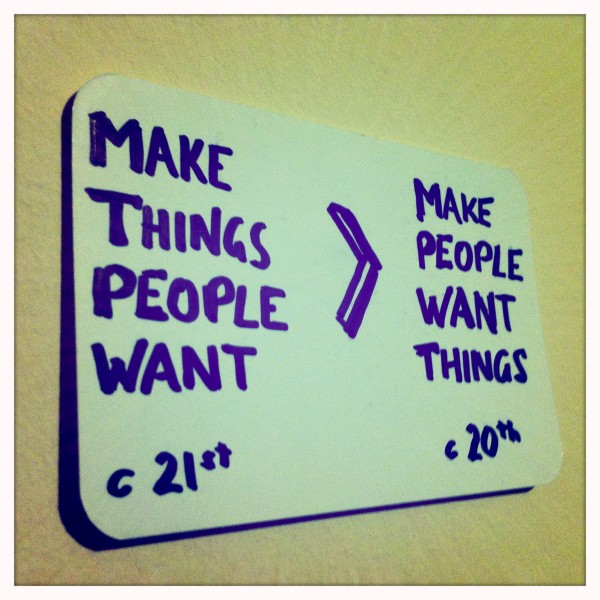
    Make-Things-People-Want-600x600

    (via)

    Possibilities

    The purpose need not have one constant rendition. As the landscape changes, a business will need to adapt it to suit changing circumstances. For that, a business needs to understand the possibilities. I saw a very good line in this post about being a maker – the more you work in the future, the less competition you will have. How much into the future a business needs to be working is subjective and depends on its dynamics, but if it doesn’t disrupt itself, someone else will gladly do it for them. (“The Jeff Bezos School of Long-Term Thinking” is a good read in this context)

    Platforms

    While purpose and possibilities are all good at high altitudes, a business also needs strong operational  platforms to back it up. As organisations scale, I have seen two things that affect agility. One, the processes that are introduced to create efficiency @ scale more often than not, become the goal instead of a means, slowing things down and taking away from actual goals. Two, as processes and manpower increase, silos are created. The good news is that it is easy to see technology platforms bringing more efficiency into processes as well as an iterative way of thinking in the near future. It is already happening in marketing. This, and many other factors are also dictating a consumer experience driven approach and are forcing organisations to break silos. As the entire brand/organisation becomes a platform (read) that regularly revisits its context and purpose in the life of a consumer, ‘everything becomes a node on the network

    People

    HuffPo had a post sometime back, citing Zappos, calling 2014 the year of workplace reinvention. It is interesting to note that parent company Amazon has apparently aped Zappos’ ‘pay to quit’ policy, even as more and more stories about working there being a ‘soul crushing experience‘ are coming out. Meanwhile, the two points it mentioned for this to happen are purpose and trust. These I’d say are the bedrock of culture. It’s intuitive that a workforce mindful of the organisation’s purpose and their role in it would keep an eye out for the business’ possibilities, be ready to work beyond silos towards a great consumer experience, and bring in others who would help the business scale. This, along with purpose, has to be the glue that holds it all together, enabling the organisation to move fast without cracking.

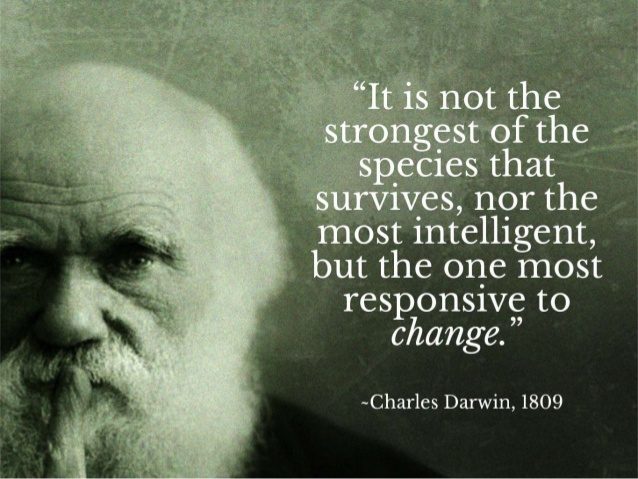
    While different sectors are at disparate distances from a radical shift necessitated by technological developments, it is, I think, inevitable. In this fantastic post titled ‘Knowledge is faster than mortar‘, which looks at scale through a different lens, the author makes the point that ‘the old mechanisms don’t fit the new social structure.Old mechanisms were built to scale stability, new ones will have to be built to scale despite instability. Anti-fragile, so to speak. Indeed, we will see many manifestations as existing structures try to adapt – internal mechanisms like Amazon’s 2 pizza rule, consumer facing disaggregation like Facebook that have a corresponding internal wiring, or brands tweaking their 4Ps even further for different contexts. But whatever paths businesses choose, this will hold true
    responsive-to-change

    until next time, the fast and the curious
  • Manufacturer, Market, Media

    Sometime last year at Myntra, we were having a planning meeting and everyone was asked for their take on the future of (fashion) e-commerce in a 5 year time frame. I confessed that I had no idea, and asked the group whether they had heard of 3D printing. Since this was before the hype machine went into overdrive, none had. My perspective was that if I could print branded merchandise on my own, what would be the role of an intermediary? (interestingly, I read something on a similar note more recently)   I have no idea how mainstream this phenomenon will become, but 3D printers are already being sold online by Staples and Amazon. eBay also has an app that allows users to buy custom goods from three of the top 3D printing companies. (via)

    There are multiple themes which we can explore from here – the augmented human, the collaborative economy and social commerce – to name a couple. But since these are fairly obvious and have at least been kickstarted on the blog, I thought of connecting this to my post from last week – the future of owned media – in which I explored the possibility of a media marketplace which is tapped by businesses to create, curate and possibly even market content that is relevant to them. The journalism that brands want subsidising the journalism that society needs. I hypothesised whether Bezos’ purchase of WaPo was a vague start to this, given Amazon’s presence in multiple domains.

    It’s interesting that Bezos had invested in MakerBot, probably the original poster boy of 3D printer manufacturing, (via) but thinks the digitisation of physical goods is a while away. It becomes even more interesting when WaPo publishes a story on the business case for 3D printing in the context of e-com players’ need to minimise delivery time. The long tail would explode even more! The article also mentions how “Amazon’s giant fulfillment centers could be another place where just-in-time manufacturing and delivery come together.

    What role does media play in this? IMO, we’re increasingly moving towards interest based communities and our consumption of media is influenced by this. With Kindle, WaPo and several other components in the mix, Amazon could indeed be well placed to aggregate the long tail of not just creators and consumers of physical goods, but information (media) as well.

    until next time, the Amazon of news

  • The Future of Owned Media?

    Tech Crunch had a rather funny take on why Bezos bought the Washington Post, but the more thought provoking piece was on the Post itself. (via @nixxin) Its premise was that the predictive analytics perfected by Amazon could be used to provide Post subscribers with personalized news feeds based on where they live and what they have read before. People browsing The Post’s Web site or tablet app could be served ads tailored to their past purchases, and then could buy products with a single click. Ironically, the last paragraph actually ends up validating the TC post. 🙂

    It reminded of an earlier post of mine, in which I had wondered about the future of media in a social era, and though I did not use the words, asked whether a ‘marketplace’ kind of model for news creators and curators was possible. To be honest, I was still skeptical whether a business model could be worked out on this line of thought. But the entire WaPo purchase by Bezos, the subsequent discussions on the web, and this fantastic article at Forbes that brings out the radical shifts in management required for a firm to thrive in ‘the creative economy’, set me out on a new direction.

    Media and advertising, like I mentioned in the earlier post, have had an intertwined life. What if media cannot now exist as a business on its own – the primary reason being that the value it provides -news -is being disrupted by technological innovations including self publishing tools? Does it mean that  its role now has to be seen within the context of a larger business? We’re already well into the paid-earned-owned media cycle, and while paid is arguably on a decline, earned is now increasingly being controlled by the platforms. (FB’s Edgerank, for example) Does it not make sense for a firm to make relevant news part of its product offering, or part of a sales process? Of course, the dynamics would work different from a merchandise marketplace, but if news is a commodity, can’t its vendors be on a marketplace? Media corporations might not be able to sustain a business model with high overhead costs, but journalists could build a reputation and thrive, and the marketplace would decide their price!

    The WaPo purchase is probably just another kind of vertical integration. Much like an e-com company India would build its own logistics or payment gateway and then even white label it, the far-sighted Bezos might have just taken the first step in evolving owned media in a scale and direction no one has ever thought of before. Journalism has mostly been subsidised by commerce – I’d say this is just another evolutionary necessity.

    until next time, to each his own media..

  • Revisiting Social Commerce

    It’s been more than 2 years since I wrote about social commerce on afaqs, and since then, there have been massive changes right from the definitions to the operations of social commerce. Karthik’s recent post on the subject led me to think about it again.

    I’ve always felt that most of the popular definitions of social commerce have constrained its actual scope. Back in 2011, facebook stores accounted for most of the social commerce discussions. These days, it is mostly referral traffic and sales from social, and that too, in terms of last-touch attribution, as the Ecommerce quarterly (that Karthik cites) would suggest. While I’d not contest EQ’s methodology or assessment, I think it’s only fair to point out that there have been a great number of exceptions. (read; Disclosure: that list includes Myntra where I work) I’m not a fan of how Facebook has throttled what we used to call organic reach, but if you want to read about how Facebook helps target users at different levels of the funnel, Zappos serves as a good example. Facebook’s Custom Audiences and FB Exchange products allow different ways of targeting consumers. Twitter is a bit late to the party, but their products also have excellent potential from what I’ve seen, and they’re moving quickly! (already into retargeting)  YouTube is already a big bet for advertisers, and Pinterest is already being used by scores of Etsy users! (read) From small experiments, I also suspect that Google+ is a potential top rung player. Even if you’d like to leave the $ out and consider (for example) only organic (eg. Open Graph actions) there are case studies evolving. (example)

    tumblr_lteusu0d0K1r54seio1_500

    So, can commerce be driven through social channels – advertising as well as organic? An emphatic yes would be my answer. Yes, it might score low if one considers only last-touch attribution, but hey, many of Facebook’s strategic PMDs are getting a handle on multi-touch attribution. (Kenshoo is an example) One should also consider that other traffic channels like search, affiliates etc have been around for longer and have tried and tested models. The point is rather simple – if we judge social’s contribution on the basis of models created for an earlier version of the web, it would not measure up. We’re at a stage where both technology and tools are still evolving to help measure social on terms that balance its uniqueness with the needs of the business. The good news is that the little that I have seen of Facebook’s strategic PMDs has been inspiring!

    (Image via)

    But I think using social channels as sources of traffic/revenue for commerce is still not capturing ‘social commerce’ in its entirety. Though arguable and reducing in favour, I’d still label many group buying options as social commerce. (example) But to me, the elephant in the room is  p2p commerce. Though the collaborative economy is more vast in scope, I’d put it in the same bucket in this context. (do read Jeremiah Owyang on the subject) From Airbnb to RelayRides to Loosecubes to TaskRabbit to even KickStarter, commerce is now happening between individuals with everyone playing creator, buyer and seller as per context. While the $ is inevitable, trust and one’s network itself are becoming currencies. Yes, these also use social platforms for extended reach, but this is inherently more social than the pure commerce play of brands.

    It is interesting to see social platforms working on these lines as well. Facebook’s Marketplace was probably a bit ahead of its time, but nothing stops them from bringing it back. I read recently that Google is planning to release Mine – a service integrated with G+ that allows users to keep track of “belongings” and then share those with friends in different circles. (via) Yes, there will obviously an Android App. It’s not just these platforms, I’d think that Amazon is slowly approaching it from a different direction as well. (read)

    To sum it up, commerce has always been social, it’s only the dynamics that keep changing.

    until next time, commercial breaks

  • Weekly Top 5

    [scribd id=71111753 key=key-a4p0puy0ty9e3nve6xr mode=list]