
I chose pre-tirement a year and a half ago, in my mid-40s. Yep, it’s a thing – the space between full-time work and retirement – a reduced workload in return for $ that meet my needs and some wants. Monika Halan’s recent column reminded me of the real question I grappled with: “Will I outlive my money or will my money outlive me?”
I agree with her take on the learn-earn-burn model and sketchy finfluencers, but I don’t think the classic career peak-in-your-50s idea will last. Here’s why.
1. Short-termism is now baked into most companies. Layoffs, shrinking business cycles, and the fast pace of disruption mean you’re constantly solving new problems with new tools. That’s largely fluid intelligence, which peaks around 40. Until now, we’ve extended careers beyond 40 largely with crystallised intelligence (experience, wisdom), but AI is catching up with both. Soon, someone younger, faster, and AI-enabled might do the same work cheaper.
2. That also means even a decade-long career may be a stretch. Once humans turn knowledge into rules, rules become algorithms, automation happens and jobs disappear. Damn AI learns!
3. This shift is especially brutal for Gen X and Millennials who weren’t prepared for it. Add subpar savings, unhealthy lifestyles, and rising stress, and mental and physical health issues are inevitable. And no, companies won’t support you.
Since I’m aged enough to offer unsolicited advice: if you’re in your 30s/40s, aim for pre-tirement by 50. Think of it as a Pascal’s wager. Better to have financial freedom so you can grow on your terms, and are not forced to make money-driven choices.
The path? Good old compounding – of intelligence, wealth, health, and relationships.
1. Stay curious. Keep learning. Solve new problems to keep your mind sharp.
2. Spend and invest consciously. Don’t finance today’s wants at the cost of tomorrow’s needs.
3. Stay healthy, not just fit – body and mind. Saves you meds money and lets you enjoy your freedom.
4. Find people in whose company you can be yourself. It aids the above three too.
In the near and mid-term, AI’s quick evolution will question not just work’s efficacy as an income provider, but also its ability to deliver a sense of purpose. On an existential scale, I think the second will cause more damage.
Tag: AI
-
A proxy life
I have forgotten where I first came across Goodhart’s Law. It was probably Farnam Street. It states that “when a measure becomes a target, it ceases to be a good measure.” An illustration should help.
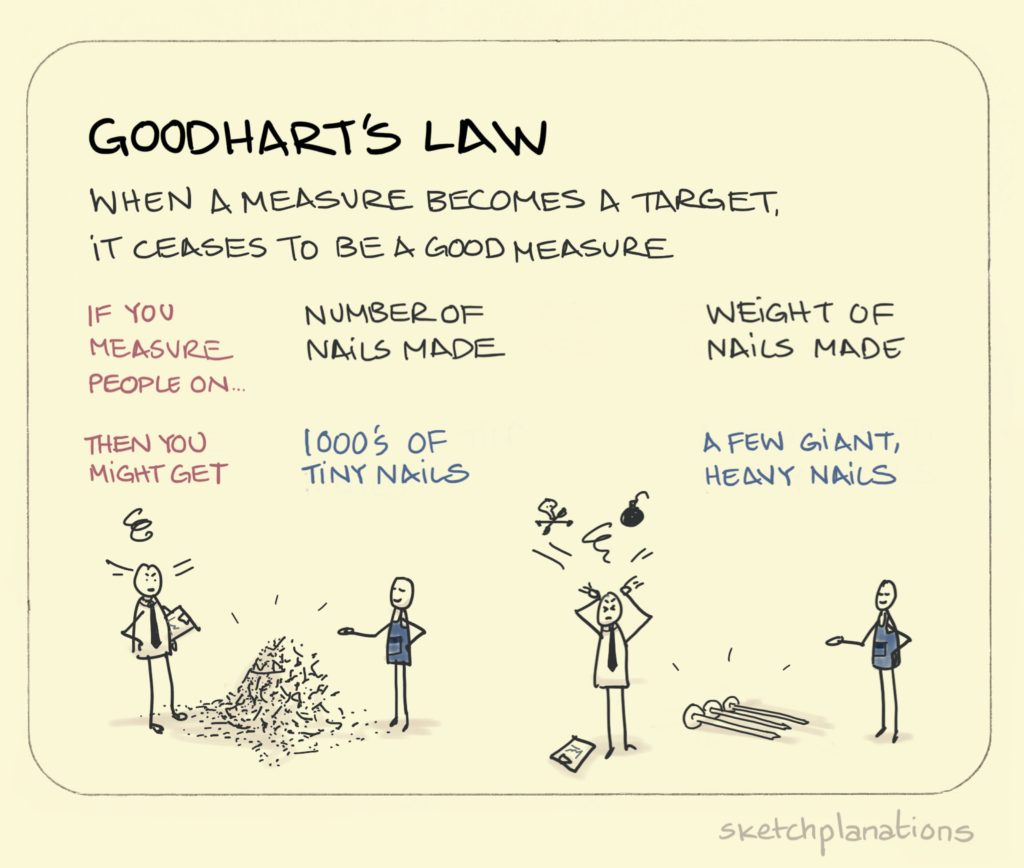
https://sketchplanations.com/goodharts-law In the organisational context, it serves as a great lens to evaluate strategy and progress. As the illustration above shows, the entire direction of a desired goal can be changed when measures become targets. But, and maybe it’s a Baader -Meinhof phenomenon, I am now seeing different versions of it everywhere.
To set some context, as more and more things have been digitised, the volume of information has just exploded. For instance, before the advent of social media, there were limits to one’s “people like me” canvas, because even an awareness of them was constrained by physical distances and the limits of one’s social circle. It had to be in real life, and public spaces like a cinema or even a vacation spot were probably an extreme. Social media changed that scale massively. Many factors including this volume of information, the lack of a granular understanding of the lives of this new set of people whom you’d never meet, and the innate human desire to do better than neighbours meant that appearances became the norm. Since we are not wired to process such large volumes of information, we dug deeper into ‘measurement by proxy.’ Not that this mode of measurement is new. For instance, we have used material manifestations (apparel, cars etc) as a measure of wealth. The stock price is a single-number measure of everything about the company. But with abundance of choice and the limits of processing power, we started developing heuristics and measuring what was easy. Meta photos (FB/Insta/WhatsApp) became a measure of everything from the quality of life to the strength of relationships. Popularity as a measure of excellence, price as a measure of quality, fitness as a measure of health, #booksread as a measure of erudition and so on.
How does this connect to Goodhart’s Law? We end up optimising our resources for the measure, not the end goal. Which means that though the goal is say, happiness and a good quality of life, we end up aiming for the measure. From the kind of photo that will get more likes to buying that thing/experience that will surely make us happy. And as we feed this more, the mind keeps on wanting. The happiness fades in a short span of time. And as the Buddha has wisely pointed out, that loss of happiness is what becomes suffering.
In the AI risk narrative, there is the story of the paperclip maximiser, a seemingly trivial task of maximising paperclips that might lead to “first all of earth and then increasing portions of space into paperclip manufacturing facilities”. The corresponding human version that I wrote in Peak Abstraction was that maybe we will get to a state where, if we get enough likes on the couple photo on Insta, there would be relationship bliss! What a wonderful world.