Tag: advertising

  • What makes a full stack marketer?

    On Twitter, GG asked a question that I felt compelled to answer because I have used this on LinkedIn for a while.

    I did borrow the phrase from tech, but sounding cool didn’t quite cover it. 🙂

    To begin with, why do I use it? First, the people I want to connect with on LinkedIn are from the consumer tech, digital marketing and brand domains. This usage would be familiar to them, and would help frame my experience and expertise. The experience straddles the offline and digital space, and has media, FMCG, e-commerce and fintech brands. The second part is to do with the skill sets that I think qualifies one for that description. This is my attempt to elaborate on the latter. The “frontend” and “backend” of marketing. It covers demand generation, lead generation, and conversion but I have refrained from classifying it because it is context-dependent.

    Disclaimer: These are my perspectives of things I have worked on. I do this with the understanding that “as our island of knowledge grows, so does the shore of our ignorance” (more…)

  • Mind your language?

    Aachi Masala’s ad – Malayalam transliteration from Tamil – has been providing unintentional humour for a while now. It reminded me of Karthik’s post on Quartz a while back- “How brands are hurting themselves with pan-India “Hinglish” ads“. 

    The crux of the post is marketing effectiveness and how, by not communicating in the language the audience uses every day, the communication is losing its effectiveness and its ability to persuade. “Advertising is not mere communication. It’s persuasion” is a reasoning that’s hard to argue with. The common justification given my marketers are apparently “everyone knows Hindi” and “cost”. I wondered though – can marketers be that callous? Could there be other reasons? A brief thought exercise followed.  (more…)

  • Can media become social enough?

    A few days back, it was reported that Facebook now had a million active advertisers, and that LinkedIn has 3 million company pages. I’ll let that sink in, in case you hadn’t heard. Despite all the social-ness, I realised it’s impossible not to call it media. The wiki definition for media is “tools used to store and deliver information or data” That, for me, is a smartphone now! I also wondered how many media behemoths could boast of a million active advertisers. And that’s when it really struck me how much the traditional media we were used to have been sidelined – yes, they still get advertising revenue, but from a sheer reach perspective. Google, Facebook, YouTube and many more platforms get anywhere between a few million to a few hundred million visitors every day.  To put it all in perspective, TOI – the world’s largest English daily has a readership of over 7 million.

    Media and advertising have had a very intertwined life, unless of course the publication/channel has been on solely a subscription based model. I think the magic of Facebook (and Google, before it) and those that followed is that they have democratised advertising by not just making it something any small business could spend on according to their means, but also giving them the ability to advertise according to contexts – intent, interest, social etc.  Though Google, Facebook etc are still intermediaries, they never flashed their powers, though the latter has begun to, recently. As brands move away from a one-size-fits-all mode of advertising, these platforms give them more options of form and function, and changing the face of advertising. (Google’s exploits are known, here’s a pertinent read on Facebook)

    In such a scenario, what really does a traditional media channel have to offer to its consumers and clients? I’m not saying that they’re all going bankrupt next Sunday, but it’s clear which way the wind is blowing. One way, of course, is to use their brand value, and replicate (and grow) their audience on devices and platforms which better serve advertising interests. They can hone their value offerings by offering various contexts and their combinations – local, social, interests, and so on, and build business models for each. The early movers are already making big deals. But that is the red ocean that everyone is fighting for. How really can a player differentiate?

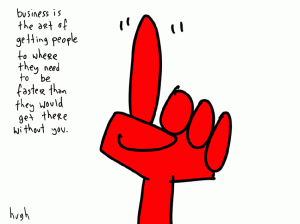
    Biz_Is_The_ArtI had a vague thought. Media’s original strength was its relationship with users and the trust involved. In the social media era, how can that be leveraged? Flipboard has already allowed users to become curators and create their own magazines. Is that the future, along with shared revenue on advertising? What if users can also curate the advertising their ‘subscribers’ can see? After all advertising is also news/information and has a certain value depending on the source. Traditionally, media  has been the middle man between advertisers and users, but what happens when everyone is media? Can media start aggregating influencers in every domain, including niches, provide them the material for curation, negotiate on their behalf to relevant advertisers, and share the revenue? Perhaps the next  disruption will be the platform that can handle the complexities involved. What do you think?

    until next time, mediator

  • Search me..

    I was quoted in a recent Social Samosa post – on Facebook Graph Search. Do check it out on their website, it has useful thoughts from various others as well.

    Given that it is a fairly large move, (third pillar, Facebook calls it) I thought I’ll add to my quote there. As a final goal, both Google and Facebook are trying to organise and display information to users, because contextually relevant information is still a means to revenue, especially in the era of information overload. Google crawls the web, and Facebook uses social connections as a means to gaining this information. Google is also trying to add social as a context, and Facebook has Bing’s support. It’s not a war now, but it’s definitely armament.

    Facebook has tons of data to get this right, and this is dynamic data, thanks to the information we supply, and this is going to get better as Pages (and people) start optimising for Graph Search. Also, once the Open Graph is integrated and actions outside FB also start becoming data, it will become a larger treasure trove of information. Though there’s no advertising product in sight, I will wager that it is an advertising foray in the guise of a consumer tool. As I wrote in the article, Facebook now has the user’s intent broadly divided into 4 categories (people, places, photos and interests), along with his/her ‘influencers’. All of this will allow for some massive segmentation, and thus better targeted ads. And this is not necessarily evil, it can be damn useful because discoverability will be increased.

    In terms of implication for brands, (like I said in the quote) brands with organic signals (eg. for a retail outlet, check in at a physical location) will have a starting advantage. Once the Open Graph kicks in, social actions on websites will become a huge advantage. Content marketing takes on added significance since every action on FB increases the chances of a brand being discovered. Oh yes, Like is a back with a vengeance! On a tangential note, recruiters could use Graph Search as a hiring tool.

    It’s a long shot, but what would happen if Graph Search was thrown open to Pages. Think about it – as a page admin, I already have the ability to target my post to a certain level (about 7 parameters) but that’s really basic demographics. What if I were able to target (organically) (as Myntra) an Angry Birds t-shirt post at people in India who Like Angry Birds. (or even standard apparel brands)

    Meanwhile, there are two immediate concerns. One – privacy. Users will, over a period of time, calibrate the information they supply to Facebook with the advantages of doing so, but it will be a difficult process. The second, I will highlight through a comment made by Romit on Twitter

    But this is just version 1. I’m sure Facebook will have/build more signals inside the hood to filter data. Social just became even more interesting. For that. Facebook gets a thank you.

    until next time, Like I said…

  • Social v2.0.1.3

    I really avoid writing “trends for 20xx”, but towards the end of last year, I jotted down a few things for an article. Same thoughts, but I expanded a bit.

    Barring a game changing phenomenon that further complicates the already shifting landscape, these are the 3 areas where I see the needle shifting more than others, in 2013.

    1. Content is (also) Advertising: Branded content will continue to rise as the worlds of publishing and commerce collide. Brands will invest (talent, money, time) more in content creation and curation. Also, paid media (traditional and social) will be used to promote owned media (blogs/twitter/FB page content etc) and we’ll continue to wonder how much was earned by publishers in supposedly earned media! By ‘advertising’, I don’t just mean the traditional marketing communication kind, but one that brings out more of the character of the brand/organisation itself. Hopefully this will be the first step towards a larger culture of authenticity, values, and transparency. Something like McDonald’s “Our food. Your questions” would fit the bill.

    2. Social Orientation: Social is media, social is CRM, social is enterprise collaboration, and many other things which we haven’t even begun to explore. Silo based approaches for social will evolve into socializing business strategy itself – a horizontal approach (and team) that looks at business objectives more clearly, and encompasses everything from CRM to ORM and beyond. These teams will also be equipped to handle everything from new social platforms to how social integrates/manifests on more advanced devices to technologies from AR to Big Data. Not all of this would happen in a jiffy, and there would be challenges aplenty – right from setting objectives to harnessing various skill sets to getting buy-ins from various verticals that social would interact with and affect. Social Business is most likely this year’s gamification in terms of buzz and random usage, but while that sorts itself, businesses would at least need to start seeing social as a strategy, one that can actually provide competitive advantage.

    3. Brand Voice: Speaking of competitive advantage, brands will figure out that they need to craft a voice and tonality that can resonate on social platforms as well. Many of the large brands we see now have grown up on media that never talked back, and hence adopt a  traditional media approach to communication on social as well – swinging between being apathetic and being servile. An identity and voice that can withstand the rigours of increasing conversations across platforms needs to start getting built. There might be multiple renditions of the voice as well – adapted to contexts, audiences, intent and so on, and brands will thus need to learn cohesion in narratives. A new approach to storytelling that spans media, understands popular culture and involves consumers better is the brand imperative.

    Update: Very heartening when people I respect – Dina, Gautam Ghosh, Prem think all of this makes sense! Mighty pleased and grinning away! 🙂

    until next time, #makeittrend 😉