Irawati Karve
-
Yuganta
Yuganta is not a linear retelling of the Mahabharata, instead it uses a few characters to do a critical analysis of the epic. At a simplistic level, the basic story thread is indeed communicated, while delving into these characters and placing them in the context of the story. But more importantly, the examination of various characters, their motivations and actions, belief systems and relationships with each other, as well as the societal frameworks of class, makes up most of the book.Irawati Karve begins with Bhishma and I almost laughed out loud at her systematic takedown of one of the epic’s revered characters. An observation that I really loved – “When a man does something for himself, his actions are performed within certain limits – limits that are set by the jealous scrutiny of others. But let a man set out to sacrifice himself and do good to others, and the normal limits vanish.” The portion on Vidura is also a look into the prevailing caste system, roles in society, and the strict adherence to these rules. This is extended in the chapter on Drona and Ashwathama. -
Nasi and Mee (Whitefield)
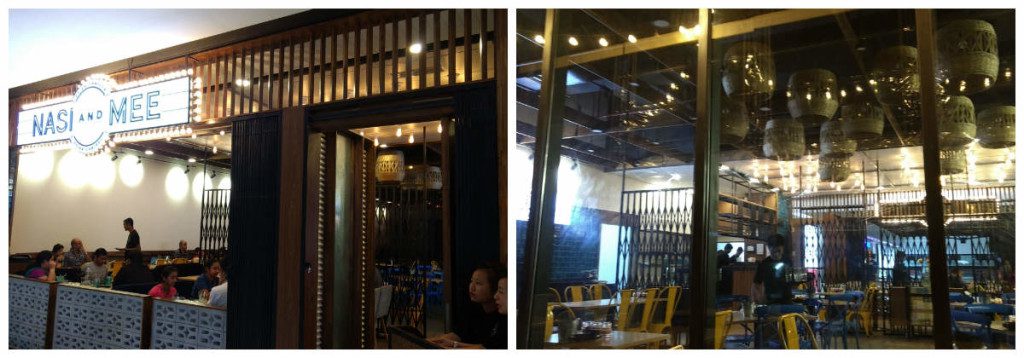
Our visits to the black box VR mall have been predominantly for the happy hours at Irish House. On one such visit, we were super thrilled to see a Nasi and Mee ‘coming soon’ sign right next door. We’d been really happy with its Koramangala version. But for the longest while, the sign was all there was, and we had given up! On the 1st of April, we decided that it was as good a day as any to check if we’d continue to get fooled. But voila, it was open, with the familiar Edison lamps (though every restaurant now sees it as the passport to coolth!) no-nonsense seating, and those shutters that remind me of a place from long, long ago.

Since we were early, we easily found a seat, especially since we chose to sit in the alfresco section. I don’t think they’ve publicised the place much, since it wasn’t really fully occupied even when we left around 9. A far cry from the Koramangala version, which would’ve had a crowd waiting outside for a table! (more…)
-
Empathy & Extinction
In Sapiens, Yuval Noah Harari explains how we’re the most dominant species on the planet because we’re the only ones able to cooperate flexibly in large numbers. The ‘funny’ part is that the things we cooperate on usually exist only in our collective imagination – religion, nation, money. Intersubjective realities.
But it gets funnier. When I look around now, I see these intersubjective realities actually causing more divisiveness between groups than unity. Offended because Spiegel allegedly called it a poor nation. Offended because Katy Perry used a Hindu goddess to describe her mood. New day, new reason to be offended. (more…)
-
Sapiens : A Brief History of Humankind
Yuval Noah Harari
“Just six million years ago, a single female ape had two daughters. One became the ancestor of all chimpanzees, the other is our own grandmother.” That appears on page 5, and somehow it convinced me that I was going to enjoy this book. Actually, even before that, the framing of the massive exercise of universe creation, and evolution, neatly into physics, then chemistry, and biology is itself a fantastic beginning. This elegance in framing, which extends to the analogies used as well, played a huge role in me recommending this book to pretty much everyone I met, even while I was still reading it.
To continue, after biology, which is the study of organisms, we come to the study of something developed by humans – culture, and that study is history. From as many as six other human species that existed until 100,000 years ago, we were the chosen ones. How did that happen, and how did we get here, that is what the book explores. (more…)
-
Rural Blues
First published in Bangalore Mirror
For a few seconds after you’ve entered Rural Blues, you might get the notion that you’re in Santorini, and not Sarjapur Road. While some uncharitable souls might claim it’s because of the distance you’ve had to travel to get there, (map) it’s actually more an effect of the Mediterranean colour palette that has been used very well. The open courtyard section with the little waterway, and smart use of mirrors make for a very relaxing ambiance, even as a stage for live music gives it a dash of verve. The seating inside is more standard fine dining in comparison, with lounge chairs, sofas and functional furniture. The lighting adds to the elegance, and the only thing that sticks out literally and metaphorically in the scheme of blue and complementary colours is the red cola fridge in the bar area. Speaking of sticking out, I did wonder whether the spelling of some words in the menu – noodels, carribian to name a couple – gave it an unintentional rural touch! ‘Herbes’, in particular, could be a sore spot for a restaurant that’s meant to be fine dining!

I am now beginning to think there’s some deep conspiracy that involves the state of menus in newly opened restaurants. This one practically came apart in my hands! While on conspiracies, the one we did discover later in the meal was that the place served cocktails. No, it’s not on the menu, but when asked, we were given a range to choose from – mostly vodka and rum based! By then, it was too late – we were well into our second beer. I briefly contemplated singing Kaisi teri khudgarzi – a song featuring Ranbir and the beer brand we were consuming, but refrained when I realised the risk of being berated for it. Flat beer joke, I know! (more…)