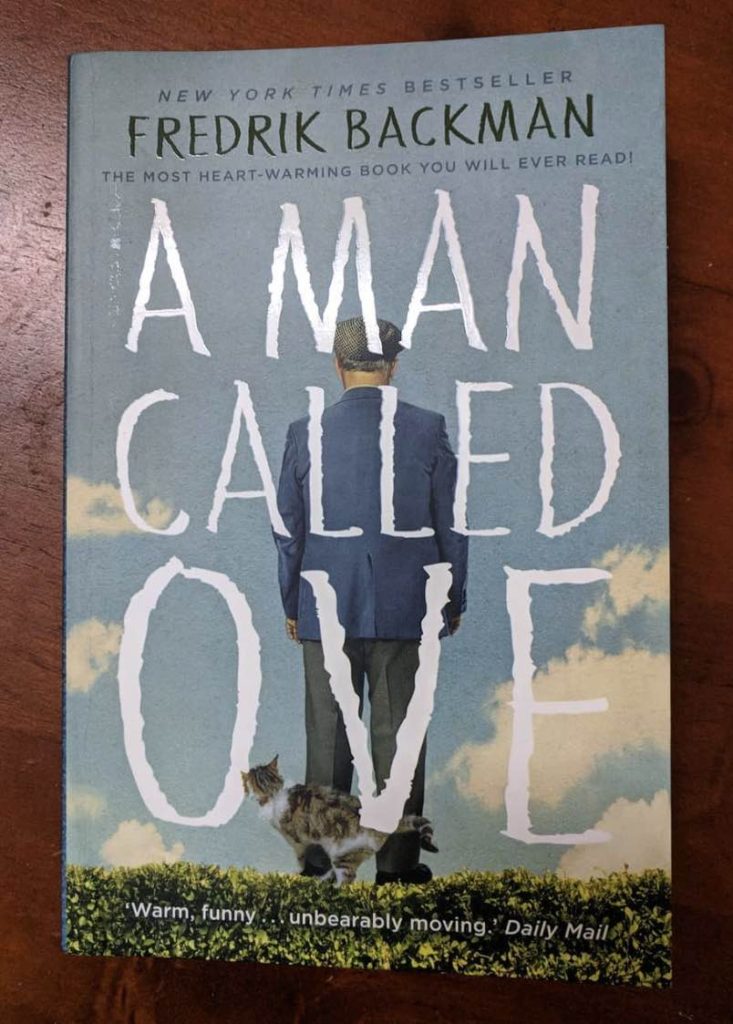
• A Man Called Ove


    Fredrik Backman

    This was a book selected by D (my much better half) as part of our once-in-two-months book shopping. So naturally, I couldn’t just read it, I had to read into it. The message was simple, I had a lot of character similarities with Ove. It was less to do with his literally hands-on approach to fixing things and more to do with “right has to be right”, but the similarities in personality were obvious enough right from the beginning for me to LOL.

    This is probably the only book that has made me go from smile to laugh to moist eyes in a span of 30 pages. Smile because I understood Ove’s perspective and why he does the things he does. As it turns out, Ove isn’t bitter. “He just didn’t go around grinning the whole time!” Laugh because the insults and reactions are hilarious and creatively sharp. And cry because. Oh wait, that’d be a spoiler, so no.

    The slow reveal of Ove’s not-so-typical heart of gold, as people keep popping into his life, is really done well. And it’s not just Ove, the other characters, especially Parvaneh, have been written very well. In general, the main reason the book worked for me, outside of the excellent humour, was its solid understanding of its protagonist’s condition, and its commentary of the changing nature of society and its mores. There is something profound that is being delivered here – on life, youth and aging, death – but with a gentle touch. That’s probably what makes the book so heartwarming and such a pleasure to read.

  • Know your mind?

    We had an interesting conversation the other day – four of us, with a 25% woman representation. From a bunch of directions, we finally reached #MeToo. While we all agreed on there being no excuse for a conscious man committing such acts, we did argue about a couple of points. One, our individual reactions to something that might happen in front of us, which IMO is subjective and contextual, and two, the responsibility of those who commit such acts, but were not in control of their mental faculties.

    The second is something that has intrigued me since I saw an excellent Malayalam movie called Mumbai Police. Yes, our titles are geography agnostic. 🙂 The movie was released in 2013, and since then, I have read quite a few books that approach the subject.  (more…)

  • The Bier Library

    It’s not very often that we land up in Koramangala, but when we do, we manage to visit a microbrewery too! Every alternate building in Koramangala is anyway an eatery now, and microbreweries are now reaching the penetration level hitherto achieved only by CCDs, Goli Vada Pav and Cult. So, finding one we haven’t visited isn’t too difficult.

    The place is massive, spread across three floors. It even has that dirty green water body that has been institutionalised by the Brewsky folks. We got a table on the ground floor, only a little away from the DJ, who was trying his best to make sure that Indiranagar didn’t feel left out! Conversations are for losers, after all.

    We immediately got around to the business at hand – craft beer! D made a Very Weiss choice – German wheat that was very fresh. Fortunately, the Wittle-Wit I wanted wasn’t available. Fortunately, because the Further – Lager I ordered turned out to be very good. For a change, even better than D’s drink.

    The menu has generous sprinklings of gluten-free and artisanal, but avocado didn’t get the representation it deserves! In terms of actual food, the Pork Belly Chili Roast was excellent, though we thought the Bhut Jolokia description was probably an exaggeration. Jacob Uncle’s Chicken Cutlet is apparently a recipe that has “handed over by generations of chefs”, but it does seem like some Chinese whispers have happened – it was quite bland. The trend continued with the Balsamic Mixed Greens, which got the last two words right, but missed out on the first!

    The Pork Vindaloo & egg pizza was very tempting, but since we’d just had pork, we decided to go with a Mutton keema & Egg slice instead. It’s difficult to get mince, tomato sauce and egg wrong, and thankfully they didn’t. In fact, it was quite delicious. But it was topped by the Mushroom Risotto – arborio and truffle oil magic.

    Three of us voted for the Serra Dura, for dessert. Portuguese with a Macau origin, its literal translation is sawdust. The taste though, is far from that – the combination of whipped cream, crushed cookies and dulce de leche was fantastic! One Chhena Jalebi sneakily made its way to our table courtesy the fourth person, and was largely ignored. 😀

    The service was courteous and considering the packed premises, fairly prompt. The DJ, as I had mentioned earlier, was trying to beat some sound record. The bill came to a little under Rs.6000 for four people.

  • Enlightenment Now

    Steven Pinker

    “The case for reason, science, humanism and progress” – a part of the book’s title, did make me wonder whether there is a use case for this book at all. Especially 450 pages. After all, isn’t this self obvious? Evidently not! I haven’t read “The Better Angels of Our Nature”, the book the author wrote before this on the same premise, but apparently this book works as a rebuttal against all the criticism raised against the former. To note, “Enlightenment Now” works completely fine as a standalone work, one that needs to be read.

    The author begins on a very philosophical note, a question raised by a student during a lecture – “Why should I live”? He gives a brief answer that touches upon not just the opportunities available to an individual to progress and flourish, but because of her/his sense of empathy, also allow her/him to help others do the same.

    What enables this are the four concepts I mentioned in the first sentence. They are what the author calls the ideals of the Enlightenment, and through this book he aims to restate them in the context of the present.

    In the first three chapters the author writes about what Enlightenment is, what drives it, and what the forces acting against it are. One among them is this – even though one might agree to it in principle, one would never agree that it would work in practice. I have to admit, I am one of those.

    But before getting to that, some praise for the next seventeen chapters, which are all about the remarkable progress that we have achieved as a species. From life itself (mortality, life expectancy rates) to economic growth and reduction in poverty to the environment to wars to human rights to life satisfaction, the author uses reason backed by data to show how this is indeed the best time to be, and how it’s only going to get better. The data in itself does seem irrefutable, though to borrow from Ronald Coase, I do not know how much it has been tortured to confess.

    Even if I assume the data represents the whole picture, I cannot ignore the malaise of angst that I see around me, really and virtually. Is that an availability bias? Quite possible, but why is it increasing if the world is consistently improving?

    Is it really accurate to depict the Trump election as an aberration when across many democracies, the tide seems to be the same. Even if the high tide of economies helps all boats rise, not all of them will rise equally. Would they compare themselves to their own past or the current circumstances of those around them?

    And I think that forms the crux of my skepticism for the book – the individual experience. Our hopes, our attachments, our relationships are not always represented in the indices of society’s progress as a whole. Also, we are measuring the past with parameters we have now thought up, who knows what kind of indices later generations will think of. The graphs then might show that while we had collectively progressed as a civilization, we had failed on other fronts.

    In summation, I am reminded of the nuanced difference between the two kinds of victories – vijaya (victory over others) and jaya (victory over self). While the data shows the first against the collective ills that torment us, the second is probably what will give us the enlightenment that will finally make us happy.

  • Enough / Efficiency

    In the 1930s, John Maynard Keynes predicted that advances in technology would increase productivity to a level that we would only need to work 15 hours a week. I wonder what he’d have to say about 996. It’s also ironic that despite  the amount of time that technology has helped us save  – Google Search, Facebook for easily connecting with an extended social network, Amazon Prime delivery and a host of other companies that deliver not just products but services as well – we still have a time deficit! I am generalising, if you have proven Keynes right, congratulations. But for the rest of us, what happened?

    A couple of reasons are obvious. One – the ease that technology brought into our lives has also made us spend more time on it, thereby negating the saving. Two – this time spend has also exposed us to more stimuli that makes us want more. The second reason, by extension, has gotten us hitched on to a never-ending ride – efficiency for its own sake(more…)