More than a year ago, in a post titled A plan to be, I wrote about how at different stages of life, one has the need to stand out, and the need to belong. Both driven by various combinations of happiness, self-image, and of course, the gene that just wants to get to the next generation. Though I didn’t really express it in the post, the “plan to be” had belonging as a large part of it. Exactly a year ago, I wrote The half of it, in which I took the thread further. I found “relevance” being rooted in “belonging”, and wondered whether we settle for that. At the cost of meaning. (more…)
-
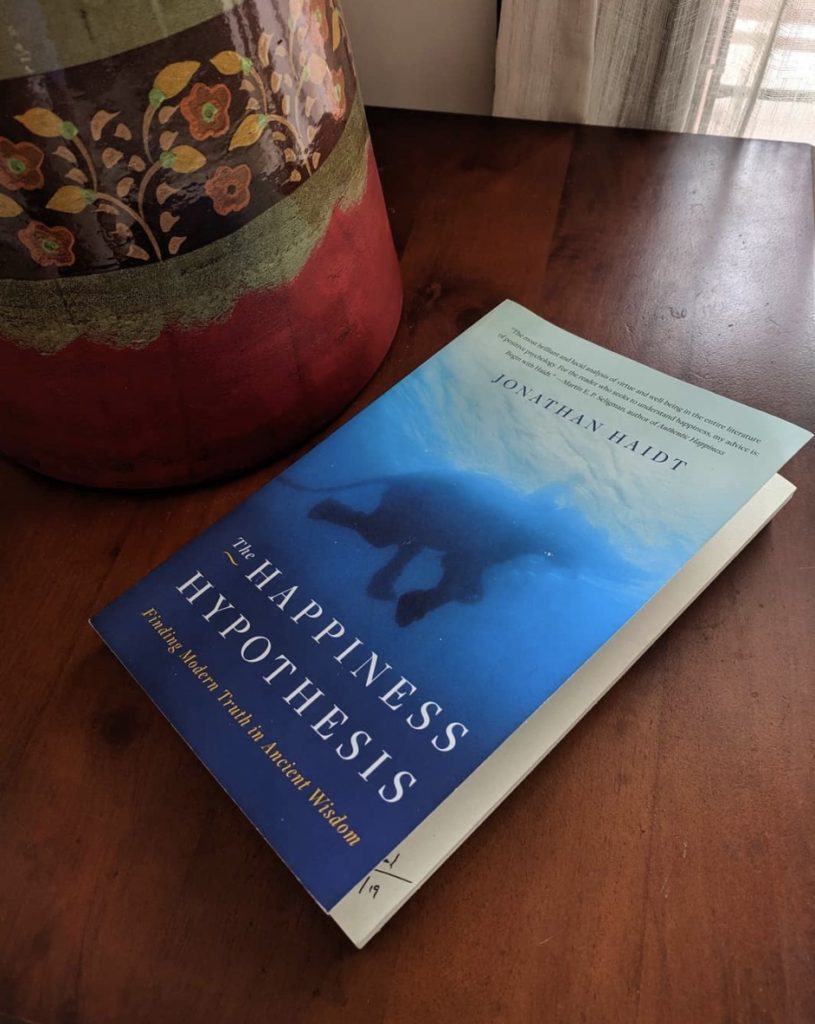
The Happiness Hypothesis
Jonathan Haidt
I don’t remember how I discovered this book, but when it arrived, I really liked the title. Mostly because of the word “hypothesis”, because it signals a scientific approach to a challenge. And that’s exactly what the book sets out to do – take ten of the best ideas/concepts from history, religious texts and philosophers, and scrutinise it through a science filter. Positive psychology is the genre.
The author begins with the idea of the divided self, and then goes deeper. Into the inbuilt “affective style” that plays a huge part in one’s personality and how that can be changed, the role of reciprocity, and our tendency towards hypocrisy – seeing the small faults in others while ignoring our own bigger ones. At a third of the book, we even come across a formula for happiness, which makes a lot of sense when viewed rationally.
My only concern with the book started around this point. The author seemed to have reframed the original thought (happiness) and moved it to meaning, and he didn’t let me in on the reasoning. He tries to bridge this in the last chapter, but to me it seemed forced.
If that is set aside, the rest of the book does an excellent job of parsing the “meaning of life” into two parts and answering the more important one. The author actually spells out the parsing only towards the end – “why are we here” and “how can I find meaning”? But the chapters before that do give a bunch of perspectives on the second – love and attachments, virtue, adversity, and divinity (agnostic of God).
There are several ideas that I could take away from the book. Though the metaphor of the elephant and the driver is not original, the idea of approaching them in tandem and making them work towards a harmony has been elaborated well. It also serves as a good reminder that evolution is only interested in our “success” (survival) and happiness is only a nice-to-have. The framing of questions as metaphors is also something I found useful. e.g. What is life? Life is like a journey.
Another very interesting concept was the the three layers of personality – basic traits, “characteristic adaptations” and “life story”. To me, it provides a clear actionable on how to approach meaning and happiness. The related concept of “arête”, as well as the nuanced difference between character and personality were also good finds.
It takes a lot of intellect, experience and effort to get the Bhagavad Gita, St.Paul, Confucius, Marcus Aurelius, Buddha, Nietzsche, Benjamin Franklin, Epicurus etc to align in a book that’s only 240 pages. The good news is that the book does this quite well.
-
Provoke the Woke?
Originally published in afaqs
“In these unprecedented times”, brands have been making many efforts to stay relevant by inserting themselves into cultural narratives, but it isn’t that easy. In fact, they are increasingly realising that their plans might actually backfire when they provoke the ‘woke’.
Woke versus Broke
Nike’s path-breaking campaign in 2018, featuring (American football quarterback) Colin Kaepernick, is now a case study for brands taking a stance on matters of societal relevance. But it also had a relatively lesser-known second order consequence. In 2019, Nike was forced to take sides in the Hong Kong protests.
When Daryl Morey, general manager, Houston Rockets (a professional basketball team in the US), tweeted his support for the protesters, China gave the National Basketball Association (NBA) a cold stare. The NBA apologised, and Nike gave an assist by pulling its Houston Rockets merchandise from five stores in Beijing and Shanghai.
It didn’t just end there. Courtesy LeBron James (professional basketball player), with whom Nike has an association worth north of $1 billion. James’s response was that Morey was misinformed, and that “We do have freedom of speech, but there can be a lot of negative things that come with that, too. I don’t think every issue should be everybody’s problem.”
Nike took a stance, by staying silent. But having taken an unflinching stance in the US on a ‘freedom of expression’ issue, Nike’s response to China reflected poorly on the brand. Unsurprisingly, they got called out by quite a few commentators. Nike had its reasons. Its China business was worth $6 billion, having doubled in five years, even as the US sales remained flat.
All the world’s staged
In ‘The Presentation of Self in Everyday Life’, Erving Goffman uses the metaphor of a theatre to describe human interactions. Backstage is where “the performer can relax; he can drop his front, forgo speaking in his lines, and step out of character.” On stage, though, there is a performance to be delivered. These days, thanks to the proliferation of social platforms, the ‘backstage’ is shrinking. We’re always ‘on show’ for some audience – on Instagram/Facebook/LinkedIn/Twitter, and yes, TikTok.
The same goes for brands as well. Advertising, PR communication, social media content, all ‘performances’ are not just watched, but connected, too, with everything that is known about the brand. Every expression is an impression. Goffman emphasises that the audience is also a part of the performance, and without their tacit agreement, the show would fall apart. Taken together, this means that the option to be selectively woke is disappearing.
Moments of truth
Back in 2017, a three-second body wash ad on Facebook, which featured a Black woman turning into a White woman, almost cost Dove years of ‘real beauty’ work. It managed to redeem itself by making some smart moves, both tactically and strategically. Things have become more difficult these days. Because ironically, we are all even more touchy in the era of social distancing! And bad news travels faster. All it takes is one status update.
Even as (Amazon’s) Jeff Bezos drew applause for “And Dave, you’re the kind of customer I’m happy to lose”, there were questions being asked about the use of Amazon’s tech by police for racial profiling. While resolving that, the company got called out for treatment of workers. It’s not just Amazon. When brands like Uber, Apple, Adidas, etc., take a stance on racism, they are being questioned on the lack of diversity in workforce and leadership. Google and Facebook are even facing employee activism.
Closer home, #BlackLivesMatter, and celebrities endorsing fairness creams make for an interesting Venn diagram. And, it’s not just celebrities. In the name of ‘Moment Marketing’, many brands have seen their woke moments in the sun rapidly become sunstrokes!
Don’t get me wrong, this is not to say that brands shouldn’t make topical and relevant narratives a part of their messaging strategy. But in an increasingly polarised world, communication is a full contact sport.
Dave or Dove, the message is clear, brand communication is no longer a skin-deep game, it is about having skin in the game. As consumers move upwards in the hierarchy of needs, their expectation from brands is moving down – in a direction that’s familiar to marketers. Rather than just creating awareness and interest on things that matter, consumers desire action from brands!
-
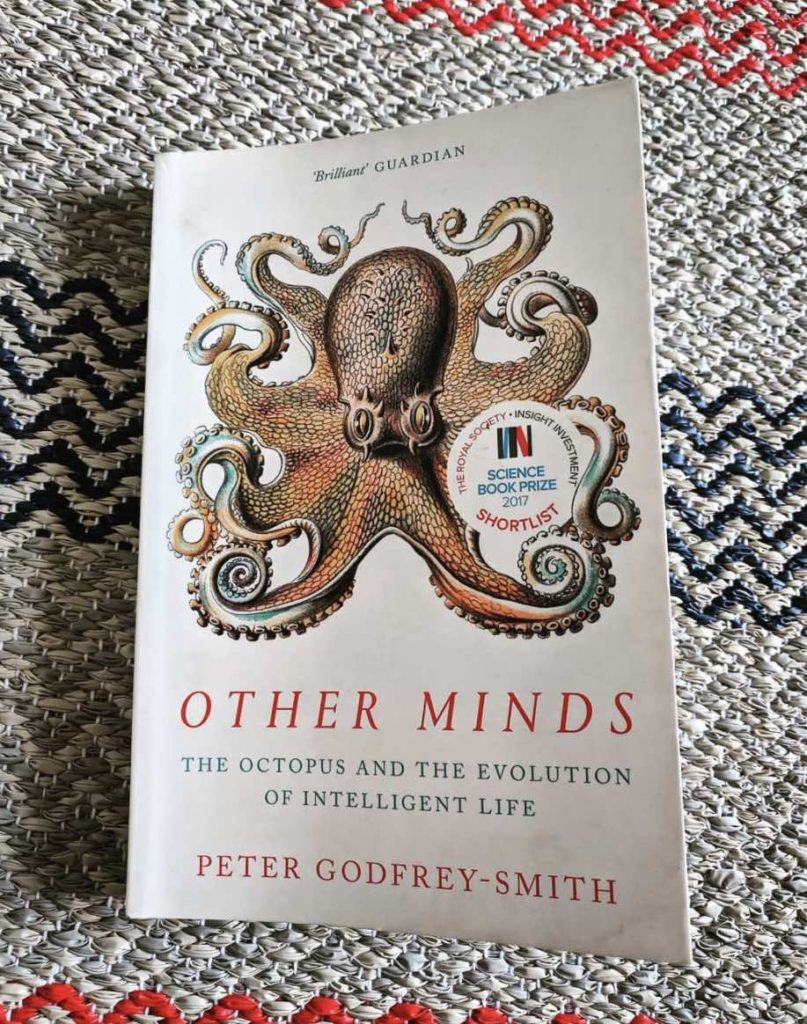
Other Minds
Peter Godfrey-Smith
A subject that has not ceased to fascinate me is Darwin’s theory of evolution by natural selection. I read the book less due to the octopus and more for the evolution of intelligent life.
I found the first few pages of the book very encouraging. The author notes how the cephalopods (which include the octopus) were an independent experiment by nature in the evolution of large brains, nervous systems and complex behaviour, and thus it is possible that this is the closest we will come to meeting an alien. Also, as we move further in the study of the mind’s evolution, it begins to touch upon philosophy, and I enjoy reading a “science book” which understands this mix. Later in the book, the discussion around subjective experience, sentience and consciousness was exactly this, and I relished the few pages that were devoted to this.
In the book’s second half, a section I enjoyed was around the entropy of living beings – a tree vs a cephalopod vs a human. How do they have fundamentally different lifespans? The explanation around mutations and how nature’s machinations result in different ways of living, reproducing, and dying were excellent perspectives that aided my understanding of evolution.
What didn’t work for me though was (what I thought) a lack of coherent structure. That resulted in multiple detours from the subjects at hand, some of which, especially if you’re not fascinated by octopus and cuttlefish, would make you wonder when we’d get back on track.