Remember the early days of the pandemic, when we played alphabet soup with economic recovery? One has to be extremely optimistic to consider the much-touted “V” now, and there’s increasing consensus around “K”. There’s something subliminal about the former sounding like “we”, and the latter sounding like, well, K, signalling that we don’t care. And that’s why I began thinking of how those in the upper part of “K” are utilising their wealth. In addition to using it to create more wealth, that is.
I think there are at least two expansion narratives at play. One is seeking new “real” frontiers. This is a centuries-old pattern – the Americas, Silicon Valley – until geography has been tamed. We’re now on to “colonising” Mars. The metaphor is clear. The other is digital frontiers, where our time and mind space is being increasingly spent. Both are about escaping the confines of reality as we know it now.
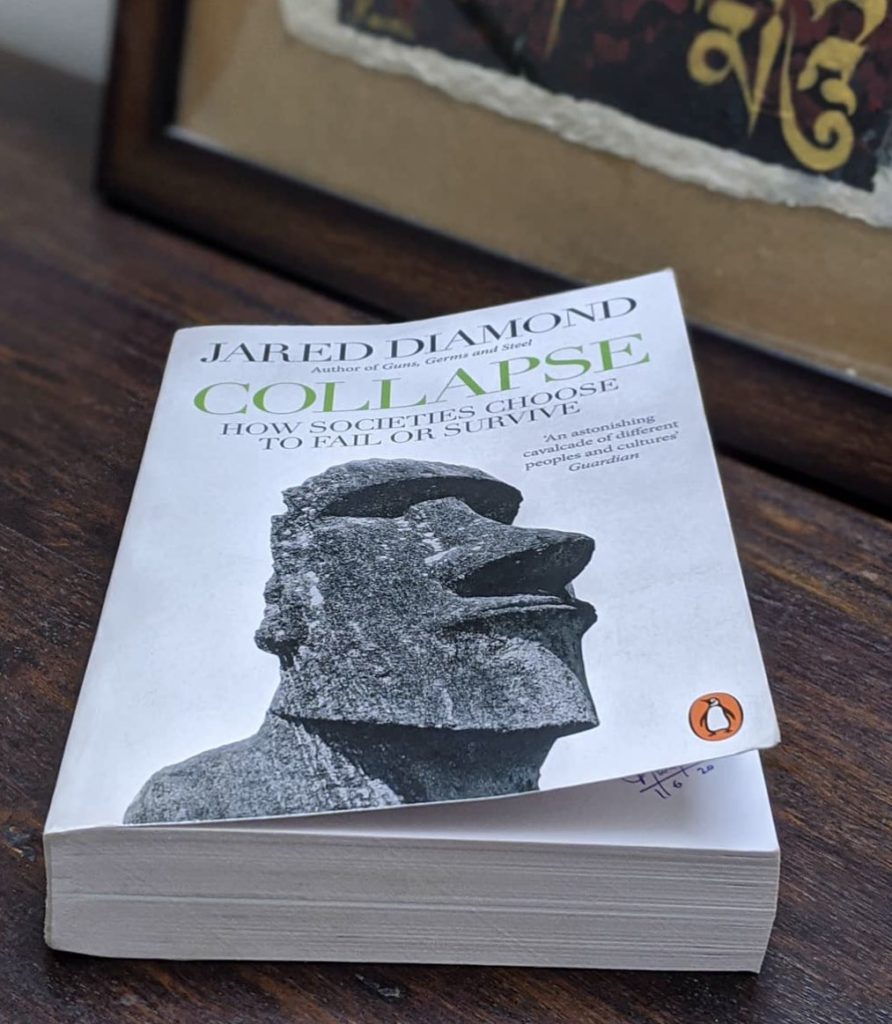
Jared Diamond’s Guns, Germs & Steel ranks among my favourites. Insightful and full of perspectives. While that book was about how and why civilisations unfolded differently around the globe, this one is on why many of them collapsed. The author defines collapse as a”a drastic decrease in human population size and/or political/economic/social complexity, over a considerable area, for an extended time.” He then uses a five point framework to analyse multiple examples, spanning time and geography. The five points are environmental changes, climate changes, hostile neighbours, decrease in trading partners, and finally, society’s response to the above.
The author starts with contemporary farms in Montana and then moves on to the Mayans in South America, the Easter Islands natives, the various Viking communities across continents, and the Native American Anasazi to apply the five point framework and understand the causes of their downfall, and sometimes survival. He then examines modern societies and their challenges – Rwanda, China, Australia, and the interesting case of neighbouring countries that went in opposite directions – The Dominican Republic and Haiti. Strangely, this is despite both countries having a history of dictators.
The last portion of the book delves into what caused societies to make disastrous decisions, and the impact of big businesses on the environment. The latter is not always a negative, and there are some excellent examples of large corporations realising that doing good can actually help the bottomline. There is also a very interesting section on the responsibility of individual consumers.
While we still may not know exactly what happened, there is a fair amount of convincing logic in the author’s hypotheses on how and why civilisations collapsed. And it gets more interesting when we look at the problems we are facing now. On one hand, the scale of the problems are indeed much higher. But on the other, there have been technological advances that can aid us. How much of a counterbalance is one for the other? And as one of his students asks, what was the islander who cut down the last tree on Easter Island thinking as he was doing it? Are we too, frogs in boiling water? Do we have landscape amnesia which prevents us from seeing the changes around us?
The book is not easy though, and sometimes one wonders whether the depth of research shared in the book takes away from the narrative flow. However, if the subject is interesting to you, it’s a read that will enlighten.
Let me begin from the unlikely context that sparked this thought. Mohanlal’s Drishyam 2. I thought the film was a poorly-written, with the character becoming inseparable from the pandering that’s required for the star’s fanbase. Most of the world thought otherwise. While I agreed that I too wouldn’t have liked to see the character lose a cat-and-mouse with the police, there are ways to script a win-win – Ayyappanum Koshiyum being a case in point. But it made me wonder about the kind of cinema that is unlikely to get made based on the will of the majority.
The will of the majority impacts other things too – for instance, politics. My Twitter feed is abuzz with people who call out the current government. It has perfectly executed the Fascism playbook of dismantling not just opponents but the architecture of institutions and culture that creates a free society. But in the larger world, one has to acknowledge that it got democratically elected, and that the people who do not like the Modisatva are still a minority.
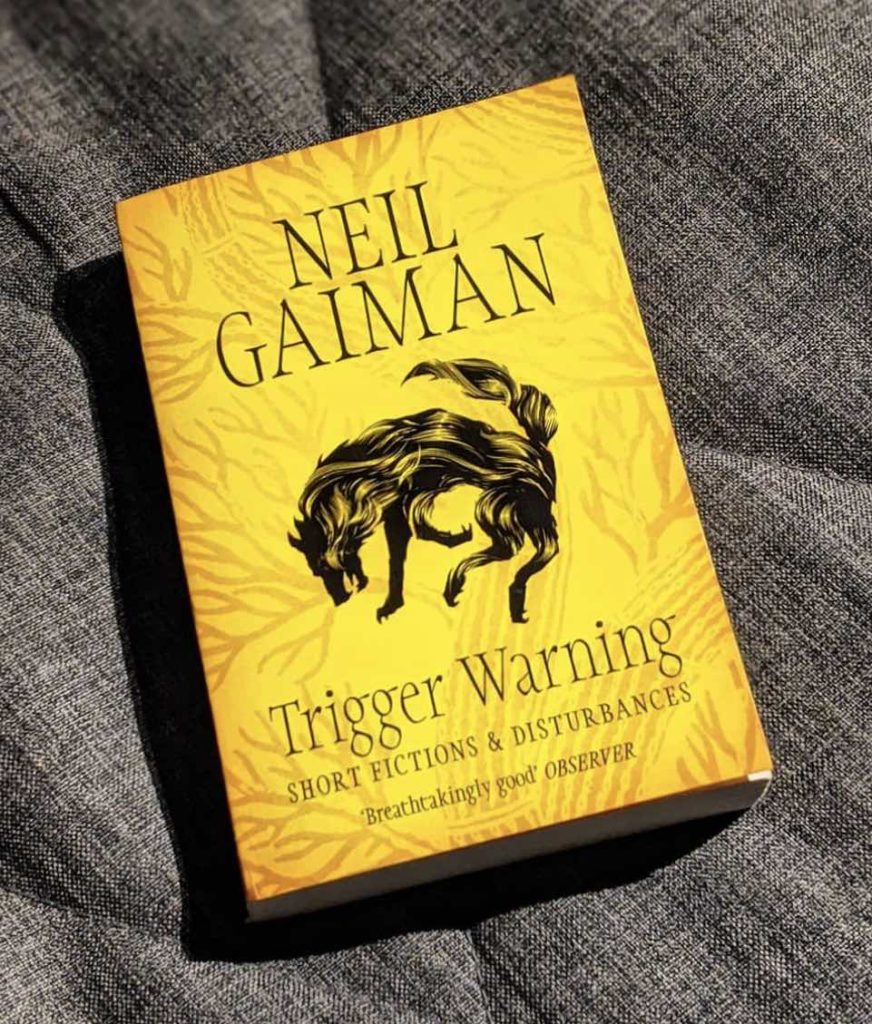
“We are all wearing masks. That is what makes us interesting. These are stories about those masks, and the people we are underneath them.” Thus reads the blurb on the back cover. It’s quite meta, because the book does have a dark theme – “Many of these stories end badly for at least one of the people in them. Consider yourself warned”- and I am reading this after Covid struck! The setting couldn’t have been worse, or better!
The book has 24 stories (including the poems) and they are of different hues. Made richer because of the long introduction, which provides the context to a lot of these stories. There’s magic, science fiction, twisty fairy tales whose characters you almost know, and yes, ghost stories too! Gaiman also gives in to self-confessed trips of silliness – “And weep, like Alexander” is one such. His own fandom can be seen in a fantastic Sherlock Holmes story, a neat tribute to Ray Bradbury, a Doctor Who tale, and a surreal and profound one for David Bowie as well. There might be more that I might have missed because of a lack of context. Gaiman ends with a story with characters from American Gods. I probably wouldn’t have gotten that if I hadn’t watched the show, I need to buy that book! In addition, there are some clever formats too – A Calendar of Tales has a story for every month, each almost a different genre. Orange is another, a subject’s responses (no questions) to an investigator’s questionnaire.
What’s common in all of these is the power of imagination, and Gaiman’s way with words. The class of a storyteller is his/her ability to transport the reader to a place and time far away, and Gaiman did that for me more than a dozen times in this book. Pick it up, I am sure you will find your own treasures.
On hindsight, I should have known it wouldn’t be that easy. A little over 150 days after Comfort Zoned appeared here, 2021 did a 2020 to me with a heart attack. Yes, literally. There is no hidden wordplay, as most of my friends assumed when I let them know! Should have done Anjuna to angina, since we had just returned from Goa the previous week! For someone paranoid enough to have done a genome-based preventive health assessment to detect and insure, this was insulting. I hadn’t expected it for at least another 3 years.
Heart attacks seem to be common now, and I checked in and out after a 3D/2N (Columbia) Asia sojourn. But cliched as it sounds, I had a lot of time to reflect. More so because while in the ICU after the angioplasty, I could hear the man who lay opposite my bed, in throes of pain and anguish, trying to find some meaning in the life he had lived. Maybe he sensed something. He became silent in an hour, even as nurses and doctors frantically tried to save him. A few minutes later, a long beep was all that remained.
It made me revisit the luxury (and privilege) of my comfort zone, and since this will be published after my second angio (done on a date that has other life-changing memories), I thought a good way for me to figure out the next chapters would be to frame the story so far.
Money
D and I arranged our own marriage, and began our lives in Bangalore with a 1 lakh loan from Citibank. Everything that followed – the hard work, the decisions – was to prevent dependence on anyone. This is not an easy responsibility and probably what led to a scarcity mindset.
It has an effect on many things, including career choices i.e. how you make money. If I had to “follow my passion”, I would probably be a travel writer, try my hand at script writing, and maybe even aspire to blink-and-miss roles. But that’s a bet. You get paid a lot if you’re in the top 1%, but the world is mostly the 99% who didn’t. Instead, I chose financial security as my North Star, and thankfully marketing isn’t the most boring career. In terms of learning, it never stops, but the focus for 20s, 30s and 40s – explore, expand, and extract respectively. See, alliteration! It’s important to keep your side interest alive. 🙂 You’re fortunate if you manage to do both.
I think financial security is underrated – there is a trade-off, but it gives you the agency to lead the life you want. Even when you’re only moving towards it, you will become increasingly comfortable investing in things you like – in my case, books, travel, good food and alcohol, ridiculous decor… And I think, if/when you’re able to tame your ego and self image and get rid of delusions of significance, things become even better! The biggest trick in the book is starting early – compounding is an extraordinary phenomenon, and it needs time.
Relationships
One problem with the scarcity mindset is that it also tends to define relationships. It was only after I got to a certain comfort level in terms of our “f*** you money”, that I even let most people in. Because early on, I had at least a couple of experiences when a friend/relative borrowed money, and only after a couple of missed deadlines told me about their philosophy of “Do I even have to pay you back?” That led to exits – money and relationship, and I became cynical about the value of relationships.
Only recently, I realised that the early mindset of being independent and not taking help might have caused a judgmental “not giving help” side effect. Funnily enough, this isn’t applicable to causes and the world-at-large, but instead, directed at friends and relatives (The intrigues of my empathy). I am still cynical, but more conscious of it, and its machinations.
Find and hold on to people who can give you non-judgmental company. It’s a treasure. I think you have to be lucky to find new friends in your 40s! That damn ability seems to shrink with age. And once you have made certain consequential and irreversible choices – the kind of apartment you buy, being parents (or not, like us) – it adds constraints. On a side note, I think folks who are parents are better at compromises and negotiations!
Health
Back in 2006, I first came to know about my stratospheric cholesterol levels. Since then, in one form or another, I have been exercising five days a week. I love my beef and chocolate, and my rum and whiskey, but everything is consumed in moderation. But fitness and health are different things that we tend to conflate. Also, the genes have a will of their own, and despite reading a lot about it, I thought I could beat it with a diet and exercise regime. Nah.
Do yourself a favour and at least at 35, start an annual checkup habit. Yes, you might have to do trade-offs, but at least to me, being in control of the narrative seems like a better choice than a take-it-as-it-comes approach, because the latter also has an effect on your spouse/partner/family. One realisation is that we have a remarkable ability to normalise things, even those we thought we could never change/live without.
Navigation
A couple of things that are applicable to all three aspects above
Habits: Another underrated phenomenon. And they work as a force multiplier in both directions i.e. the good ones will give you superpowers, and the bad ones will pull the rug from under you. Take the time to understand what kind of person you are, and want to be. And build your habits around that. The caveat to that is moderation. For instance, I am a compulsive planner. The good part – I could guide D while experiencing a heart attack, because I had the scenario planned. The bad part – irritation when things don’t go according to plan e.g. not enjoying a vacation because the plan is chockablock. On a related note, it is in the nature of things to change. I can assure you that you will laugh at the things you decided/did when you were younger. In that context, acknowledge that habits will need rewiring too. To borrow from another context, “we first shape our habits, then our habits shape us”. A good idea to revisit them every once in a while, and look at them objectively.
Trade-offs: Many things in life are finite, include time and money. While “All I want is everything” is a perfectly normal stance, reality most likely will include trade-offs. Some conscious, and some that you realise only later. The higher the ‘conscious’ tally, the better I feel. You will need to find your own balance. A related application is in decision-making. A friend taught me to ask myself “how important will this be in five years?” For the past few years, my optimisation has been to give myself optionality, with a broad idea of where I want to be. Reality is a full contact sport, and there’s only so much control you have.
P.S. A good book to read on many of these things – Morgan Housel’s The Psychology of Money.