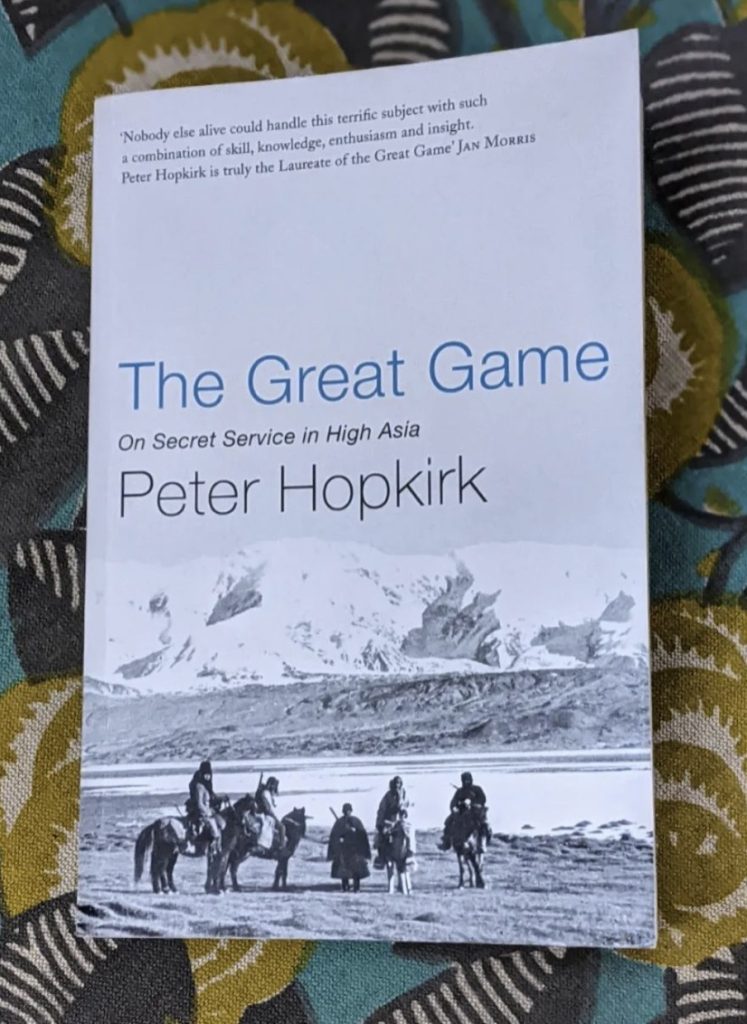
• The Great Game : On Secret Service in High Asia

    Peter Hopkirk

    I first came across “The Great Game” in Sherlock Holmes. Not the series, the book! The phrase is attributed to Captain Arthur Conolly (but made famous in the book Kim), and fittingly his last moments in 1842 in Bokhara, a classic Great Game location, is where Peter Hopkirk starts his narrative. The Great Game was the name given to the diplomatic and political confrontation between two empires – British and Russian – across Central and South Asia that happened through the nineteenth century and the beginning of the twentieth.

    The British felt that the ultimate aim for all of Russia’s expansions in the Central Asian region was its crown jewel – India, and the Russians didn’t take kindly to any attempts made by the British to block these advances. While a lot of it seems like shadowboxing, it involved intrigues, treachery, and adventures featuring individuals on both sides, Sultans and Shahs and minor chieftains, and sepoys and Cossacks fighting for every inch and fort. 
    When it all began between Victorian Britain and Tsarist Russia, over 2000 miles separated them, and by the time it ended in early 1900s it had come down to 20 miles. The book features the military personnel and politicians on both sides, many of whom made dangerous trips in the guise of traders and holy men into areas where no white man had been before, and in some cases, gave up their lives to seek information that would strengthen their respective empires. Across the 1800s, the British explored the many paths that Russia could use to conquer India, even as Russia increased its sphere of control across Central Asia. Beginning with France, the Ottoman Empire, the Persian empire, and then Tashkent, Samrkhand, Bukhara, Khiva and Afghanistan, and towards the final stages Tibet, China and Japan, this was Monopoly being played at global levels and possibly the longest and most intense geopolitical conflict the world saw before the Great War. Ironically enough, in that war, the former foes were allies. 

    In the context of the US leaving Afghanistan, this book, written in 1990 offers a fantastic lesson in history – not of the Soviets in the late 1980s, but the humiliating and tragic withdrawal of the British in the 1840s when they tried to displace Dost Mohammed with their favourite Shah Shuja. Peter Hopkirk tells history the way it should be told – a very accessible narrative, full of excellent details, and practically recreating entire episodes for the reader. If you like history, this is a must-read. If not, it’s still a treasure trove of excellent, old fashioned intrigue.

  • Notion States 2

    For a while now – since 2010, I have felt that the nation state (or notion state really) is a shared mental model which is nearing its expiry date. But like other intersubjective realities (money, god), we are reluctant to let go of it. That’s why I found it interesting when Aakar Patel spoke about how nation states are quite inefficient.

    It’s quite true. All you need to do is think about the movement of people and objects and you’ll figure it out for yourself. And while the state has begun using things like Aadhaar to increase legibility about its citizens , and thereby increase efficiency (and further nefarious interests), it is advancing at incremental levels, while the world is moving exponentially.

    Not to mention that the nation state is an instigator and participant in one of the most net-negative things humanity has been continuing – wars! And these days, it’s not just the ‘simple’ human conflicts any more. In the digital space that we spend a lot of time in, and in which we have created identities, state surveillance and deliberate offences using things like ‘zero days’ against its own citizens and enemy states are all contributing to equal if not greater retaliation. In fact, this can actually lead to physical losses too thanks to hacking of power grids, nuclear facilities, healthcare systems and so on.

    So how is this glorified middleman holding on? I think a big reason for the popularity of the nation state is the sense of identity it fosters. Along with religion, nationalism continues to be a superpower. The line on paper is strong even if culture ignores it. Think Delhi and Lahore vs Delhi and Chennai.

    However along came the internet, which has a way of disposing inefficient middlemen. It has massively accelerated the geographical movement of ideas, and increasingly that now includes identity. As Fukuyama points out in Identity, as we moved away from agrarian societies with a strict hierarchy to technology-driven societies with multiple social classes, pluralism, diversity, and choice emerged and identity started becoming increasingly complex. By early nineteenth century, there was a fork – universal recognition of individual rights, and collective recognition. Arguably, Fortnite and LGBTQ rights can increasingly unite people more than a national flag does.

    However, given that the internet has destroyed many things without finding a remotely appropriate replacement, I also began to think of a ‘for’ case. One other relevant intersubjective reality we can learn from is money. In the case of money, once upon a time, different geographies had different systems. Vulnerability in one was of less concern to another. But now, it’s all interconnected, and thus fragile. Even in a nation state dominated system, covid just took over the globe and in addition to lives, had a telling effect on the economy. No country was really spared. So it’s important to ask what would happen if no barriers existed. Is it always good to completely remove friction? There is more. Money is also dependent on the rule of law, and its enforcement by physical force – one of the tasks of the nation state. A big concern with crypto is this enforcement.

    And to now expand this line of thought, what happens to governance? Many evils are kept on a leash because of regulation. Who is accountable for rights and duties of citizens? Minorities might not be in a great place now but without the pretence of the state that pretends to care for them, what happens? What becomes of those who are economically not contributing to the system – the old, the infirm, the less-educated and so on?

    One thought is that there will be a replacement and it won’t be all binary. It will move in stages. For instance, money seeks efficiency too. And it is interesting that money itself, at least in form to begin with, is being challenged by the blockchain. On a related note, our lives are increasing moving into the digital domain, where the nation state’s borders are mostly irrelevant. This means the state’s playbook for regulation cannot be deployed automatically. The worry though is that all this might end up breaking things faster than we can find a replacement, even if it is a notional one!

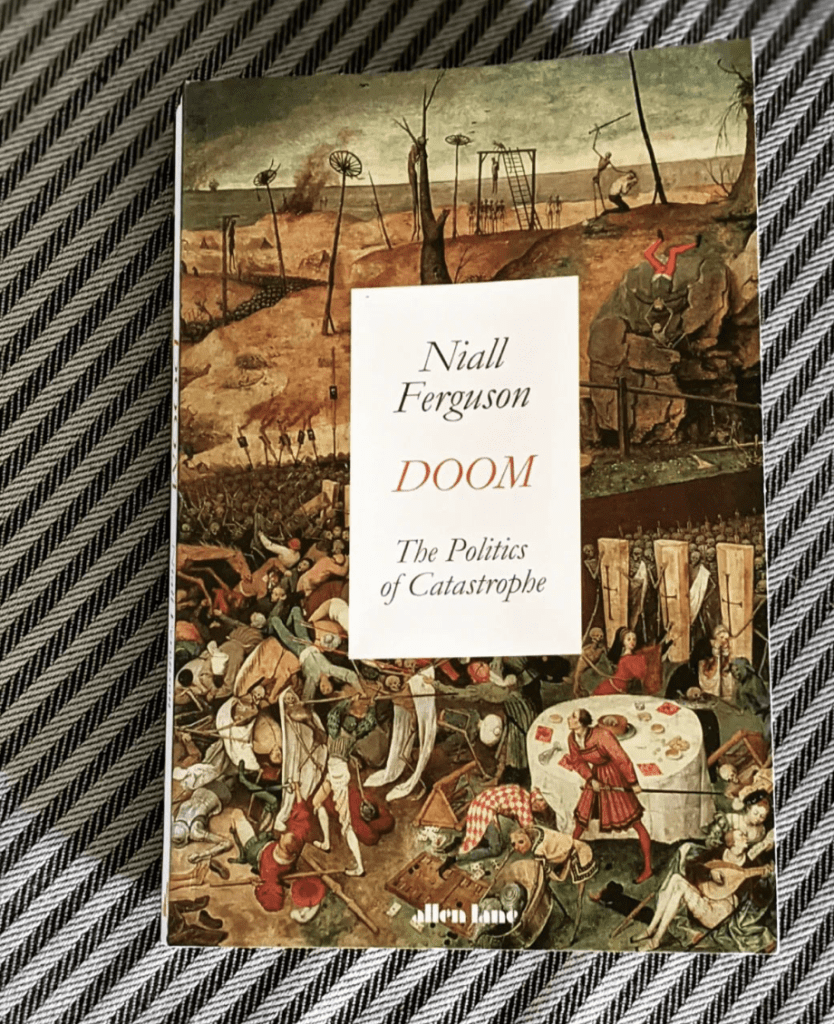
  • Doom: The Politics of Catastrophe

    Niall Ferguson

    This, if I’m not mistaken, is Niall Ferguson’s fifteenth book, and it shows in the buffet of information and perspectives that the book offers. The title Doom : The Politics of Catastrophe does a good job of not forcing the book into any category. More on that towards the end. It allows Ferguson a free hand in bringing his breadth and depth of knowledge to a bunch of relatively disparate subjects – history, epidemiology, cliodynamics, network theory, economics, geopolitics – all viewed through the lenses of catastrophe and decision-making. 

    Across different chapters of the book, we are fed a rich assortment of disasters – from the eruption of Vesuvius (geological) to the World Wars (geopolitical) to the Spanish Flu and AIDS (medical) to Chernobyl, Challenger, and the Titanic (oh well, hubris) to the recent handling of the pandemic by various nations. It does a good job of showing what we can learn from history (and don’t!) Disaster (mis)management has its own categorisation too – failure to learn, failure of imagination, tendency to fight the last war/crisis, threat underestimation, procrastination. 

    As much as it enlightens, I think it is also meant to provoke – not just the low-hanging fruit like Trump supporters, but even climate change activists (calling Thunberg a “child saint of the twenty-first-century millennialist movement”) and those who support a lockdown as a necessary course of action (which Ferguson seems skeptical about). He is also clearly on the side of institutional incompetence as opposed to individual idiocy. 

    The broad scope of the book, not just on the temporal and geographical axes, but also on disciplines, sometimes made me dizzy. It doesn’t help that in the first few sections Ferguson is reeling out facts and figures like a “this day in history” AI gone rogue, and in one chapter tries to connect Black Swans, Gray Rhinos and Dragon Kings! What loses out in all this is the narrative arc, and patterns a reader could use to make sense of the direction of the book. (Guns, Germs & Steel or the two-part Political Order come to mind as positive examples) 

    I’d also say that the attempt by the publisher to link this to the pandemic was probably belated (after the author had written most of the book), too obvious, and doesn’t do the book any favours as it tries to weld COVID-19 to a general history of catastrophe. That is not to say the book isn’t worth reading. On the contrary, it does a great job of not just historical chronicling, but also uncovers precedents (Asian flu 1957-58, which is missing from most coverage of COVID, but was the closest on many counts), linkages without narrative fallacies, causes (active and latent), and in the end even categorises dystopian sci-fi – the “history of the future”!

    Doom The Politics of Catastrophe
  • An interview with ET Brand Equity on PR

    First published in ET Brand Equity.

    PR is an essential component in building a cohesive brand narrative: Manu Prasad, Scripbox

    PR is a great means to develop and propagate a unique voice and point of view. Since we are focused on a specific target customer, PR, through its various channels, is a great way to talk about issues that matter to them, says Prasad…

    As we gear up for the India Communication Summit 2022, a special series has been introduced. ‘My Experiments with PR’ captures the opinions and experience of senior marketing leaders from diverse industries. It aims to bring out to our readers insights on how marketers see the PR industry and leverage communications to overcome challenges.

    In this edition, we present Manu Prasad, chief marketing officer, Scripbox. 

    1. What are the major PR challenges that your industry is facing now?

    Scripbox is a wealth manager, and because we are a digital native, we get classified as a fintech, and more recently, wealth tech. A domain that has been transformative from an economic perspective, and one that has received a lot of attention, some good and some bad. One of the biggest challenges therefore, has been to create our signal amidst the noise, from a brand and messaging perspective.

    Related to that is the second challenge – much of the messaging in the domain has been around specific products and the returns they provide – from IPOs to crypto. In contrast, our focus has been on helping our customers develop the mindset and behaviour that helps in long-term wealth creation. 

    The signal of right advice amidst the hype noise is a challenge in an era of constant FOMO, for us as well as our customers. In addition, our target customer is a mature investor who has seen a range of products and market cycles, so it is important that even when discussing the complexity of investing, we don’t get tagged as being overly simplistic, or too condescending. 

    Lastly, our entire business is built on trust. Building this trust organically, without resorting to seemingly quick fixes like sponsored media appearances, awards etc is not an easy path.

    However, the challenges also present us with an opportunity to innovate and push our creative boundaries. Keeping unpredictable trends in mind, our PR objective is to cut through the clutter, while also staying relevant and communicating our messaging in the media. 

    2. How do you as a CMO plan to leverage PR as a weapon to fight those challenges?

    PR is a great means to develop and propagate a unique voice and point of view. Since we are focused on a specific target customer, PR, through its various channels, is a great way to talk about issues that matter to them.

    Money is not a topic that is discussed enough in the public sphere, though all of us have hopes, fears and aspirations that are almost always intrinsically connected to money.

    By adding this to the discourse, doing our bit to increase awareness around financial planning and wealth management, and providing perspectives that our customer might not have considered, our aim is to build a relationship of trust with them. One based on our expertise and always having the customer’s interests in mind.

    From a channel perspective too, both print and television relatively speaking have their audience’s trust. In a complementary way, digital helps us target very specifically, both in terms of message and audience. 

    3. Is PR only there for crisis management or can it be leveraged to achieve long term goals?

    That does make PR sound like the underappreciated hero who gets to shine only when a villain (crisis) makes an appearance. But that, in my view, is a very narrow way of looking at what a good PR strategy can add to the overall brand perception. 

    In the wake of an unexpected crisis, PR efforts surely come to the rescue of a brand, by taking actions required to minimise negatives and repercussions. But inherently, PR is a long game, and a worthy investment which is instrumental in building a brand’s reputation in the long run. Brand is all about building a perception and in a trust-based business, PR is an indispensable and integral part of brand strategy. 

    Very few brands run brand campaigns (different from acquisition campaigns) all year round. With the right efforts, PR builds consistent visibility for the brand among the target customers. With the help of PR, we are able to establish ourselves as thought leaders, influencing and impacting the space in a way that makes us synonymous to the domain. 

    4. Digital wealth is an up and coming concept and many might not be well aware of what it actually deals with. How has PR helped you in spreading awareness about your brand?

    Wealth management has been around for the longest while, and in recent years, accelerated by the pandemic, personal finance too has gone through a digital transformation. We have always believed in the unbiased power of algorithms, technology’s potential to elevate data to applicable insights, and digital’s capability to provide personalisation and intuitive interfaces. Now customers are increasingly believing that too. 

    But digital is a means. Our objective, as a digital wealth manager, is to relieve investors’ fears and doubts around money and financial planning. Our audience shouldn’t shy away from conversations around money matters, rather finance should be a topic of interest to them. With an attempt to simplify wealth management for our target audience, we strive to educate our consumers with genuine financial advice. Our PR efforts have allowed us to be creative and engage with our consumers on complex topics in a seamless manner. 

    Intending to target a specific consumer base, we have leveraged selective PR to communicate our distinct positioning and desired messaging. We’ve preferred to channel our resources in an effective organic PR strategy, rather than taking the paid route, to increase credibility for the brand among viewers and readers. Slowly but steadily, PR has continuously helped us build trust with our consumers and investors. 

    5. How has been your experience with PR in your professional journey? 

    In the past, I have worked as a brand manager in print publications, I have also been a columnist, and PR has been a part of my recent roles. These varied experiences have given me a relatively more rounded view of the domain. 

    I have found PR to be both a good lead on some brand-driven campaigns (e.g. the annual surveys we do around financial freedom, World Savings Day and Women’s Day) as well as an excellent complementary aspect in general marketing campaigns. There have also been occasions when the PR coverage around a campaign has provided the brand more visibility than the actual campaign – for example, when the brand has used influencers. 

    The challenge of showing the benefits of PR has been an interesting one to continuously solve. From anecdotal feedback to showing spikes in brand keyword traffic, it has been quite a journey. 

    Overall, I think PR is an absolutely essential component in building a cohesive brand narrative over the long term. Media has gone beyond traditional mainstream into many streams and that makes the role of PR an ever-expanding and interesting one. 

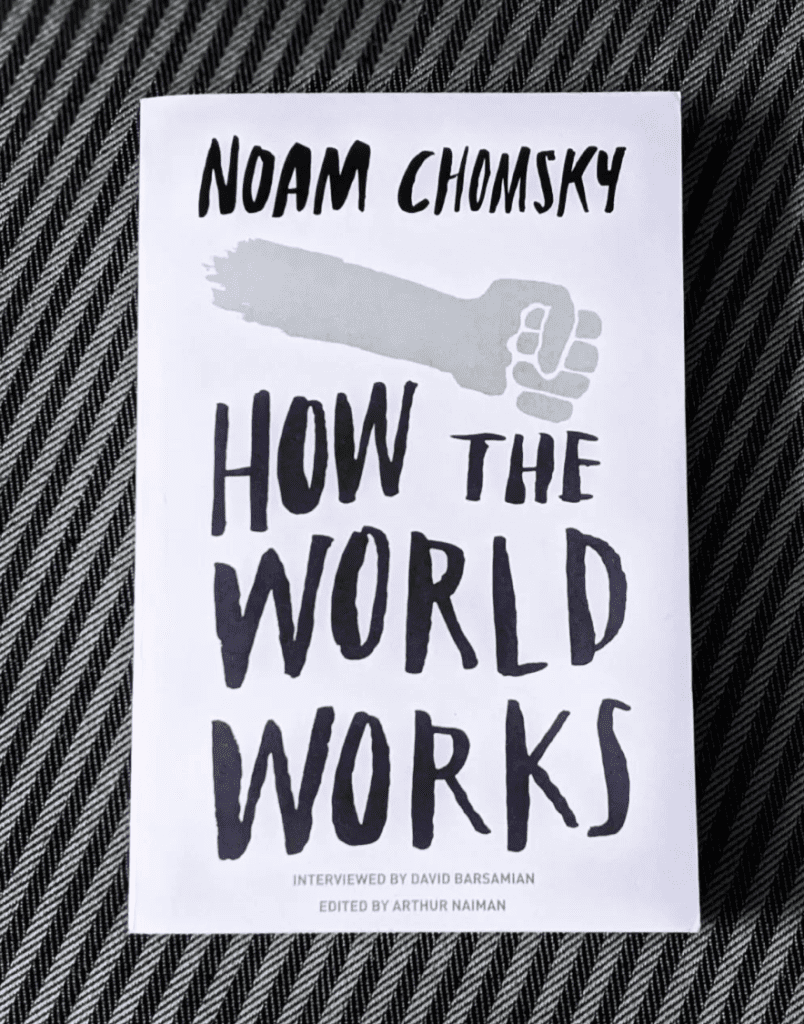
  • How the World Works

    Noam Chomsky

    I think the biggest proof of the US hegemony that Chomsky brings up regularly is how (relatively) unknown he is to the world at large. Because it’s not the kind of publicity the US would like. It’s true that the name has come up in many conversations online, and that is the reason I picked up this book, but for his quality of ideas, he really should be known and quoted a lot more.

    This book serves as a great introduction to Chomsky’s perspectives, not just because of the different topics that have been covered, but also because of how accessible it is – thanks to it being derived from the spoken word through Chomsky’s many media interactions. And yes, the index does help when you want to read about a specific topic and get a quote. There is some repetition, but that is to be expected, and as a contemporary reader, we may not have all the contexts, but that’s also a small price to pay. 

    Of the many topics covered, the US government acting as a bully inside and outside the country is one that’s central. Calling out its usage of government agencies, its military, its allies, as well as international organisations like the UN to enforce its will on nations is what makes Chomsky unpopular. Any nation or leader that attempts an alternate path, especially that is good for the people in the long term, is at the receiving end of many deterrents – local and international – acting in the interest of the US. Because an example is dangerous – it shows that something is possible, countries like Vietnam and many countries in Latin America like Brazil have had to pay the price. All of this became even more easier once the Cold War ended. Though it was convenient to show the USSR as the bogeyman, the US was also good at creating other villains. Within the country, the idea is to ensure that the social, economic and political agenda of an elite class is implemented and also that the general public doesn’t get to have a say in the matter even though it’s supposed to be a democracy. Big business has an important play in this and over a period of time, media which is supposed to be a conscience-keeper, becomes a cheerleader. 

    It’s amazing how well his insights age, as many of them can be used in current contexts. It is also fascinating to see history rhyme – Daimler-Benz and Fidelity as predecessors to Big Tech in holding cities ransom and threatening to vote with their feet if they didn’t get tax cuts.


    On one hand, it is a little heartening that the problems we face now aren’t new. The scale and manifestation might have changed, but the fundamental causes are the same. On the other hand, it does seem that there really is no hope on things getting better – the wealth gap decreasing, or the common citizen getting a level playing field. Chomsky’s view is that these are not laws of nature and that the individual can play a role in changing things, but he points out that it only works if everyone takes the subway. If some drive, it’s going to be better for those who drive! Classic prisoner’s dilemma. When educated classes line up for a parade, he says, people of conscience have three options – march in the parade, join the cheering throngs on the sidelines, or speak out against the parade (and of course, expect a price for doing that!) and that’s been the story for a thousand years and more. 

    I am not sure I have read anyone else who has so much information on things that happened in the world and is able to cite examples for any question asked, is able to convert that into knowledge that connects the assorted pieces, and then deliver such timeless insights. Irreplaceable, I think.