• Aftermath…..

    ‘Intrigued’ might seem an insensitive word, but as the nation observed the first anniversary of 26/11 last week, I was intrigued by the reactions of different segments towards it. Bloggers, microbloggers, all forms of media, brands, everyone had a take on it, and their own ideas. Yes, nobody forgot, but this is year 1. Doesn’t count.

    I got few mails asking me for my opinions on everything from government apathy to the twitterverse on 26/11 – the POV of a blogger. I hardly had any, and whatever I had, I usually share here, like this. (my views haven’t changed) But I had been thinking about my feelings on the day, and what, to others, and perhaps even a part of me, might seem to be apathy, until I read this well written post. (thanks to Balu) And that set me thinking on standards and ‘Who decides?’, and then on to a tangent.

    Who decides what is to be done and how?

    A nation is formed. Its popular leaders, elected by the people, decide the way the country should be run. From sectors that should be open to private investment to tax slabs and from infrastructure to relationships with neighbouring countries, a few individuals, representative, some would argue, steer the fate of the country. In a few years, the policies and processes set up to aid the smooth functioning of the conduit – between the representatives and the represented- starts to work against this desired objective, because the balance of power between the objective and the processes have shifted. In a few more years, even the objectives which should have perhaps been reviewed, have been taken a step further, and promptly forgotten.

    Humans get together and aggregate, communities are formed, communities agglomerate, society is formed (in the original usage, not the housing kind :|) The society builds in conformation. Even with the non conforming kind, there is an understanding. Belief systems evolve, religions are formed, and rules are made. Do’s and don’t s are established in societies and sub societies. Popular culture is created and social ethos are formed. In a few years, the reasons for why things are done, and in the way they are, get forgotten, a mindless following ensues. Non conformists emerge, but then, we’ve been there before. Trading one system for another.

    A few people get together and form an organisation, knowing that they can create a better product/service than the places they have been working in. The founders have a vision for their work place, they set up systems and processes to achieve this, they hire more people, who can implement these. In a few years, a conglomerate is formed, the founders are at the top of the heap, there is a new breed that manages daily affairs, the process diktats are in place…. you know where I am going with this  🙂

    In all these cases, there would probably be a disruption at the end, and the start of a new cycle. It is what seems to be expected. In general, nations will sit up and take collective notice only when they are themselves under attack. The travails of another city, much less country are viewed only through the prism of how it would affect us. Society will take up cudgels when they feel a threat to the status quo. Those in power will want to retain it. Organisations collapse when they are unable to see macro changes and lack the foresight to adapt. When they begin to get affected, and they react, in many cases, its too little too late.

    The common factor is the LCD, no, not the screen kind, the kind you learned in primary school – lowest common denominator – the human. Recently, when taking some personal decisions, I tried watching my own mind work, drilling down from the seemingly obvious reasons to the unstated ones, and from there, down to the foundations of why i thought the way I did, and therefore did the things I did. Belief systems, created and maintained by experiences, peer metrics etc, and thought structures, the changes to which were only superficial with time (contrary to expectations), they were all there, with the reasons buried under multiple layers built over time. My experiences, my perspectives, so I decide, on hindsight, objectivity was perhaps impossible.  Autopilot. This is perhaps what gets reflected in everything that I am part of – organisations, society, nation.

    The realisation was pretty simple. Standards and decisions are on auto pilot, though they seem otherwise. Humans. Us. Living in bubbles, deciding objectives and setting up structures to get there, and then forgetting why.  Even when I think I am deciding, what is deciding for me is the baggage of the past.

    I thought of the poor souls in Leopold, Taj, Nariman House on that fateful day….who till then had built a structure and process to their life. Is that what it takes to get one out of autopilot? A cataclysmic moment – the moment when beliefs and structures scarily slip away, and the illusion of control becomes exactly that – an illusion. In the aftermath, calculated scenarios mostly don’t count.

    until next time, deciding the questions
  • (Non) User Generated Content

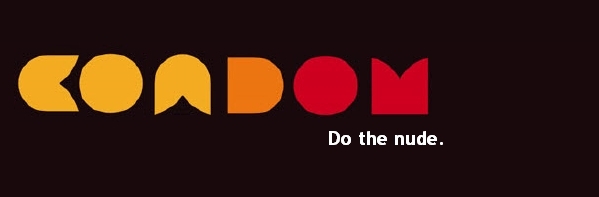
    World AIDS Day – a humble contribution

    condom

    Much to the brand’s credit, they RT ed my work, on Twitter.

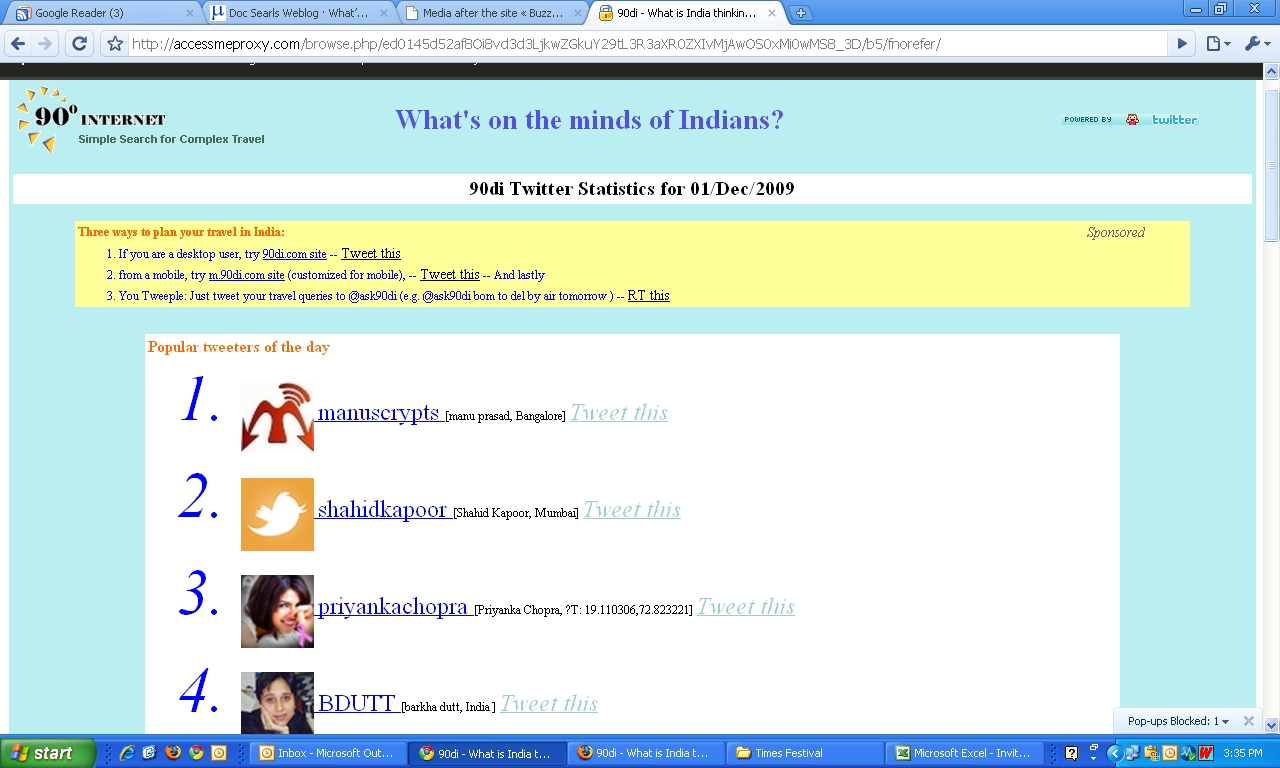
    And that little stunt led to the image being viewed some 2000+ times and my 15 seconds of fame as India’s most popular twitterer for a brief few hours, thanks to more than a 100 RTs from the twitterati. I also got a Samsung Galaxy from Tata Docomo. Ok, I made that last one up. :}

    Twitterer #1

    Yes, yes, don’t worry, I’ll still be posting here :p

  • A Dunbar’s number for brands?

    Seth Godin had a very good take on the Dunbar Number recently in the context of connections made on Twitter and Facebook. (Wikipedia: Dunbar’s Number is a theoretical cognitive limit to the number of people with whom one can maintain stable social relationships. No precise value has been proposed for Dunbar’s number, but a commonly cited approximation is 150) Godin was of the opinion that “You might be able to stretch to 200 or 400, but no, you can’t effectively engage at a tribal level with a thousand people.”

    A few months back, I’d written a post wondering whether smaller organisations were better placed to use social media effectively. This was based on a post by Chris Brogan. Smaller organisations with a flatter structure, and a culture more open to ideas. In that post, I’d questioned whether ideas becoming products/services and then further on brands, meant that the large audiences developed by brands would dictate the kind of communication used, and if mass media one way messaging became easier then. Also, I’d wondered whether larger organisations could handle the empowerment required to work in a social media environment.

    When I read the post by Godin, I wondered if there was a Dunbar number for brands, dictated by the number of people  the brand can connect with- internally as well as externally? There are two things I read recently which added to the thought. One was the idea of the Intention Economy (via Surekha) which “grows around buyers” and is “about markets, not marketing”, and which is builts beyond transactions alone – conversations, reputation, authority, respect all of which are earned by the sellers and buyers. This is a provisional idea, the other is a report from 360i (via Mashable) which states that “that a majority of social media search listings that appear for brand-related queries are created by individuals not affiliated with the brand”, an increasing trend.

    Meanwhile, another interesting thought occured to me when I read Jeremiah’s  post on #OperationBlueWater – where he proposes sharing one’s personal goal plan with online and offline social networks to help people achieve it. I wondered if organisations could ever approach this scenario- not so much as an objective, but the openness and the willingness to share and collaborate along the journey.

    With or without Dunbar’s number, brands would have to involve either consumers or employees (ideally both) to thrive in a ‘social’ world. If its employees, it means hiring people who are passionate about the stuff they’re working with. Yes, the communication has always been that way, maybe the virtual and social forces will make it happen in reality. As for consumers, in most mass advertising, we have been seeing for sometime now, what Godin describes as “politician’s glassy-eyed gaze or the celebrity’s empty stare”

    until next time, social goal setting 🙂

  • Progress report

    One of the most memorable parts of the Andaman trip was the conversation I had with D, on the day we went aimlessly walking on the promenade. The conversation also seemed to understand the mood and was in its own way, aimless. As i wrote in one of the posts, I am fascinated by night lights, especially by the sea shore. It reminds me of Cochin, and sends waves of nostalgia at me.

    The entire trip had also made me wonder about human ‘progress’ and the motivation behind it. In a few minutes, the conversation that began there navigated itself to individual motivations. The comparisons with the Leh trip that I’d made  a couple of hours before at Corbyn were still fresh in my mind. I had set expectations for this trip even before i started out – expectations not based on any previous trip to Andaman, but on previous vacations. I thought loudly on what these expectations were – the beauty of the place? the feelings the place and people evoked in us? a getaway from the daily grind? A new setting and a scope for ‘discovery’? Comfortable stay, good food? Probably any or all of these. Anyway the expectations were set.

    And then D brought up one unacknowledged aspect – our projection of how wonderful the trip was, best characterised by the photos we share on FB and other private albums. (earlier, family gatherings and conversations) Isn’t that an expectation in itself – a proof of good times? Sometimes for ourselves, sometimes for others. I thought that was a good place to start understanding our motivation.

    From childhood, when we had richer cousins/friends flaunting their better toys, or showing us snaps of places they’d been to, or talking about the wonderful food they’ve eaten, a kind of motivation existed – to match better that at some point in the future. A driving force that dictated the choices made in life, which justified the ‘sacrifices’ made. Study hard to get better grades, to get a better job, to make more money and to finally get all the things that the cousins/friends had, even if it was a couple of decades late,  all the stuff that can be a justification for what is (in a sense) euphemistically called the rat race. And then to look back at the proof of achievement and let out an audible sigh of accomplishment.

    The problem arises perhaps not from being a rat even at the end of the race, but probably the realisation that a personal motivation got subverted into a generic rat race, which then became a motivation in itself. The rest of the life story would depend on the stance towards the original motivation. In many cases, the race stops, the baggage is dropped and a path of ‘self discovery’ is started.

    In my personal map, this is the place where I see a ‘You are here’ sign. I would’ve been happy with this, if I hadn’t realised that it has the same ending as the rat race. The path is different, and because there are no obvious indicators like the rat race, I have to evolve my own set of indicators. But the desired end is the same, simplistically put, personal growth, with previously decided benchmarks. The consolation offered is that it was reached on one’s own terms. I wonder, is it really one’s own terms if the destination is no different?

    Ayn Rand said “Man’s ego is the fountainhead of human progress”. Human progress, not just from a humankind perspective – the places and things he builds, but a deeply personal one too, as the ‘ego’ would indicate. I was conscious of this when I shared the Andaman photos, conscious that somewhere, someone was setting a benchmark and the beginning of a race, just like I had, and continue to do, even outside the rat race. And I wonder whether I’ve really replaced one rat race with another in my case. And I still continue to wonder about ‘progress’.

    until next time, progress cards with my own signature :]

  • Even distribution

    The per second and per character billing wars happening in the Indian mobile space now, made me consider whether its beyond a price thing – a need for consumers to slice and splice until they get exactly what they need. I see a parallel in the flow of content too, something I discussed earlier.

    Which explains why I tweeted that I was still watching with great interest, the results of Murdoch’s arachnophobia, though it will take months. (despite having some fun with irobot.txt, and Walled Street Journal 😉 ) Now that’s a subject on which everyone’s had an opinion, so I’ll refrain. (though I’ll share the interesting Bing Theory) The other part of his announcement, where he wants to be paid for content, will obviously depend on the quality of content he can give, and whether it can be found elsewhere for free.

    Meanwhile, as a believer of the link economy, I should’ve logically said that News Corpse was the future, but I refrained. The reason was that for me, the complete mechanics of content distribution is still in an evolution stage. I wrote about brand content distribution last week, and I’m exploring similar thoughts on information in general, especially when i see studies on sharing trends like these (via Social Media Explorer), which I still think is a good indicator despite the inherent skews in sample/methodology it might have. The specific part that interested me being the low shares of Google channels and Twitter, and the larger understanding (reminder) that the web is much bigger than the social media savvy crowd. While Google News has become a great aggregator, there might be other distribution mechanisms that can be developed, keeping a paid model in mind.

    Media has long served as a distribution platform for brand communication, so its obvious that any effect on media would also force brands to think differently from what they’ve done so far. It means seeking and understanding various smaller ecosystems that are bound to develop, where media itself would be different from what we see now. In essence, brands would have to slice and splice their content to reach various audiences. Again, one can’t completely rule out the possibilities for Murdoch with niche specific audiences.

    Meanwhile, I had a good debate recently with Surekha on social media’s usage by brands- product/brand centric vs communication centric approaches. This great post (via Surekha) sums it up quite well. My contention was that ‘buzz’ (for lack of a better term) could be generated without a communication centric agenda, if brands/products were serious about social media and approached it from a business design perspective. Communication centric approaches would tend to see networks as broadcast platforms and the focus would be on ideas and execution, which may quite often be platform centric, with less thought on how sustainable it is in the long run,  especially if all parts of the organisation are not aligned to a different way of working that’s required. Also, in addition to the spurious ROI methods which are evolving, my issue with communication – centric approach is best described by Godin in Hammer Time (every function (PR/Advertising all bring their own hammers to nail social media) and Rex in “If Advertising is your middle name, your surveys will always suggest the solution is….

    (Update: Thanks Dina, for sharing this)

    It led me to wonder if brands’ usage of  FB, Twitter etc as broadcast platforms, also contributes to the way these platforms are evolving – from the concept of digital sub-prime crisis that Umair Haque has written about recently to the kind of hiring that brands do. (In this context, the Ad Contrarian’s 3 Distinctions post is also worth reading) Taking it further, is that why (simplistically put) instead of collaboration and easy interoperability, there is the scenario that Tom Reilly very interestingly describes in ‘The War for the Web‘ – war between natural monopolies  (search, social networking, classifieds etc) for adjacent areas.

    I’m hoping that like with all things web 2.0, the community will turn both the fights in a direction that is beneficial to itself, and we won’t be left replacing one system with another that develops with the same principles.

    until next time, choosing sides 🙂