
• Relative..reality

    For some strange reason, I’ve read Pankaj Mishra’s books in reverse order..well, almost. I read The Romantics first, a long time before, and it remains a book I’m very attached to. Its a good book, but I’ve never figured out the exact reason for this strange bond, in spite of making a rare exception and reading it a second time. Maybe it was the time I first read it (a stage of life) or its characters or its title, someday I hope to know, it will tell me a bit more about myself, perhaps. But meanwhile, from The Romantics, I was lured straight to ‘Temptations of the West‘. A few months later, I read ‘An End to Suffering‘, which served as a kind of introduction to Buddhism for me, as Mishra mapped it on to his own spiritual evolution. I finally completed his first book, ‘Butter Chicken in Ludhiana: Travels in small town India’ more recently. Though its title would indicate so, calling it a travelogue would be a gross injustice, as it also manages to recreate the India of the 90’s. So, yes, it is a travelogue, but like many of its ilk, it works in space and time. No, this is not really a review. 🙂

    I’m quite glad that I read his books in the order I did. If I read it earlier, I might have been irritated by the cynicism in the book. But having read his later books, I felt almost as though I was with him, as his thoughts and personality evolved. The book gives you loads of nostalgia triggers – from Baba Sehgal’s ‘Main bhi Madonna’ (i still remember the Magnasound casette cover :D) to mentions of Nonie and Mamta Kulkarni, it draws upon tiny incidents of those forgotten days.

    Many of you may not be able to associate at all with those three people mentioned above, for me, they bring back an era, their importance is relative. I even wondered whether, in future, we will have nostalgia townships, like we have the amusement parks now. The 70s, 80s, 90s re-created in terms of people, music, movies, fashion and all the elements of pop culture that can be attributed to an era. So, when you have those nostalgia pangs, you can call a few friends and take a vacation to bring back a period in your life. 🙂

    A common theme struck me as I ‘moved’ through the book’s pages. Mishra mentions Murshidabad looking towards Calcutta in hope, for job prospects and a better life in general. In many people’s perception, Kolkata is perhaps the worst of the metros on those terms. He writes about the ‘immense cultural vacuum of North india’, and ‘looking towards Bengal for instruction’, and the decline of Allahabad and Benaras. But I realised that for me, those two places were perhaps teeming with culture and history. Again, in Murshidabad, he talks to a person who considers the Babri Masjid as just another mosque, while a nation still burns at regular intervals – the repercussions of an act long ago. The common theme is the relative nature of these things – they means different things to different people, all relative versions of the same thing equally real, when considered from each point of view.

    I remember thinking about progress during my Andaman visit. I saw it in its current state, and can visualise it in the years to come, as tourism becomes a larger factor in the scheme of things, and the changes it will invariably bring in, into a way of life. To quote from the book we’ve been discussing

    Civilisation, however, is on the move, and as E.M.Cioran remarks, nothing more characterises the civilised man than the zeal to impose his discontents on those so far exempt from them.

    When the tourist money flows into the system, it will help the locals afford many things that they perhaps didn’t have access to. But even those who do not wish to change might be sucked into this new way of life because it would be a question of survival. Were they better off and happier before all this happens to them? I don’t know, because after all, even happiness is so relative now.

    Objectivity –  based on observable phenomena and uninfluenced by emotions or personal prejudices, and not the result of any judgments made by a conscious entity. But everything is relative. Things not seen from one’s own perspective don’t seem to matter, and objectivity’s definition would suggest “no one’s perspective”. Maybe that’s why we don’t care for it much anymore?

    until next time, time, space and relativism
  • Effective Cause

    The Pepsi Refresh project is something I keep bumping into, inside this blog, as well as conversations outside. I admit to a bias towards it, because I somehow sense a sincerity in its approach. Some time back, Surekha shared with me a document on which we debated a bit. From what I’ve been reading, Pepsi hasn’t given (at least clearly) this project a CSR label, so the debate over whether CSR money has been spent well or not is a little pointless. Besides it was more on crowdsourcing CSR .

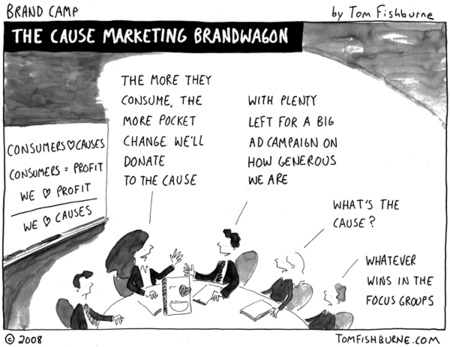
    But thankfully, the national animal ensured that we continued the debate. Aircel’s ‘Save the Tiger’ has also not been given a label, but it does give a good handle to convey my thoughts on CSR, especially since there are at least a couple of good posts on it already, by L.Bhat and Karthik. Harish’s ‘Branding with a cause‘ is a more general, but very relevant read in this context. Aircel’s high decibel campaign ensured that most of everyone knew there were only 1411 tigers left. If awareness was the objective, as stated, it’s been done, especially since the slacktivist generation has retweeted and facebook-fanned it so much that even the tigers must know now. They haven’t been asked whether they want to be saved in a planet full of us, but that’s a different debate. So is the debate whether Aircel should complete the loop, after all why can’t we? (and maybe there’s another phase anyway) But I digress, and generalise. Sorry.

    Clipboard02

    (Image Courtesy: Tom Fishburne)

    The questions I have are these. Should CSR be related to the business domain or not? Aircel’s was not, but as Surekha rightly pointed out, they chose a topic that would connect with their target audience. My problem with that, though it helps stand out from the clutter in a commodity category, is the lack of context. With Pepsi, though one could say the project has nothing to do with sugared water, there was always a ‘youth’ context, which was established long ago. Now, if it were connected with the business, and it is possible with say, the pepsi project (surekha gave me at least 2 excellent ideas) I would turn around and say, vested interests, and doubt the sincerity of their efforts. ‘The big corporate giving us eyewash’ view. It would also bring in ROI measures etc, which I find hard to associate with CSR. Roshni put it succinctly when she said ‘sort of like proclaiming, hey, we did charity’.

    In trying to find a solution, I remembered a post by Umair Haque on ‘Great to good, which, perhaps unwittingly, made me think of a similarity between social media and CSR. As mentioned in my last post, the piecemeal approach to social media is something I dislike. Its as though it exists stand alone inside a box, I think I have a similar problem with CSR as a label. So, (simplistically put), what if the label were to be taken of and every process was carried out with an inbuilt csr approach – from creating environmentally friendly, sustainable products/projects and choice of partners/vendors to eco friendly packaging and everything in between? Oh yes, practical business considerations. I forgot. 🙂

    until next time, with great responsibility comes great power?

    Relevant Read: Cause Effect

    PS: JK cement deserves appreciation for its support of an unrelated, but worthy cause – bikinis 😉

    PPS: While on tigers, this one, by my good friend Blues, is a killer read 😀

  • Fire Drill

    A few years ago, 3 to be precise, I might’ve been in the thick of it. The fire at Carlton Towers. My visiting card then carried this – Mid Day, 301, Carlton Towers…. No, I wouldn’t have been tweeting, because twitter would come into my life only three months later. But perhaps this was the reason the entire scenario bothered me, even as I sat watching the Twitter stream and the reactions. At first, i thought it was some minor mishap, and even cracked a mallu pun at TGIF’s expense. (@mixdev reminded me of that yesterday) But later, of course, I realised it wasn’t.

    I don’t watch news channels, so I was spared the repeated shots (a good post by my friend Nishant) of those tragic jumps. I was watching the stream though, and kept seeing retweets of @jackerhack , who was stuck in the building. I read about people jumping from the windows, and my first reaction was what the hell was wrong with them? What did they expect, a bloody bed of roses??!! And then I realised that there was no way I could even imagine, let alone understand what they must’ve felt in those moments. The closest I could get to is perhaps when I have trouble breathing. Now these are very very minor asthmatic attacks, but even then I know the intense desire to get one lungful of air. And that’s perhaps just a decimal percentage of the trauma those poor poor souls must’ve gone through.

    Trivialisation bothers me. I still read Malayala Manorama daily, and my biggest grouse with them is the way they capture deaths. Not events like the above, but individual deaths. Though I realise its perhaps a way of communicating to those who might not have known, reducing a life (and its end) to a few column cms with a matter-of-fact headline bothers me. Perhaps its some sort of block towards mortality. When @jackerhack ‘s (okay, he has a ‘real’ name, and its easier to type – Kiran), so, when Kiran’s tweets were retweeted by everyone who had access to an enter button, it somehow reminded me of the above. After some time, when he tweeted about not panicking, I was even mildly irritated. (Sorry!) If it was meant for the twitter audience, i was wondering whether the majority of the audience cared for him enough to panic, and for those who did care for him, I wondered if the words would do any good. Was the twitter crowd mature enough not to panic, or not to see this all as a “ok, big event happening, let me part of it” thing? Are we really so different from the media we claim to hate?

    Now he bloody obviously had reasons to do what he did, which he has articulated very well on his blog. I read and re-read and even before that, could empathise. And so, this is not so much about him as it is about us. Us, the crowd which blocked the roads there to take a look, us who sat watching on the tube or the stream, us the viewers and readers, us the voyeurs, and definitely me, who writes a post. Death makes a good story. With apologies to the few who don’t look at it that way, I wonder if being part of the excitement has taken a whole new turn when we’ve become the media on Twitter. Unlike the case with other media, when the crowd creates and consumes, who can complain? Yes, there are many cases in which relief and charity work have been augmented by Twitter, but this wasn’t such a case. Hopefully, all this is just me 🙂

    until next time, false fire alarms?

  • Woodstok

    Yes, you see something missing, but no, I haven’t gotten the spelling wrong. Nor is this some wordplay stunt on any famous golfer you might have heard of recently.

    I assume that since the owners would have found it difficult to replicate the original, naming their ‘resto-cafe’ to sound like the iconic event would be their way of paying a tribute. Works for me, and if good ol’ rock’n’roll ain’t good enough for you, the fact that they have a soup laced with chocolate should get your immediate attention and affection. But we’ll come to that it in a while.

    Woosdstok serves continental food, pastries too, and is located on the road that connects the Koramangala-Indiranagar 100 ft road to CMH Road/12th Main etc. When coming from Koramangala, take a left immediately after the flyover, and you’ll find it on your right after about a 100m. You can find a map right here. Parking isn’t too difficult for 2 wheelers, and I’m sure those at a higher tier can find a way.

    We didn’t reserve in advance since we planned to reach early, but we saw that the place was beginning to get crowded by the time we left, so you might want to keep that in mind. Woodstok has seating on two floors and seemed like a house converted into its current function. So instead of coldly functional/symmetric/ordered seating, there are balconies, diner style options, some modas and so on, all lending character to the place, while retaining the functional element. Ok, enough of design, we obviously had other designs for the visit. We chose to sit on the balcony, overlooking a not-so-crowded road, and it added a lot to the the experience.

    The menu can be found online, so bonus points for that!! I’m guessing the kids menu would be popular too. We started with a ‘Cream of chicken with a twist’. The twist is in the form of a chocolate sauce, just a wee bit, but hey, just for once, I’ll say its the thought that counts. The soup was very creamy, and with a little pepper, it worked out very well indeed. Though it did take a little longer than usual to get to us, they kept us occupied with a garlic bread basket. (though I found it odd that they chose to give 3 slices when there were 2 of us – wouldn’t any even number have made more sense? )

    For the main course, we asked for a London House Woodstok Grill (its a sizzler) and a Chicken Marsala. The Grill was all that its descriptor promised it to be, with grilled chicken, a mini steak, cocktail chicken sausages, bacon and ham with a pepper sauce. Yes, there were sauteed vegetables too, but they only got the attention they deserved. The mashed potatoes were good though. The steak was well done and unlike the Mallu joke, I didn’t have to kill it before I ate it. Grilled chicken, bacon, ham, bliss, enough said. The Marsala, we were told when we ordered, would be slightly sweet, but it actually had a strong oregano flavour instead. Along with the mushrooms, mashed potatoes and tender chicken, this has a unique taste worth checking out.

    The flip side is that we were too stuffed for dessert, in spite of the many tempting options. ‘Woodstok Wonder’, we’re destined to meet someday, i promise ya. Meanwhile, they also gave us a complimentary lime sorbet (completely frozen) that served as some consolation for me.

    All of the above came to just over Rs.1050, including a 10% service tax which is well deserved. There is a nice personal touch to their feedback mechanism. The sheet not only asks for feedback on the specific items you have consumed, but also has the name of the ‘crew’ who served you. Neat, and Bijoy, you did a great job, along with the wonderful lady who showed us to our seat and came back to check if everything was fine. This one goes right into my favourite list, food, ambiance and service, and is definitely worth checking out if you have a relaxed evening in mind.

    Woodstok, Near Firepro, #3777, Domlur Service Road, HAL 2nd Stage, Indiranagar, Ph: 080-42115042/+91 9686191998

    Menu and Photos at Zomato

  • Social Scalability

    When I see brands and organisations take a piecemeal approach towards social media – either the token presence or the department focus-based approach, I sense that the need for a cultural shift is ignored by many. Cultural shifts are a difficult proposition (good post by David Armano) and need a buy in from all parts of the organisation before even starting out. I have really begun to wonder if the scale of global corporations have made this impossible, and whether splitting up the usage of social platforms as per functional areas is this is their way of keeping the scale under control.

    The scalability of social media has always been a topic of interest to me. The link that I had ended last week’ s post with mentions that ‘socialising cannot scale’, although that is in the context of individuals. But I read this line – “Once a group reaches a certain size, each participant starts to feel anonymous again, and the person they’re following — who once seemed proximal, like a friend — now seems larger than life and remote…..It becomes old-fashioned broadcasting.” and wondered if that would apply to brands too.

    I’d discussed this topic here earlier – whether smaller organisations are better suited to social media and more recently, the possibility of a Dunbar’s number for brands. Last week’s post  – on the preferential approach by brands towards customers with more social influence also creates a context. A smaller scale and lesser number of consumers would mean all the conversations could be treated the same, and the business/brand could remain true to its soul. (good post by Chris Brogan) Again, is it possible for a large organisation to go back to the basics outlined in the post and if necessary re-define itself? What about all the investments made and the processes sculpted over a period of time? Simplistically put, will a Starbucks, for example, ever consider doing this counter intuitive yet brilliant ‘Disloyalty Card‘? (for a moment, forget relative positions in the marketplace)

    So I still believe that unless large organisations go through fundamental cultural shifts, small brands have a better chance of using social platforms to their full potential. Is it possible that the spread and dominance of social interactions will force businesses to scale down? Unlikely, even I have to admit, and its more likely that small and big businesses will co-exist in social platforms as they have so far in the real world. Their treatment of consumers will differ because large brands most often appeal to a mass audience. They have to tread many middle paths and rely on solutions that are a compromise. Smaller brands can perhaps be truer to their soul and will attract audiences simply because of the customised tone and attitude. (a great product is taken as hygiene here) So how will consumers react to the different way they’re treated by these brands of different scale?  Will they have expectations according to categories too – product vs service, considered purchase vs commodity? I doubt that. So, shouldn’t brands develop their social media plans only after understanding the specific expectations of the crowd from their category, rather than generic category case studies?

    until next time, weighing scales 🙂