• Social evolution, at least?

    Judging by the number of responses to his article in ‘The New Yorker’, Malcolm Gladwell seems to have ruffled quite a few feathers, especially in the Twitter loving community. Not surprising, since he has torn apart at least a couple of Twitter’s poster children revolutions – Iran and Moldova. His grouse seems to be that we have forgotten what activism is, and are perhaps doing the word disrespect by using it for activities that happen basis the ‘weak ties’ of social media. The benchmark he sets for activism are indeed high – the Civil Rights Movement, which happened before and without the internet.

    I could give you quite a few links that offer rebuttals to this argument or try to put in context – Evgeny Morozov’s post in NYT, Maria Popova’s vehement retort, Gaurav’s 6 point reasoning of why Gladwell is wrong, Anil Dash’s more nuanced approach, and even cite say, a Pink Chaddi campaign (in a country which has a single digit internet penetration) to attempt a contra view. But there’s no denying that armchair activism/slacktivism exists.

    However, as Maria explains in her post, different generations face different societal challenges. They also have a different set of tools that enable them to achieve changes in the status quo. And that’s probably why I think its unfair to dismiss the influence of social platforms in combating the issues of our time. The issues can be across domains – from water crises (check Mashable’s post on Blog Action Day 2010 – Water) to changing the ‘unhealthy’ business models of several traditional media outlets. It is challenging individuals to create and collaborate and break out of  work/life mindsets. I am able to be part of say, a micro finance venture and spread the word on social channels. Such changes can’t be deemed worthless. In any case we’re perhaps too early to postulate what these tools would achieve. Precisely being in the middle of this would take away our objectivity.

    Despite this hilarious Maslow’s hierarchy of internet needs, I’d like to think that we are moving through a hierarchy as web technologies evolve. From a general source of information, the web has moved on to being able to connect us in context. It has allowed the rapid amplification of signals. We have only started with location as a context of networking. There would be a tremendous difference when we start addressing civic issues, using social tools as a means to aggregate locality based communities.  In essence, tools are just that, and we have to define contexts to make them more useful. And we have to evolve to that level.

    Maybe there will never be massive revolutions, just small uprisings across time and place that subvert what could’ve been a great crisis if it was allowed to grow without checks.

    until next time, rebelution it is 🙂
  • False Memories

    I read this interesting post titled ‘Time traveler‘, thanks to a Reader share. (Mo?) Its about memories not being the same for two people, even if they’re part of the same events in life. So, who’s to say which memory/recollection is real and which is not? “The past is just a reconstruction of our minds, then.”

    I came across a similar thought in ‘Lunatic in My Head’, where a twenty-something guy plays slides from two decades back. Though he’s present in the slides, he has no memories of them, and he felt that it was unfair that his parents should possess those memories, but he doesn’t, even though he was present in the slides. He is forced to rely on his parents’ recollections, but sometimes rebels by creating stories and arguing with them.

    Maybe these reconstructions of the mind are based on an identity we have created for ourselves at that particular point in time – in the present. So all events, people, concepts, understandings are seen through that prism? And as time moves on, the prisms change too, like some sort of kaleidoscope, where every memory gets rearranged in context, based on our changing perceptions, notions and views.

    And not all the photos and posts and tweets and videos can ever be free of a prism, some prism. Maybe we change our own memories too.

    until next time, prism break.

  • Ente Keralam

    This review first appeared in Bangalore Mirror, and has, as usual been modified to fit the blog’s ahem editorial guidelines. 🙂

    So, after a lot of tapas, divinity has finally been attained. In other words, what used to be Zara Tapas Bar on Ulsoor Road is now a representative of God’s Own Country – Ente Keralam, which translates to ‘My Kerala’. Here’s a map to get you there. This is the road that joins Dickenson Road to the gurudwara. I think access to it from the gurudwara side is closed temporarily, since one of the government agencies have received reports of some ancient buried treasure. Massive digging in process, but it’s not really a spoilsport.

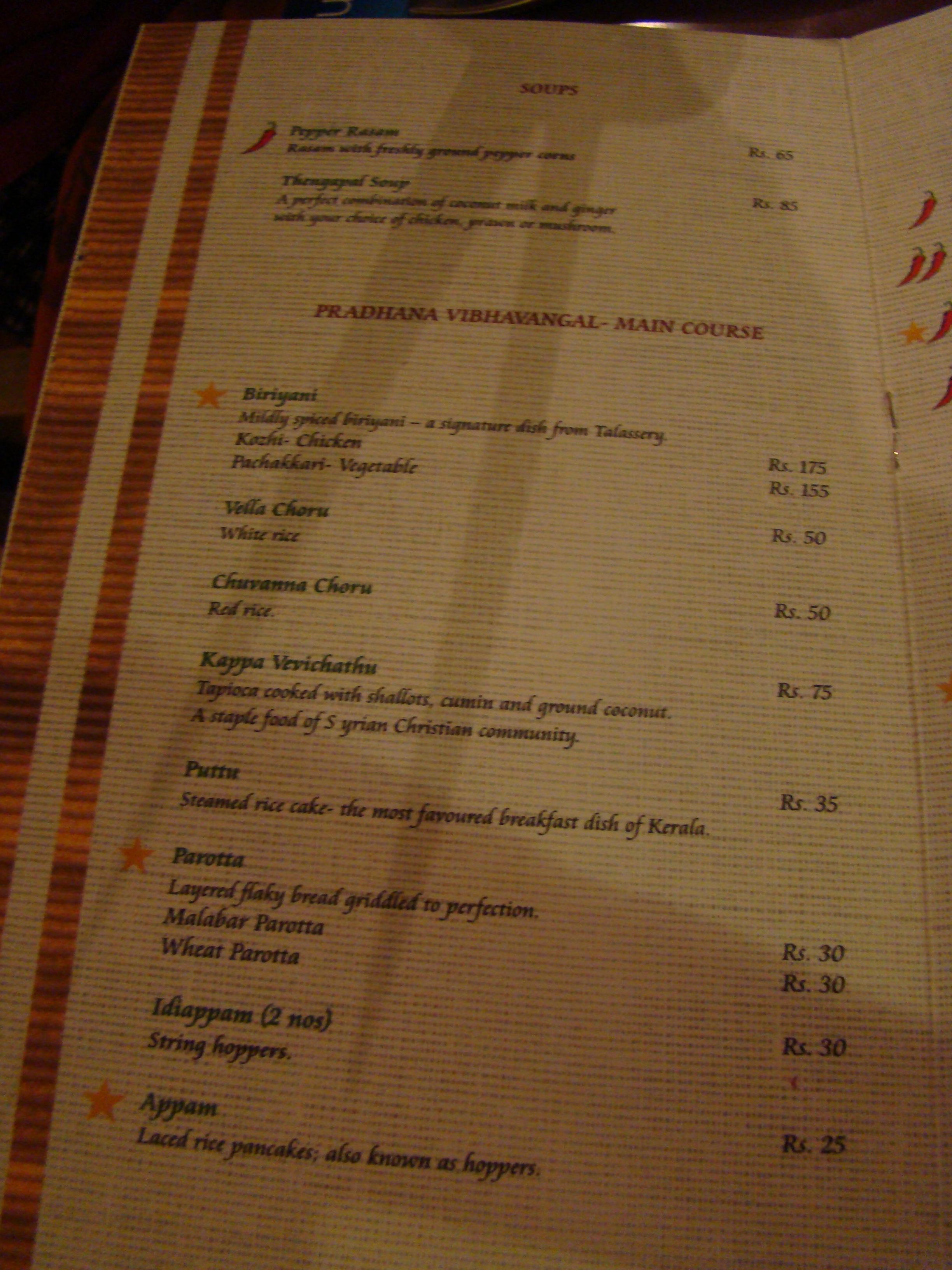
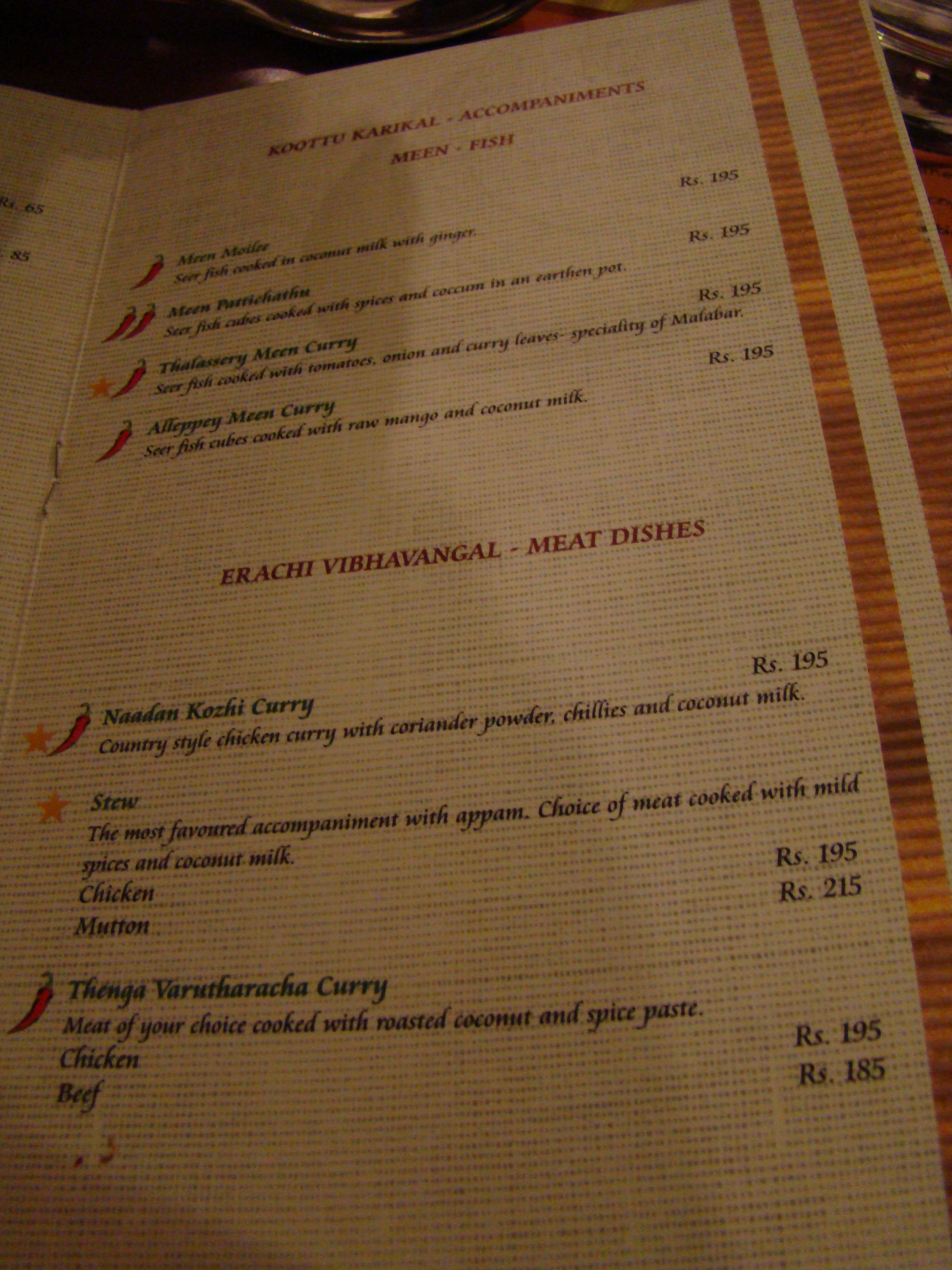
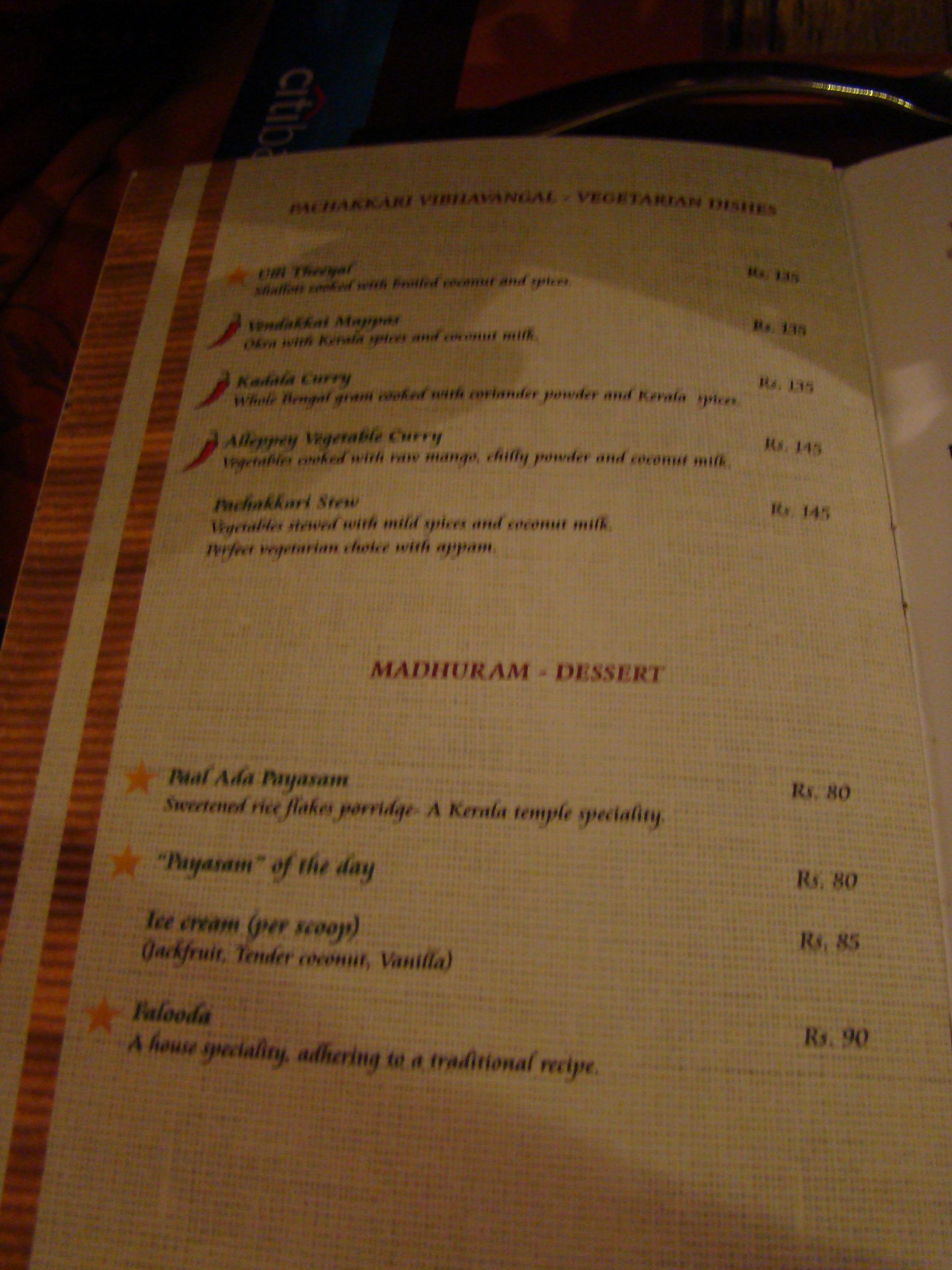
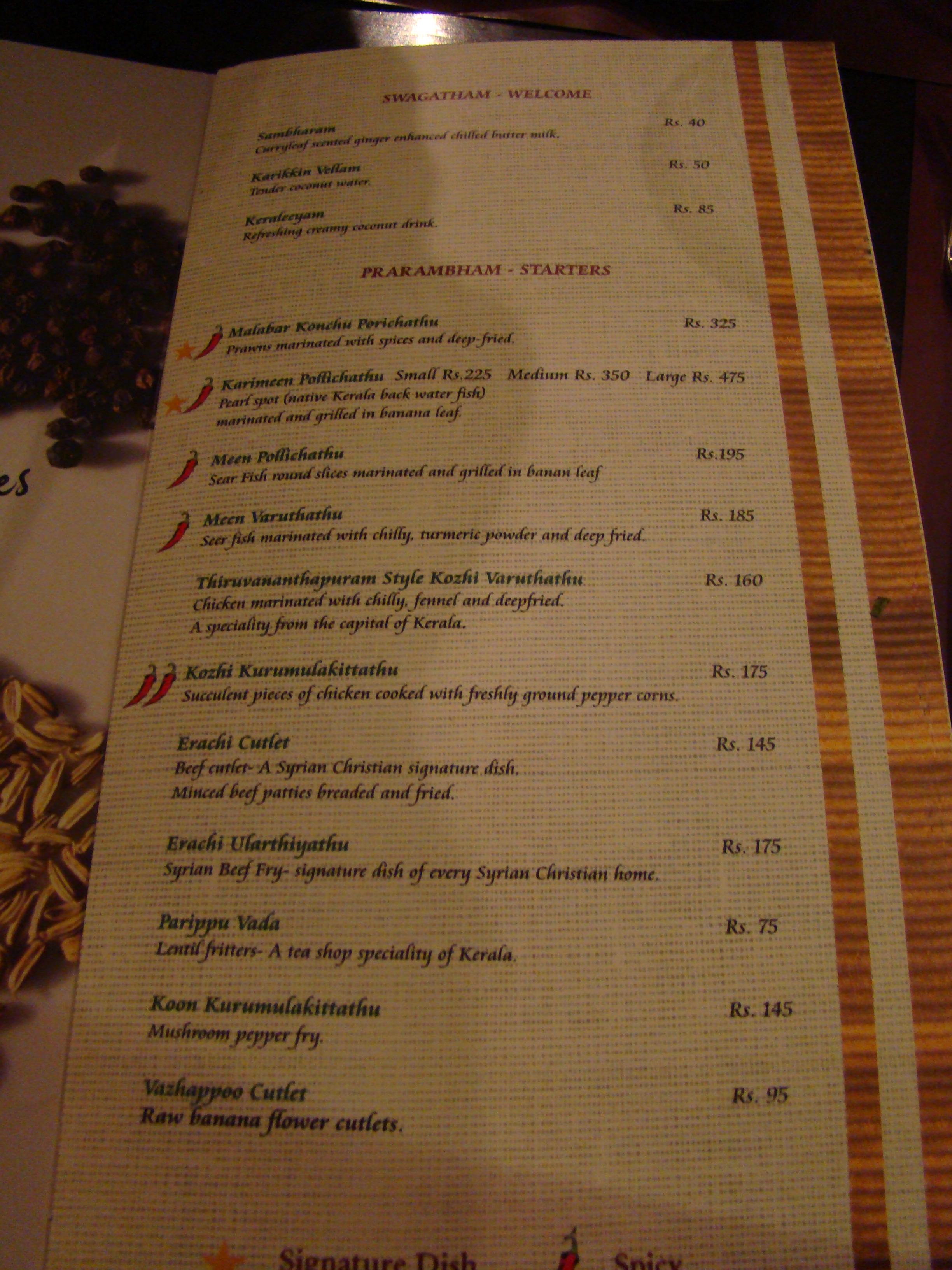
    ‘Ente Keralam’ tries to capture the varied cuisines of Kerala – from Thiruvananthapuram to Thalassery, but despite a great setting and a compact menu that looks good on paper, the food came perilously close to being labelled Keralame. Here’s the menu.

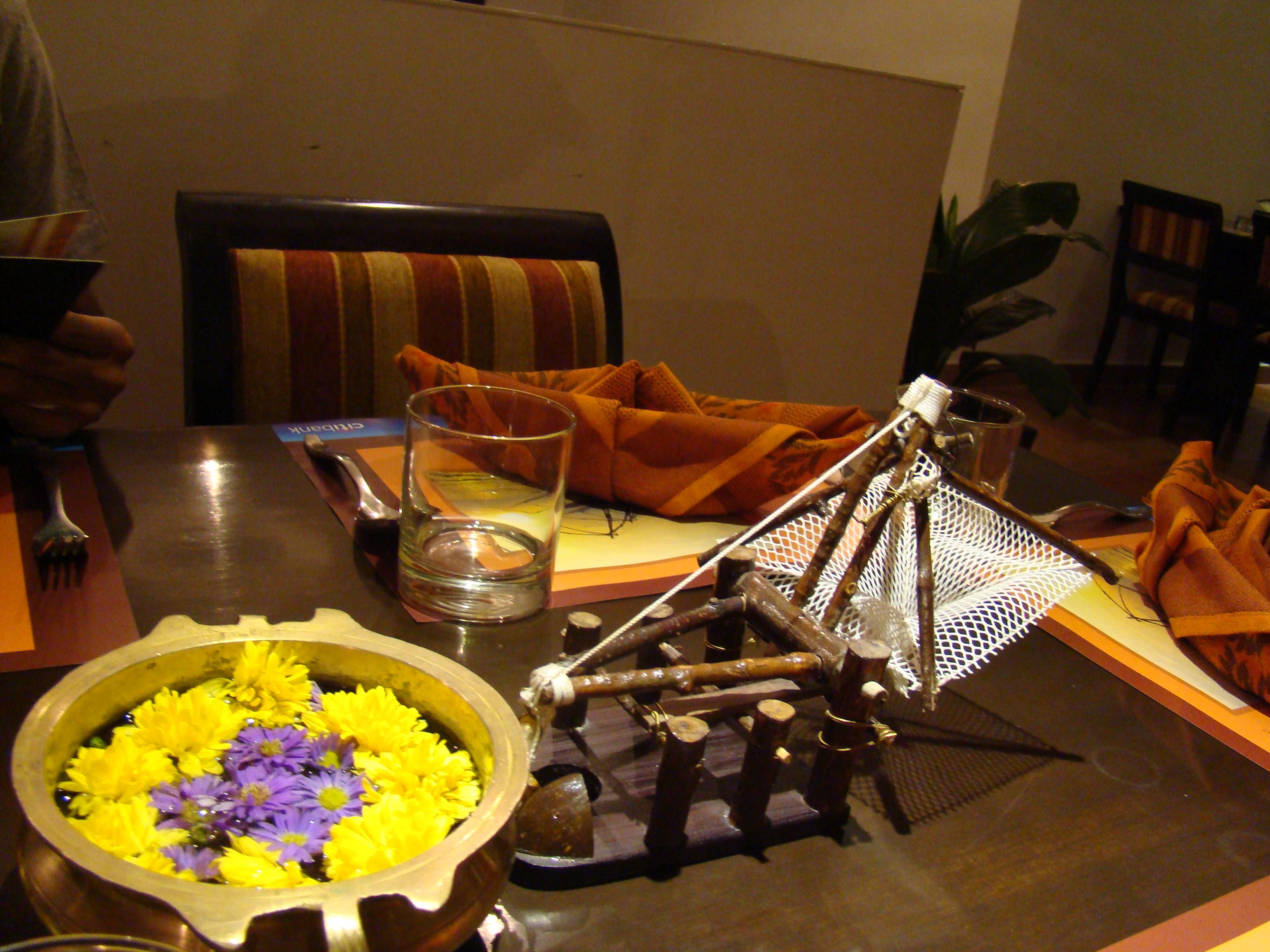
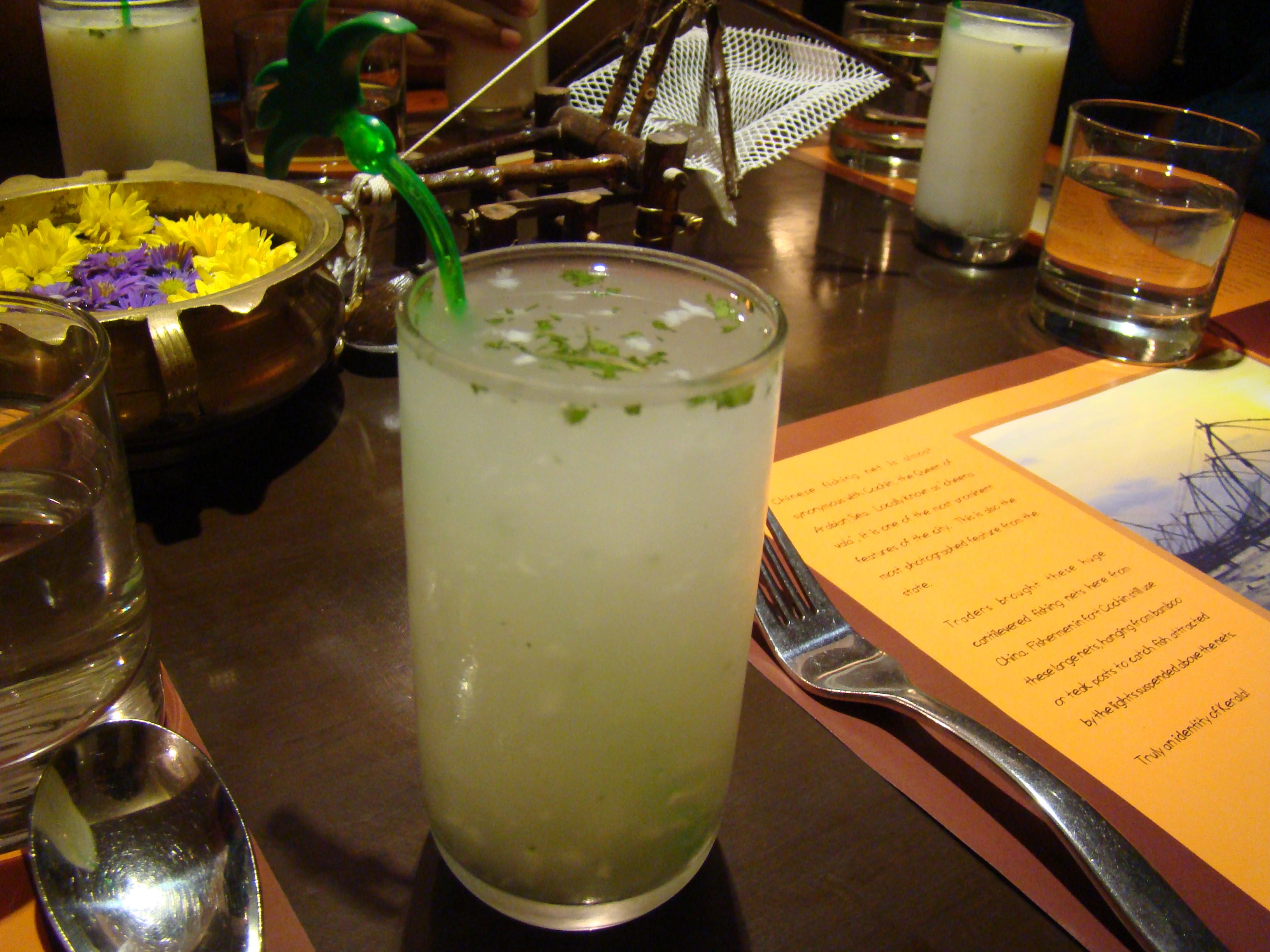
    The ambiance is probably the best thing about the restaurant. The décor includes a few traditional vessels – para, uruli, they have Malayalam books and magazines at the Reception, there’s a miniature Chinese fishing net on the table (Cochin is famous for its kind) and I saw an elephant’s nettipattam too! What works even better is the music – hits from the 80s, which took us all on a nostalgia trip.

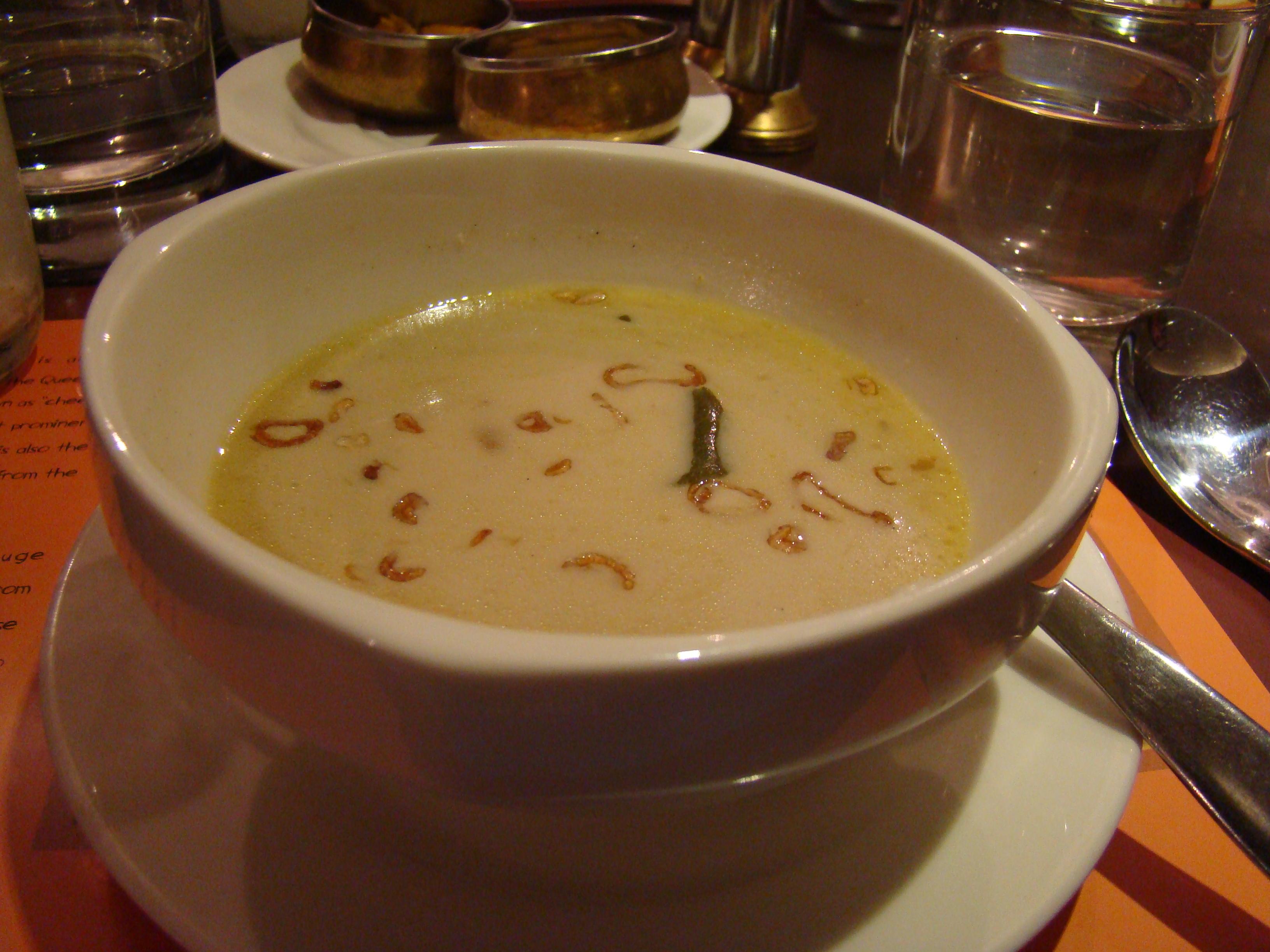
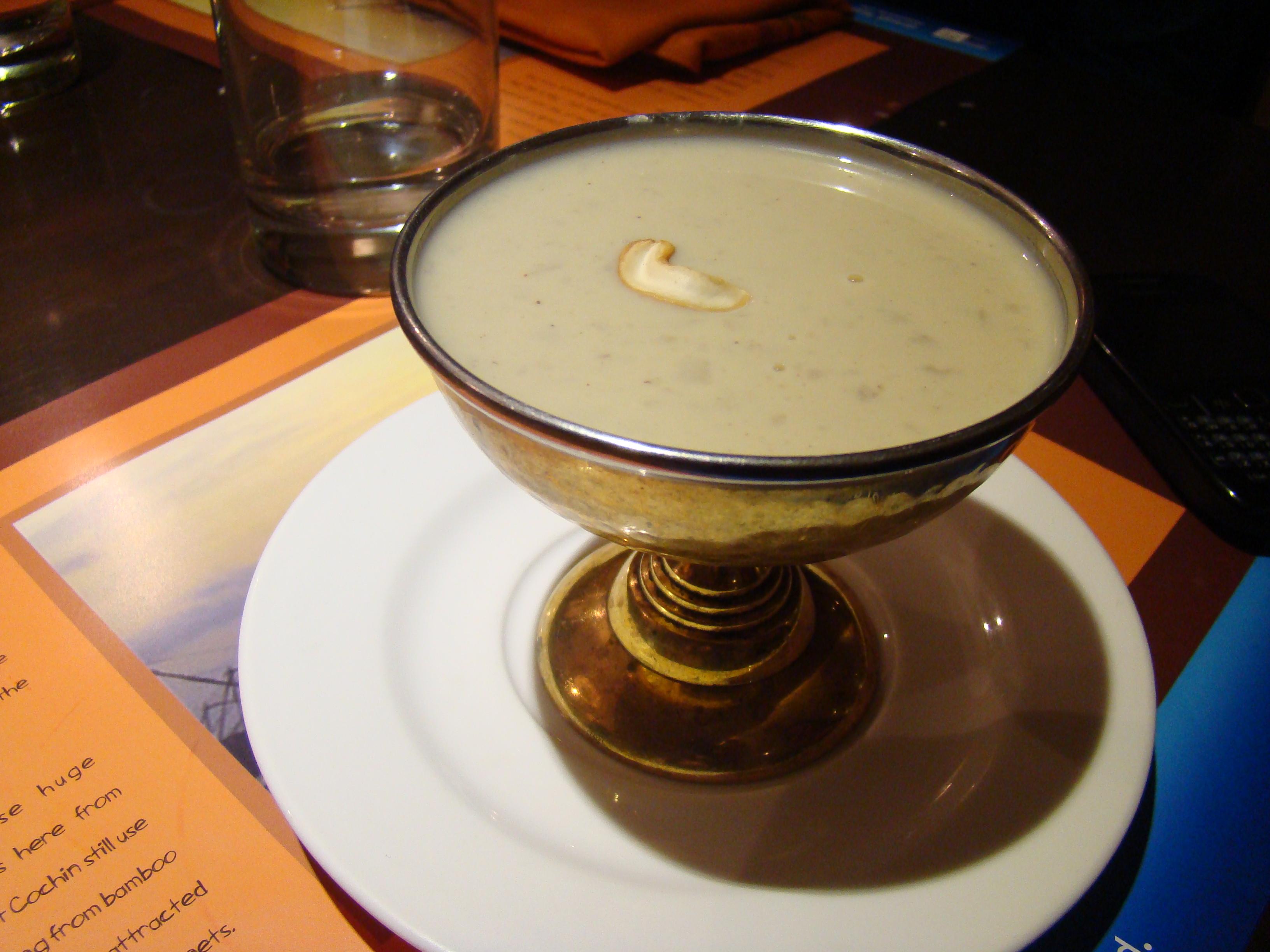
    We started with Keraleeyam, (coconut drink) and the Sambharam (butter milk) . Both were extremely good, particularly the latter, which turned out to be a major hit.  We also tried a Thengappal soup (Chicken). Though it justified the name (coconut milk), it was only just above average. Among the starters, the Erachi cutlet (beef) was reasonably good. But the other three were, well, non starters. The Kozhi Kurumulakittathu was stingy on pepper and was particularly insipid. The Malabar Konju Porichathu (prawn) and the Vazhapoo (raw banana) cutlets were only just okay. Since the veg and non veg cutlets looked similar, we had some minor drama as the sole vegetarian in the group was ‘encouraged’ to try beef.

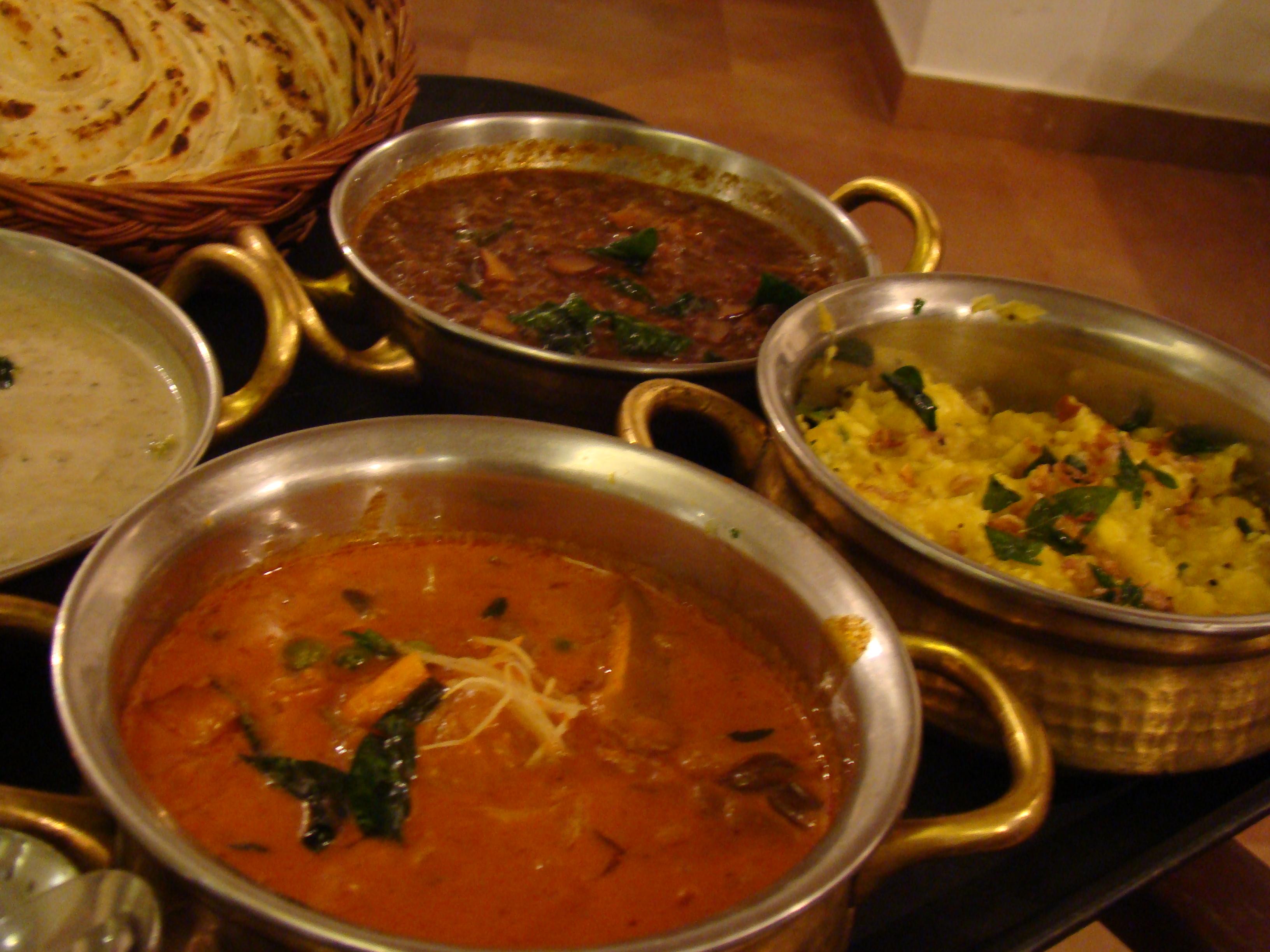
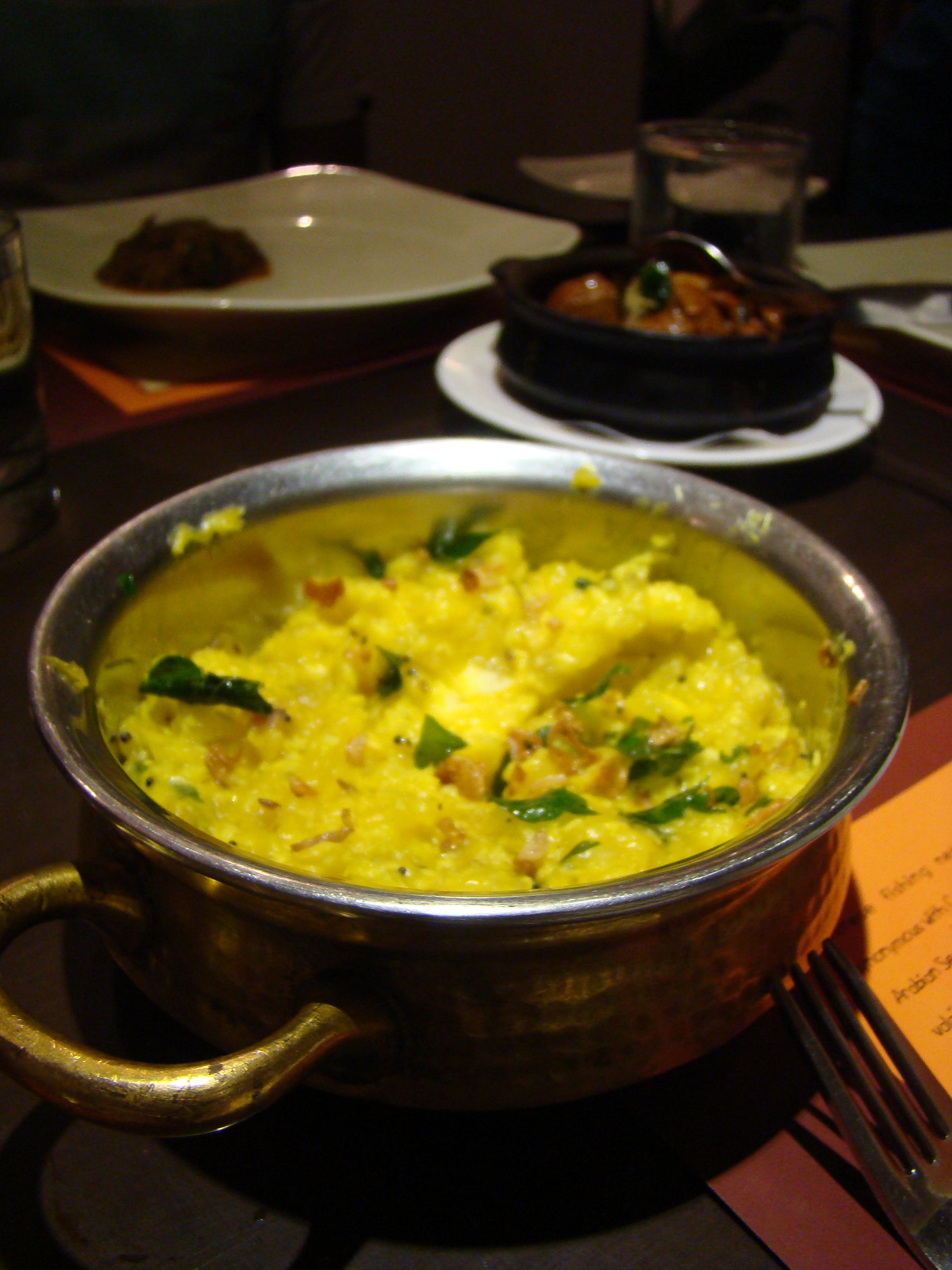
    In the main course, the appams were fluffy and would’ve been perfect if they had held back a bit on the sweetness. The Chicken Stew complemented it well. The Alleppey Vegetable Curry was a tangy marvel, but the best dish was the Meen Pattichathu (fish), which did a lot to salvage the regular combination  – with Kappa Vevichathu. (tapioca)   The Kappa turned out to be mushy and almost spoiled the combination. The Beef Thenga varutharacha curry was an outright disaster. The Thalassery biriyani, of which much was expected, chickened out and even the unique date pickle couldn’t save it. The Paal Ada Payasam was watery and its sugar kick overcompensated.

    The service is quite good, and very prompt. Except for the cutlet fiasco, we had nothing to complain about, and even though we only ordered after we finished each set, they managed to get the next course on the table pretty fast.

    A meal for two would cost you about Rs.1000, and you could get quite a fill with that.  I’d recommend that you drop in if you want to try some Malayali cuisine that’s not commonly found in menus. And unless you have a Malayali in your group, practise saying Kurumulakittathu a few times before visiting. Trust me, it will help. 😉

    Ente Keralam, No: 1/3, Ulsoor Road, Bangalore – 560008. Ph: 080-32421002

    PS: This review was extra special because I was meeting a few friends after more than 7 years. To say that we had an absolute blast would be an understatement. :))

  • Facebook Groupie

    What kind of a blog would this be if we didn’t discuss Facebook’s new announcements. At a simplistic level, it would seem that Facebook learned a lot from that Google study. (via a conversation with Mahendra)

    Though i can’t access it yet, I’m very happy with the backup option, and hope that its a step towards portability. The new chat availability ‘visualisation’ seems slightly better than the old one. I can’t see the app dashboard yet.  But the other big announcement was the revamping of groups. I’d been categorising friends using lists for a while, but didn’t actually utilise them for anything specific. Though its easy to see this as a wall within a wall, from initial usage, I think the new Groups allow that one layer that needed to be added to generic ‘friendships’ – context, not to mention better control over who sees what. And from what I see, I don’t even have to be friends with a person to share things and have a great conversation on a topic both of us like. There are other advantages too. Of course, there are a a few issues, and as always, Facebook kept everything as public as possible (as default) but changes in this version is as inevitable as the waves of outrage that follows all Facebook announcements.

    I’m still debating whether I’d like the Groups to be integrated better in the newsfeed (with ways to filter as per importance) or whether its current location (sidebar) is a better approach. From a signal-noise perspective, perhaps it should stay the way it is. I’m not very convinced about looking at Groups as ‘Friendfeed going mainstream‘ or even Wave. But that does make me wonder whether the next version will also have a feed aggregator, directly, or indirectly – allowing apps like Networked Blogs. That might actually get RSS to go mainstream. 🙂 If that happens, I am also wondering about the implications on Google Reader, and actually any other network which serves as a content distribution/consumption channel.

    Groups can be made ‘Secret’, and I’m still not sure how ‘Open’ and ‘Closed’ groups will show up in Facebook Search. Also, since I still don’t have access to Places, I can only wonder whether ‘Location’ can also be made a group feature. I’m seeing both the above from a brand perspective. Would a brand, for example, be able to highlight a location specific group on their Page, as part of a local promo? Even if the brands do not get information about the groups, Facebook would still have it, and that would definitely help target ads better.

    Groups are not really a silver bullet, but I don’t think Facebook is aiming for that now either. Its just that they’ve not missed the starting gun, to slice and dice my social graph – that’s useful for me, as well as advertisers.

    until next time, group on 😉

  • The crowd in my head

    Two wonderful posts I read a while back – one which I could completely identify with, and the other, such a complete antithesis of what I do that it was almost like a mirror I was forced to look into- but something I could utterly understand.

    Amit Varma’s ‘Society, You Crazy Breed‘, which is about many inter-related things -the need to escape the clutter, even of our own thoughts, the want of validation and acceptance, the human interaction that will take us away from “the terror of [our] own singular thoughts.” (from) It also talks about debate on the internet, but while that makes a large part of the ‘clutter’, especially the micro-debates, the ‘must comment’ social obligation is something I’ve written about earlier, so I was more interested in the first part.

    I used to absolutely love solitude earlier, and it was easier to access too. But now what’s easily more accessible is a crowd. It slowly becomes a sort of addiction, despite me wanting to stay away. Its no longer easy to be objective enough to separate a want from a need, and its quite easy to fool the self. When one has never been the particularly confident type and has barely gotten out of a constant validation requirement, its particularly difficult. An RT on Twitter is easy validation, and as I’ve said before, the vicarious ‘living’ is easy and fun. Its good to be connected, and be a carefully moulded version of ourselves that is acceptable to those we would like to be connected to. The trick, of course, is to be a version  true to our own selves, something we are comfortable with, in solitude, or in a crowd. But that’s not easy.

    That brings me to the second post, “One for the time capsule” wonderfully written by The Restless Quill, about living life on one’s own terms, fighting the battles inside, the arguments outside, and ‘inhabiting a life’, which can create a ‘light-band of memories’. Chances are, choices such as those, would be made with minimum validation. Its also, I think, a lot to do with confidence and an understanding that perhaps comes from listening to oneself, in solitude.

    Its easy to guess which post I could identify with, and which one is the anti-thesis. There are times when my destiny stared at me in the face, and I looked away furtively, as though looking would mean acknowledging, and then accepting. I can dimly sense these. The ability to make those ‘difficult’ choices and keep walking, joyous in the consciousness of what one has learned and the comfortable understanding of what one has lost out on, it must be liberating. I have a feeling, and unfortunately, a feeling only, that it must really be wonderful.

    until next time, a crowdsourced time capsule