• While on contextual reputation…

    Though I don’t answer much on Quora, I am quite a gawker and vote up answers too. One feature of Quora that I found extremely interesting and useful (and tweeted about) is the way Quora gives contextual ‘reputation’ (while reading answers) using the person’s topic bio. The interesting coincidence (because he also RT ed this tweet) is that I noticed it thanks to Mahendra‘s answer to a ‘Google Reader’ based question, and right next to his name was “Daily, dedicated user. Subscribed to over 200 feeds, followed by over 700 people on Reader/Buzz”. I must admit, before I realised that it was a topic bio, my first thought was why Mahendra was ‘wasting’ his Quora bio on Reader when he had such a huge list of phenomenal things he could say about himself. šŸ™‚

    But yes, coming back to ‘contextual reputation’, I liked it because it gives a lot of relevance and credibility and adds a layer to an answer – you can better understand where thisĀ  answerer and his response is coming from, for example. Another nuanced way of helping the reader weed out noise. I also thought this was a good way for brands/organisations to develop credibility in their domain, and involve their users, using function specific spokespersons, (brand, HR, operations etc) since “brands are currently not supported on Quora“.

    And now we can go off on a tangent and check out a few brand experiences I had last week, all with oblique connections to contextual reputation, though lycra like they might seem šŸ™‚

    When Airtel changed its logo sometime back, though there were infinite debates on the need and quality of the new logo, their on ground management of the logo change was almost unequivocally appreciated. However,

    To their credit, the ‘everything’ search, though has the old images, has the first link pointing to the new logo. But from an image perspective, ‘contextual reputation’ for logo change online gets a thumbs down.

    Cleartrip, quite a favourite brand for their ‘no nonsense. clear talk and action’ way of managing their product and online presence, has a new campaign ‘Every trip has a purpose‘. But favouritism unfortunately doesn’t stop me from wordplay and I tweeted

    Just as i was chided for provoking a brand, and was replying that I trusted Cleartrip to have a sense of humour, they replied with a ‘laughing hard’. Contextual reputation thumbs up. Hopefully they weren’t being sarcastic.

    The last experience was from Tanishq, whose new Blush campaign I came across last week. Like I tweeted then, immediately after the Quora tweet, I found it quite interesting and worth an applause that a brand was experimenting with a Firefox/Chrome plugin. Instead of me explaining how it works, I will, in my new found enthusiasm for imagery, give you a screenshot.

    As you can see, the plugin gives you, in addition to the ‘Like’, ‘Comment’ options you see after a Facebook status, a ‘Blush’ option, which when clicked, adds a comment with a link to the ‘Blush’ page. Hmm. I won’t get into a ‘app within FB vs outside website’ debate (there must be some reason, I assume). But unfortunately, boring that I am, I’ve never seen a jewelery that has made me blush. I can’t even see it in the Tanishq collection, assuming that I have the ‘where to wear it’ right. Maybe girls/women see it differently. So, why didn’t Tanishq just have a ‘Gold’ button, which would actually add to their ‘contextual reputation’ more than blush, and tie it to some sort of action that would actually get something tangible for all involved.

    For example, I install the plugin and start using it just because of the ‘show off’ value. What if they tied in an offer linked to the number of “Golds” I gave/received on statuses, and then communicated that in the comment that appears after I have ‘Gold’ed a comment. Or how about virtual gifts, a way to showcase the gallery, and then an easy app to add the virtual gift to a profile pic? I have an inkling that women are likely to have a “nice earrings/pendant. where did you get it from” conversation. They could even make this Like based contest i.e. if you virtually gift someone and get them to add it to their profile pic, and they get maximum likes (make a leaderboard) we’ll let you actually gift them for free. Do that on Valentine’s day, and it just might work.

    Meanwhile, I have a ‘reputation’ for longish posts, so I’ll just stop here.

    until next time, add to the context?

  • Master Classes

    The last few episodes of Masterchef Australia Season 2, especially after it came down to the final four, were quite awesome. For me, it went beyond the cooking or even the amazing camaraderie between the participants and the judges. The final two turned out to be Adam and Callum, separated in age by more than a decade.

    Adam, I thought, (thou shalt not dare to bring up the fact that I know zilch about cooking) was quite a genius. Though he was a bit too arrogant in the mid-episodes to be my favourite, his range and the thinking and creativity he brought into his cooking were nothing short of phenomenal. Meanwhile Callum’s level of cooking sometimes made you forget the age (and experience) difference between the two.

    But something more than that made me identify with Callum. A very smart friend recently gave me a Master Class and pointed out to me a classification of personalities – askers and guessers. I belong to the latter, I do tons of calculations and thinking before I can ask something of someone, and I still wonder if I’m being presumptuous or inconveniencing them. The worse part, I’ve noticed that the shyness is mistaken for arrogance!!

    In one episode, when Callum’s dish earns special praise from an external judge, he mumbles a ‘thank you’. Matt Preston admonishes him and reminds him of what he’s supposed to say when he’s praised. Callum then asks the judge whether he can do a stage, (“Staging is when a cook or chef works briefly, for free, in another chef’s kitchen to learn and be exposed to new techniques and cuisines”), and is promptly rewarded. I wonder how much ‘asking’ has to do with confidence and passion. Callum is fortunate to have discovered a passion early in life. I’m sure that his experiences will make him more confident.

    I read this excerpt from a book, which talked about “young adults in America choosing to slow down their path to adulthood”. Probably a good move. (Generalising) By the time we go through the motions of education and work, the baggage and constraints start accumulating. The passion practically disappears, and the experience possibly does more harm than good. Rediscovering all of it is no easy process.

    Perhaps, if we had an ‘education system’ that could help identify what we wanted+were good at+ could earn money with, we’d have more askers than guessers. Because then, we’d know our passion, and with that knowing would come a direction to seek our experience, with that would come confidence, and then all the world would actually be a stage – to learn and to perform.

    until next time, youthopia indeed

    Related Read: A toast to common genius

  • Elements Heritage

    In terms of heritage, Elements used to be quite liked for its continental menu, while on Nandidurga Road. I was looking at the photos on their site, and wondered how I managed to miss it. 😐 All’s not lost though, as the new Elements Heritage, on Mosque Road, (just after Savoury, diagonally opposite Empire, just before Mosque Road meets MM Road – map) scores heavily on ambiance, and only differs in cuisine focus. Parking shouldn’t be a big problem, more so because there are enough side lanes around.

    Apparently, this was a really old Raj bungalow which has been revamped. As soon as we got there, we were shown a table, but also encouraged to take a little tour to see more seating options. That included a section upstairs with a live counter, but apparently, that was for the buffet diners. So we got back to our ground floor table, which was neat enough. The ambiance is really super, and the spread out table groups, not visible to each other, ensure that you feel the restaurant buzz, but still retain the exclusive dining experience. The lighting is dim, but the only discomfort that caused was in the photography.

    The menu is below, the last one was the buffet menu for the day, priced at Rs.550 + tax. (click to enlarge) While I was struggling to take the photos, the owner, presumably, who was taking another set of guests on the restaurant tour, offered to send me the menu by mail. I was almost through though, so I didn’t take up the offer. (seeing that quenchers page, I should have :\ ) That only adds to my feeling that the guys who run the place want to add a personal touch and make the dining experience really good.

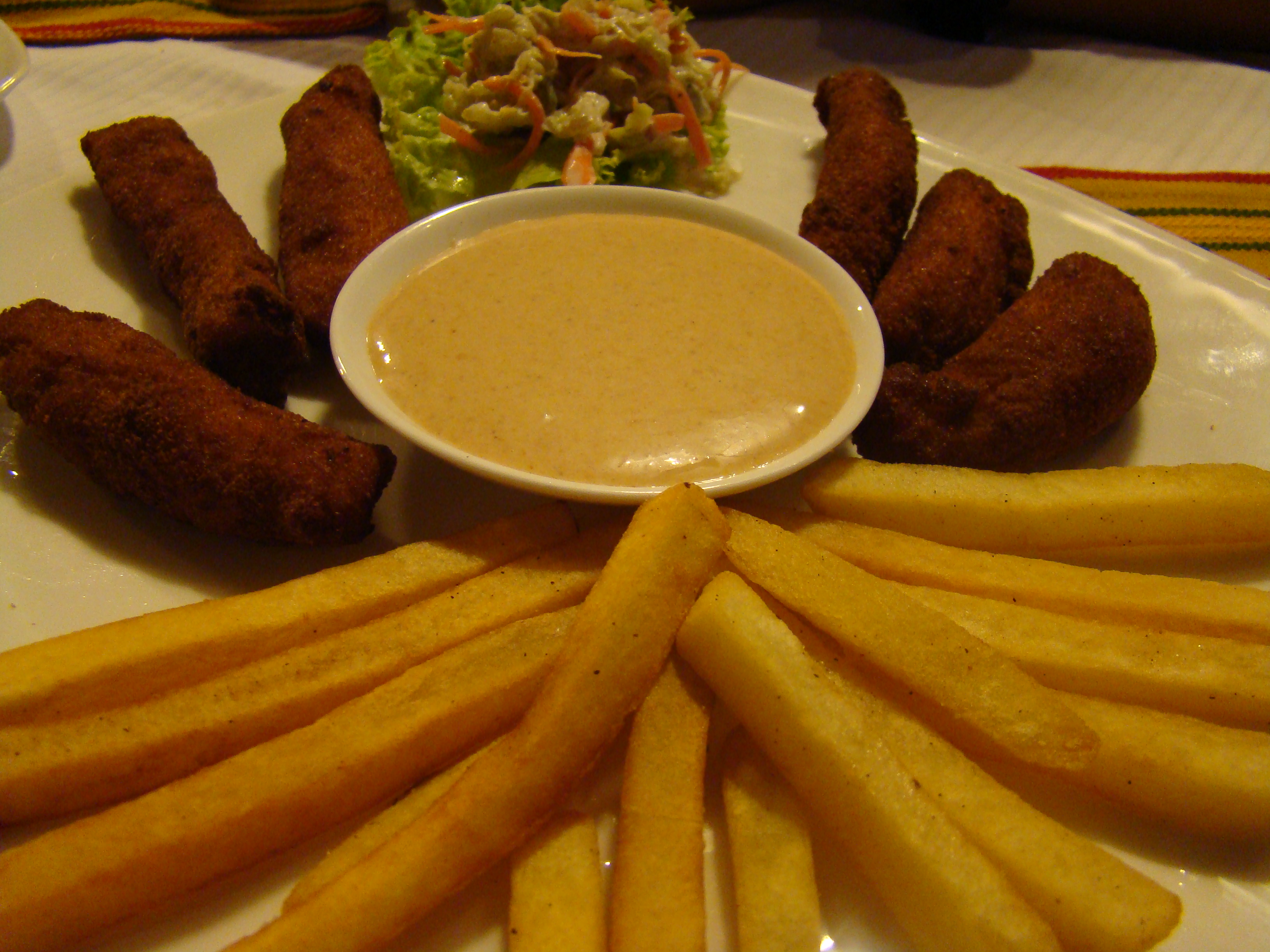
    From that large selection, which included many many things we wanted to try, we skipped the shorbas and went for a “Seekh ‘e’ Elements” and a Bheja Fry. The formerĀ  consists of 4 seekh kebabs, each with an idiappam. Quite good, but the winner was clearly the Bheja fry, spicy and cooked superbly.Ā  This was the part where I was caught between getting a good photo and devouring the food. The latter won out, as is obvious.

    For the main course, we ordered a ‘Meen appam’, and a ‘Kozhi Mulagh Ittathe’. Most of the dishes come with neer dosa/rice, so ask before you order naans/ appam/ rice separately. The meen appam actually turned out more like an ada than appam, with fish stuffed in it and cooked in a banana leaf. It comes with a sauce that seemed to have a jeera flavour, which worked well to complement the taste. Though we felt that the ada overpowered the fish filling, its still a dish you could try. The chicken dish came with two kinds of rice (one of which was the Kerala style boiled rice) and 4 neer dosas. We expected this to be really spicy, but it was actually more flavoursome, despite me eating up one of the large chillies.

    We debated a biriyani, but then decided to behave in a more un-glutton manner andĀ  debated whether we should ask for a halwa of the day or a Shahi Tukda. The former wasn’t available (thankfully, on hindsight). The Shahi Tukda was really good – less heavy (ghee) than usual, and is highly recommended. All of the above cost us a little less than Rs.1000. The service is brilliant, offers to help and the place probably has the promptest delivery time I’ve seenĀ  recently.

    Elements gets into our favourites list for many reasons – a menu that’s not very common, an ambiance that’s really awesome, excellent service and overall, a wonderful dining experience.

    Elements Heritage, #55, Mosque Road, Frazer Town, Ph: 41144146/8

  • Appeasing consumers

    Last week, I had asked on twitter whether Indiatimes should consider buying/building a GroupOn clone and use its other media platforms to scale the business, especially since its also proxy advertising for their clients. In response, Shahid had wondered what prevented an Airtel from getting into it. The point (simplistically) being that, any platform owner with a ‘captive’ audience could get into the business.

    It made me think about the mobile as a platform, especially considering the app talk I’ve been doing on the blog for a while now. While appification across platforms is what I’d discussed last week, for the purpose of this post, I shall restrict my thoughts to mobile platforms. Even before I read and wrote about the appification across platforms, I had asked a question on qoura “Has any Indian bank considered a smartphone app?”Ā  (http://qr.ae/GETp) I got 2 answers, and though I was looking for Android, they were still helpful – Robin Samuel pointed me to ICICI (I think Gopi had also mentioned it on Twitter) and Aditya Sengupta mentioned a Nokia Money + YES Bank pilot.

    Citibank, whom I bank with, had a few Android apps, I noticed. The Citi Hong Kong app was specially interesting, since in addition to location of ATMs, they also display offers nearby. I’d obviously like an app which will also help me transact, and they have that too, elsewhere. (they are by no means, the pioneers or only ones, as a google search would tell you). The idea here, though is a ‘commodity’ service (banking) increasing user convenience, and making a shift to another bank less appealing. This isn’t an ad vs app debate, but spreading this information would be simple enough (without mass media) during consumer acquisition, as well as later through digital and social platforms. Maybe even tie up with a mobile manufacturer and offer to subsidise the handset for the consumer in return for publicity. The point, platforms are exploding and brands need to think of new ways to associate and partner. These apps could itself evolve into a branding vehicle.

    And since that point is made, we can broaden the scope beyond mobile as a platform. Just in case you thought brands might be constrained with that as the only option, how about TVs, kitchens, laundry rooms, cars, tables? Check it out.Ā  (via Avi Joseph)

    until next time, Applying minds šŸ™‚

  • When you’ve no business doing it…

    Sometime back, I read this amazing piece titled ‘The Night I met Einstein‘ – how Albert Einstein helped Jerome Weidman discover his ear for music, step by step. I put that very simply, but the story has to be read fully to understand its depth and context, perhaps best summarised by its ending, Einstein’s words – ā€œOpening up yet another fragment of the frontier of beauty.ā€

    I wonder if amidst prioritising our lives, we have lost theĀ  ability to experience for the sake of experiencing, and to help others discover that magic. We have an entire web to discover content on any interest we might have, and yet even an Instant search does not mean that we can do something without an agenda, a purpose that goes beyond the sheer thrill of a new experience. Yes, I include the vacation – Facebook photos nexus (para 7) in this. šŸ™‚

    When I watched the participants getting eliminated on MasterChef Australia, week after week, I felt sad for most of them. (there are perhaps only a couple towards whom I had taken a strange dislike) I felt sadder when they showed the ‘what do they do now’ and I realised that many had gotten back to their lives, and different lines of work that has nothing to do with the love for food. While the show gave them an experience they would cherish, it was also perhaps the best push they’d get to realising what they’re really meant to do.

    And that is perhaps a rare opportunity, especially when I look around and increasingly feel that the business of living has become the meaning of life.

    until next time, lifejacking

    PS: An insightful read in the same context “What does it mean to work hard?” via Mahendra