• Tyrus Technologies

    [scribd id=51587911 key=key-1dv5768sjruxs2hqigee mode=list]

  • Zingron

    Zingron serves Naga (and some Manipuri) cuisine and is almost opposite Corner House in Koramangala.(map) The trend of climbing required to reach restaurants serving North East cuisine continues. Remember NE Diner? In Zingron’s case though, there is a midway stop in the form of Coorg.

    Unlike NE Diner, which is purely functional, Zingron is tastefully done in what seemed (in artificial lighting) a cherry red dominated ambiance. The wicker chairs-and-low table options, and the road facing views I am a sucker for, all added to the peace that comes after a good climb. 🙂

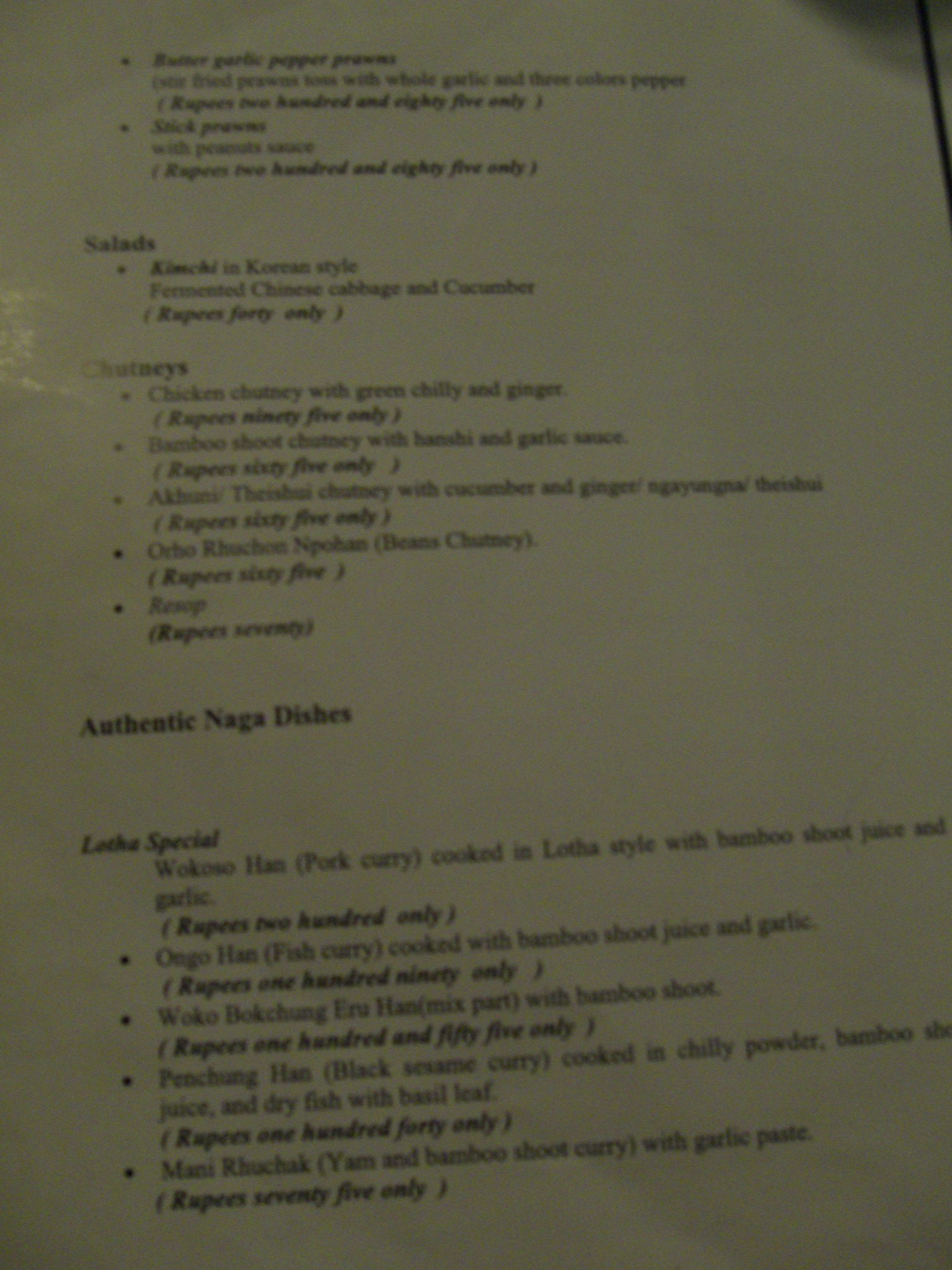
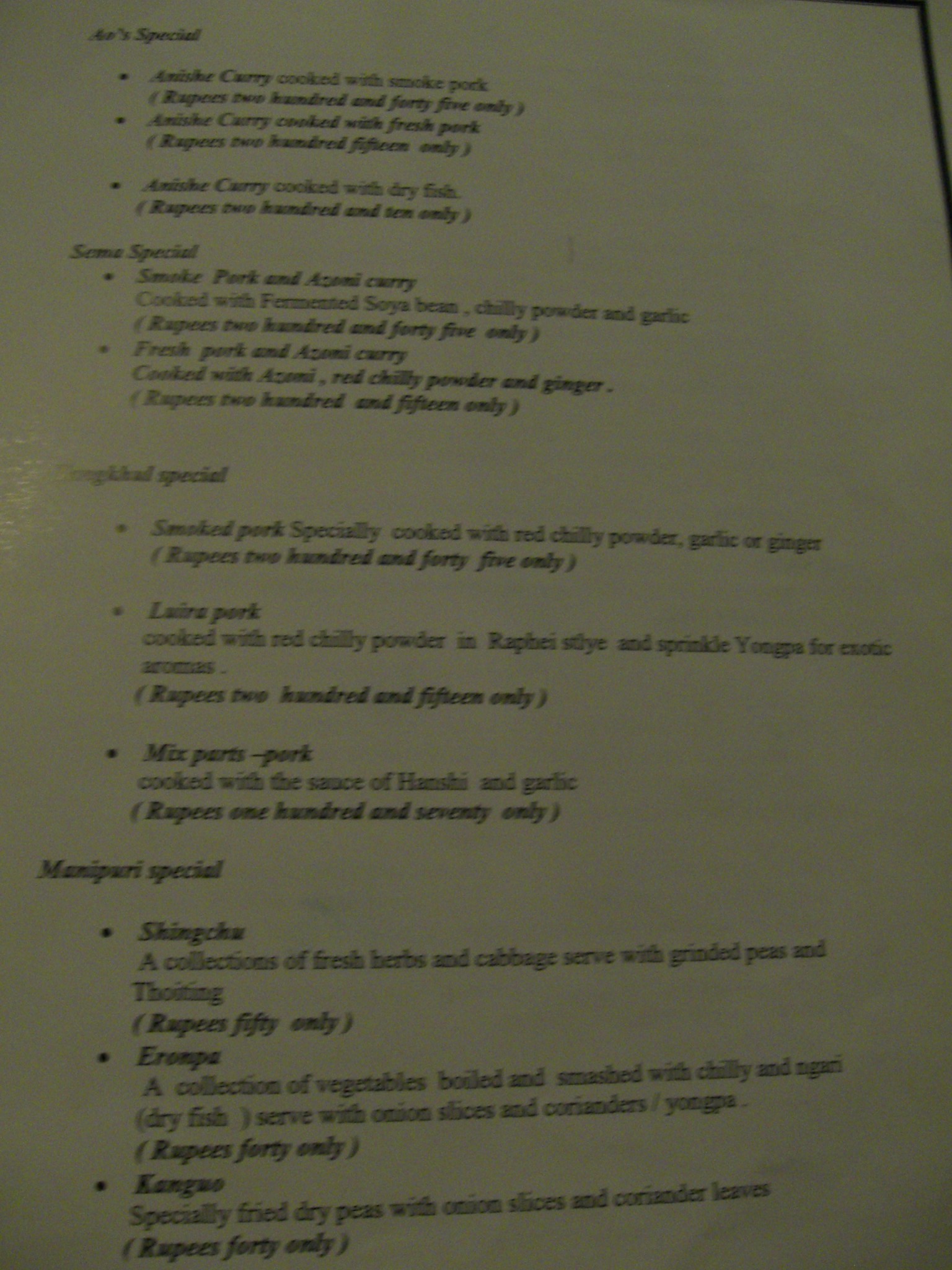
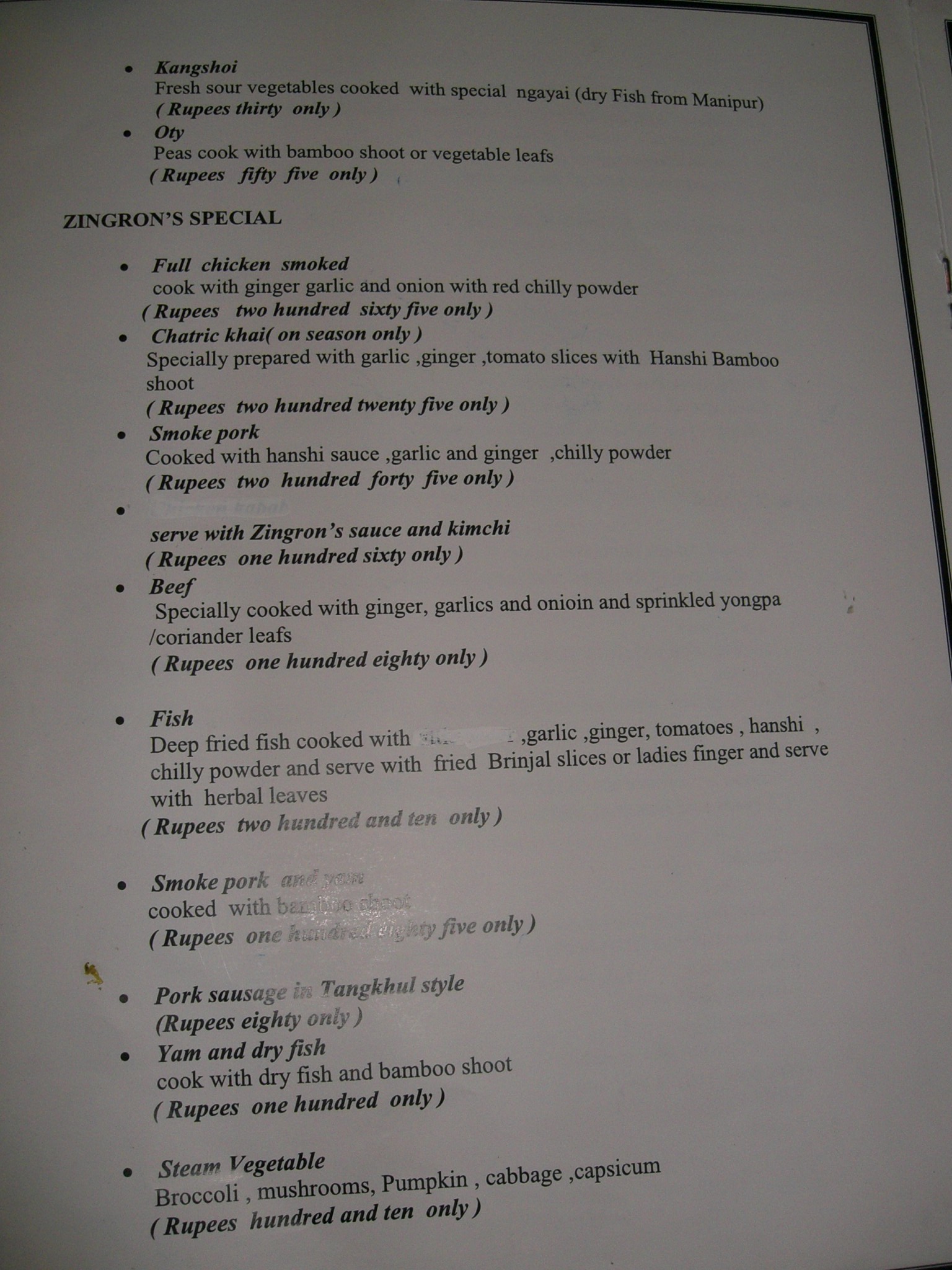
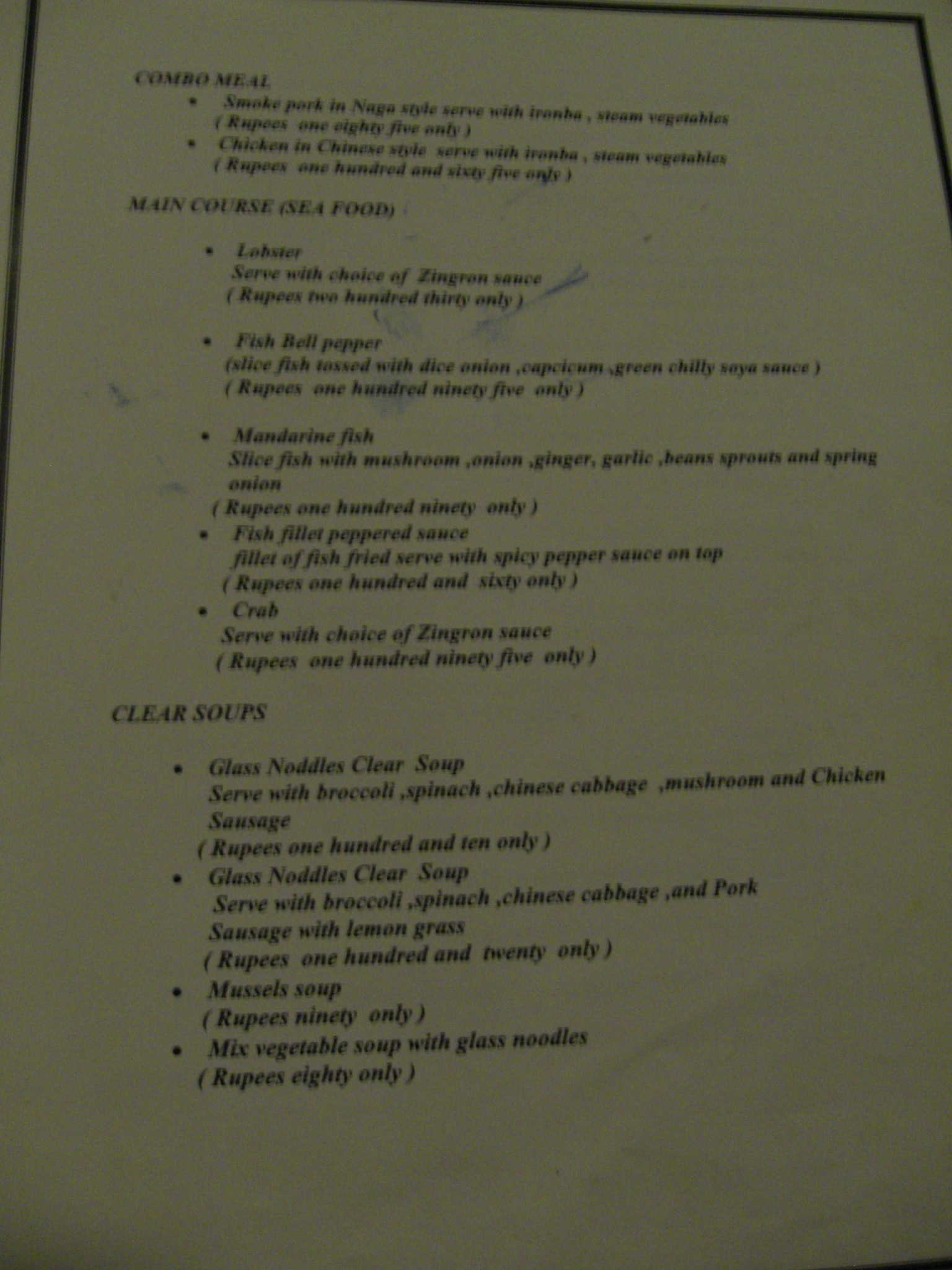
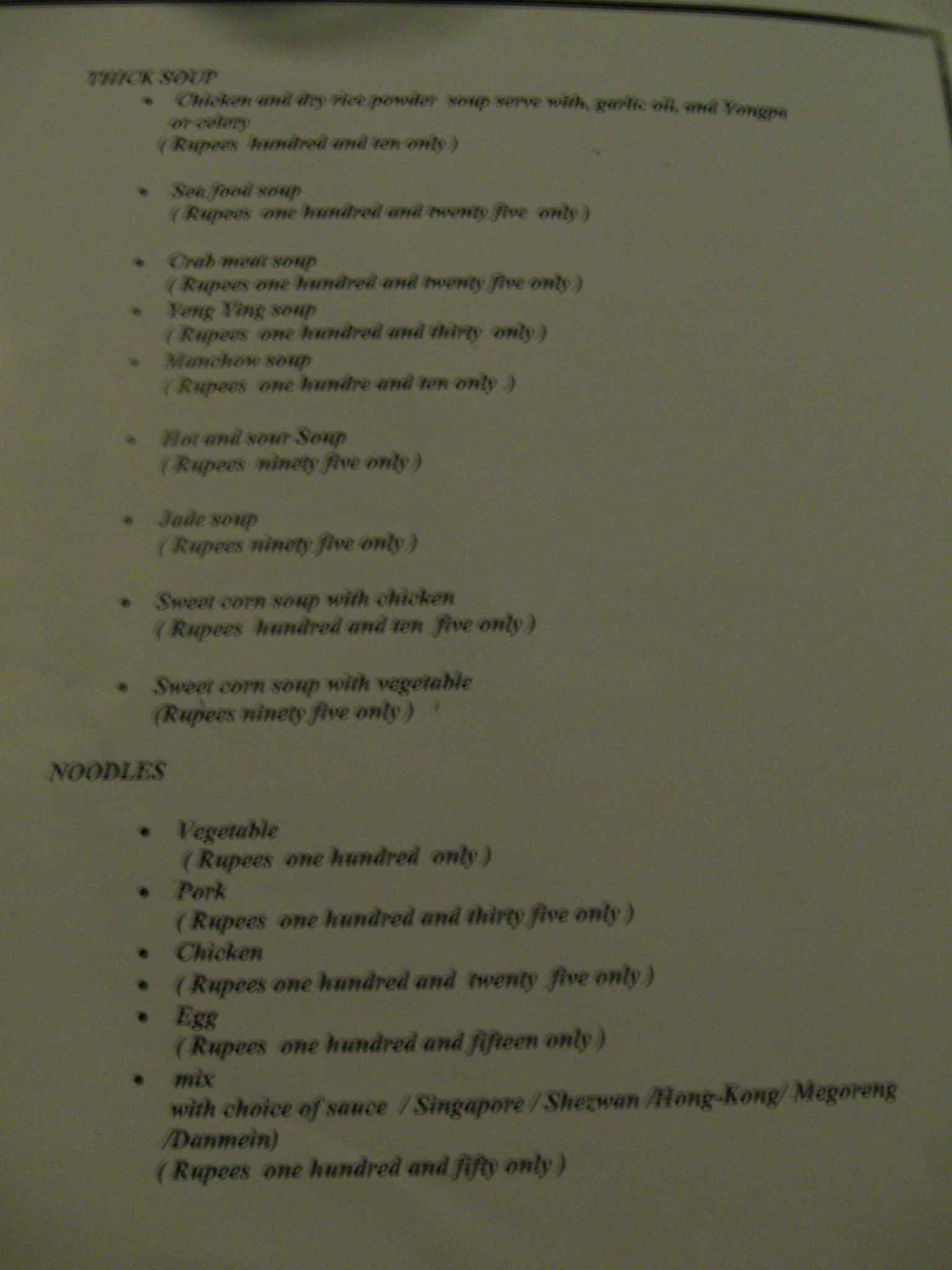
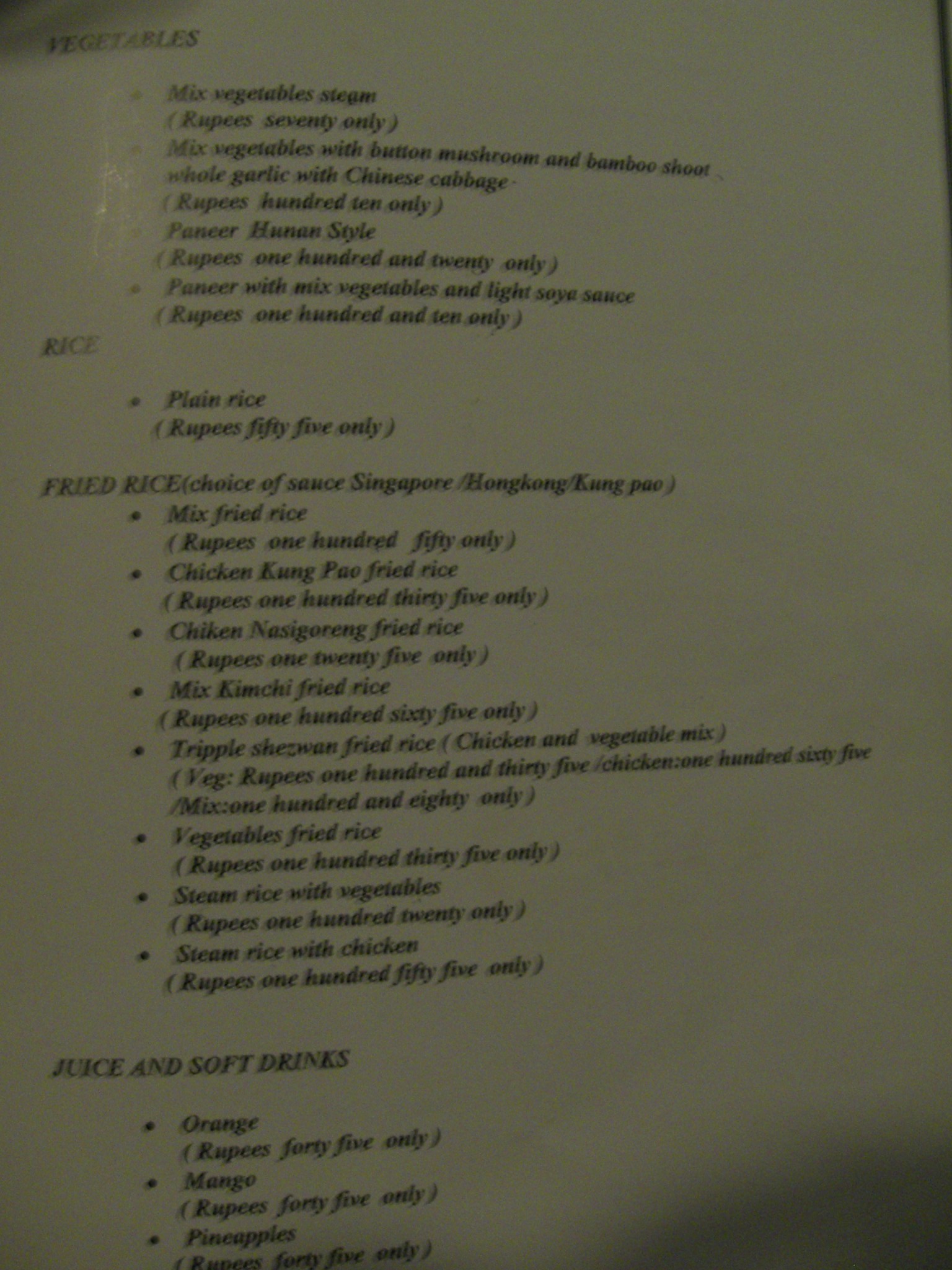
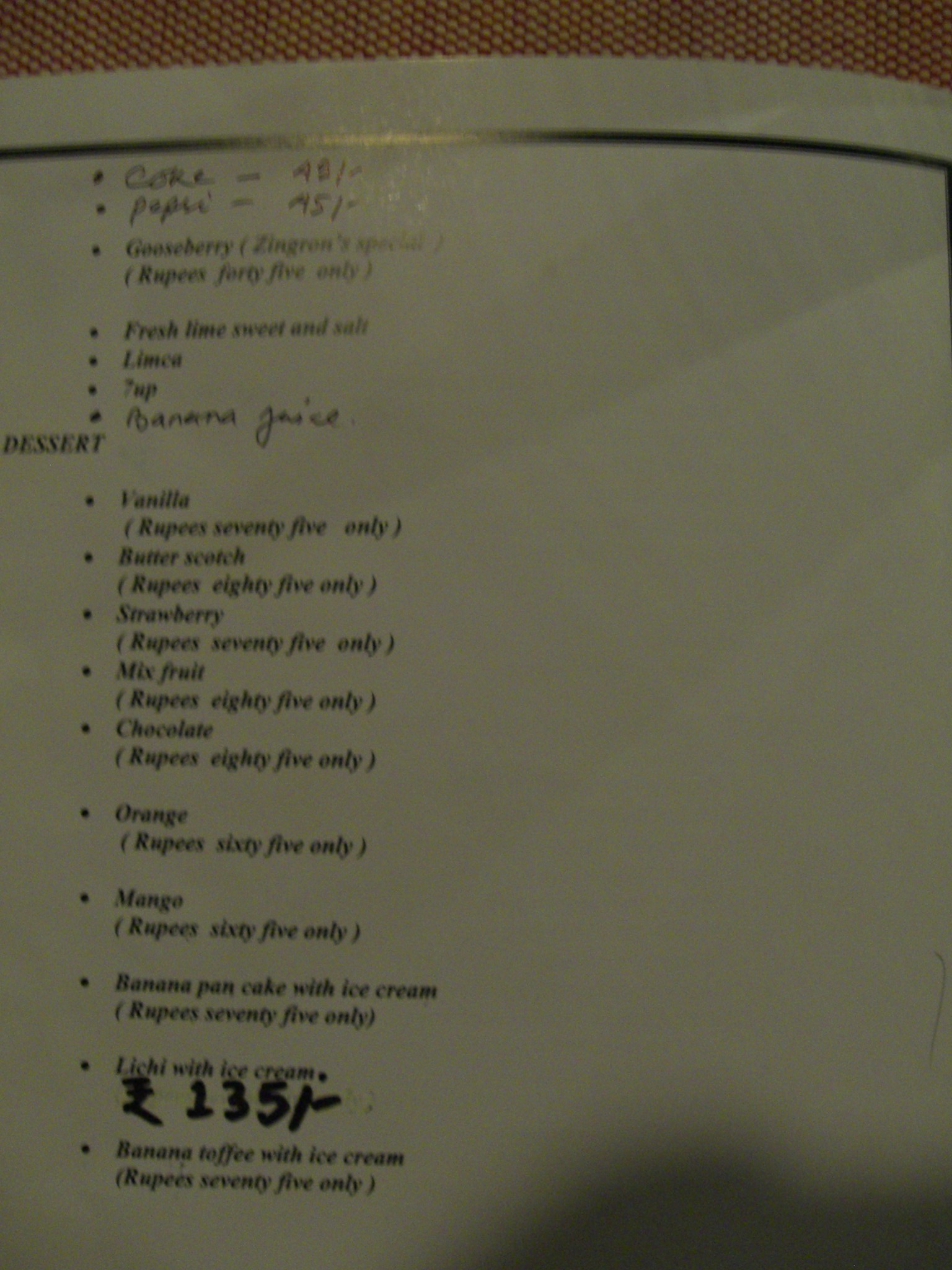
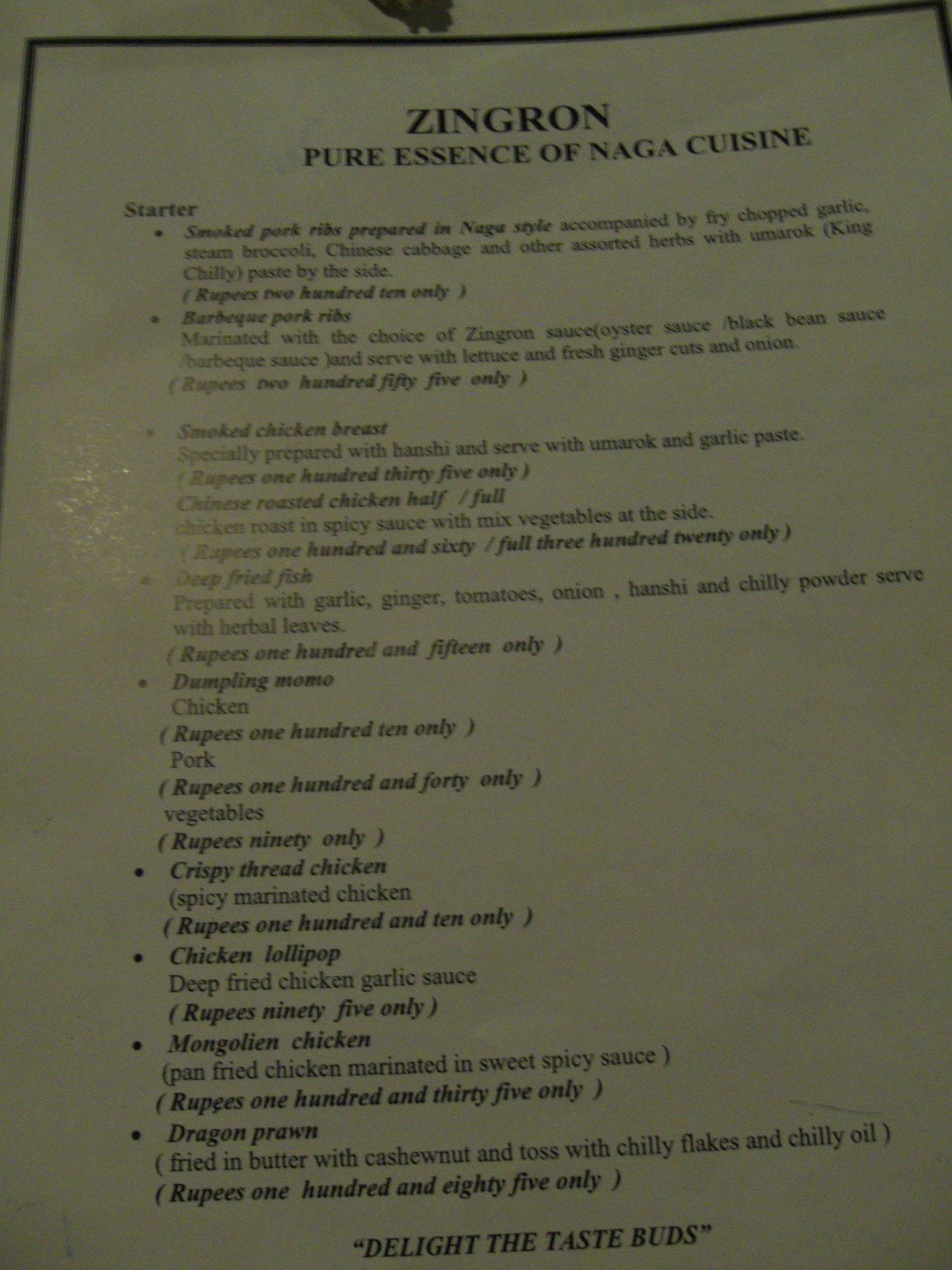
    But hungry hogs we were, and thus, dived straight into the menu. You can too, virtually, below (dim lighting didn’t help, and I am bullheaded about using flash)

    As you might notice, choice is abundant, and thus it required complicated rounds of delicate discussions before we decided on the exact food path.

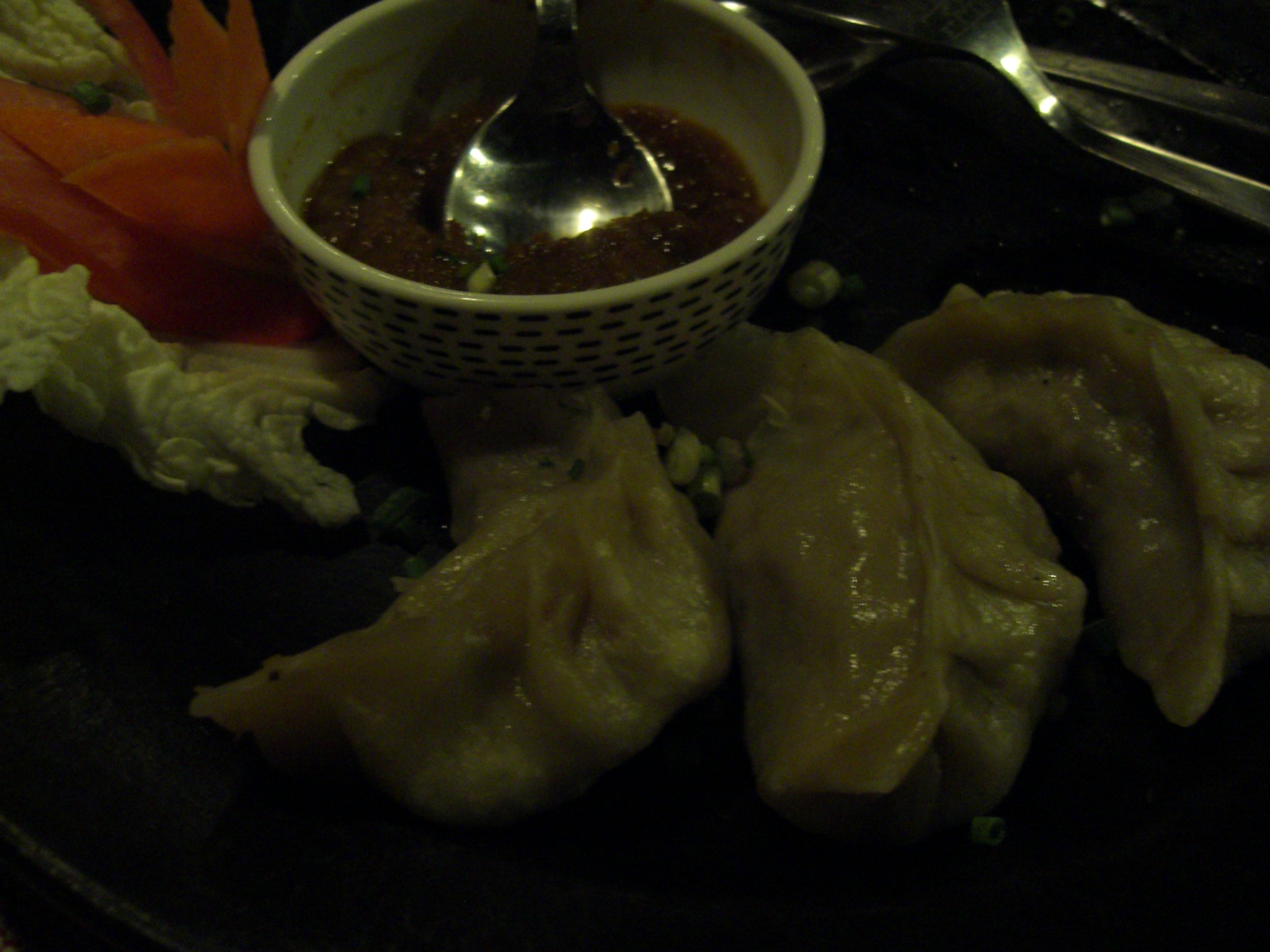
    Since we weren’t foodsure, our first foodhold (last one, promise :D) was in familiar territory – chicken momos. We also ordered a ‘Pork sausage in Tangkhul style’ and a Chicken and dry rice powder soup. The pork came first, and though quite unique and different from the regular fare, was a bit bland. Maybe we should’ve asked for a Bhoot Jholokia chutney. Next time, I’ll try the pork ribs. Meanwhile, the food is served in those nice Manipuri earthenware plates. (we’d seen earlier in a shop in BDA complex, Koramangala, and were told that it actually contributes to the taste) The soup turned up next, and was quite decent, reminded us of sweet corn though it did. The momos turned out to be great, but it was actually the chutney that accompanied it that made the dish fantastic.

    We’d also ordered a Gooseberry juice and a Banana juice. The former was just okay, I liked the one I had at Ants Cafe better, but the fermented banana juice was simply awesome. It would also play a major role later in the dinner.

    For the main course, I ordered a Luira pork and D ordered a Fish fillet with peppered sauce. I was tempted to order a Beef dish too, but decided to figure that out later. We were told that plain rice would work best with what we’d ordered.

    The food takes a while to arrive, but the service more than makes up for it by being very helpful. That pork dish, cooked with red chilly powder in Raphei style, has to be one of the spiciest things ever, and had D crying in seconds. So potent was it that, the fish, which had its own dose of pepper power paled in comparison. Thankfully. The rice managed to temper things a bit, but it was the banana juice that actually saved the tongue from total annihilation. Both dishes are highly recommended, but don’t attempt the pork if you have a problem with chillies or pork fat. The only downside was that we just didn’t have space enough for the beef. But the good part is that D has taken her baby steps towards accepting North Eastern cuisine (at least at Zingron) as a viable repeat-visit place. 😀

    On the cost front, all of this cost us just less than Rs.950, and was completely worth it. Drop in once, and I’m sure you’ll go gaga over Naga too. 🙂

    Zingron, Solitaire Cascade, #62, 2nd Floor, 1st A Main, 7th Block, Koramangala Ph: 40997506
  • Weekly Top 5

    [scribd id=51588944 key=key-1c6uu4xv3i5f88tvluss mode=list]

  • Brands going places

    So, almost a year after I blogged here about Cafe Coffee Day’s potential gains from Foursquare, they have become (as far as i know) the first Indian brand to get an official page on Foursquare and have special offers for 4sq users. (Bangalore outlets). I plan to drop in soon! Meanwhile, I remember the DM conversation then, with the person handling the CCD Twitter account and touching upon the problems of scale that would arrive with a platform like Foursquare. But now we have tools that address franchise needs, so I hope that can be addressed too. Anyway, good on CCD, because it’s not easy for an organisation of that size to be an early adopter marketer. Also good on the agency for (probably) getting them to do it. 🙂

    With Foursquare and Facebook Places, I think that brands whose product/service experience is intrinsically tied to retail outlets are perhaps closest to a kind of interaction utopia I have in mind. Here’s why.

    With every platform advancement, the customised interaction potential has increased – from mass media and the static web to social web, location based services, apps and technology like Augmented Reality. But even now, given the tendency to aggregate ‘Like’s and followers, I sometimes feel that ‘social’ as it relates to friends and followers’ overrules ‘social’ as a relationship between brand and consumer. That’s a dichotomy that few brands have acknowledged or addressed. Conformation!

    And that’s why I feel retail brands on 4sq, Places etc are near to that utopia – because it allows real-time interaction and context at the place of experience. Social is only a topping, and something that the user will scale by connecting his friends/followers to the experience. The brand/platform just has to play along. Technically, you could say it is possible on FB, Twitter too, but there the Like/follower currency is way too prevalent, so it is easier for brands to get sidetracked. (If we go by a recent report, brands will eventually find that it’s not really getting them anywhere)

    Meanwhile, just like FB and Twitter, platform protocols and constraints for brands also apply to apps and location based services. And that’s why, at this level of my imagination, I can only imagine utopia (for non retail brands) as brand ‘controlled’ interactive sensors attached to each product we consume. 🙂

    These shifts would hopefully drive more brands to define their own destiny.

    until next time, CCD, may the foursquare be with you 🙂

  • Armchair travel plans

    If I discount Pico Iyer, the travelogues of Pankaj Mishra, and Mishi Saran’s Chasing the Monk’s Shadow, I hardly read travel books. But I picked up Rahul Jacob’s ‘Right of Passage’ on a whim (influenced by Pico Iyer’s comment on the jacket) and quite liked it, mostly because its really not just a travelogue. Shall publish a more detailed post on that later.

    I was hooked on early enough thanks to the last lines of the preface

    Still, there is this final paradox of travel: time and again, these memories come back unbidden with the clarity of something that happened yesterday, long after we have returned to the rhythm of our lives

    Later in the book, he compares flight travels with train journeys – that he can remember his first flight journey but the rest are a blur. In contrast, however, he remembers most of his train journeys. Though I’m not really the most frequent of fliers, I can relate to that.

    I wonder if its to do with memories of childhood, in which train journeys played a very important part (for me), and that affinity meant that later journeys would also be cataloged better by the brain. Or is it the entire set of experiences – from ‘uniform’ airports to passengers consciously avoiding each other even if it means staring resolutely at the seat in front compared to colorful railway stations that seem to be oozing character to seats facing each other and almost forcing conversations?

    I juxtaposed this with cities and their culture too. Recently, when I went to Cochin, and dropped in at its most ‘happening’ mall, I wondered how much of homogeneity was being created by malls. The same brands, almost the same store experiences, familiar multiplex chains that somehow give you an air of familiarity even in an unknown town (not Cochin for me, but otherwise). How much of a city’s original hangouts and culture will survive this  onslaught? In fact, I even told D that I could already see landmarks of my days in Cochin  (local shops famous for some particular item) disappearing and the new ones (like a Nilgiris store) being unfamiliar to me. Would most people prefer familiarity over serendipity? Or would a middle ground be found – carefully packaged serendipity?

    Going beyond the things to be seen in a place, every travel experience is also about the  discovery of the character of the place you visit. Will we end up creating a homogeneous world, in our constant quest for convenience, and change travel from the train journeys they should be (opinion) to controlled fancy flights?

    Fortunately for this generation, this is perhaps not a reality we’ll live to see, and even in the sunset years we will have our memories and photographs and be thankful that not all journeys need travel.

    until next time, planed travel