[scribd id=77640458 key=key-1kxc52n6zwm8hng6lplv mode=list]
-
The Curious Case of 221B: The Secret Notebooks
Partha Basu
Partha Basu takes Arthur Conan Doyle’s master detective Sherlock Holmes and shows him as well as many of the cases that Baker Street fans are familiar with, in a wholly different light.
The primary narrator is Jit, who comes across the secret diaries of Dr.Watson, the original chronicler of Holmes’ adventures. One one hand, the diaries recount the stories that were never formally published, with ‘mid-words’ from one Emma Hudson, whose identity is also a little mystery, and which add multiple layers to the official adventures, and on the other, we have Jit’s story and that of his parents, and how they happened to be in possession of the diaries.
Partha Basu seems to have done quite some decent research, though whether the tales he has chosen were the best possible for this exercise would always be debatable according to personal Holmes favourites. But the concept itself is very interesting and adds multiple perspectives to the iconic character of Holmes, and to a certain extent to Watson’s too. This is more so because Holmes has always been the one on whom the focus has been on, while Watson has been content playing the foil to the superb skills of Holmes’ mind. Here, they seem to share the stage almost equally in terms of focus with Watson even outwitting Holmes in one case.
So ‘The Scandal in Bohemia’, ‘The Illustrious Client’, ‘The Disappearance of Lady Frances Carfax’, ‘The Speckled Band’, ‘The Three Students’, ‘The Solitary Cyclist’, ‘Abbey Grange’ are all taken apart and reset in terms of either characters or circumstances as events that happened either before or after the case was published are brought to light, Characters and their motives are suddenly shown differently, thereby revealing that all may not have ended well. The book also gives a hat tip to the unofficial Holmes work – written by one Seamus Hyde.
I also like the expressed aim of the author – to get more people to read the original works of Sir Conan Doyle. Its not very easy for a Holmes fan to be told that the master detective may have been wrong more than once – either in the specific context, or for failing to grasp the larger picture, and that he may have had character flaws that were significantly worse than portrayed in the published works, but if you can live with that, this book is a very interesting read for Holmes fans. I quite liked the touch of Holmes (once) corresponding with Arthur Conan Doyle.
-
Well. Begun
Twice in the last few weeks, my hosting service took down my sites citing database problems. The second time, I decided to a slightly more detailed check, and figured out that the rogue database was one of my lifestreaming experiments. Thanks to memolane, I could delete it without fretting much. Coincidentally, that was also the day that I gained access to Facebook’s new Timeline feature, and was inspired enough to start filling it. 🙂
Though I have connected all my online presence, the blogs retain their individual identity. The only place where they really met was the lifestream. But like I mentioned in an earlier post, Google+ allows me to integrate identities even while allowing compartmentalisation. Increasingly, so does Facebook. Privacy is already a huge concern, and anonymity is not something our institutions can digest. Thankfully, in my case, I do end up behaving as per Darth Schmidt’s adage “If you have something that you don’t want anyone to know, maybe you shouldn’t be doing it in the first place” At least I wouldn’t post it 😀
What I do post however (across both the blogs) are a range of topics – personal perspectives, restaurant reviews, book reviews, my start up and technology columns, travel photos, job notes, and so on. All of these are part of my identity, and technology allows me to distribute it according to the audience. Considering that these parts are already getting integrated on social platforms, one of my ‘projects’ for 2012 is going to be how I can accommodate all of this on a single blog/site. Any ideas?
Meanwhile, memolane is already thinking of how brands can use ‘lifestreaming’. When Facebook opens the Timeline feature for Pages, it is going to be really interesting! But for now, I’d like Facebook to open up imports from other sites.
until next time, 1/2.0 done 🙂
-
In the beginning…
Over on the other blog, I had discussed one of my favourite 2012 trend decks – by Ross Dawson. Within that, my favourite trend was #4 – Institutions in question, in which he talks of political situations (Arab unrest), and the change in status of financial institutions leading to movements like Occupy Wall Street. The last slide is titled “Transformation not apocalypse”, in which he mentions the significance of 2012 for several reasons – from the Mayan calendar’s end of the word prophecy to it being hailed as the year of the Singularity – a subject that keeps popping up on this blog. 🙂
I, for one, believe that we’re in for a transformation. But it’s not just the political, economic or even technological changes happening around us, I think we’re fundamentally going to change as individuals and how we relate to others – society. So it’s not just the economic and political institutions that will be transformed, but even social institutions – marriage, family, parenthood, friendship and so on.
As the average human life span increases thanks to medical advances, the ‘rational’ reasons underpinning these social institutions will be under scrutiny. I have a feeling that technology will soon allow us to find surrogates for each of these, one way or the other. It isn’t as though the institutions themselves will disappear, but their importance and the solidity they had thus far enjoyed would diminish. What exactly the changes would be is something I’m still trying to imagine, but the effect of social networks on relationships is probably the beginning of this transformation, and we are likely to be known as the generation under whose watch it all began.
until next time, a happy 2012 to you 🙂
-
Haramain
The last time we’d visited The Chocolate Room (map) to ensure we completed the year’s chocolate quota, we saw a restaurant right opposite it, with a bright red signage, and something undeniably Mallu about it. 🙂 [Twas also nice to see the review I had done for Mirror pinned up on their board]
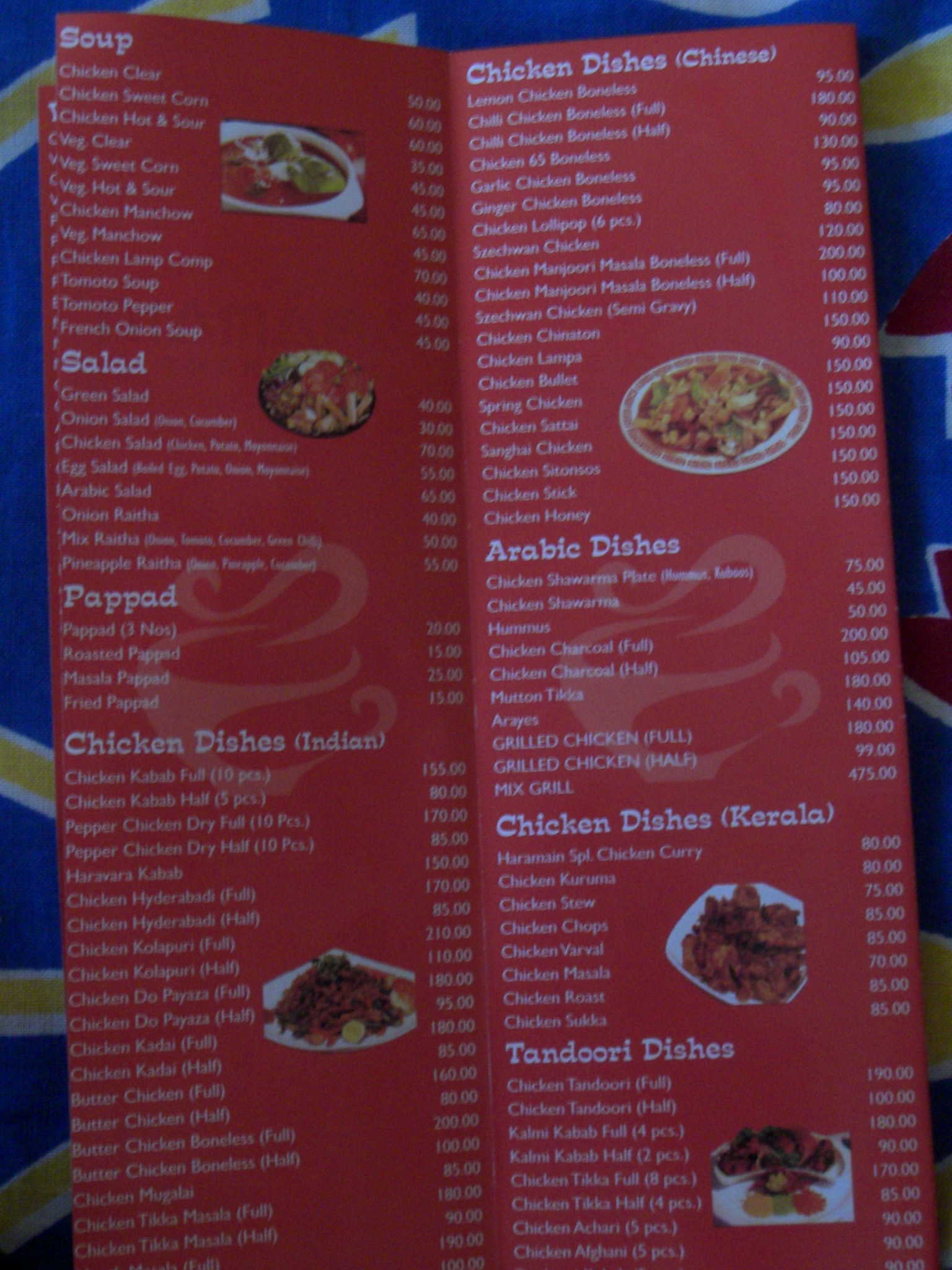
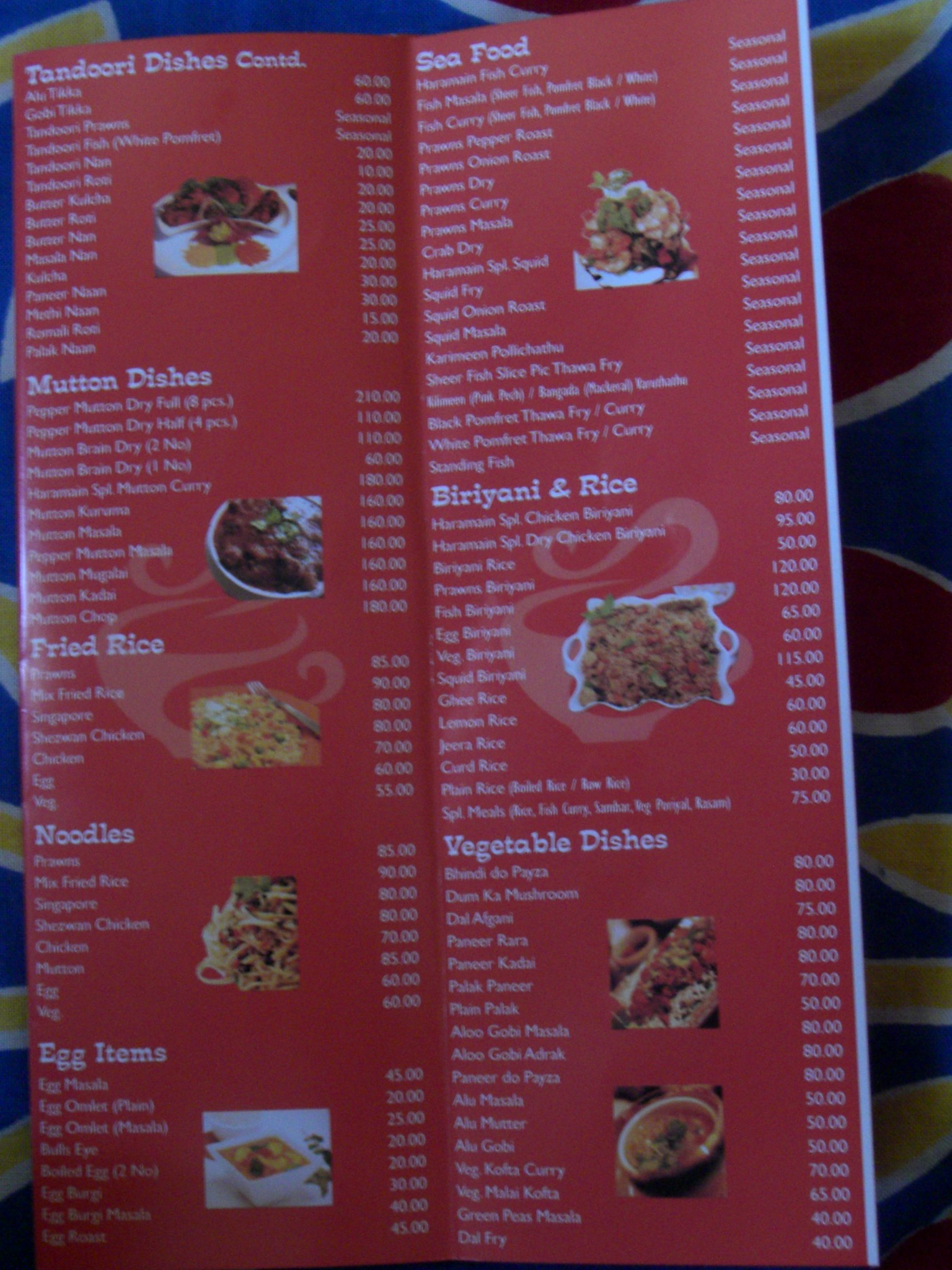
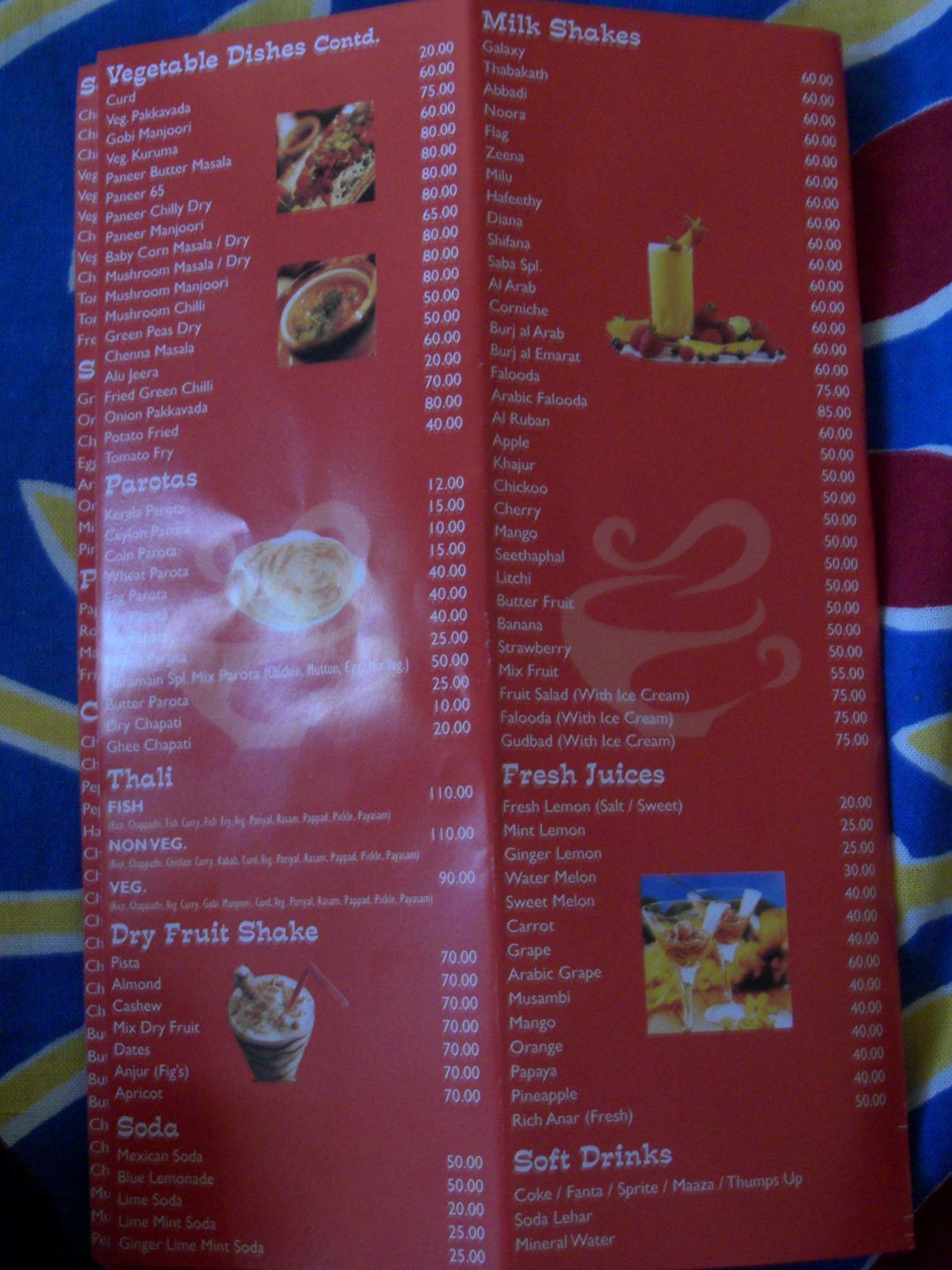
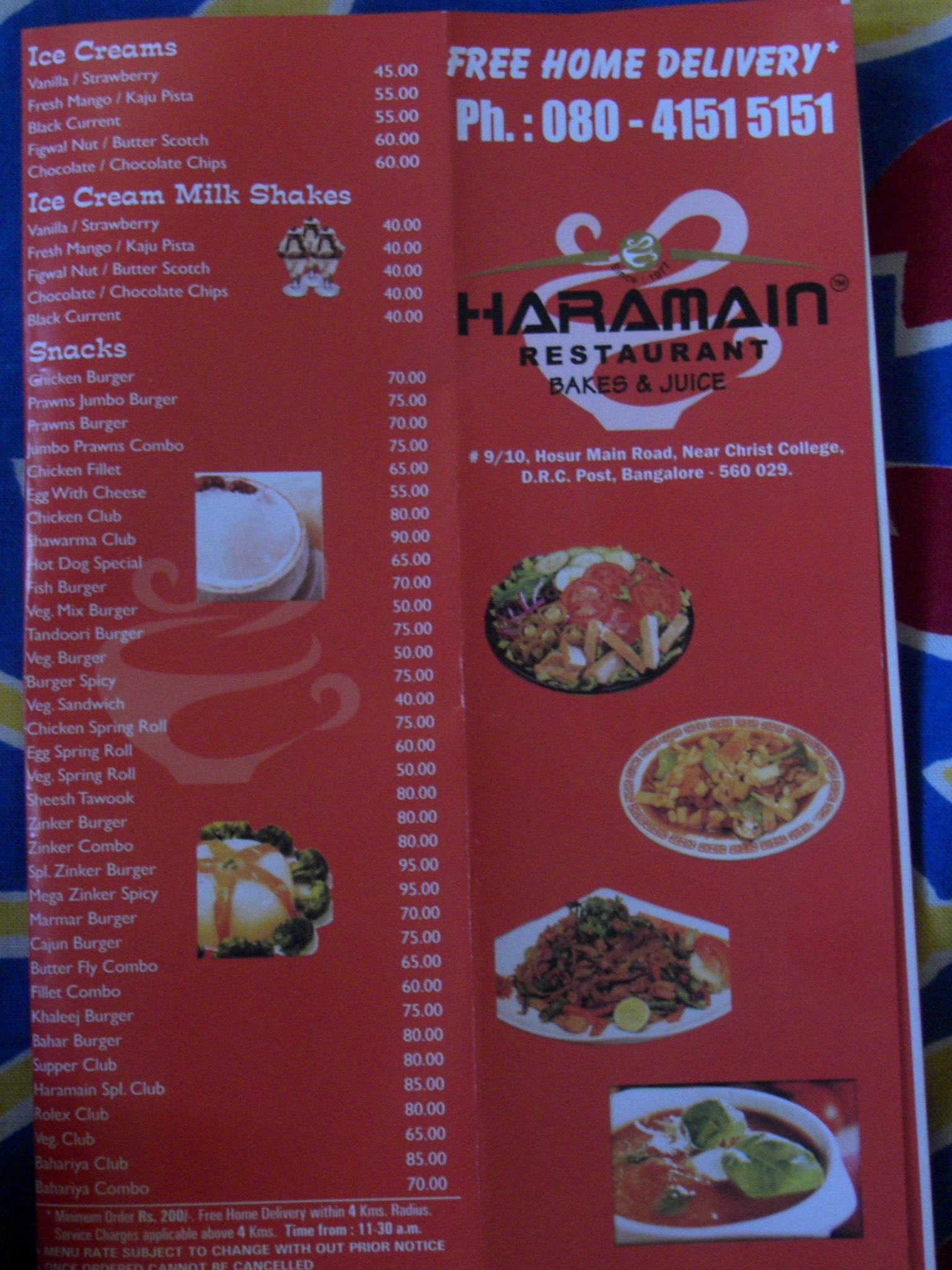
So a couple of weeks later, we decided to drop in at Haramain. It belongs to the Imperial/Empire mould but without the combos. To compensate, they have a smattering of Arab dishes, and burgers, juices, shakes etc which is probably to get the Christ College kids to drop in. Here’s the menu.
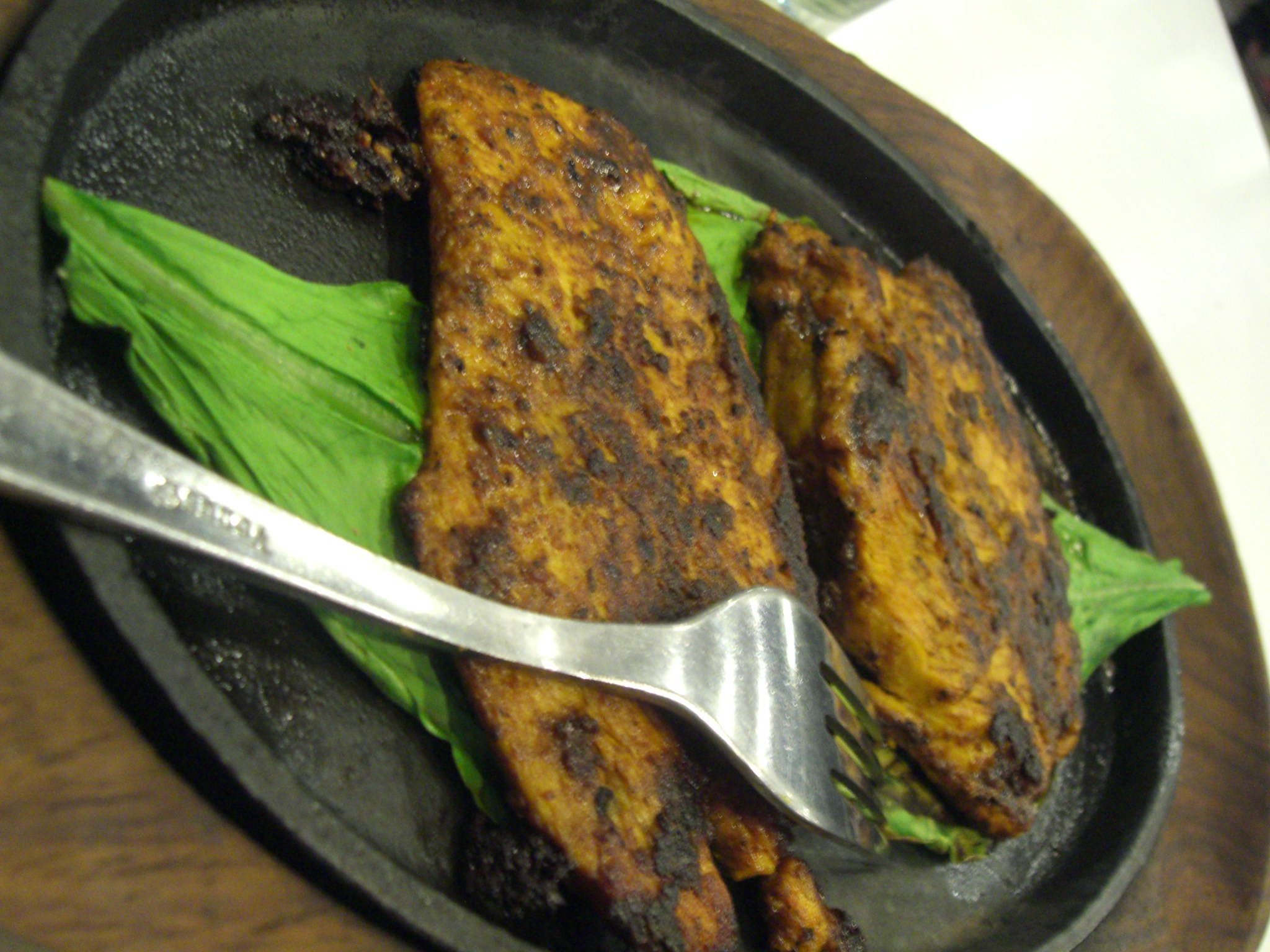
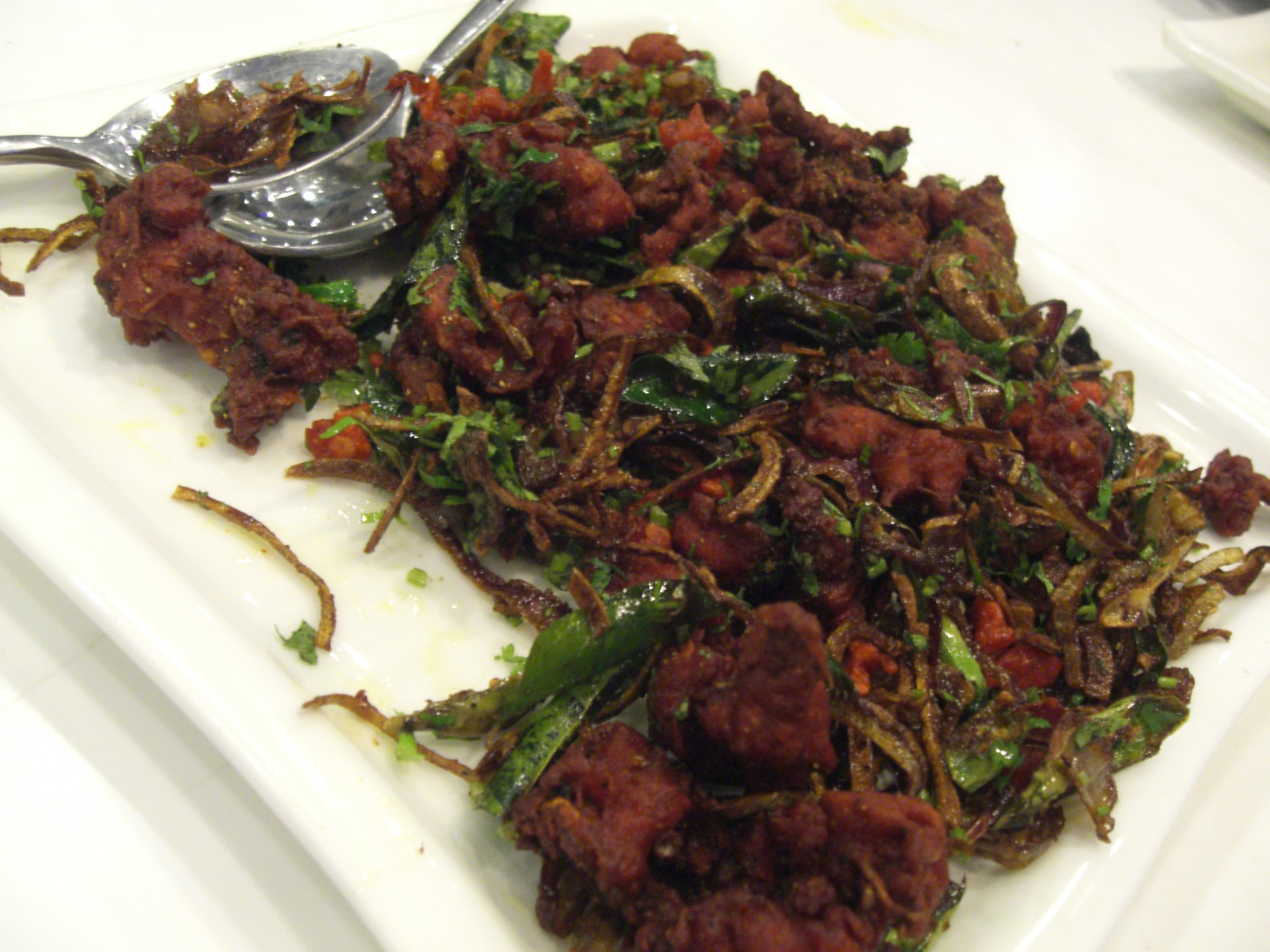
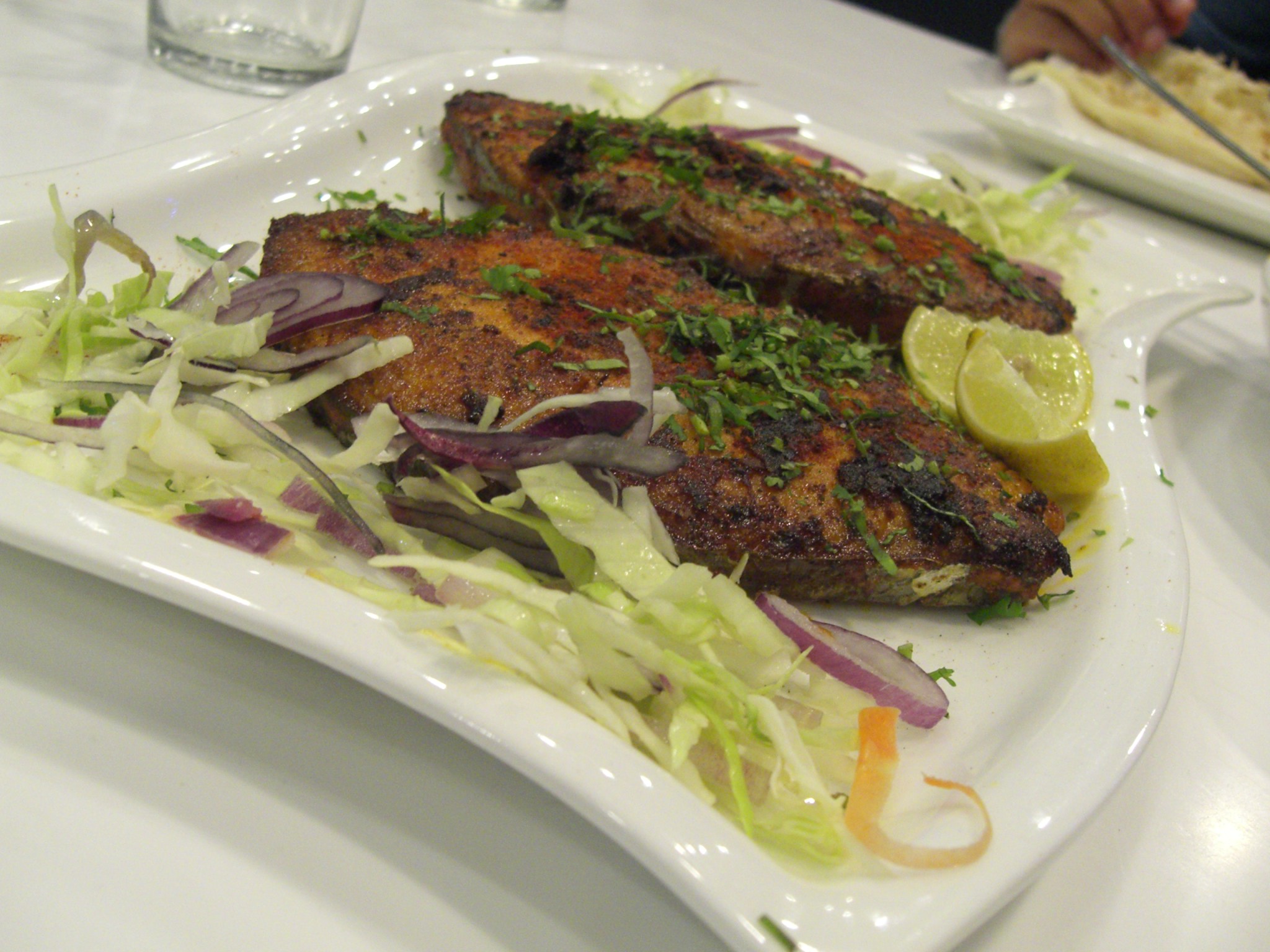
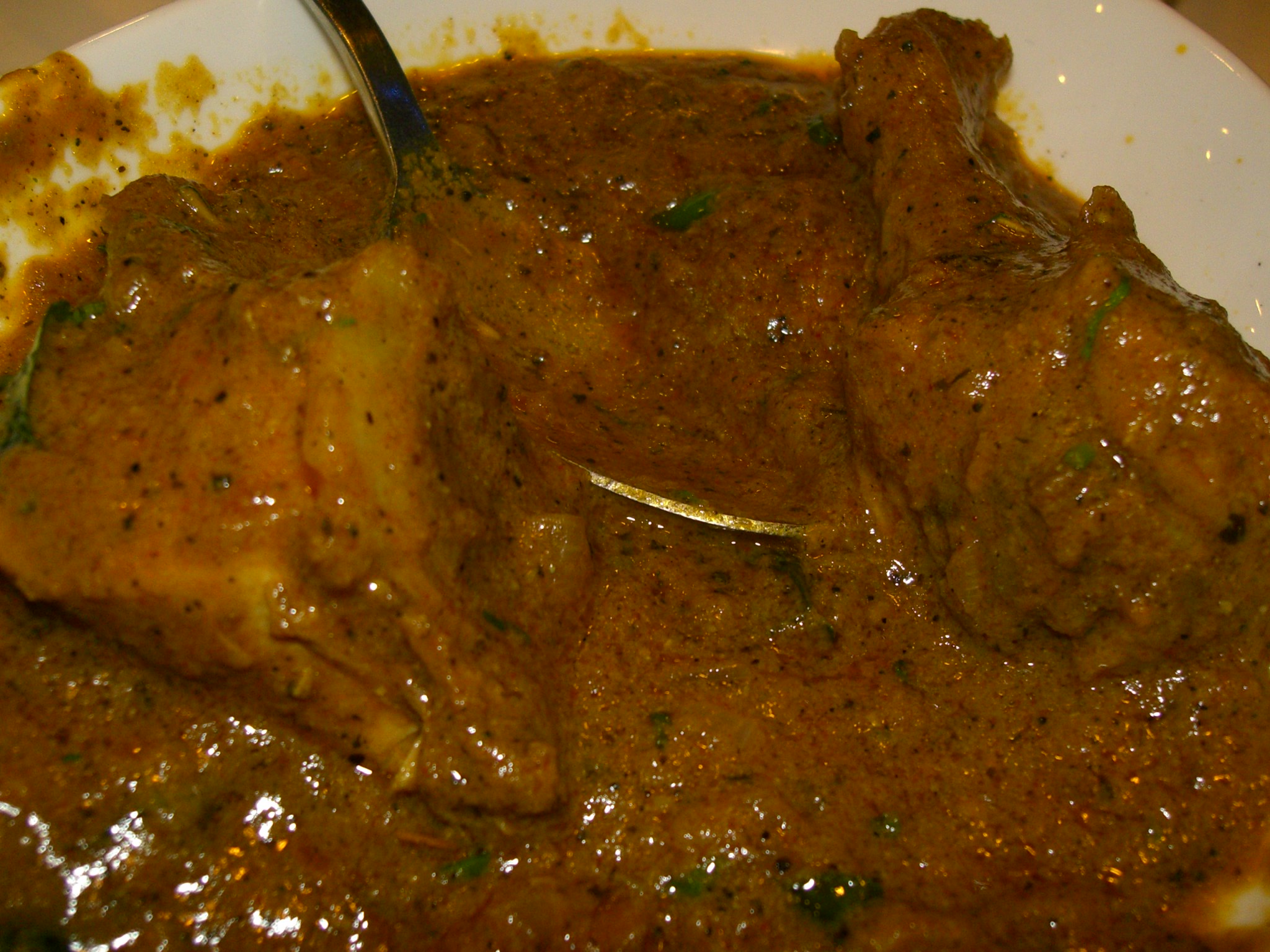
 We succumbed to the cold and started with a Chicken Hot & Sour soup, which though hot and spicy, is hardly the dish I’d recommend here. Though we’d ordered the Mussels Dry (day special) and the Haramain Special Chicken Kabab, they were the last to arrive. We didn’t like the mussels much since it was more pakoda than anything else, with the crisp covering completely dominating the mussels. The chicken dish was much better, with the masala not being relegated to the outer layers. It was served sizzler-style, and quite spicy, and tasty.For the main course, we’d wanted a Brain Fry, but that was not available. So we asked for fish fry and Haramain Special Chicken Curry, with a couple of Kerala Porottas to start with. The Biriyani was also not available, so we had to settle for a couple of coin porottas. The Porottas were good, but the coin versions looked like they would have liked to spend more time getting cooked. The fishy fry masala was good, but unfortunately hadn’t seeped in enough. The Chicken dish was quite quite tasty – spicy and with a mild coconut milk flavour.
In essence, nothing we’d really go back for, except probably, the Hosur Road view that included The Chocolate Room. All of the above cost us close to Rs.700.
Haramain, #9/10, Hosur Main Road, Near Christ College, DRC Post. Ph: 41515151