Centuries apart, but both in The Wonder Eras and Irascible, I had written about the documentation of incidents that we now call mythology and history. (respectively) In the former, I had mentioned the feeling when I saw the place where Sita had been temporarily imprisoned in Lanka, and in the latter, a fictionalised version of an event that happened in 1919. Both a bit intangible – the first only because of the centuries that have passed and it was still difficult to believe that myth was just history but more ancient, and the second because I am not sure if it actually happened.
Sometime back, I read William Dalrymple’s ‘The Last Mughal’, that uses Bahadur Shah Zafar as a ‘device’ to write about the events of 1857. The book is based on actual documents. As I wrote in my review (will share soon) what remains with me long after I have read the book, and something I went back to, almost every time I picked up the book to continue, is the photo of Zafar, lying with his face to the camera – the face of a broken old man who through his life saw the dominion of his ancestors taken away from him until all he had was his city and an empty title, who had just been made to undergo a trial and many humiliations before it, eyes expressing melancholy, and resigned to his destiny.
Suddenly, the images that I remember from history textbooks were transformed into a real person, and history was somehow tangible, as was his plight. It was almost as though that if I could take a few steps more, I could somehow feel the same about our myths. Have you ever felt that when reading/seeing anything?
Perhaps it is that way in every age, when some things that were history move into legend and then on to a myth status. I am still debating in my mind whether the layering that happens, adds or subtracts.
until next time, history repeats?
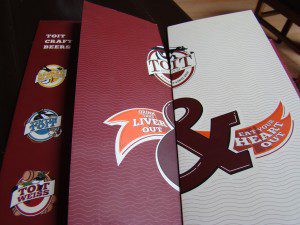 Finally, we used the same tactic at TOIT as The Biere Club – Sunday lunch, much more easy to accomplish than the 2 seater Saturday dinner. For those not in the know about TOIT,
 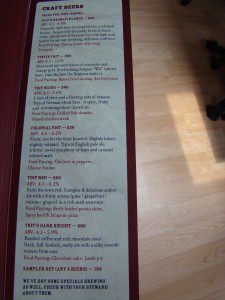 The microbrewery has 3 floors, and we sat in the non smoking section on the 3rd floor. The smoking section has a great view of the Metro, though you need to be a large group to get a table there. At lunch hour on Sunday, it’s quite a peaceful place, but the buzz during evenings is quite something! Over to the food and booze. You can take a look at the menu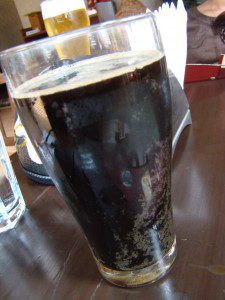
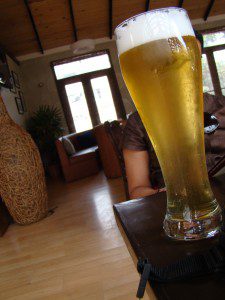
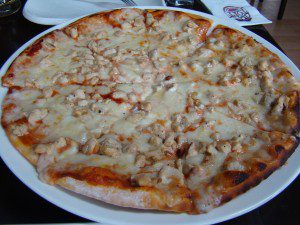
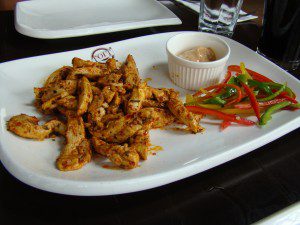 We ordered a TOIT Sunavachik for starters, strips of chicken with a dip and which can be made mild, spicy or very spicy as per your choice. We asked for very spicy, but it really wasn’t all that spicy. The dip complemented it well and it made for a good combo with the beer too. [Again, during another visit, we ordered ‘spicy’, and boy it was!] I think the menu has changed a bit though, since I couldn’t find the special TOIT pork dish I was looking for and the dish we had ordered was not something that was in the menu earlier. Hmm.