• Maria’s Room

    Shreekumar Varma

    I’m still not sure whether I could ever describe Goa as languid, despite siestas and feni, but this book did make me consider that possibility, and for that, Shreekumar Varma’s way with words can take credit.

    The protagonist, Raja Prasad, an author from Chennai, reaches a Goa that seems to echo his own ‘broken down’ self. The sun takes an extended break as rains lash Goa, and the narrative alternates between the introspective author, willing himself to break from his past and his concerned/nagging father, and work on his new book, and his observations of life, people and places. Its in these initial sections that we see a Goa that’s rarely captured – heavy rains instead of sun and sand, decrepit hotels replacing swanky resorts and a local life relatively less centered around tourists.

    We then seem Raja get acquainted with another guest in the resort – Fritz, and later shifting to “Maria’s Guesthouse”, where he falls in love with Lorna, and gets interested in the story of Maria, the girl’s aunt, after whom the guesthouse is named. As Raja’s romance progresses and he follows the mystery of Maria’s life, and death, it seems as though the two stories are just different in rendition.

    What didn’t work for me was the inconsistent pace of the plot and a narrative in which we’re forced to follow the extended wanderings of the protagonist without facts that would indicate a plot in progression. There’s a limit to what descriptive prose can do to stretch curiosity.

    However, the book itself is a bit like Goa in pace, if you can get adjusted to it, you will perhaps begin to like it. Even the deluge of ‘loop closing’ in the end is a bit like you’ve been idling and suddenly realised that there are some places to see and things to be done before you bid Goa goodbye.

    I got the feeling that the author enjoyed giving Raja Prasad the freedom to carry the plot at his own pace and create his own subtext that some readers would enjoy.

  • Sunohre Technologies

    Imagine hiring a sales guy and paying only incentives and not salary; that is Sunohre. In conversation with founder Praveen M…

    [scribd id=109103162 key=key-248he5sti6vhpr5kvhj mode=scroll]

  • Data.Information.Knowledge.Wisdom

    I still remember a time when most social media presentations considered the “One Size doesn’t fit all” slide mandatory. The platforms were new, and brands/practitioners were told that aping was not really the best policy. Yes, there were best practices to learn from, courtesy early adopters, but there were many factors to be considered before they could even be adapted, let alone, cloned.

    I still subscribe to that. Every organisation’s business objectives are different, even if they appear to compete in the same category and fight for the attention of the same audience. This difference could most likely stem from their different visions – from how they would scale over time, geography and even their business domain to the nuances in consumer tastes they want to target. This difference would then translate into how they conduct their business – internally and externally – how much hiring gets done in what function, what and how much of marketing is done, how customer care and operations works, what products and features are shipped first and how, to name a few.

    These would then dictate what the organisation’s metrics are, and how and when they are measured. Considering that social media is the most ‘direct contact’ and ‘mass’ set of platforms, these differences are arguably exaggerated, because audiences can be sliced thinner (compared to traditional media) and some organisations might deliberately do things to keep out certain audiences eg. what they communicate and how and where too.

    Why a repeat of these known perspectives? With more and more data being created by the activities of brands on social platforms, we are seeing tools that are trying to convert all this into usable information. Sometimes these tools are in human form too, and they bring their own perspectives (or lack of it) which essentially means comparison of apples and oranges just because they are fruits. I saw an example last week, which also included the brand I work on – Myntra. To quote Pico Iyer “Where once information had seemed the first step to knowledge, and then to wisdom, now it sometimes seemed their deepest enemy.” Goes for the step before too – data.

    Take a couple of examples – Facebook Page and Post Likes. Thanks to the subtle way in which Sponsored Stories/Page Post Ads work, it’s extremely difficult for any tool to bifurcate organic and inorganic Likes. (I am excluding the Page Admins of course) And yet, comparative analyses are made on Like growths. Or take Engagement – semantic analysis is at such an early stage that many tools would consider 100 comments on a post dissing the brand as high engagement. And yet, ‘insights’ are delivered on Engagement. Uff, engagement! My thoughts on that mother word have been documented earlier. These are operations mind you, I am not even getting started on strategy.

    Does that mean you should not consider this data/information- competitive or not – at all? Of course not! But how you use that is where knowledge and wisdom step in. Like the famous saying goes, “Knowledge is knowing the tomato is a fruit, wisdom is not putting it in a fruit salad.” Sadly, the way information is being used, oranges would soon be passe, apples would be compared to tomatoes because they are both fruits and are red in colour.

    until next time, data diarrhea

  • Halve nots

    During N’s last visit to Bangalore, the final minutes of our conversation was around rights and wrongs. Zeros and ones. Black and white. At some point in our evolution, we created halves – half rights, grays. Who’s to say your gray is grayer than mine? It becomes subjective, contextual. For argument’s sake, we could say that rights and wrongs themselves are such. But each time we make that gray decision, we know, and we pretend not to notice that little voice.

    Many years ago, as I sat eating an ice cream at the Cream & Fudge Factory in Koramangala (it no longer exists) an old man’s eyes met mine for a few seconds. He probably didn’t mean it, but as I took in his frayed but neat clothes, and his gaze that somehow conveyed that he couldn’t afford what I was having, I was suddenly struck by the unfairness of it all. These days, I wonder if I just imagined it all, and it was just my sub conscious conveying something to me. In any case, it’s like that subtext that once is known, is impossible to clear.

    We have to live, and make a living, N said. He was kind, and gave me various ways to assuage my feelings of guilt. But every time I make a choice – across life’s various scenarios – an extravagant meal, a new pair of jeans, a movie – I know I’m watching myself, and judging. It is easy to allow myself things, but who’s to say where the allowance ends. How objective can I be about myself? Every time I ignore that little voice, I add to the imbalance, blur the lines in my own eyes. A life has to be lived after all.

    until next time, live long and proper..

  • Toscano

    Between the Diesel 50% sale and the fact that I’ve heard so many diverse comments about Toscano, the decision was swung in favour of a UB City visit. (as opposed to a special event at Benjarong) Toscano is at one end of the food court on the 2nd floor, and opposite Soul City. As almost all the eateries here go, the seating includes an al fresco option too, an excellent choice on a windy Bangalore night.

    8.30 pm on Saturday is around the time that Bangalore behaves as though it hasn’t eaten all week. So we did reserve, but still had to wait for 10 minutes for a table. It might have been more if I hadn’t pointed out a free table. :\ There’s no real waiting area, so it wasn’t  the greatest of beginnings.

    But thanks to the wait, we had the time to decide what we wanted to eat. Yes, I’d have preferred doing that sitting down, but let me not nag now. 🙂 You can take a look at the menu here. Also take a look at the wine list and watch out for the day’s specials! A complimentary bread basket arrived before the Minestrone (chicken) soup we ordered. Two dips, one seemed to be herbed butter with olives, and the other had a chilli flavour. The soup was thick, with a tasty, mildly spicy broth base, and yes, chicken pieces were spotted along with pasta and cheese! (the photos were taken using the  phone camera, that would explain the worse-than-the-usual-bad visuals) 😉

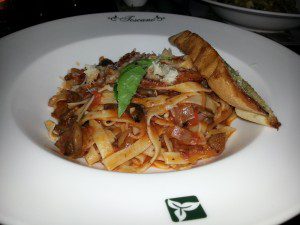
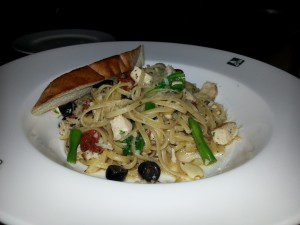
    For the main course, D ordered a Linguine Chicken Aglio e olio Peperoncino and I asked for a Fettuccine e Salsiccia Piccante. (yes, just point to them on the menu card!) The former was a tad bland (for our palate, of course) despite the promise of chili in the description. But a huge dose of chicken cubes slightly made up for it. I quite liked the fettuccine though, lots of spicy sausages and a mild tang to it.


    Despite appearances, the dishes were quite filling, and we didn’t have space for desserts. The service was quite prompt and all the above cost us just over Rs.1300.

    Toscano, UB City, The Collection, 2nd Floor, Vittal Mallya Road, Ph: 4173 8800