Grocery, staples and over 7000 products delivered to your home, courtesy BigBasket.com. In conversation with co-founder and CEO Hari Menon.
[scribd id=112012625 key=key-u0f9nh1k6vzihwbuws5 mode=scroll]
-
Bow Barracks
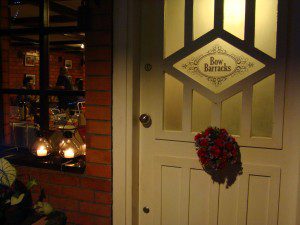 The good news is that you don’t have to go as far as Kolkata. There is no bad news. A little away from our regular Indiranagar haunts is 2nd Main, near the BDA complex. The last time we were on this road (On Double Road, take a right just before you hit Old Madras Road when coming from the CMH Road direction) was years back, and that restaurant has been replaced by a safer Punjabi outlet. In fact, the road now sports several food options including Chettinad, Punjabi and a few others! The map
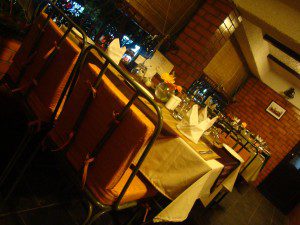
 as well as the menucan be found on Zomato. Parking for 2 wheelers is easy and there are lanes around for 4 wheelers in case you don’t find space in front of the restaurant. A brick building with a doorway that makes you feel as though you’re entering a home. 🙂The interior too has a cosy feel to it with just the right amount of buzz. We chose the less crowded 1st floor and by the time we left, that too was fairly full, and people were being taken to the next floor. I think that’s where it ends, but can’t be sure. In addition to the splendid ambiance, watch out for the knickknacks. The clock, the old kind of switches, some wonderful photographs on the brick wall, all add to the personality of the place.
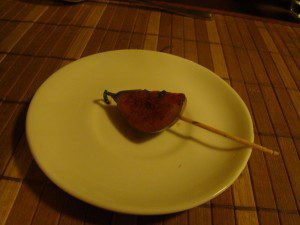
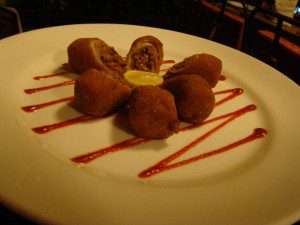
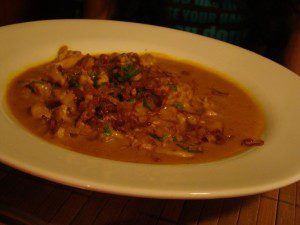
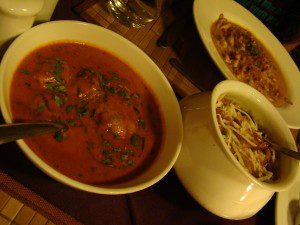
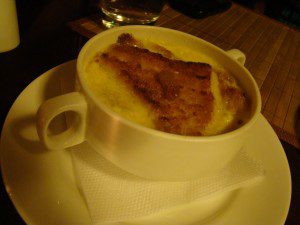
 The menu has Anglo Indian, Continental as well as Indian sections, but we were clear in our intent. We were even reasonably sure of 3 out of 4 items we planned to have, but we still needed to decide the 4th. As we sat debating that, an amuse-bouche made its way to the table. A fig with vinaigrette. I popped it in without giving it much thought until the flavour explosion hit me – tangy and sweet at the same time, with a crunch that will definitely make you sit up and pay attention.We started with the Pantheras – the beef version. The beef mince was superb, and the crumbed, deep fried crepes wrapped it up very well indeed. But what made us completely forget to add that lime twist was the sauce that came along with it. In terms of taste, it reminded us of a local favourite – sauce that came with the Delicacy momos – but this one was more suave! For the main course, we ordered the Khow Suey – Chicken, and in the battle between the Fish Moilu and the Chicken Ball Curry, the latter won. We also ordered Coconut Yellow rice to go with the curry. The Khow Suey is a favourite and they did complete justice to it – the Anglo Indian rendition doesn’t really vary from the original Burmese and the coconut milk, noodles, cumin, turmeric etc with the help of a twist of lime made up an excellent mix as always. The Chicken Ball curry also has coconut milk flavour in the background, but it’s only to add that little extra to the tomato base (consistency and taste) and to the chicken mince that is made into koftas. The Coconut Yellow rice – basmati – worked beautifully with the curry and for our Mallu palates, this overdose of coconut felt just divine! :)) We were almost full, but the bread pudding had already booked itself space, though it was more mind and spirit than body! Served with mild custard sauce, I felt it could’ve been slightly less watery. But thankfully, it didn’t take away much from the taste. An excellent meal in a perfect setting! The service was prompt, helpful and altogether smooth. The meal made us poorer by Rs.1276 (including a service charge) but it was thoroughly worth it. This one goes into our favourites, and with so many more dishes to try, we’ll raid again soon!
Bow Barracks, 618/1, 2nd Main, HAL 2nd Stage, Indiranagar. Ph: 42072555, 9739601015
-
a1000yoga
A1000yoga.com aims to bring yoga back into our lives with world class studios. In conversation with founder Pradeep Gowda.
[scribd id=111237819 key=key-15ufaw7ce22hhz975q3b mode=scroll]